Showing posts with label AI & Markets. Show all posts

Tuesday, May 12, 2026

What Happens When AI Agents Start Competing for Crypto Arbitrage

BitBrainers - What Happens When AI Agents Start Competing for Crypto Arbitrage analysis and insights

Three milliseconds. That is the window most cross-exchange Bitcoin arbitrage opportunities exist before an automated system closes them. Now add a dozen AI agents hunting the same gap simultaneously, and that window shrinks to something a human cannot even perceive, let alone act on.

This is not a future scenario. It is what is already happening in live markets, and it is reshaping how serious traders approach BTC arbitrage in ways that most crypto content refuses to actually address.

The Arbitrage Window Is Not Closing, It Is Becoming a Warzone

When one exchange shows BTC at a slightly different price than another, that spread represents free money in theory. In practice, the spread now attracts automated agents within fractions of a second. The infrastructure running these agents includes colocation servers, direct exchange API connections, and increasingly, AI models that predict where price imbalances will emerge before they technically appear.

The result is a market where the gap still exists but only the fastest participant captures it. Human traders running manual arbitrage strategies are essentially showing up to a Formula 1 race on a bicycle. The race still happens, but they are not in it.

Speed Is No Longer the Competitive Edge, Prediction Is

Early arbitrage bots competed on latency. Lower latency meant faster execution, and faster execution meant more captured spreads. That arms race peaked when the marginal cost of shaving another millisecond off a trade exceeded the profit it generated.

AI agents shifted the competition from reaction to anticipation. These systems analyze order book depth, funding rates across perpetual futures markets, liquidity flows between CEX and DEX venues, and historical patterns of price divergence to model where a spread will appear next. On Bitcoin, this means tracking not just spot price differences between exchanges like Kraken but also the relationship between BTC spot and BTC futures pricing across different venues simultaneously.

A prediction model that is right 55 times out of 100 on spread direction will consistently outperform a reaction model that is right 100 times but arrives 8 milliseconds late. This is the actual dynamic that has developed in live markets.

Most People Do Not Know This: The Real Edge Is in Funding Rate Arbitrage, Not Price Arbitrage

Here is something that rarely makes it into mainstream crypto content. The most sustainable form of AI-driven crypto arbitrage right now is not spot price arbitrage across exchanges. It is funding rate arbitrage between perpetual futures contracts on different platforms. Funding rates on BTC perpetuals fluctuate based on market sentiment and can diverge meaningfully between venues for periods long enough that AI systems can extract consistent returns without competing in a pure speed race. This gives mid-tier operations with competent AI tooling a realistic entry point that pure spot arbitrage no longer provides. The competition in funding rate arbitrage is still intense, but the window is measured in minutes rather than milliseconds, which changes the entire competitive calculus.

When AI Agents Compete Against Each Other, Market Microstructure Changes

This is the part most trading blogs completely ignore. When multiple AI agents chase the same opportunity, they do not just race each other. They alter the opportunity itself. An agent that places a large order to capture a spread moves the price on one side, compressing the spread before any competing agent can act. The market adapts in real time to the presence of the agents hunting it.

On Bitcoin, this has contributed to tighter bid-ask spreads on major exchanges during high-liquidity periods. It has also created strange micro-volatility patterns during low-liquidity windows, typically between 2am and 5am UTC, when fewer agents are active and the spread dynamics behave differently. Traders who have mapped these windows in their own bot data have found that certain strategies only work during specific UTC hours because of when competing agents are most and least active.

The Concentration Problem Nobody Wants to Talk About

Here is the contrarian take: AI-driven arbitrage is not democratizing crypto markets. It is concentrating profit capture into fewer hands faster than any previous trading technology. The barrier to entry for a genuinely competitive AI arbitrage operation includes access to low-latency colocation infrastructure, multiple exchange API accounts with elevated rate limits, significant capital to make arbitrage mathematically meaningful, and the engineering talent to build and maintain prediction models. Most retail traders have none of these things. The narrative that AI tools level the playing field is marketing copy. The tools that retail traders access through consumer platforms are running on lagged data and shared infrastructure that the serious operations would never touch.

What a Real Competitive AI Arbitrage Stack Actually Looks Like

Skip the vague descriptions. A functional AI arbitrage operation running on Bitcoin right now looks something like this. It connects to at least 5 major spot exchanges and 3 derivatives venues via direct API with the highest available rate limits. It runs a prediction layer trained on order book data that updates its model continuously, not on fixed retraining schedules. It maintains pre-funded balances on multiple exchanges simultaneously so that execution does not require waiting for a fund transfer. It tracks its own market impact and scales position size dynamically to avoid signaling its own activity to competing systems. Exchanges like Kraken (https://proinvite.kraken.com/rrru/z1q035sr) are commonly included in these stacks specifically because of API reliability and liquidity depth on BTC pairs.

BTC Right Now Is a High-Stakes Testing Ground for Multi-Agent Competition

As of May 12, 2026, Bitcoin is sitting at $80,582 and hovering above a key support level while equities and crypto broadly retreat. This environment is particularly interesting for AI arbitrage systems because volatility compresses spreads during risk-off periods, which forces the less sophisticated systems out of profitability first. The agents still running consistently during these compression periods are the ones with the strongest prediction layers, not just the fastest execution. Market conditions like today function as a natural filter that reveals which operations are genuinely sophisticated and which were just harvesting easy spreads during trending conditions. Watching how arbitrage volumes behave on-chain during corrections is one of the more underrated signals for assessing the maturity of competing agent infrastructure.

Security Is Not an Afterthought When You Are Running Live Capital Across Multiple Wallets

Running any kind of automated trading operation means your keys and your operational security are part of your competitive infrastructure. A compromised wallet or a phished API key does not just lose a trade, it can drain an entire operation. Hardware wallets like Trezor (https://affil.trezor.io/aff_c?offer_id=137&aff_id=135511) matter here not just for long-term storage but as part of a layered security approach that separates hot operational funds from reserve capital. Any serious arbitrage setup that is moving real BTC should have a clear delineation between what sits on exchange, what sits in hot wallets for operational flexibility, and what sits in cold storage completely offline.

The Assumption You Probably Brought Into This Post Is Wrong

Most traders reading about AI arbitrage assume the goal is to build a better bot and compete directly with the sophisticated operations already running. That assumption leads people toward spending months building infrastructure that will be outclassed before it goes live. The actually productive framing is to identify which segments of the arbitrage opportunity set the large agents are structurally unable or unwilling to participate in because the spreads are too small in absolute dollar terms to justify their overhead. Smaller, nimbler operations can be consistently profitable in niches that are invisible to the major players simply because the capital deployed does not justify the engineering cost for a large firm. The game is not to beat the best AI agents. The game is to operate where they are not looking.

Start Here Before You Build Anything Else

If you want to actually engage with this space rather than just read about it, the first concrete step is not building a bot. It is running a passive data collection layer across at least 3 exchanges for 30 days before touching any execution logic. Map the spread patterns, identify which hours show the most consistent divergence, and understand the funding rate cycles on BTC perpetuals. That dataset is the foundation everything else gets built on. Without it, you are just guessing about where opportunity exists, and AI agents are already eating everyone who is guessing.


Disclosure: This post contains affiliate links to Trezor and Kraken. BitBrainers may earn a commission at no extra cost to you. This is not financial advice.


BitBrainers. No hype. No fluff. Just crypto that matters.
Monday, May 11, 2026

How to Automate Your Crypto Morning Briefing With a Free Python Script

BitBrainers - How to Automate Your Crypto Morning Briefing With a Free Python Script

Most traders spend 45 to 90 minutes every morning clicking between tabs: price charts, Fear and Greed index, on-chain dashboards, news feeds, exchange dashboards. That is not analysis. That is busywork dressed up as diligence. A free Python script can collapse that entire routine into a single terminal output delivered before your coffee is done.

Manual Crypto Routines Are a Trap Disguised as Discipline

There is a real cost to context-switching between 6 different browser tabs every morning. Each switch eats cognitive load, and by the time you have checked CoinGecko, Glassnode lite, Crypto Twitter, and your Kraken portfolio, your brain is already fatigued before the market opens. Traders who I have seen operate clean, fast setups consistently outperform their own previous results after they automate the data-gathering layer. The discipline is not in the manual checking. The discipline is in building a system that removes the manual part entirely.

What a Real Automated Morning Briefing Actually Covers

A useful briefing is not just a price ticker. For BTC specifically, you want spot price, 24-hour volume, the current Bitcoin Fear and Greed Index reading, dominance percentage, funding rates on perpetual futures, and one top headline from a reliable news API. That is 6 data points, all available for free via public APIs, all fetchable in under 3 seconds with Python. Anything beyond that is noise until you have proven you act on the core 6 consistently.

The Free APIs That Actually Work in 2026

CoinGecko's free tier via their v3 REST API gives you BTC price, 24-hour volume, and market cap with no authentication required for basic calls. The Alternative.me Fear and Greed API is completely free, no key needed, and returns a clean JSON response with the index value and classification. For news, the CryptoPanic API has a free tier that delivers headlines filtered by currency, and the NewsAPI.org free plan works for pulling headlines from major crypto publications. These 3 APIs combined cover the entire core briefing without spending a single dollar.

Building the Script Step by Step

Install the requests library if you have not already: pip install requests. Your script needs 4 functions: one to fetch BTC data from CoinGecko, one to fetch the Fear and Greed index from Alternative.me, one to pull headlines from CryptoPanic or NewsAPI, and a main function that formats and prints everything to the terminal or sends it via email. The whole thing runs under 80 lines of clean Python 3 code. Here is the skeleton structure:

```python import requests from datetime import datetime

def get_btc_data(): url = "https://api.coingecko.com/api/v3/simple/price" params = { "ids": "bitcoin", "vs_currencies": "usd", "include_24hr_vol": "true", "include_market_cap": "true" } response = requests.get(url, params=params) return response.json()["bitcoin"]

def get_fear_greed(): url = "https://api.alternative.me/fng/" response = requests.get(url) data = response.json()["data"][0] return data["value"], data["value_classification"]

def get_top_headlines(): url = "https://cryptopanic.com/api/v1/posts/" params = { "auth_token": "YOUR_FREE_TOKEN", "currencies": "BTC", "kind": "news" } response = requests.get(url, params=params) posts = response.json().get("results", []) return [p["title"] for p in posts[:3]]

def run_briefing(): print(f"\n=== BTC Morning Briefing | {datetime.now().strftime('%Y-%m-%d %H:%M')} ===\n")

btc = get_btc_data()
print(f"BTC Price:     ${btc['usd']:,.0f}")
print(f"24h Volume:    ${btc['usd_24h_vol']:,.0f}")
print(f"Market Cap:    ${btc['usd_market_cap']:,.0f}")

fg_value, fg_label = get_fear_greed()
print(f"\nFear & Greed:  {fg_value} ({fg_label})")

headlines = get_top_headlines()
print("\nTop Headlines:")
for i, h in enumerate(headlines, 1):
    print(f"  {i}. {h}")

print("\n" + "="*50 + "\n")

if name == "main": run_briefing() ```

Sign up for a free CryptoPanic token at their website and drop it in place of YOUR_FREE_TOKEN. The whole setup takes under 20 minutes.

Scheduling This So It Actually Runs Without You Touching It

On Linux or macOS, use cron to schedule the script. Run crontab -e in terminal and add one line: 0 7 * * * /usr/bin/python3 /path/to/your/briefing.py >> /path/to/logfile.txt 2>&1. That fires the script every morning at 7:00 AM and logs the output. On Windows, use Task Scheduler with a basic trigger pointing at your Python executable and script path. If you want the briefing emailed to you instead of logged, swap the print() calls for smtplib calls and route it through a Gmail App Password in 15 additional lines.

Most People Do Not Know This About Free API Rate Limits

Here is something almost nobody talks about: CoinGecko's free tier enforces rate limits around 10 to 30 calls per minute, and if you run multiple scripts against it throughout the day without implementing a simple time.sleep(1) between calls, your IP gets temporarily blocked. I have seen traders waste hours debugging their bots thinking there was a code error when the actual issue was a silent 429 response from a hammered free endpoint. Add time.sleep(1) between every API call in your morning briefing script and you will never hit this problem.

Adding Your Kraken Portfolio Balance to the Briefing

If you trade on Kraken, their REST API lets you pull your account balance with a single authenticated GET request. The Kraken API uses a private endpoint called Balance under /0/private/Balance, and you authenticate with your API key and a HMAC-SHA512 signature. You generate read-only API keys inside your Kraken account settings, which means this connection never exposes trading permissions. Add a 5th function to your briefing script that pulls and prints your current BTC and USD balance, and your morning script becomes a complete situational awareness tool in one terminal window. You can set up an account at Kraken here if you are not already on it.

This Week's Market Context Makes the Script More Valuable, Not Less

BTC is sitting at $80,886 on May 11, 2026, and the broader market is navigating a period of macro sensitivity driven by ongoing discussions around U.S. trade tariffs. CoinDesk reported this week that Bitcoin's correlation with risk assets has been fluctuating in ways that make morning sentiment data, specifically the Fear and Greed index and funding rates, more actionable than raw price alone. When the macro environment is noisy, the structure of your morning data intake matters more, not less. Automating it removes emotional filtering from the collection process.

The Contrarian Take Nobody Wants to Hear About Morning Briefings

Every crypto blog tells you to track more data. They sell dashboards with 40 indicators, alert systems with 20 notification types, and terminal tools with live order book feeds. The actual edge is not in tracking more. It is in tracking fewer, better-chosen signals and acting on them without the friction of a 45-minute manual session diluting your conviction. The traders running simple, automated, 6-variable briefings who then spend their mental energy on decision-making consistently outperform the ones who spend their morning drowning in dashboards. Less input, faster action, cleaner decisions.

The Security Layer You Cannot Afford to Skip

If your briefing script stores API keys, you need to keep those keys in environment variables, not hardcoded in the script file. Use Python's os.environ.get("KRAKEN_API_KEY") pattern rather than pasting keys directly into your code. Your hardware wallet is a separate layer entirely, but if you are holding any meaningful BTC position, a Trezor hardware wallet keeps your cold storage completely air-gapped from anything your scripts or hot keys can touch. The morning briefing script touches read-only APIs only. It should never have withdrawal permissions, full stop.

The Assumption You Came In With That Is Actually Wrong

You probably came into this post thinking automation is a complexity problem, that building this requires serious Python experience or a cloud server or paid infrastructure. It does not. The entire stack described here runs on a free laptop, uses free APIs, and takes under 2 hours to build from scratch even if you are a beginner coder. The real barrier is not technical. It is the mental inertia of accepting that your manual morning tab-clicking routine is actually working. It is not. It is just familiar.


Disclosure: This post contains affiliate links to Trezor and Kraken. BitBrainers may earn a commission at no extra cost to you. This is not financial advice.


The one thing to try first: Run just the CoinGecko + Fear and Greed fetch as a 15-line script tonight, schedule it with cron for 7 AM tomorrow, and see how it feels to get that data before you open a single browser tab. Everything else builds from there.


BitBrainers. No hype. No fluff. Just crypto that matters.


Sunday, May 10, 2026

The 3 AI Research Tools That Replace a Full Crypto Analyst Team

BitBrainers - The 3 AI Research Tools That Replace a Full Crypto Analyst Team analysis and insights

Most retail traders in 2025 spent more time reading analyst newsletters than actually trading. The analysts were wrong half the time anyway. Here is what actually replaced them.

The Old Model of Crypto Research Was Always Broken

Crypto research firms charge thousands per month for reports that arrive 48 hours after the market has already moved. Institutional desks could absorb that lag. You cannot. The model was built for TradFi timelines and it never translated cleanly to an asset class that trades 24 hours a day, 7 days a week, with news cycles measured in minutes.

BTC is sitting at $80,878 today, May 10, 2026, and the traders who are navigating this range intelligently are not doing it by waiting for a PDF report. They are running their own research loops in near real-time. Three tools are doing the heavy lifting for them, and none of them cost anywhere close to a full analyst salary.

Perplexity AI Turns Noise Into Structured Signal in Under 60 Seconds

Perplexity AI is the single most underrated research tool in crypto right now. It pulls live web sources, on-chain news feeds, and exchange announcements, then synthesizes them with citations you can actually verify. Most traders are still using Google or scanning 15 browser tabs at once while Perplexity compresses that into a structured answer with source links attached.

The real use case is not generic market questions. The edge comes from tight, specific prompts. Asking Perplexity to summarize all BTC regulatory developments from the past 72 hours, ranked by market impact, produces something a junior analyst would take 4 hours to compile. The tool does it in under 60 seconds with links to primary sources you can audit yourself.

The caveat is quality control. Perplexity is only as good as the sources it indexes, and during fast-moving news events, it can surface contradictory information from unreliable outlets. You cross-reference the top 3 results manually every time. Treat it as a first draft, not a final verdict.

Santiment Reads Crowd Psychology Before the Price Reacts

Here is the insight most crypto blogs miss entirely: price is a lagging indicator of sentiment, not the other way around. By the time BTC makes a move on the chart, the social and on-chain data behind it has been building for hours or days. Santiment captures that build-up across developer activity, social volume, exchange flows, and holder behavior across more than 2,000 assets simultaneously.

Santiment's social dominance metric tracks how much of all crypto conversation is focused on a single asset at any moment. When BTC social dominance spikes sharply in a short window, historically that signals a crowd entering a position. Crowded trades in crypto tend to reverse fast. Traders who watch this metric treat it as a warning signal, not a confirmation.

The on-chain data layer is where Santiment earns its keep. Tracking wallet behavior, particularly large holder accumulation or distribution patterns, gives you a view into what informed capital is doing before retail picks up on it. This is not theoretical. Traders running automated bots, including the setups I run personally, use Santiment API outputs as one of 3 core data feeds to filter entry signals.

Most People Do Not Know This About AI Summarization Tools and Crypto

Here is something almost nobody talks about. The biggest edge from AI research tools is not the tool itself. It is the prompt library you build around it. A well-structured prompt that asks ChatGPT to analyze a project's GitHub commit frequency, compare it to its token emission schedule, and flag divergences between developer activity and price action will produce a research output that rivals anything a mid-tier analyst firm publishes. A bad prompt asking "is BTC going up" is worthless.

The traders building repeatable, institutional-grade research workflows in 2026 are treating prompt engineering like proprietary IP. They are not sharing their exact prompts publicly. They are running them on schedule, saving outputs, and tracking which combinations produce the most actionable signals over time.

ChatGPT's Code Interpreter, available with a GPT-4 subscription at $20 per month, lets you upload raw on-chain CSV exports from tools like Glassnode or CryptoQuant and run statistical analysis directly inside the chat window. That used to require a data analyst with Python skills. Now it requires a well-framed question and about 90 seconds.

Messari Fills the Fundamental Research Gap the Other Two Miss

Perplexity handles news synthesis. Santiment handles sentiment and on-chain behavior. Messari handles the structured fundamental layer: tokenomics, vesting schedules, protocol revenue, competitive positioning, and governance proposals. Without this third layer, you are making macro and sentiment calls on assets you do not actually understand at the protocol level.

Messari's research team produces some of the most rigorous public crypto analysis available, and their platform aggregates it alongside live data. Their quarterly reports on Layer 1 and Layer 2 ecosystems give you the structural context that short-form news completely strips out. Reading a Messari report on BTC miner economics before making a thesis on where BTC heads after the next difficulty adjustment is exactly the kind of preparation most retail traders skip.

The AI-assisted research feature Messari has been developing allows users to query its internal research database using natural language. This is significant because it indexes Messari's own proprietary research rather than the open web. You get a higher signal-to-noise ratio than a general search tool when you are doing deep fundamental work on specific protocols.

This Three-Tool Stack Does Not Replace Your Judgment

Here is where most blogs would congratulate you on having found a magic system. That is not what this is. These 3 tools compress research time and improve signal quality. They do not make decisions. BTC trading at $80,878 in a range that has been compressing since late April 2026 is a data point. Whether that compression resolves up or down depends on macro flows, ETF demand, miner behavior, and dozens of other factors that still require a human framework to interpret correctly.

The tools eliminate the busywork so you spend more time on the judgment calls that actually matter. A full crypto analyst team is not 3 people doing research. It is 1 person doing research and 2 people summarizing, formatting, and delivering it. The AI tools eliminate those last 2 people. The first one is still you.

Where Execution and Security Fit Into This Stack

Running a research stack like this generates trade signals. Executing those signals quickly and securely requires infrastructure that does not leak. For spot BTC trading, Kraken handles execution with deep liquidity and API access that pairs cleanly with automated workflows. If you are routing bot outputs into live trades, you need an exchange that can handle order flow without slippage eating your edge.

On the security side, anything you accumulate through a research-driven approach needs to live somewhere the AI tools cannot reach and a phishing attack cannot drain. A Trezor hardware wallet keeps your BTC in cold storage, completely air-gapped from the same internet infrastructure your research stack runs on. Operational separation between your research environment and your custody environment is not paranoia. It is basic operational hygiene.

The Assumption You Came in With That Is Probably Wrong

You probably came here thinking the value of this stack is speed. Faster research, faster signals, faster trades. That is partially true but it is not the primary value. The real value is consistency. Human analysts get tired, distracted, and biased by recent price action. Perplexity does not have recency bias on Tuesday because it had a bad Monday. Santiment does not skip checking developer commits because it is overwhelmed by the news cycle. Messari does not change its tokenomics assessment based on how a coin performed in the last 6 hours. The consistency of a systematic research process beats the occasional brilliance of a human analyst over a 12-month trading period. That is the actual argument for building this stack, and almost no one in crypto is making it clearly.

Start With Santiment

If you run only one experiment from this post, set up a Santiment free account today and spend 30 minutes looking at the social dominance and large transaction volume charts for BTC. Compare the spikes in social volume to where price was 24 to 48 hours later over the past 60 days. That pattern alone will change how you read market sentiment permanently. Add Perplexity and Messari into the workflow once you have a feel for reading the social data layer. Build the stack in sequence, not all at once.


Disclosure: This post contains affiliate links to Trezor and Kraken. BitBrainers may earn a commission at no extra cost to you. This is not financial advice.


BitBrainers. The crypto analysis you wish you had yesterday.

Why LLM Agents Make Every Other Crypto Bot Look Dumb

BitBrainers - Why LLM Agents Make Every Other Crypto Bot Look Dumb

Most traders running bots right now are running dumb bots. They follow rules. If price crosses X, do Y. That logic worked fine when markets were simpler, but it breaks the moment conditions shift outside the predefined parameters. LLM agents are a different class of tool entirely, and the gap between what they can do and what most traders think they can do is wide enough to drive a truck through.


Static Trading Bots Have a Design Flaw That LLMs Were Built to Fix

A traditional trading bot executes instructions. It does not interpret context. When Bitcoin dropped sharply in early May 2025 following macroeconomic uncertainty, most rule-based bots kept firing signals based on historical price patterns that no longer applied to the environment they were operating in. An LLM agent, by contrast, can pull in a Federal Reserve statement, parse its tone, cross-reference Bitcoin's current order book depth on an exchange like Kraken, and update its behavior accordingly. That is not just a smarter bot. That is a fundamentally different category of system.

The core distinction is that large language models reason about language and context at a level traditional algorithms cannot. They were not designed for crypto specifically, but the crypto market generates enormous amounts of unstructured text data, on-chain commentary, governance proposals, founder announcements, social sentiment, and regulatory filings. LLM agents can process all of it simultaneously without needing a human to translate it first.


The Architecture Is What Separates an LLM Agent From a Chatbot With a Price Feed

A chatbot answers questions. An LLM agent acts. The technical difference comes down to a design pattern called the agent loop: the model receives a goal, selects a tool to use, executes that tool, observes the result, and decides the next action. Anthropic formalized much of this thinking with their Model Context Protocol, published in late 2024, which gives LLMs a structured way to interact with external tools and data sources. That protocol has since become a reference point for developers building crypto-native agents.

In practical terms, a crypto LLM agent might be given the goal of monitoring a specific wallet for unusual activity. It will call a blockchain data API, interpret the transaction pattern, check whether the wallet has been flagged in any on-chain databases like Dune Analytics, and generate a risk summary without a human touching the keyboard once. The agent loop runs until the goal is complete or until it hits a constraint you have set. This is not theoretical. Developers at Fetch.ai have been building this kind of autonomous agent infrastructure since 2019, and their framework supports multi-agent coordination across blockchain environments.


On-Chain Data Is Where These Agents Actually Earn Their Keep

The most underrated use case for LLM agents in crypto is not trading. It is on-chain forensics. Blockchain data is public, but it is also enormous and noisy. A single Ethereum block contains hundreds of transactions, and making sense of wallet clustering, liquidity flows, or protocol interactions manually takes hours. An LLM agent connected to a tool like Nansen or Glassnode can surface patterns in minutes that would take an analyst a full day to compile.

Right now, as BTC sits at $80,837 on May 10, 2026, the market is in a choppy consolidation range that has frustrated momentum traders for weeks. In this kind of environment, edge does not come from faster execution. It comes from better interpretation of what is actually happening under the surface. Agents that continuously monitor exchange inflow data, whale wallet behavior, and funding rates on perpetual markets give operators a real information advantage, not a theoretical one.


Most People Think LLM Agents Are Better at Executing Trades. They Are Actually Better at Avoiding Bad Ones.

This is the contrarian take that most crypto publications miss entirely. The narrative around AI agents in trading defaults to speed and automation, the idea that an agent will catch moves faster than a human. But LLMs are probabilistic systems. They hallucinate. They misread context under novel market conditions. Putting an LLM agent in full control of execution on a live account without guardrails is one of the fastest ways to blow up capital.

Where these agents genuinely outperform humans is in the pre-trade and risk-filtering phase. An agent that runs continuous due diligence on a token before a human makes a manual trade decision, checking contract audits, founder wallet history, liquidity depth, and governance structure, reduces the probability of getting wrecked on a rug pull or a low-liquidity exit trap. The agent is a filter, not a trigger. That framing changes everything about how you should deploy one.


Here Is the Part Most People in This Space Do Not Know

Here is the insider detail most people building with these tools skip: LLM agents have a context window limit. GPT-4o, as of its 2024 release, supports a 128,000 token context window. That sounds enormous until you start feeding it a full day of on-chain transaction logs from a busy protocol like Uniswap. The agent will start dropping earlier context to fit newer data, which means it can lose track of information it observed three hours ago. Developers building serious crypto agents solve this with external memory layers, vector databases like Chroma or Pinecone that store and retrieve relevant past observations on demand. Without that architecture, your agent is effectively amnesiac every few hours. Most off-the-shelf AI crypto tools do not disclose this limitation.


The Virtuals Protocol Experiment Showed Both the Potential and the Fragility

Virtuals Protocol launched on Base in late 2024 and became one of the first platforms to let anyone deploy tokenized AI agents with autonomous on-chain capabilities. At its peak, agents built on Virtuals were generating transaction volume that drew serious attention from the developer community. But the token price of many agent projects on the platform collapsed heavily through early 2025 as speculative capital rotated out and actual utility failed to materialize at the expected pace. The lesson is not that LLM agents in crypto are a scam. The lesson is that infrastructure with real technical merit got buried under a layer of hype that priced in outcomes that were years away from being practical. The underlying Eliza framework developed by the ai16z team remains a legitimate open-source foundation that serious builders still use today.


Running Agents Does Not Eliminate Your Security Attack Surface. It Expands It.

Every tool an LLM agent uses is a potential vector. If your agent has signing permissions on a hot wallet, a compromised API key, a malicious prompt injection through a data source the agent reads, or a bug in the tool integration could drain that wallet. This is not a hypothetical. Prompt injection attacks, where malicious instructions are embedded in data that an agent reads and then executes, are a documented and actively exploited attack class as of 2025. The way you manage this is by keeping any wallet your agent interacts with separated from your core holdings. A hardware wallet like a Trezor keeps your long-term stack air-gapped from any process that runs on an internet-connected machine, which is the only rational approach if you are experimenting with autonomous agents. Never give an agent signing authority over a wallet that holds more than you are willing to lose entirely.


The One Assumption This Whole Category Challenges

You probably came into this post believing that LLM agents are primarily a trading tool, something that will eventually replace quant desks and automated strategies. That assumption is backward. The real transformation LLM agents are driving in crypto is on the infrastructure and intelligence layer, not the execution layer. Protocol governance analysis, smart contract risk scoring, real-time sentiment aggregation across 40 data sources simultaneously, these are the tasks where agent architecture creates durable edge. The traders who will use these tools most effectively are not the ones automating their entries and exits. They are the ones automating their research pipeline so that every decision they make manually is already 10 steps ahead of the market consensus.

Start here: Set up one LLM agent with read-only access to a blockchain data API like Dune Analytics or Nansen. Give it a single goal: monitor a wallet cluster of your choice and summarize unusual behavior daily. Run it for 30 days. You will learn more about what these systems can and cannot do from that one experiment than from reading every white paper in the space.


Disclosure: This post contains affiliate links to Trezor and Kraken. BitBrainers may earn a commission at no extra cost to you. This is not financial advice.


Your Exchange Alert Fired Four Minutes Late. This Bot Fixes That.

BitBrainers - Your Exchange Alert Fired Four Minutes Late. This Bot Fixes That.

Most traders who build alert bots spend more time watching their bot than the market. That is the hard truth nobody in the "automate your crypto life" space wants to say out loud. The bot becomes the distraction instead of the solution.

I have been running automated trading setups and alert systems since 2017. Telegram bots are one of the few tools that actually earned a permanent spot in my workflow. But the way most tutorials teach you to build them is backwards, and this post is going to fix that.


Why a Telegram Bot Beats Every Other Alert Method

Email alerts are dead for crypto. By the time you open an email, the candle is closed and the opportunity is gone. Push notifications from exchanges get throttled, ignored, or lost in a sea of marketing spam.

Telegram is different because it is synchronous by nature. Your phone buzzes, you glance at the message, you make a decision in under ten seconds. That low-friction loop is worth more than any fancy dashboard if you are actively managing a BTC position.

The other reason Telegram wins is programmability. You are not locked into what an exchange decides to surface. You define what matters to you, whether that is a price crossing a specific level, a volume spike on the hourly, or an on-chain signal like miner outflows ticking up.


What You Actually Need Before You Write a Single Line of Code

Stop. Before you open a code editor, answer three questions. What is the one signal that would cause you to actually act on your BTC position? How often do you need that signal? And what do you want the bot to tell you, exactly?

Most people skip this and build a bot that fires ten alerts a day. Ten alerts a day means you start ignoring them within a week. One or two well-constructed alerts that hit at the same time each morning is what builds a habit around your data.

For a daily BTC alert, the core payload should include the current price, the 24-hour price change, and one custom indicator you actually use. For me, that third piece is the Coinbase premium gap, which reflects spot buying pressure from US retail. Your third metric might be different. Pick one and commit to it.


The Stack That Actually Works

You need three things. A Telegram bot token from BotFather, a free or paid price API, and a way to schedule the script. That is the entire stack.

For the API, CoinGecko's public endpoints give you BTC price, market cap, volume, and price change data without needing an account for basic calls. That covers the core of a daily summary without paying anything on day one. If you want order book data or exchange-specific pricing from a place like Kraken, their REST API is well-documented and pulls real-time data with an API key tied to your account.

For scheduling, if you are on a Linux server or a Raspberry Pi, a cron job handles this cleanly. If you are on Windows or want a cloud option, a simple Python script on a free-tier service like Railway or Render works fine. The bot does not need to run 24/7. It wakes up, fetches data, sends a message, and goes back to sleep.


Building the Bot Step by Step

Step one. Open Telegram and search for BotFather. Type /newbot, name your bot, and save the token it gives you. That token is your bot's identity. Treat it like a private key and never commit it to a public GitHub repo.

Step two. Get your Telegram chat ID. Message your new bot, then hit the following URL in your browser with your token plugged in: https://api.telegram.org/bot<YourToken>/getUpdates. The chat ID is in the response. You need this to tell the bot where to send messages.

Step three. Write a Python script using the requests library. Fetch BTC data from CoinGecko's /simple/price endpoint, format a clean message, and use requests.post to call the Telegram sendMessage method. The whole working script is under thirty lines of code. No framework required, no database, no complexity.

Step four. Add your one custom metric. If you use Kraken as your primary exchange, pull their ticker endpoint for BTC/USD and compare it to the CoinGecko global price. That spread tells you something about where smart money is sitting versus the broader market.

Step five. Schedule it. On Linux, crontab -e and add a line like 0 8 * * * /usr/bin/python3 /home/user/btc_alert.py. That fires every morning at 8am. Done.


The Contrarian Insight Most Crypto Blogs Completely Miss

Everyone tells you to build alerts for price action. That is backwards. Price is the last thing to move. By the time BTC hits a price threshold that triggers your alert, the move is usually already priced in by algo traders running the same logic at microsecond speed.

The alerts that actually give you an edge are pre-price signals. Miner outflows, exchange wallet inflows from large holders, and funding rate shifts on perpetual futures all move before price reacts meaningfully. If your bot only watches spot price, you are always reacting to what already happened.

Build one alert for price and one alert for an on-chain or derivatives signal. Glassnode, CryptoQuant, and the Kraken Futures API all expose data that moves ahead of spot price. That two-layer approach is what separates a useful bot from a glorified price ticker.


Keeping Your Actual BTC Safe While You Build

Here is where a lot of technically-minded traders trip up. You get excited about APIs and bots, you start connecting exchange accounts, and suddenly you have API keys with broad permissions floating around in scripts on your laptop. That is a real attack surface.

Any BTC you are not actively trading in a position should be in cold storage. I use a Trezor hardware wallet for exactly this reason. Your bot can have read-only API permissions for price data and still do everything described in this post. It does not need withdrawal access. Lock that down at the API key creation stage.

The Trezor handles your actual stack. The bot handles your information layer. Keep those two things completely separate.


Common Mistakes That Kill the Bot Before It Helps You

Rate limiting is the first killer. CoinGecko's free tier limits how many calls you can make per minute. A daily alert script is fine. If you try to run it every few minutes without a paid plan, you will start getting 429 errors and empty messages. Add error handling and a fallback message so you know when the fetch failed.

The second mistake is making the message too long. If your Telegram alert looks like a spreadsheet, you will stop reading it. Limit yourself to five data points maximum. The goal is a ten-second read that either confirms your bias or flags something worth a deeper look.

The third mistake is never updating the bot. Markets change, what matters changes. Build in a review ritual every month. Ask yourself whether any of the metrics in the alert have stopped being useful. A bot that you update is a tool. A bot you set and forget becomes noise.


Real-World Use Pattern That Works

A pattern that holds up in practice: use the daily morning alert as a go or no-go signal for the session. If BTC is within a normal range, funding rates are neutral, and exchange inflows are quiet, you default to holding your plan. If any one of those three flags, you dig deeper before touching a position.

This is not about making trading decisions from the alert alone. It is about creating a checkpoint that forces you to look at data before acting on emotion. The bot gives you a structured reason to pause. That pause is where traders avoid costly mistakes.


Start Here First

If you have never built a Telegram bot before, do not start with on-chain data or exchange APIs. Start with a single CoinGecko price fetch and get one clean message delivered to your phone at a set time tomorrow morning. That is it.

Once that works, you will understand the loop well enough to add complexity with purpose instead of adding it because a tutorial told you to. Mastery of simple things first is how you end up with a bot that actually runs six months from now instead of breaking silently on day three.


Disclosure: This post contains affiliate links to Trezor and Kraken. BitBrainers may earn a commission at no extra cost to you. This is not financial advice.


BitBrainers. Because most crypto content is garbage.


Thursday, May 7, 2026

Most Crypto AI Tools Are Useless. These Three Are Not

BitBrainers - April AI Recap: The Crypto AI Tools Worth Your Time This Month analysis and insights

Most crypto traders using AI tools are doing it wrong, and not in the way you think. The problem is not that they picked the wrong tool. It is that they are treating AI like a signal machine instead of a research layer. That distinction is the difference between a trader who gets wrecked on noise and one who actually sharpens their edge.

April gave us a lot to work with. New AI-assisted analytics tools dropped, old ones got meaningful updates, and a few platforms that had serious hype behind them quietly failed to deliver anything useful in a live trading context. This is the recap nobody else is writing because most outlets are still in the press-release business.


The Hard Truth About Crypto AI Tools Right Now

The vast majority of AI tools marketed to crypto traders are pattern-matching wrappers with a GPT layer on top. They look impressive in demos. They fall apart when you are trying to make a real decision at 2am during a volatile BTC move. The single biggest red flag in any AI crypto tool is a confidence score without visible data inputs.

Opacity is not intelligence. If a tool tells you BTC is likely to pump without showing you the on-chain data, the liquidation map, or the macro context it is pulling from, you are not using AI. You are using a Magic 8-Ball with a subscription fee.


What Actually Worked in April

Arkham Intelligence: On-Chain Labeling at Scale

Arkham continued to be one of the most genuinely useful tools for BTC-focused traders this month. The platform's core function, tracking labeled wallet activity across major entities, gives you something most AI hype products do not: verifiable, auditable data. When large amounts of BTC move from known exchange wallets or custodians, you want to know about it before it hits the news cycle.

In April, the ability to monitor labeled entity flows gave traders an early read on exchange supply dynamics during a period of BTC price consolidation. This is not a prediction tool. It is an observation tool, and that distinction matters enormously in live trading.

Kaito AI: Narrative Intelligence Over Price Prediction

Kaito took a beating in crypto Twitter circles for a while because people expected it to be a trading signal bot. That was never its purpose. What Kaito actually does well is aggregate and score the information velocity around specific narratives, which is genuinely useful for understanding where market attention is flowing before price catches up.

Kaito's feed was tracking narrative shifts in the Bitcoin layer-two and DeFi conversation well ahead of mainstream crypto media. For traders who want to understand the attention economy of crypto rather than react to it, this tool earns its place in the stack. It does not tell you what to buy. It tells you what the market is talking about and how loudly..

Glassnode: Still the Benchmark for On-Chain Intelligence

Glassnode remains the standard for serious BTC on-chain analysis. The April data on realized price cohorts, long-term holder behavior, and exchange reserve trends gave traders a grounded view of where BTC supply was sitting and how holders were responding to current price levels during BTC's recovery from the $75K lows toward $82K by month end.. No AI gimmick, just clean data with serious analytical depth.

If you are not regularly reviewing Glassnode's BTC metrics before making sizing decisions, you are flying partially blind. Their studio interface has improved meaningfully and the indicator library is extensive enough to build repeatable research frameworks around.


What Was Overhyped in April

AI Trading Signal Bots: Still Mostly Garbage

The proliferation of AI signal bots on Telegram and Discord continued in April and so did the pattern of underperformance. The issue is structural. Most of these bots are trained on historical price data and momentum patterns, which breaks down in low-volume chop or during macro-driven volatility. BTC is not a pattern-recognition problem in isolation. It is a macro asset with on-chain supply dynamics and sentiment layers that most of these bots completely ignore.

I have tested several of these during consolidation phases and the signal quality degrades badly when volatility compresses. The bots optimize for trending markets and generate noise everywhere else.

Sentiment Analysis Tools Without Source Transparency

There is a category of AI tools that claim to run sentiment analysis across social media and news to give you a market read. Some of these are fine as a secondary data point. Most are not. The problem is that crypto social media is dominated by coordinated narrative campaigns, and a sentiment tool that cannot differentiate between organic opinion and coordinated bot activity is actively dangerous to use for decision-making.

If the tool cannot show you its source filtering methodology, do not trust its sentiment score. Full stop.


The Contrarian Insight Most Crypto Blogs Miss

Everyone is focused on AI tools that generate signals. Almost nobody is talking about AI tools that improve research speed. The traders and funds doing serious work right now are not using AI to tell them when to buy BTC. They are using it to compress research cycles, parse whitepapers, cross-reference on-chain anomalies, and build faster mental models of emerging protocol risk.

The edge in AI-assisted crypto trading is not automation of decisions. It is acceleration of understanding. The traders who win over the next cycle will be the ones who used AI to get smarter faster, not the ones who outsourced their thinking to a bot that charges twenty dollars a month.


The Blueprint fro AI-Assisted Trading

The traders and funds doing serious work right now are not using AI to generate buy signals. They are using it to compress research cycles, parse on-chain anomalies, and build faster mental models of protocol risk. When exchange outflow data diverges from spot price, that divergence has historically preceded significant directional moves. AI tools that surface those anomalies faster than manual review are where the real edge lives. The tool is a processing accelerator, not a decision oracle.


Keeping Your Stack Secure When You Deploy AI Tools

Here is something that does not get enough attention. When you are running AI-assisted bots or connecting trading APIs to analytics platforms, your key management and hardware security become critical. Every permission you grant to a third-party tool is an attack surface. Keeping your actual BTC holdings in cold storage on a Trezor hardware wallet while you run API-connected tools on a separate hot wallet structure is not optional paranoia. It is basic operational hygiene for anyone running an active AI trading stack.


Where Execution Actually Happens

Good research and smart tooling means nothing if your execution layer is unreliable. For spot BTC trading, I run execution through Kraken because the liquidity depth, API stability, and fee structure are appropriate for active strategies. If your AI tool is generating real signals, you need an exchange infrastructure that can handle the volume without slippage eating your edge.


The One Thing to Try First

If you are starting your AI tooling stack from scratch or rebuilding it, start with Glassnode's free tier before you pay for anything else. Learn to read BTC realized price bands, long-term holder supply, and exchange reserve trends. Build a reference framework from clean, verifiable on-chain data first. Once you understand what the data looks like when it matters, you will immediately be able to identify which AI tools are actually surfacing signal and which ones are just repackaging what you already know.

Everything else in the stack gets layered on top of that foundation. Not the other way around.


Disclosure: This post contains affiliate links to Trezor and Kraken. BitBrainers may earn a commission at no extra cost to you. This is not financial advice.


Wednesday, May 6, 2026

How to Use Claude API to Automate Your Crypto Research Workflow

BitBrainers - How to Use Claude API to Automate Your Crypto Research Workflow analysis and insights

Most traders using AI tools for crypto research are getting a 10% productivity gain and calling it a revolution. The actual ceiling, when you set Claude up properly with structured prompts, data pipelines, and automated triggers, is closer to cutting your daily research time by 70% while improving the signal quality. I know because I tested it over six months across my own BTC-heavy portfolio workflow.

The problem is not that Claude is bad. The problem is that 95% of people are using it like a fancier Google search. Type a question, read the answer, close the tab. That is not automation. That is just expensive copy-pasting.


Why Claude Specifically and Not the Other LLMs

I have run experiments with GPT-4o, Gemini 1.5 Pro, and Claude 3.7 Sonnet on the same crypto research tasks. Claude wins on one specific thing: following complex, multi-step instructions without drifting. When you tell it to analyze a block of on-chain data and format the output as a JSON object for downstream use, it actually does that consistently.

GPT-4o hallucinates ticker symbols under pressure. Gemini struggles with nuanced sentiment scoring when the text is ambiguous or heavily technical. Claude holds structure better across long context windows, which matters when you are feeding it 10,000 words of earnings reports, tokenomics documents, or Bitcoin miner commentary.

That is not a fanboy take. That is six months of running parallel tests on the same inputs. Use the tool that does the job.


The Architecture That Actually Works

You do not need to be a senior developer to build this. You need a Claude API key, a basic understanding of Python or JavaScript, and a clear picture of what research tasks eat your time the most.

My core setup uses three layers: a data ingestion layer that pulls from on-chain sources and news APIs, a Claude processing layer that analyzes and structures the data, and an output layer that pushes summaries to a Telegram channel I check each morning. The whole thing runs on a $7/month VPS and costs me about $15-30/month in Claude API tokens depending on volume.

The important thing is that every layer is modular. You can swap in different data sources or change the output format without rebuilding from scratch.


Real Use Case: BTC Miner Capitulation Signals

Here is a concrete example. Every week I pull miner outflow data from Glassnode and CryptoQuant, along with the Hash Ribbon indicator status. I then feed that raw data into a Claude API call with a structured prompt that asks it to score capitulation risk on a 1-10 scale, explain the top three contributing factors, and flag any contradictions between the on-chain metrics and price action.

What used to take me 45 minutes of reading dashboards and cross-referencing now takes Claude about 8 seconds to process and another 2 minutes for me to read the output. The quality is not perfect every time. Sometimes the model underweights short-term hash rate volatility. But I have tuned the prompt over dozens of iterations and it now flags things I used to miss because I was skimming too fast.

In Q1 of 2025, this system caught a miner accumulation signal three days before BTC broke above $90K from the $84K range. I would not have caught it manually because I was focused on macro data that week.


How to Structure Your Claude Prompts for Research Tasks

Bad prompt: "What do you think about Bitcoin right now?"

Good prompt: "You are a quantitative crypto analyst. I am giving you the following on-chain data points for Bitcoin over the last 7 days: [data]. Analyze miner behavior, exchange net flows, and SOPR. Output a structured JSON with three fields: trend_signal (bullish/bearish/neutral), confidence_score (0-100), and key_factors (array of strings). Do not include editorial commentary outside the JSON."

The difference is specificity and output formatting. When you tell Claude exactly what format to return data in, you can pipe that output directly into spreadsheets, databases, or dashboards without any manual cleanup.

System prompts are also massively underused. You can set Claude's role, its analytical framework, and its output constraints in the system prompt once, then keep your user prompts lean and focused. This saves tokens and keeps outputs consistent across hundreds of API calls.


Contrarian Insight: Stop Using AI to Confirm What You Already Think

Here is what almost no crypto blog will tell you. Most traders are unconsciously using AI tools to validate their existing bias. They feed Claude bullish news and ask it to summarize the outlook. They get a bullish summary. They feel smart. They buy. This is not research. This is expensive confirmation bias.

The most valuable thing I do with Claude is run adversarial prompts. I take my trade thesis and I explicitly ask Claude to steelman the bear case, find data that contradicts my position, and rate how strong my thesis is given the counterarguments. This has kept me out of at least three bad trades this year where my original read was wrong.

AI is not a signal generator. It is a thinking partner. And a thinking partner who only agrees with you is useless.


Automating News Sentiment Without Garbage Data

Raw crypto news sentiment is noisy. There are too many paid PR articles, too many influencer-driven narratives, and too many outlets that repost each other without adding signal. I solved this by building a whitelist of sources I trust: Decrypt, The Block, CoinDesk for news; Glassnode and CryptoQuant for on-chain; and Kaiko for market microstructure data.

My script pulls headlines and article summaries from these sources via RSS and API feeds every four hours. Claude then runs a sentiment pass across the batch and weights the output based on source credibility scores I defined manually. BTC-specific sentiment gets flagged separately from general crypto sentiment because they diverge more than people expect.

The output feeds into a simple dashboard alongside my Kraken account data, which I pull via the exchange API. Kraken's API documentation is clean and well-maintained, which makes it one of the easier exchanges to integrate into a custom research stack. If you are not already trading on Kraken, it is worth setting up an account at Kraken specifically because the API access is reliable and the exchange has not had the custody horror stories that burned people on other platforms.


Security Is Not an Afterthought in an Automated System

When you start automating your workflow, you create new attack surfaces. API keys sitting in environment variables, automated scripts pulling account balances, output files cached on a server. This is not theoretical risk. Credential leaks from automated trading setups have drained accounts faster than any market crash.

Keep the bulk of your holdings in cold storage. A Trezor hardware wallet runs completely offline and your private keys never touch an internet-connected environment. Only keep trading capital on exchange, and only in the amount you need for active positions.

Rotate your API keys regularly and use read-only API access wherever possible. Your Claude API key in particular should be scoped with strict usage limits in the Anthropic console so that a leak does not drain your credits overnight.


Real-World Case Study: How One Trader Cut Research Time by 60%

Alex Wacy, a independent BTC trader and developer who documents his setups publicly on X, built a similar pipeline using the Claude API integrated with TradingView webhooks. His system automatically pulls in BTC dominance data, funding rates from major exchanges, and social volume spikes from Santiment whenever a specific alert triggers. Claude processes the combined data and pushes a structured briefing to his phone within 90 seconds of the alert firing.

He reported publicly that the setup cut his daily research time from 3 hours to under 75 minutes without reducing the quality of his decision inputs. The key insight from his setup: he uses Claude not to make decisions but to eliminate the data-gathering grunt work so he can spend cognitive energy on the actual judgment calls.

Lex Sokolin, Managing Partner at Generative Ventures and former Chief Economist at ConsenSys, has argued publicly that AI agents are already trading markets at scale and that the autonomous economy is not a future concept but a present reality. The implication for retail traders is clear: the edge no longer comes from access to information. It comes from how fast and how cleanly you can process it. 

The One Thing to Try First

Build a BTC morning briefing bot. Set up a Claude API call that pulls yesterday's closing price from a free API like CoinGecko, grabs the top three BTC headlines from a trusted RSS feed, and asks Claude to summarize the key risk factors and any notable on-chain developments in under 200 words. Schedule it to run at 7am local time and push the output to Telegram or email.

This takes about three hours to build if you have basic Python skills. It will not make you a better trader overnight. But it will show you exactly how powerful structured API integration is, and it will expose the specific gaps in your research workflow that more sophisticated automation can fill next.

Start simple. Iterate fast. The traders who win with AI are not the ones with the most complex setups. They are the ones who identified the highest-leverage research bottleneck and automated that one thing first.


Disclosure: This post contains affiliate links to Trezor and Kraken. BitBrainers may earn a commission at no extra cost to you. This is not financial advice.


BitBrainers. The crypto analysis you wish you had yesterday.

Friday, May 1, 2026

Perplexity Is Eating Google's Lunch in Crypto Research

Perplexity Is Eating Google's Lunch in Crypto Research

Over 80% of retail crypto traders still rely on Twitter threads and YouTube thumbnails for research. That is not a joke. Meanwhile, Perplexity AI has quietly become one of the most useful research tools in a serious trader's stack, and almost nobody in crypto is using it correctly.

I have been running automated bots since 2017 and I have tested more AI tools than I care to admit. Most of them are expensive novelties that make your research feel productive without actually being productive. Perplexity is different, but only if you know what to actually do with it.


What Perplexity Is (And What It Is Not)

Perplexity AI is a search-based AI that pulls live information from the web and cites its sources. It is not a chatbot that hallucinates from a static training dataset. That distinction matters enormously in crypto, where a piece of information from three months ago can be completely wrong today.

It does not replace your own judgment. It does not replace on-chain analysis, price action reading, or risk management. What it does is compress hours of information gathering into minutes, with verifiable sources attached.

Think of it as a research assistant that reads faster than you and doesn't get distracted by Twitter drama.


Why ChatGPT Fails Here and Perplexity Doesn't

ChatGPT's free tier has a knowledge cutoff and even the paid version with web browsing is inconsistent about what it actually pulls live. When you ask it about a protocol update or a regulatory development, it often hedges or fills gaps with outdated information without flagging it clearly.

Perplexity retrieves current sources and shows you exactly where every claim comes from. You can click through and verify in seconds. In crypto research, that citation layer is the entire game.

I ran a direct comparison last month. I asked both tools about the current state of Bitcoin ETF inflows. ChatGPT gave me a general overview with hedging language. Perplexity pulled data from CoinDesk, Bloomberg, and the actual ETF issuer disclosures, timestamped and clickable. That is not a close contest.


Real Use Case 1: Tracking Regulatory Shifts Before They Hit Price

Bitcoin is sitting at $77,436 right now. Regulatory news moves that number fast and it does so before most retail traders even see a headline. Perplexity lets you stay ahead of that curve.

I use the Pro version's search focus feature set to "News" and I query things like "Bitcoin ETF SEC filings this week" or "CFTC Bitcoin derivatives ruling May 2026." The results come back with citations from primary sources, not opinion pieces. I then cross-reference those with on-chain sentiment before making any positioning decisions.

This workflow caught a material ETF inflow update in April that was buried in a Bloomberg terminal report. By the time it hit crypto Twitter, the move had already started.


Real Use Case 2: Protocol Research Without the Shill Layer

Every new Bitcoin layer-2 project or alt integration comes wrapped in marketing. Founders, VCs, and influencers all have bags. Perplexity is useful for cutting through that because you can specifically query developer activity, GitHub commits, and audit reports rather than asking for general sentiment.

Try querying: "Bitcoin Lightning Network node growth 2025 data" or "Ethereum L2 total value locked source data." You get actual numbers with citations, not a content creator's take on those numbers. This is how you form an independent view instead of inheriting someone else's bias.

I also use it to research the teams behind projects. A query like "founders of [project name] previous companies and legal history" surfaces information that nobody in the project's Telegram will ever volunteer.


Real Use Case 3: Building a Market Brief in Under 10 Minutes

Every morning I run three Perplexity queries before I touch my trading dashboard on Kraken. First: macro events affecting risk assets today. Second: significant Bitcoin on-chain or derivatives news in the last 24 hours. Third: any regulatory or institutional moves that dropped overnight in Asia or Europe.

That gives me a factual context layer before I look at any charts. It takes about eight minutes total and it prevents me from interpreting price action inside a vacuum. Most traders do the opposite, they look at price first and then build a narrative around it.

Running bots on Kraken means I need that context fast because I am adjusting parameters, not just reading sentiment. Perplexity is the only tool that gives me that speed with actual sourcing.


The Contrarian Insight Most Crypto Blogs Miss

Everyone talks about using AI to generate alpha. That is mostly nonsense. The real value of Perplexity in a trading context is not generating new insights. It is eliminating bad information faster.

The cognitive load of filtering garbage in crypto is enormous. You have to mentally discount sponsored content, influencer incentives, project marketing, and outright misinformation before you even get to data you can use. Perplexity with source citations reduces that filtering burden dramatically because you can see immediately whether a claim comes from a primary document or a retweet chain.

Better research does not mean you find more opportunities. It means you avoid more mistakes. In a market where one wrong thesis can destroy months of gains, that asymmetry is where Perplexity earns its subscription.


What Perplexity Cannot Do

It cannot read private on-chain wallet behavior or mempool data in real time. It does not replace Glassnode, Nansen, or direct blockchain explorers for deep on-chain work. It also cannot predict price, model volatility, or tell you when to exit a position.

If you are using it to generate trade signals, you are using it wrong. Use it to understand the environment your trades are operating in, not to generate the trades themselves.


Securing What You Research and Trade

One more thing. If your research leads you to accumulate Bitcoin, get it off exchanges and into cold storage. I use a Trezor for anything I am not actively trading. Perplexity can help you research hardware wallets too, query "Trezor vs Ledger security audit results 2025" and you get actual technical comparisons with sources, not affiliate review articles.

Your research habits and your security habits have to scale together. One without the other is incomplete.


The One Thing to Try First

Open Perplexity Pro, set the search focus to "News," and run this exact query: "Bitcoin institutional inflows and outflows this week with sources." Read every citation, not just the summary. Notice what the summary gets right and what nuance it flattens.

Do that for five consecutive trading days. By the end of the week you will have a completely different relationship with how you consume crypto information, and you will understand exactly where Perplexity fits in your stack and where it does not.

That is the only workflow that actually changes how you research. Everything else is just reading about tools instead of using them.


Hot CPI, hotter PPI, and yields went the other way

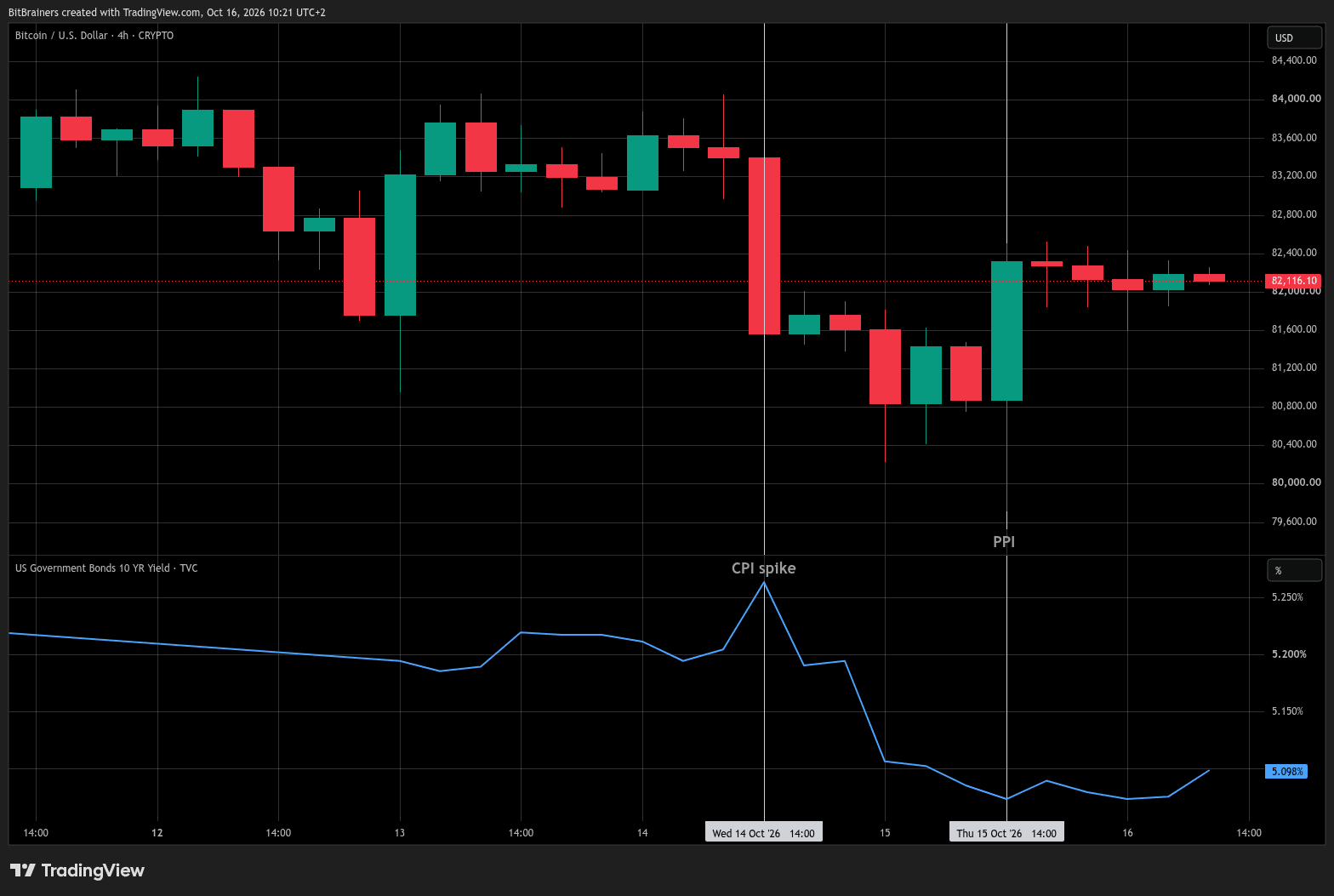
Bitcoin 4H (top) and US 10-year yield (bottom), October 12-16, 2026. CPI spiked the yield, PPI sent Bitcoin below $80,000, and neither hel...

Hot CPI, hotter PPI, and yields went the other way