
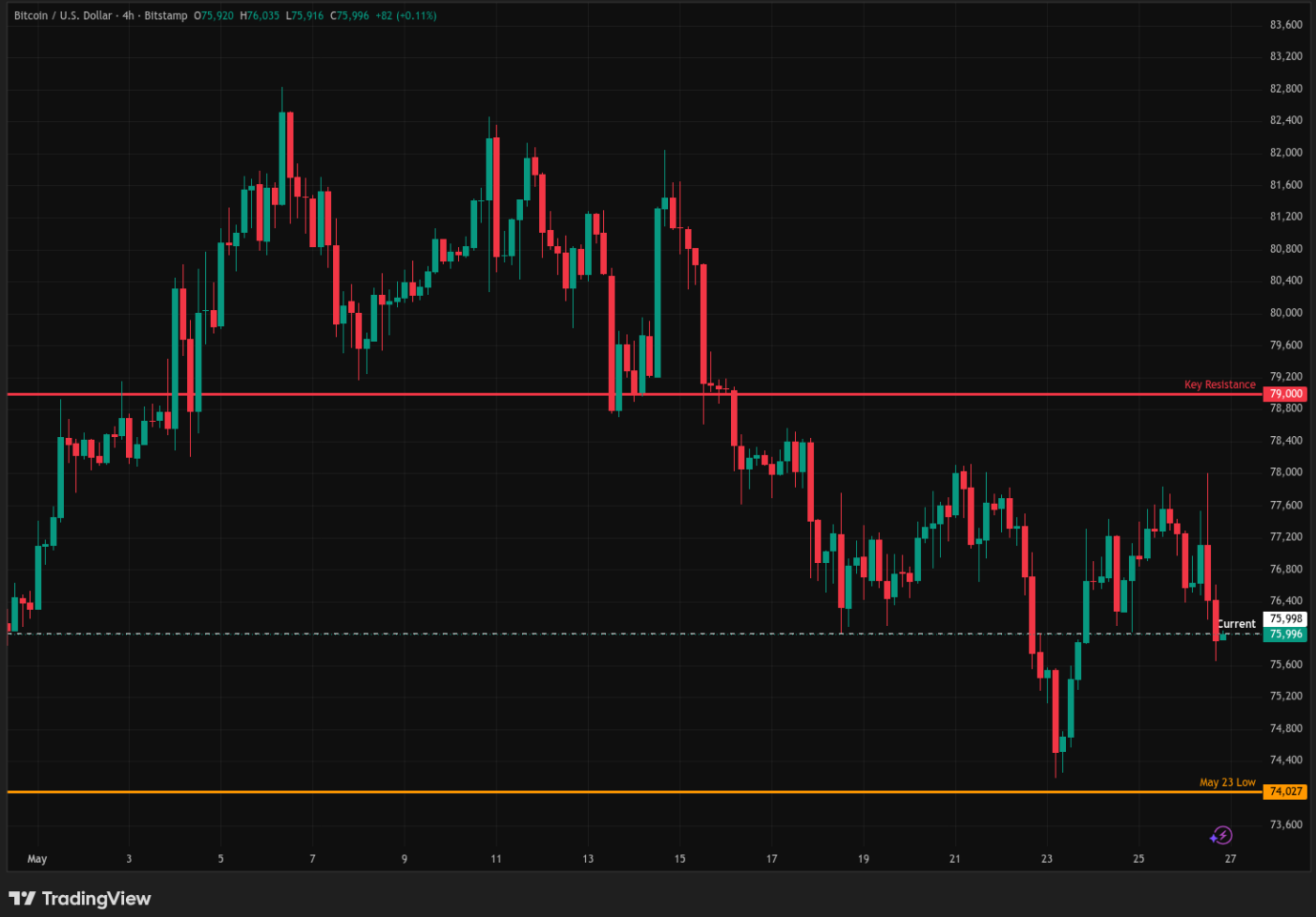
$766 million. Gone. Not from a hack, not from a rug pull. From traders who bet wrong on leverage and got margin called into oblivion in a single sweep. That is the number sitting at the center of this week's market narrative, and if you are not paying attention to what it signals, you are going to be the next person staring at a liquidated position wondering where it all went wrong.
Bitcoin sat above $100K earlier this year. Right now, as of May 26, 2026, it is trading at $76,479. The gap between those two numbers tells a story that a lot of people are still refusing to read clearly.
$766M in Liquidations Is Not Just a Number, It Is a Market Confession
When you see a liquidation event of this scale, the first instinct for most retail traders is to call it manipulation or whale games. That framing lets them off the hook. What actually happened is simpler and more damning: the market was loaded with over-leveraged long positions, and the price did not cooperate.
Leverage amplifies in both directions. When BTC was climbing through May, traders piled into long contracts expecting continuation. They were not wrong about the trend. They were wrong about the timeline and the volatility within it. The result was a $766 million wipeout that erased the gains the market spent most of May building.
This is not a one-off anomaly. This is how crypto markets work when leverage gets excessive. The same pattern played out during previous cycle corrections, and the mechanism never changes: price dips, stop-losses and liquidations cascade, price dips harder, more liquidations trigger. You do not need a conspiracy. You need a basic understanding of how overleveraged order books unwind.
$79K Is Not Just Resistance, It Is a Psychological Contract the Market Has to Break
Analysts are flagging $79K as the critical resistance level Bitcoin needs to reclaim and hold. That is not a random number. It represents the price zone where the most recent wave of liquidations accelerated, and it also aligns with a cluster of sell pressure from traders who got caught long and are now waiting to exit at break-even.
This is how resistance levels actually form. They are not technical drawings on a chart for their own sake. They reflect the emotional and financial positions of thousands of market participants. Every trader who bought near $79K and got crushed in this liquidation event is now a potential seller at that price. Until BTC absorbs that supply, $79K acts as a ceiling.
The critical question is not whether $79K will be retested. It is whether the buying pressure on the next approach will be strong enough to break through without triggering another cascade. If it cannot, expect the market to spend significant time in the $72K to $79K range grinding out a base.
Most People Do Not Know That Liquidation Cascades Front-Run the Next Move
Here is something that does not get talked about enough in the mainstream crypto content space. Liquidation events, while painful for those caught in them, often function as fuel for the next leg up. When long positions get liquidated at scale, the market forces those positions to close. That creates a flush. And a flush clears out weak hands.
After the May liquidation sweep, the futures market becomes cleaner. Over-leveraged longs are gone. Open interest drops. The funding rate resets. That is structurally healthier for a sustained move higher than a market sitting on top of an overloaded derivatives stack. Traders who enter after a liquidation event of this size are often entering with far less competition from leveraged tourists.
The $766 million wipeout on May 26, 2026 actually set the conditions for a more stable rally. If BTC can reclaim $79K from here on a clean order book rather than on the back of excessive leverage, that move has more conviction behind it.
Altcoins Got Dragged Down and That Is Exactly What You Should Expect
Every time BTC takes a hit at this scale, altcoins get punished harder. ETH and the broader altcoin market did not escape the liquidation event. They never do. When BTC margin calls flood exchanges, traders sell whatever they have liquid to cover positions. ETH and majors go first, then mid-caps, then the small illiquid tokens get completely wrecked.
This is worth keeping in your mental model whenever you allocate across multiple assets. The correlation between BTC and alts during a liquidation event approaches 1. Your diversification across 10 different tokens means almost nothing when the storm arrives. BTC sets the tone, and everything else follows the same beat, usually with more severity.
If you are trading on an exchange like Kraken, this is exactly why your position sizing across spot and derivatives matters. One overleveraged position across multiple assets is not diversification. It is concentrated risk wearing a costume.
The May Gains Wipeout Has a Specific Lesson About Entry Timing
Bitcoin had been building a recovery through May 2026. Traders who entered early in the move and managed risk appropriately came out fine or slightly green. Traders who chased the momentum in the final leg of the move with leverage got caught when the reversal hit. That is not a lesson about the market being unfair. That is a lesson about entry quality.
Late entries into momentum moves are structurally the most dangerous trades you can make in crypto. The reward-to-risk ratio collapses when price has already moved significantly. You are essentially paying a premium for confirmation, and if the move reverses, you absorb the full downside. The $766 million in liquidations was disproportionately driven by traders who entered late with high leverage because they did not want to miss the move.
Watching the entry, not just the direction, is the discipline that separates people who survive multiple cycles from people who blow up accounts every year.
Cold Storage Is Not Paranoia After a $766M Liquidation Event
When markets get this volatile, exchange risk becomes a real conversation. The concentrated activity around a liquidation event of this size puts significant stress on exchange infrastructure and order books. It is also the kind of market environment that historically precedes phishing campaigns, fake exchange alerts, and social engineering attacks targeting traders who are already emotional and distracted.
If you hold any meaningful amount of BTC outside of active trading, keeping it off exchanges is basic operational security. A hardware wallet like Trezor puts your private keys in your hands, not on a server sitting in a data center somewhere. The market wiping out $766 million in paper positions is one kind of loss. Losing self-custody is a different kind entirely, and it is the one you never recover from.
The Contrarian Take Nobody Wants to Hear Right Now
Everyone is watching $79K like it is the enemy. The standard read is that $79K has to break before anything good happens. That is the consensus. And consensus in crypto is almost always a setup for the opposite trade.
Here is the contrarian position: $79K resistance is doing the market a favor by slowing down the next leg. A BTC that grinds, consolidates, and builds structure under $79K before breaking through is more dangerous to shorts and more sustainable for bulls than a BTC that rips through $79K on overleveraged momentum and then immediately rolls over again. The slow, painful consolidation that everyone is frustrated by is exactly the thing that constructs the next reliable higher low.
Patience is the most boring and most profitable discipline in crypto. The traders who made money through previous cycles were not the ones trading every move. They were the ones who identified the structure and waited for price to confirm it.
Watch the Funding Rate, Not the Price
Before you close this tab and go check your portfolio, here is the one thing to actually watch: funding rates on BTC perpetual futures. After a $766 million liquidation event, funding typically flips negative or approaches zero. That signals that leveraged shorts are now dominant or that the market is neutral on direction.
When funding starts creeping back into positive territory again and BTC is still sitting below $79K, that is the signal that the derivatives market is loading up on longs again without confirmation. That is the warning sign that another liquidation cascade could be building. If BTC approaches $79K with neutral to slightly positive funding and rising spot volume, that is a very different setup. Watch the funding rate on May 26, 2026 and the days following. It will tell you more than any price target.
The assumption you probably walked in with is that $79K breaking is the most important thing to watch. The real signal is the health of the derivatives market on the approach. Price is the result. Funding is the leading indicator. Most traders spend all their time watching the result and almost none watching the cause.
Disclosure: This post contains affiliate links to Trezor and Kraken. BitBrainers may earn a commission at no extra cost to you. This is not financial advice.
Sources
Bitcoin.com. Analysts Flag $79K Resistance After $766M Bitcoin Liquidation Wipes May Gains
BitBrainers. We check the facts so you don't have to.


