
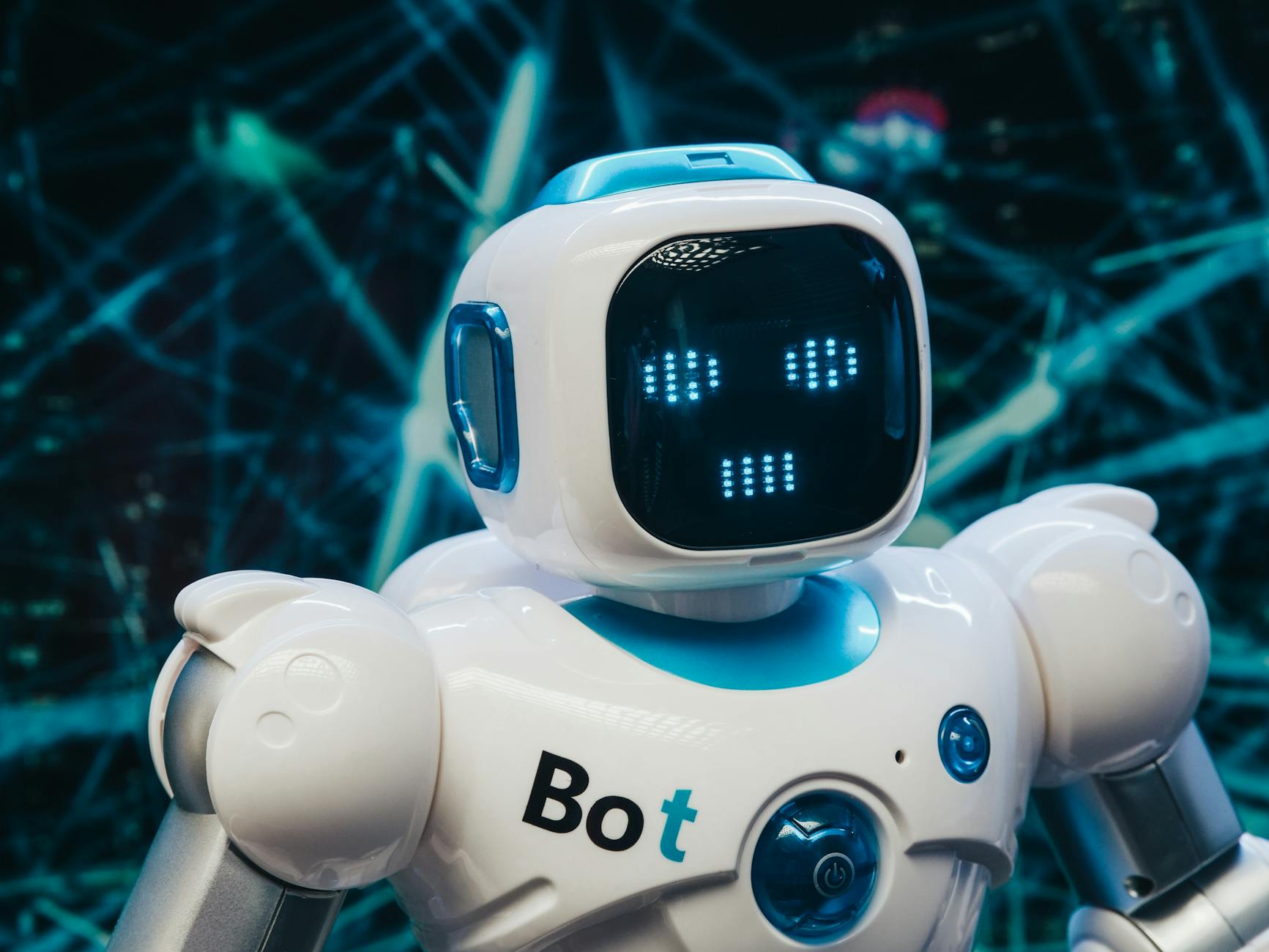
For years, AI has been a tool. You give it a prompt. It gives you an answer. That is the whole relationship. A very smart calculator that waits for instructions.
That model is dying fast.
On April 21, 2026, two things happened that most people scrolled past without blinking. The first was a quiet technical announcement out of Singapore. The second was a $25 billion check written in Silicon Valley. Put them together and you get a clear picture of where AI is actually going. Not where the hype says it is going. Where the money and the infrastructure say it is going.
Key Takeaways
- 0G Foundation and Alibaba Cloud launched onchain access to Qwen LLMs for AI agents on April 21, 2026, removing the need for centralized APIs and human-managed billing.
- AI agents can now pay for compute using tokens directly, enabling fully autonomous operation for the first time at commercial scale.
- Anthropic and Amazon signed a deal securing up to 5 gigawatts of compute for Claude, backed by up to $25 billion in new Amazon investment.
- Anthropic's run-rate revenue hit $30 billion in early 2026, up from $9 billion just months earlier.
- Both stories point to the same shift: AI is moving from a service you access to infrastructure that runs continuously and autonomously.
- Bitcoin remains the most logical neutral settlement layer for an economy increasingly dominated by machine-to-machine transactions.
The Onchain Move Nobody Talked About
0G Foundation and Alibaba Cloud announced a partnership to bring Alibaba's Qwen large language models directly onchain. This means AI agents running on 0G's decentralized infrastructure can now query one of the world's most capable AI model families without going through a centralized API, without a credit card, and without a human managing the billing.
The mechanism is token-based. An AI agent holds tokens. It spends tokens to access compute. It receives results. It acts on those results. No account creation. No fiat billing. No company policy that can pull the plug tomorrow.
To understand why this matters, you need to understand what has been holding AI agents back. The problem was never intelligence. GPT-4 level reasoning has existed for a while now. The problem was access. How does an autonomous agent reliably pay for its own compute? How does it prove its outputs are trustworthy? How does it interact with financial systems without a human counterparty?
Centralized APIs break all of those requirements. They require accounts tied to humans. They can be revoked. Their outputs cannot be independently verified. They create a ceiling on what autonomous agents can actually do in the real world.
The 0G and Alibaba partnership cracks that ceiling open. As Michael Heinrich, CEO of 0G Labs put it: inference runs on Qwen and verification runs on 0G, forming a more complete foundation of compute and trust for autonomous AI systems. That is not marketing language. That is a description of actual technical architecture.
Developers building on 0G can now create multi-step agentic workflows that are fully auditable on-chain. Every query, every response, every decision point can be traced and verified. That is the kind of trust layer that enterprise adoption requires. It is also the kind of infrastructure that a genuine agent economy needs before it can scale.
0G has been building toward this for a while. The Aristotle Mainnet launched in September 2025. The ecosystem includes over 100 partners including Chainlink, Google Cloud, and now Alibaba Cloud. NVIDIA CEO Jensen Huang projected a trillion-dollar agentic AI opportunity at GTC 2026. 0G is betting its entire infrastructure stack on being the blockchain layer that makes that economy function.
Qwen is not a small player in this equation either. Alibaba released Qwen3.6-Plus in early April 2026, specifically designed for agentic coding and multimodal reasoning. This is a model built from the ground up to support agents that navigate complex, real-world tasks without human guidance. Plugging it into decentralized infrastructure is not an accident. It is a deliberate bet on where AI compute is heading.
Anthropic Just Signed the Biggest AI Infrastructure Deal in History
The same week, Anthropic and Amazon announced they were expanding their partnership to secure up to 5 gigawatts of compute capacity for training and running Claude models. Amazon is putting $5 billion in immediately, with up to $20 billion more available in the future. That is on top of the $8 billion Amazon had already invested. Anthropic committed over $100 billion to AWS technologies over the next decade.
To put 5 gigawatts in context: industry estimates suggest that building 1 gigawatt of AI data center capacity costs around $50 billion. Anthropic is securing five times that. One gigawatt comes online by end of 2026. The rest follows through Trainium2, Trainium3, and Trainium4 chip generations.
Anthropic reported a run-rate revenue of $30 billion in early 2026. That is up from $9 billion at the end of 2025. Over 100,000 enterprise customers now run Claude on Amazon Bedrock. Consumer usage across free, Pro, and Max tiers is accelerating sharply.
This deal is not about research anymore. This is about infrastructure at a scale that matches what nation-states spend on energy grids. When a company commits $100 billion to cloud compute, it has already seen where demand is going. It is not guessing. It is building ahead of a wave it knows is coming.
The timing matters too. OpenAI sent a letter to investors the same week pitching its compute capacity as its main competitive advantage over Anthropic. Anthropic responded not with a press release but with a signed agreement for 5 gigawatts of capacity. That is how you answer a competitor in this space. Not with words.
What These Two Stories Have in Common
A small blockchain AI project partners with one of the world's largest tech companies to put AI models onchain. The leading AI safety company secures enough compute to power a small country. These look like separate stories. They are the same story.
The story is that AI is transitioning from a service you access to infrastructure that runs continuously, autonomously, and at massive scale. The bottlenecks that existed six months ago, centralized APIs, human-managed billing, unverifiable outputs, insufficient compute, are being systematically removed one by one.
When AI agents can access compute through token-based mechanisms on decentralized infrastructure, and when the underlying models powering those agents are being trained on five gigawatts of dedicated hardware, you are not talking about a chatbot upgrade. You are talking about a new computing paradigm.
Crypto has always been positioned as infrastructure for a world where machines transact directly with each other without intermediaries. That world is arriving. The agents need rails. The rails are being built. Bitcoin holders who understand that digital scarcity, programmable money, and autonomous AI are three components of the same system are early.
Most people will understand this in about three years, when the applications built on this infrastructure become impossible to ignore.
What to Watch
Keep your eyes on 0G's $0G token as the agent economy thesis develops. Watch how quickly enterprise developers adopt Qwen onchain versus traditional API access. Track Anthropic's revenue growth against compute deployment timelines. And pay attention to how many other major AI labs start looking for similar decentralized infrastructure partnerships.
The compute wars are not just about who has the most GPUs. They are about who controls the infrastructure layer when AI agents become the dominant economic actors on the internet. That question is being answered right now.
If you want exposure to this trend without picking individual tokens, the Bitcoin thesis is straightforward. Scarce, programmable, neutral settlement layer for an economy that will eventually be dominated by machine-to-machine transactions. Every piece of infrastructure being built around autonomous AI is another argument for why that settlement layer has value.
The agents are coming. The rails are almost ready. The question is whether you are positioned before or after that becomes obvious to everyone.
Frequently Asked Questions
Want to store your Bitcoin securely while all of this unfolds? Trezor hardware wallets keep your keys offline and your stack safe. Trade crypto with low fees on Kraken and get 50% off trading fees with our referral link.
BitBrainers covers Bitcoin, AI, and the infrastructure layer most people overlook. Bookmark us and come back when the obvious becomes expensive.



No comments:
New comments are not allowed.