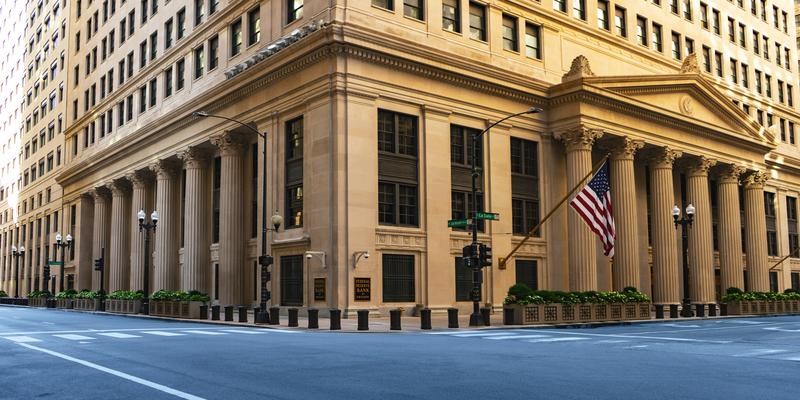
 On May 15, 2026, Jerome Powell's tenure as Federal Reserve Chair ends. The man taking his place is Kevin Warsh, a former Fed Governor, Trump ally, and the first Fed Chair nominee in history to have personally invested in more than a dozen blockchain protocols.
That last detail is not a footnote. It is the story.
On May 15, 2026, Jerome Powell's tenure as Federal Reserve Chair ends. The man taking his place is Kevin Warsh, a former Fed Governor, Trump ally, and the first Fed Chair nominee in history to have personally invested in more than a dozen blockchain protocols.
That last detail is not a footnote. It is the story.
What the Historical Record Says First
Before discussing why Warsh is different, the data on Fed transitions deserves honesty. Bitcoin has sold off during every Fed Chair transition since 2014. When Janet Yellen became Fed Chair, Bitcoin dropped 86%. When Powell was first appointed, Bitcoin shed 73.56% of its value. At Powell's second term confirmation in 2022, Bitcoin fell 60.72%. That is not a coincidence. It is a pattern driven by the same mechanism every time. New leadership brings uncertainty about monetary policy direction. Markets do not like uncertainty. Bitcoin, as the highest-beta risk asset in the world, takes the sharpest hit when uncertainty spikes. When Trump nominated Warsh in January 2026, crypto markets fell sharply, with Bitcoin dropping approximately 14% cumulatively. The market read him as a hawk and sold first. The question now, with the transition eight days away, is whether that selloff already priced in the risk or whether history is about to repeat.Who Kevin Warsh Actually Is
Warsh served as a Federal Reserve Governor from 2006 to 2011. He became Ben Bernanke's liaison to Wall Street during the 2008 financial crisis and worked in mergers and acquisitions at Morgan Stanley before entering public service. His reputation is that of a monetary hawk who prioritizes discipline over stimulus. He criticized the Fed's low-rate stance during the 2021 to 2022 inflation surge as a "fatal policy error" and has consistently advocated for a smaller Fed balance sheet and tighter monetary discipline. A smaller balance sheet means less liquidity in the financial system. Less liquidity is generally bad for risk assets including Bitcoin. That is the bear case in one sentence. But Warsh is not a simple story. Through a web of venture fund structures, he holds equity positions in more than a dozen blockchain and digital asset companies spanning DeFi lending, decentralized derivatives, Layer 1 and Layer 2 networks, prediction markets, and Bitcoin payments infrastructure. He has pledged to divest the majority of them upon confirmation. During his April 21 confirmation hearing before the Senate Banking Committee, Warsh stated that digital assets are "already part of the fabric of our financial services industry" and argued for clear rules rather than enforcement actions. He called Bitcoin "an important asset that can help inform policymakers when they are doing things right and when they are doing things wrong." This is not the language of someone who views Bitcoin as a threat. It is the language of someone who has thought seriously about what Bitcoin actually measures.The Confirmation Path
The Senate Banking Committee voted on April 29 to advance Warsh's nomination along strict party lines. All 13 Republican members voted in favor. All 11 Democrats voted against. It was the first fully partisan vote on a Fed Chair nominee in the committee's history. The full Senate is expected to vote on his confirmation the week of May 11, with Republicans holding a 53-seat majority. Warsh needs only a simple majority to be confirmed as the 17th Fed Chair since 1913. His confirmation before May 15 is now widely expected, barring any last-minute surprises. The path to this point was not smooth. Senator Thom Tillis of North Carolina had vowed to block Warsh's nomination unless the DOJ dropped its criminal investigation into Powell over alleged building renovation cost overruns. The investigation produced no evidence of wrongdoing and was widely viewed as politically motivated. On April 24, the DOJ dropped the probe and Tillis reversed his position. Democrats on the committee, led by Senator Elizabeth Warren, called Warsh a "sock puppet" for Trump and walked out before the vote. Warren warned that confirming Warsh would erode the Fed's independence from the executive branch.The Two-Sided Argument for Bitcoin
The bear case is structural. Warsh's hawkish stance on tighter policy, higher real rates, and balance sheet reduction represents a shift from Powell's accommodative stance. Slower rate cuts in 2026, accelerated balance sheet runoff, and less predictable forward guidance are all headwinds for risk assets. Higher real rates increase the opportunity cost of holding non-yielding Bitcoin relative to Treasuries. A stronger dollar, which typically accompanies Fed tightening, inversely correlates with BTC price. These are the mechanics of how monetary policy transmits into asset prices. The bull case is equally structural. Unlike every previous Fed transition, the US now has a maturing crypto regulatory framework, spot Bitcoin ETFs with $100 billion in total net assets, and institutional products that stabilize liquidity in ways that did not exist in 2014, 2018, or 2022. The 14% Bitcoin drop in January when the nomination was announced may have already priced the transition. ETF buyers absorbing supply have changed the market's response function to macro shocks. Warsh is set to become the first Federal Reserve Chair with disclosed crypto holdings, and the first whose policy instincts could still squeeze the sector harder than his predecessors did. That tension is the defining feature of his appointment for crypto markets.The CLARITY Act Running Parallel
The Warsh transition does not happen in isolation. The Senate Banking Committee markup of the CLARITY Act, the crypto market structure bill, is expected as soon as the week of May 11. Galaxy Digital prices the odds of the CLARITY Act becoming law in 2026 at roughly 50-50. Polymarket prices a 2026 signing at approximately 47%, down from 82% in February. If both events land in the same week, the Fed transition and a major crypto regulatory milestone, the market will have to process two significant macro signals simultaneously. That kind of overlap has historically created sharp volatility in both directions before a trend establishes itself. The CLARITY Act matters because it would provide the first clear legal framework distinguishing when a digital asset is a security versus a commodity. That distinction determines which regulator oversees crypto, which exchanges can operate legally, and what disclosures are required. For institutional capital sitting on the sidelines waiting for regulatory clarity, its passage or failure is a binary event.What the Market Is Showing Right Now
Bitcoin is trading at $81,540 on May 7, 2026. The session opened at $81,350, ran up to a high near $82,500 in the early afternoon, then sold off to a low around $80,900 through the overnight hours before recovering. The structure is intact but the key test has not been passed. The 200-day moving average sits at $82,228. Bitcoin has not closed a daily candle above it since October 2025. ETF flows have been the clearest driver of this week's strength. Spot Bitcoin ETFs pulled in $467 million on Tuesday alone, with $1.63 billion in total inflows since May 1. BlackRock's IBIT led with $251 million in a single session. Exchange reserves remain at a 7-year low. Whale wallets have net-bought 270,000 BTC over the past 30 days, the largest monthly accumulation since 2013. One additional data point worth watching: funding rates on Bitcoin perpetual futures are currently slightly negative at approximately minus 0.002%. That means longs are being paid to hold their positions, which indicates elevated short interest in the derivatives market. If Bitcoin pushes back toward $82,228 with that positioning in place, a short squeeze could accelerate the move in either direction.Summary
Kevin Warsh takes over from Jerome Powell on May 15, 2026. Every previous Fed transition has coincided with a significant Bitcoin selloff. Warsh is a monetary hawk who favors a smaller balance sheet and higher real rates, both of which are short-term headwinds for Bitcoin. He is also the first Fed Chair in history with personal crypto holdings and a stated belief that Bitcoin serves as a legitimate macro signal. The CLARITY Act markup is expected the same week as his Senate confirmation. Bitcoin is holding above $81,000 with strong ETF support but has not confirmed a daily close above the critical $82,228 level.What to Watch
The Senate confirmation vote expected the week of May 11 is the first trigger. Watch Bitcoin's reaction in the 24 hours after confirmation. If it sells off, the historical pattern is reasserting. If it holds or pushes higher, the market has already priced the transition and the ETF bid is stronger than the macro headwind. The daily close on May 15 itself will be the most important candle of the month. Everything else this week is positioning.Sources
- Benzinga — Bitcoin sells off under new Fed Chairs, May 2026
- CoinDesk — Kevin Warsh crypto portfolio disclosure, April 2026
- CryptoTimes — Powell exit Warsh arrival CLARITY Act roadmap, May 2026
- CNBC — Trump Fed pick Warsh clears Senate hurdle, April 2026
- CBS News — Senate Banking Committee advances Warsh nomination, April 2026
- BlockchainReporter — Bitcoin price today May 7, 2026
BitBrainers. We check the facts so you don't have to.