Something unusual is happening today and it is not getting enough attention.
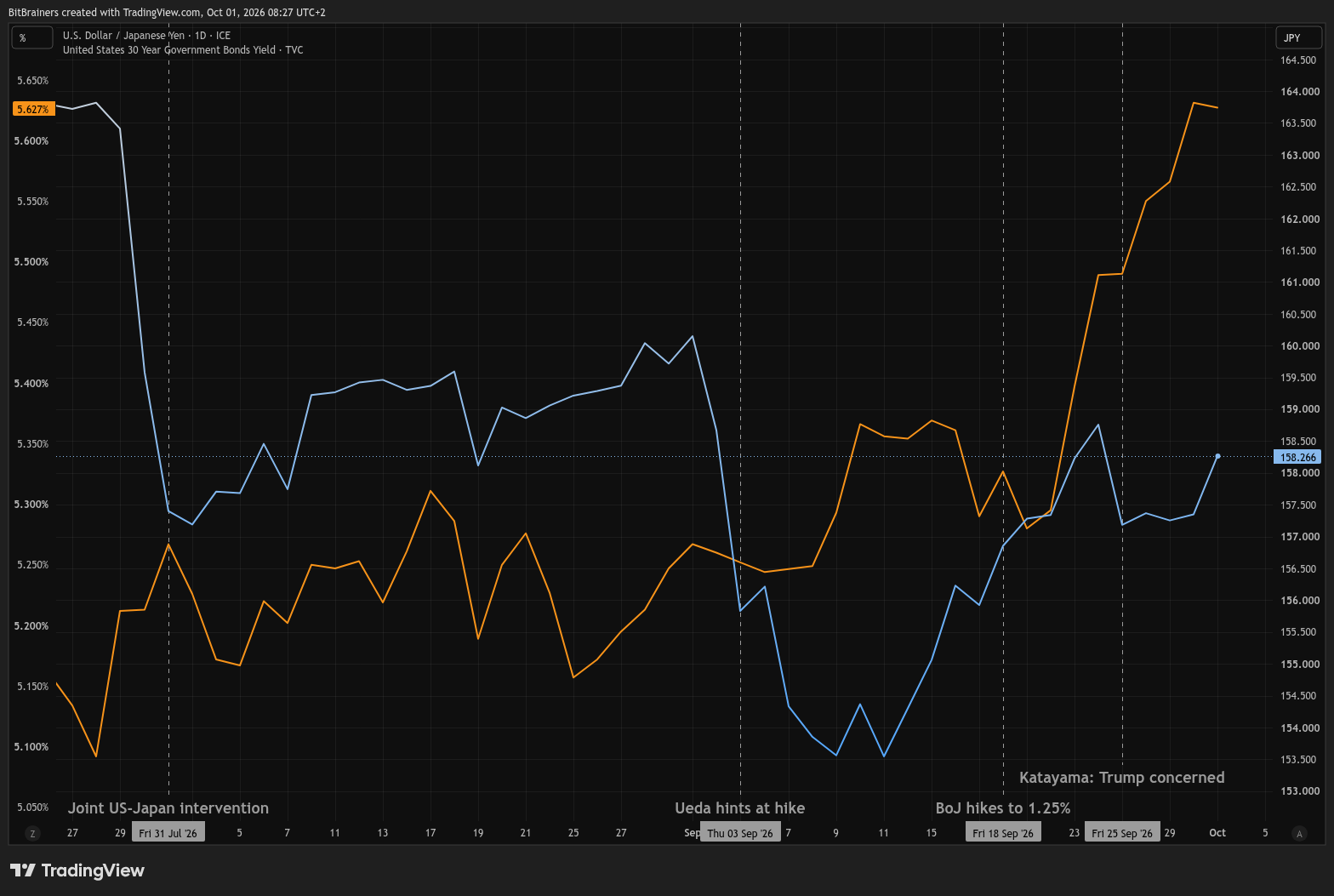
Three sovereign bond markets on three different continents are breaking at the same time. Not one of them is a small economy. Not one of them is a crisis state. These are the United States, the United Kingdom, and Japan — the three most important bond markets in the world — and all three are repricing simultaneously.
That does not happen often. When it does, it means something.
The Numbers
The US 30-year yield is at 5.085%. The 20-year at 5.092%. The 10-year at 4.538%. Every maturity rising together. The government is running a $2 trillion annual deficit and borrowing more every day to fund a war.
UK 10-year gilt yields hit 5.13%, the highest since 2008. UK yields now exceed the US, Germany, and every other major advanced economy. Every 1% yield rise costs the British Treasury £15 billion annually in debt interest by 2030.
Japan's 10-year bond yield climbed above 2.6%, the highest since 1997. Japan spent three decades in deflation. It borrowed accordingly. Now inflation is arriving and the bill is coming due.
The Common Thread
Japan imports more than 90% of its crude oil from the Middle East. The spike in oil prices from the effective closure of the Strait of Hormuz has hit Japan harder than almost any other major economy.
The Strait of Hormuz is the single thread connecting all three crises. When it closes, oil spikes. When oil spikes, wholesale prices follow. When wholesale prices follow, central banks face a choice between hiking rates into a slowing economy or letting inflation run. Neither option is good. Both options are bad for sovereign debt markets that borrowed at near-zero rates for a decade.
Trump left China today saying he and Xi agreed Iran must reopen the Strait. No timeline. No mechanism. No deal. Yields will keep climbing.
Why This Is Not a Normal Repricing
Bond markets reprice all the time. What is different today is the simultaneity and the structural nature of what is being priced.
The US is borrowing to fund a war. The UK is dealing with political chaos that threatens to install a more fiscally liberal government at exactly the moment borrowing costs are surging. Japan is the world's largest holder of US Treasuries, and when Japanese yields rise, Japanese investors sell US bonds to bring money home — which pushes US yields higher still.
These are not independent events. They are a feedback loop. And the feedback loop is just getting started.
What Bitcoin Does in This Environment
Bitcoin dropped today along with everything else. That is the short-term correlation trade — when liquidity tightens and investors need cash, they sell whatever is liquid. Bitcoin is liquid. So it sells off.
But the medium-term picture is different. In 2022, when the UK gilt market nearly collapsed under Liz Truss, Bitcoin gained roughly 20% in the weeks that followed. The pattern is consistent: initial sell-off on liquidity fear, followed by accumulation as the structural argument for hard assets becomes undeniable.
The structural argument is not complicated. Every bond yield climbing simultaneously means the cost of holding fiat debt is rising. Governments that borrowed cheap are now paying expensive. The only way out of that trap is to inflate the debt away — which means printing money — or to default — which destroys trust in the system entirely.
Bitcoin does not inflate. It does not default. It does not have a central bank trying to thread an impossible needle between growth and inflation. Its supply is fixed. Its rules do not change based on who is in office or what the energy market is doing.
That is not a price prediction. It is a structural observation. And right now, with three bond markets breaking at once, the structural observation has never been more relevant.
The Strait of Hormuz Is the Variable Nobody Can Control
Everything else in this story — the political chaos in London, the deficit spending in Washington, the inflation shock in Tokyo — is downstream of one chokepoint in the Persian Gulf.
If the Strait reopens, oil falls, inflation pressure eases, bond markets stabilize. The crisis gets delayed, not resolved, because the debt is still there.
If the Strait stays closed, oil stays elevated, inflation stays hot, central banks keep hiking, and governments that borrowed trillions at near-zero rates face an increasingly uncomfortable arithmetic problem.
Bitcoin was not designed to solve this problem. But it turns out that a monetary system with no central bank, no sovereign debt, and a fixed supply is exactly what you want when the alternative is three bond markets breaking at once.
If you are accumulating Bitcoin through this volatility and moving it to cold storage, a Trezor hardware wallet keeps your stack outside any system that can be hacked, manipulated, or inflated. And if you want to trade the near-term volatility while the larger story plays out, Kraken is where we do it.
The future showed up. The bill is on the table.
Disclosure: This post contains affiliate links to Trezor and Kraken. BitBrainers may earn a commission at no extra cost to you. This is not financial advice.
Sources
- Reuters/Yahoo Finance — Global shares drop, bond yields climb on inflation worries
- Britain Today News — UK Gilt Yields Hit 2008 High on Starmer Turmoil
- Trading Economics — Japan 10 Year Bond Yield
- CNBC — Japan risks Trump's ire as Iran war fallout sparks currency intervention
- Crypto Briefing — UK Borrowing Costs Hit 18-Year High, Bitcoin Benefits
- Goldman Sachs — Why Are UK Gilt Yields So High?