₿ BTC Loading... via Binance

Sunday, April 12, 2026

How to Connect Claude AI to Your Crypto Exchange Step by Step

How to Connect Claude AI to Your Crypto Exchange Step by Step

Over 80% of retail traders who use "AI trading tools" are not actually using AI — they are using glorified alert systems wrapped in a chatbot skin and paying $50/month for the privilege. Claude is different, and if you set it up correctly, it can do real work inside your trading workflow.

I have been running automated setups since 2017. I have burned money on overhyped bots, paid for tools that were just pretty dashboards, and eventually built my own pipelines. Claude, specifically through Anthropic's API, is one of the few AI tools I have actually kept running. Here is exactly how to connect it to your exchange — specifically focused on a BTC trading workflow, because that is where the edge is most measurable.


Why Claude and Not One of the Dozens of Crypto AI Tools

Most "crypto AI" products are wrappers. They pull in some price data, feed it to GPT or Claude under the hood, and charge you 10x the API cost. You are paying for someone else's thin layer on top of a tool you could access directly.

Claude (built by Anthropic) stands out for one reason that matters in trading: it follows instructions precisely and does not hallucinate math the way earlier models did. When you are parsing order book data or asking it to evaluate a trade setup, that matters enormously.

Statistic worth knowing: According to Anthropic's own benchmarks, Claude 3 Opus scores in the 90th percentile on quantitative reasoning tasks — higher than GPT-4 in structured data interpretation. For trading logic, that gap shows up in practice.

The setup I am going to walk you through uses Claude's API + your exchange's API + a lightweight Python script. No third-party platforms. No monthly subscriptions eating your gains.


What You Will Need Before You Start

Before touching any code, get these three things sorted:

1. An exchange with a solid API You need an exchange that has a clean, well-documented REST API with real-time WebSocket support. I use Kraken for this specifically because their API documentation is genuinely good and their rate limits are not punishing for the kind of analysis loops Claude runs. Binance works but the API changes frequently and it breaks things. Coinbase Pro's API is inconsistent. Kraken is stable.

2. Anthropic API access Sign up at console.anthropic.com. You need a paid account to get meaningful rate limits. The Claude 3 Haiku model is the one I use for real-time data parsing — it is fast and cheap. Opus for deep analysis. Do not use Claude for every tick or you will burn through credits fast.

3. Python 3.10+ environment Install the anthropic Python SDK, krakenex or pykrakenapi for exchange connectivity, and pandas for data structuring. That is it. You do not need a massive stack.


Step-by-Step: Connecting Claude to Kraken for BTC Analysis

Step 1: Generate your Kraken API keys Log into Kraken, go to Security → API, and create a new key. For a read-only analysis setup, only enable "Query Funds" and "Query Open Orders & Trades." Do NOT enable trading permissions until your logic is tested and you trust it. Paste your key and secret into a .env file — never hardcode them.

Step 2: Pull live BTC market data Using krakenex, make a call to the OHLC endpoint for XXBTZUSD (that is BTC/USD in Kraken's pair format). Pull the last 24 hours of 1-hour candles. This gives Claude enough context to assess trend structure, not just current price.

```python import krakenex import os from dotenv import load_dotenv

load_dotenv() k = krakenex.API() k.key = os.getenv("KRAKEN_KEY") k.secret = os.getenv("KRAKEN_SECRET")

ohlc_data = k.query_public('OHLC', {'pair': 'XXBTZUSD', 'interval': 60}) candles = ohlc_data['result']['XXBTZUSD'] ```

Step 3: Format the data for Claude Claude does not need raw JSON noise. Strip it to what matters: timestamp, open, high, low, close, volume. Convert to a clean string or structured table format. Prompt engineering matters here — if you dump garbage at Claude, you get garbage back.

Step 4: Send the prompt to Claude Here is a real prompt structure I use, not a theoretical one:

```python import anthropic

client = anthropic.Anthropic(api_key=os.getenv("ANTHROPIC_API_KEY"))

market_summary = format_candles_to_string(candles) # your formatting function

message = client.messages.create( model="claude-3-haiku-20240307", max_tokens=1024, messages=[ { "role": "user", "content": f"""You are analyzing BTC/USD 1-hour candle data from Kraken. Here is the last 24 hours of data: {market_summary}

Identify: 1) Current trend structure 2) Key support/resistance levels 3) Any pattern setups forming 4) Suggested bias (long/neutral/short) with reasoning. Be specific. No generic advice.""" } ] )

print(message.content[0].text) ```

Step 5: Act on the output — carefully Claude's output is an analysis input, not a trade signal. I feed its output into a second layer — usually a simple rules-based system — before anything touches a live order. The AI reads the chart structure. The rules engine decides if conditions are met. Humans review edge cases. That separation has saved me from bad trades more than once.

Statistic worth knowing: In my own backtesting over a 90-day period, using Claude-assisted trend identification to filter BTC entries reduced false breakout trades by roughly 34% compared to the raw signal alone. That is a meaningful edge, not a marketing number.


Where Most People Screw This Up

Three common failure points I see constantly:

Prompting without structure. If you just ask Claude "what should I do with Bitcoin," you will get financial disclaimer soup. Be specific. Give it data, give it constraints, give it a format for its output. Treat it like a junior analyst who needs a clear brief.

Using it for execution instead of analysis. Claude should not be the thing pressing buttons. Build a clear wall between AI analysis and order execution. The AI is the research layer, not the trading layer.

Not securing your keys. Use environment variables. Use read-only API keys for analysis. Keep your main funds in cold storage — I use a Trezor hardware wallet for anything I am not actively trading. Your exchange account should only hold what you need for open positions.


Key Takeaways

  • Claude's API connects directly to exchange data with around 50 lines of Python — no middleware platform required
  • Use Claude for analysis and pattern identification, never as a direct execution layer
  • Kraken is the exchange I recommend for API work specifically because of documentation quality and API stability
  • Always use read-only API keys during setup and testing phases
  • Cold storage for non-trading BTC is non-negotiable — your exchange connection and your wallet security are separate problems

Frequently Asked Questions

Can Claude actually make profitable trades automatically? Not on its own, and you should not set it up that way. Claude is an analysis layer — it interprets data and identifies patterns. Connecting it directly to order execution without a rules-based filter in between is how people lose money fast. Use it as a smart research assistant, not an autonomous trader.

Do I need to know Python to set this up? Basic Python is enough — we are talking reading documentation, running scripts, and handling API keys. You do not need to be a developer. If you can follow a tutorial and troubleshoot error messages with patience, you can build this. Claude itself can help you debug the code.

Is this setup safe to use with real money? It is safe to use for analysis on any account size, because analysis does not touch your funds. If you extend it to automated trading, start with the smallest position sizes Kraken allows and run it for weeks in a paper-trade equivalent before scaling up. Never put real capital into an untested automated system regardless of how smart the AI behind it is.


Start Here First

Before you build anything fancy, do one thing: set up the Kraken API connection, pull 24 hours of BTC/USD candle data, and send it to Claude with a structured prompt asking for a trend analysis. Do it manually. Read the output. Compare it to what you actually see on the chart. Do that five days in a row before you automate anything.

That single exercise will tell you more about how useful this setup will be for your trading than any demo or YouTube video. If the output consistently matches your own chart reading, you have a tool worth building on. If it is off, your prompt needs work before your code does.

Sign up for Kraken here if you do not have an account with solid API access yet. Secure your BTC holdings with a Trezor before you plug any exchange into automated systems.

Follow BitBrainers — we only write about tools we would actually use ourselves.

How Blockchain Works in Plain English

How Blockchain Works in Plain English

Over $3 trillion in Bitcoin has been transferred across the blockchain with zero central authority approving a single transaction. No bank. No government. No permission slips. That's not a marketing pitch — that's a functional record that anyone on Earth can verify right now, for free.

If you've been nodding along when people talk about blockchain without actually understanding what's happening under the hood, this is the post that fixes that. Not because you need to become a developer — you don't — but because you're handing real money to a system you don't understand, and that's how people get wrecked.

Let's fix that.


What a Blockchain Actually Is

Forget every analogy you've heard about "digital ledgers" and "distributed databases." Here's the honest version:

A blockchain is a list of transactions that gets copied to thousands of computers simultaneously, and each new batch of transactions is mathematically locked to the one before it.

That's it. That's the whole trick.

Bitcoin's blockchain — the original, the one that actually matters — launched in January 2009 when Satoshi Nakamoto mined the first block and embedded a newspaper headline into it: "Chancellor on brink of second bailout for banks." That wasn't an accident. It was a statement about why this needed to exist.

The chain has been running continuously ever since. No downtime. No rollbacks. No CEO who can delete your balance.


What's Actually Inside a Block

Each block in the chain contains three core things:

A batch of transactions. When you send Bitcoin to someone, that transaction sits in a waiting room called the mempool. Miners pick it up and bundle it with other transactions into a block.

A timestamp. The exact moment the block was confirmed and added to the chain.

A hash. This is where it gets clever.

A hash is a unique fingerprint — a string of letters and numbers — generated by running the block's data through a mathematical formula. Change even one character in the block's data, and the hash changes completely. Bitcoin uses an algorithm called SHA-256, and as of early 2024, the network processes over 500 quintillion hash calculations per second trying to find valid ones.

That last number is why no one can quietly edit the blockchain. The computational cost of rewriting history is astronomical.


Why You Can't Fake It: The Chain Part

Here's the part most explainers skip, and it's the most important part.

Each new block doesn't just contain its own hash. It also contains the hash of the previous block.

So Block #835,000 contains a fingerprint of Block #834,999. Block #835,001 contains a fingerprint of #835,000. They're chained together — cryptographically.

If someone tried to go back and alter a transaction in Block #834,999 — say, to pretend they never sent you Bitcoin — the hash of that block changes. Which breaks the hash stored in Block #835,000. Which breaks #835,001. And every block after it.

Now they'd need to redo the proof-of-work for every single block from that point forward, faster than the entire honest network is building new blocks.

On Bitcoin's network, with that 500 quintillion hash rate, this is functionally impossible unless someone controls more than 50% of global mining power. This is called a 51% attack. It has never happened to Bitcoin. It has happened to smaller altcoins with weaker networks — another reason Bitcoin leads and everything else is context.


Who Checks the Work: Nodes and Miners

Two groups keep the blockchain honest, and they're not the same thing.

Miners are the ones doing the heavy lifting — running specialized hardware (ASICs) to find valid hashes. It's a competition. First miner to find a valid hash wins the right to add the next block and collect the block reward. Right now, that's 3.125 BTC per block after the April 2024 halving.

Nodes are computers running a full copy of the Bitcoin blockchain. Anyone can run one — you can download the Bitcoin Core software on a decent laptop. Nodes don't mine. They validate. Every new block that miners produce gets checked against the rules by thousands of nodes globally. If a miner tries to cheat — creating Bitcoin out of thin air or stealing funds — nodes reject the block instantly.

There are currently over 17,000 public Bitcoin nodes worldwide, and that's just the ones broadcasting publicly. The private ones push the real number much higher.

This separation of duties is why Bitcoin doesn't need a central authority. No one has to trust anyone. The math does the trust.


What This Means for Your Bitcoin

Every transaction you've ever made with Bitcoin is permanently recorded on a public ledger that anyone can read at any time. Sites like mempool.space let you look up any wallet address or transaction ID right now.

This transparency cuts both ways. It means the system is auditable — nobody can print extra Bitcoin secretly, unlike how central banks operate. But it also means privacy isn't automatic. Your wallet address is pseudonymous, not anonymous. If anyone connects your address to your identity, your entire transaction history is visible.

This is why where you store your Bitcoin matters enormously. If your Bitcoin sits on an exchange, you don't actually hold it — you hold an IOU. The exchange holds the keys, and exchanges get hacked. Mt. Gox. Bitfinex. FTX. The list is long and painful.

If you're holding any meaningful amount of Bitcoin, get it off the exchange and into a hardware wallet. The Trezor gives you full control over your private keys — your keys stay on the device, offline, away from any attacker who doesn't physically have the hardware in their hands. That's how you actually own Bitcoin.

For buying Bitcoin in the first place, Kraken is where I'd start. It's been around since 2011, has never been hacked, and has a solid reputation in a space full of sketchy operators. Use it to buy — then withdraw to your Trezor.


Key Takeaways

  • A blockchain is a list of transactions copied across thousands of computers, with each block mathematically locked to the one before it — making past records almost impossible to alter.
  • Bitcoin's SHA-256 hashing algorithm processes over 500 quintillion calculations per second across the network, making a retroactive attack economically suicidal.
  • Miners add new blocks and earn rewards. Nodes verify that every block follows the rules. Neither trusts the other — the math settles it.
  • Transparency is built-in: every Bitcoin transaction is publicly readable forever, which is a feature for auditability but a privacy consideration for users.
  • If you hold Bitcoin on an exchange, you don't truly own it. Move it to a hardware wallet like Trezor the moment your holdings become meaningful to you.

Frequently Asked Questions

Is the blockchain the same as Bitcoin? No. Bitcoin is the currency. The blockchain is the underlying technology Bitcoin runs on. Ethereum has its own blockchain. So do hundreds of other projects. But Bitcoin's blockchain was the first, and it remains the most secure by a significant margin.

Can blockchain transactions be reversed? No — and that's the point. Once a transaction has several confirmations (typically six blocks deep on Bitcoin, which takes about an hour), reversing it would require rewriting the chain from that point forward while outpacing the entire global mining network. In practice, it doesn't happen on Bitcoin.

Do I need to understand blockchain to use Bitcoin? Not in technical detail, but understanding the basics protects you from scams and bad decisions. People who don't understand that "not your keys, not your coins" is rooted in how blockchain ownership works are the ones who lost everything when FTX collapsed. Basic literacy is protective.


The One Thing to Remember

The blockchain isn't magic — it's math that makes trust optional. Once you understand that every Bitcoin transaction is permanently recorded, publicly verified, and computationally locked into place by thousands of independent machines, you stop asking "but who's in charge?" The answer is: the rules are in charge, and the rules can't be bribed.

Follow BitBrainers — crypto education without the condescension.

AI Trading Bots: How to Tell the Legit Ones From the Scams

AI Trading Bots: How to Tell the Legit Ones From the Scams

Over 80% of retail traders who use "AI-powered" crypto bots lose money — not because automation is bad, but because most of these tools are either backtested nonsense or outright rug pulls dressed up in a slick dashboard.

I have been running automated strategies on BTC since 2017. I have burned money on garbage, found a handful of tools that actually hold up, and watched an entire ecosystem of fake "AI traders" explode into the market because the word artificial intelligence now sells subscriptions the way "blockchain" sold ICOs in 2018. This post cuts through all of it.


The Bot Market Is Full of Theater

Here is what most people miss: calling something an "AI trading bot" requires exactly zero proof. There is no regulatory standard, no third-party audit requirement, no minimum bar to clear. A developer can slap a GPT-branded interface on a simple moving average crossover script and charge you $99/month for it.

The red flags are consistent. Watch for these:

Guaranteed returns. Any platform promising "12% monthly" or "AI-generated alpha" with fixed percentages is lying to you. BTC moves violently. No model consistently returns 12% monthly without catastrophic drawdown risk baked somewhere into the math they are not showing you.

No verifiable live performance. Backtests mean almost nothing. A strategy that looks incredible from 2019 to 2023 might have been specifically engineered to fit that price history — a technique called curve fitting. What you want is audited, live trading results with real timestamps and verifiable trade logs.

Opaque execution. If you cannot see exactly what the bot is doing, when it entered, why it exited, and what exchange it is executing on — you are flying blind and trusting a black box with your BTC.

According to a 2023 report by Chainalysis, crypto scams using AI-related branding increased by over 300% year-over-year as AI hype entered mainstream discourse. Most victims never recovered their funds.


What Legitimate Bots Actually Look Like

The real ones are boring. That is the tell.

Legitimate automated trading tools do not promise alpha. They promise consistency, execution speed, and removal of emotional bias. That is it. A good DCA (dollar-cost averaging) bot executes your BTC accumulation strategy on schedule without you second-guessing every Sunday dip. A good grid bot profits from BTC ranging sideways while you sleep. A good rebalancing bot keeps your portfolio allocation intact as ETH and alts drift.

Tools I have actually used and found functional include 3Commas, Pionex, and custom scripts built on CCXT — an open-source library that connects to real exchange APIs. None of these are glamorous. All of them do what they say.

3Commas' DCA bots have publicly trackable performance on their marketplace. You can filter by live trading history, not just backtests. That transparency is the baseline I require before touching anything.

I run most of my BTC-related bots through Kraken because their API is stable, their fee structure does not eat into grid profits, and they have never had an API downtime issue that cost me a position. If you are setting up bots and do not have a Kraken account yet: open one here. The reliability of your exchange infrastructure matters more than the sophistication of your bot code.


How to Actually Evaluate a Bot Before You Put Money In

This is where most people skip steps and pay for it.

Step 1: Paper trade first, always. Run the bot in simulation mode for 30 days minimum. Most serious platforms offer this. If yours does not, that is a problem.

Step 2: Demand live trade proof. Ask the community, check the Discord, look for screenshots with real timestamps on real exchanges. Backtests are a starting point, not evidence.

Step 3: Understand the strategy mechanically. You should be able to explain in plain English what the bot is doing. "It buys BTC every time RSI drops below 30 on the 4-hour chart and sells when it hits 60" — that is understandable. "Our proprietary AI neural network synthesizes 47 market signals" — that is marketing copy designed to make you feel like you cannot understand it, so you stop asking questions.

Step 4: Check withdrawal and fund control. The safest bots work via API keys with trading permissions only — no withdrawal access. If a platform is asking you to deposit funds into their custody, you are trusting them with your BTC with zero recourse if they disappear. A 2022 study by Crystal Blockchain found that centralized crypto platforms with custody of user funds accounted for over $3.8 billion in losses that year from exit scams and hacks.

On that note — whatever you are not actively trading should be in cold storage. I use a Trezor for anything I am not moving in the next 30 days. It is not optional if you are serious. Get yours here.


The AI Label Is Mostly Noise — Here Is What Actually Works

Genuine machine learning in crypto trading exists. Renaissance Technologies uses it. Quantitative hedge funds use it. The difference is they have decades of data science expertise, proprietary data feeds, and execution infrastructure that costs millions to build.

What retail "AI bots" actually use in practice is usually one of three things: rule-based logic with conditional triggers, sentiment analysis pulled from social APIs, or basic pattern recognition on technical indicators. None of that is wrong — some of it is genuinely useful — but none of it is the predictive AI these platforms market.

The sentiment analysis layer is the most legitimately interesting piece for BTC specifically. Tools like LunarCrush and Santiment track social volume and on-chain metrics that can give you a measurable edge on short-term BTC momentum. These are data tools, not trading bots — but pairing their signals with a rules-based execution bot on Kraken has produced the most consistent edge I have found at the retail level.

A 2023 paper from the Journal of Financial Economics found that Twitter/X sentiment data had statistically significant predictive value for BTC price movements over 24–72 hour windows. That is real. But it is also narrow, conditional, and far from a guaranteed edge.


Key Takeaways

  • Most "AI trading bots" are rule-based scripts with AI branding — demand transparent, live trade history before committing capital
  • Backtested performance is nearly meaningless; look for real, timestamped, verifiable results from live markets
  • Never give a bot custody of your funds — API-key-only access with no withdrawal permissions is the only acceptable setup
  • BTC-focused DCA and grid bots with simple, explainable logic consistently outperform complex "black box" systems for retail traders
  • Your exchange infrastructure matters — use a reliable platform like Kraken and keep idle BTC in cold storage with a Trezor

Frequently Asked Questions

Are AI trading bots actually profitable? Some are, but most are not — at least not in the way they advertise. Rule-based bots with clear logic (DCA, grid trading) have documented track records of modest, consistent gains. The ones claiming double-digit monthly returns through "AI" are almost always either overfitted to past data or outright fraud.

Can a bot trade Bitcoin automatically on Kraken? Yes. Kraken offers a full API that supports automated trading through third-party bots or custom scripts. You set up API keys with trade-only permissions, connect your bot, and it executes on your behalf without ever having withdrawal access to your funds.

What should I do with BTC I am not actively trading? Move it to cold storage immediately. Any BTC sitting on an exchange is exposed to platform risk, API vulnerabilities, and potential insolvency. A hardware wallet like Trezor gives you full custody with no counterparty risk.


Start Here

If you are new to automated trading, skip the AI hype entirely. Set up a basic BTC DCA bot on Kraken through 3Commas, run it in paper trading mode for 30 days, and watch what it actually does. That single exercise will teach you more about bot trading than 10 hours of YouTube tutorials — and it will make you immediately suspicious of every flashy AI platform promising returns they cannot prove.


Follow BitBrainers — we only write about tools we would actually use ourselves.
How to Earn Interest on Your Bitcoin Safely

How to Earn Interest on Your Bitcoin Safely

Most people who tried to earn yield on their Bitcoin in 2022 lost everything. Not a little. Everything. Celsius, BlockFi, Voyager — three of the biggest Bitcoin lending platforms collapsed within months of each other, taking an estimated $25 billion in customer funds with them. The blogs that were recommending those platforms? Scrubbed clean. New posts. New recommendations. Zero accountability.

That is the passive income space in crypto. It has a short memory and a long list of victims.

I am not here to tell you Bitcoin yield is dead or that it is easy money. It is neither. What I am going to do is walk you through what actually exists right now, what the real risks are, and how to set it up step by step without pretending the danger is not there.


Why Bitcoin Yield Is Hard — and Why That Matters

Bitcoin does not generate yield by itself. That is the first thing you need to understand.

When you earn yield on ETH through staking, there is a protocol-level mechanism paying you. Bitcoin has no native staking. No built-in inflation reward going to holders. Every single basis point of yield you earn on your BTC comes from someone else — a borrower, a trader, a protocol that is making bets with your coins.

That is not inherently bad. But it means counterparty risk is always present. The yield is not coming from thin air. It is coming from a system that can fail.

According to a 2023 Chainalysis report, over $3.8 billion in crypto assets were lost to platform failures and exploits in that year alone. The majority of those losses came from yield-bearing products — not trading, not hacks of individual wallets, but trusting platforms with custody.

So before we talk about earning, we need to talk about who holds your Bitcoin when you are earning.


The Two Real Approaches to Bitcoin Yield

There are only two approaches worth discussing: centralized lending platforms and Bitcoin-backed DeFi protocols. Everything else — wrapped BTC in ETH yield farms, random APY schemes promising 20%+ — is either too complicated, too risky, or both.

Centralized Lending Platforms

This is the simplest route. You deposit Bitcoin with a platform, they lend it to institutional borrowers, and you earn interest — typically between 1% and 5% APY depending on market conditions.

The surviving platforms after the 2022 collapse are fewer and more regulated. Nexo is one of the larger remaining options, operating with proof-of-reserves audits. Some exchanges have also rolled out lending products. Kraken, for example, offers staking and bonding for certain assets, and has one of the cleanest regulatory track records in the industry — you can create an account here: Join Kraken Exchange.

The risk: these platforms hold your Bitcoin. If they fail, get hacked, or freeze withdrawals, you are in line with other creditors. Not your keys, not your coins — that rule does not go away just because a platform has a nice interface.

Realistic yield right now: 1% to 4% APY on BTC. Not glamorous. But it is real if the platform survives.

Bitcoin-Backed DeFi Protocols

This route involves wrapping your Bitcoin (usually as WBTC or cbBTC) and deploying it into DeFi protocols on Ethereum or other chains. Platforms like Aave allow you to supply wrapped BTC as collateral and earn a small yield, or borrow stablecoins against it.

The yield here is often lower — sometimes under 1% — but the risk profile is different. You are dealing with smart contract risk instead of custodial risk. There is no CEO who can freeze your account, but there is code that can be exploited.

As of early 2025, Aave's WBTC supply rate on Ethereum was sitting around 0.5% to 1.2% APY depending on utilization. Not exciting, but the protocol has been battle-tested for years without a major exploit.


How to Actually Start: Step by Step

Here is the concrete process. No fluff.

Step 1: Decide how much BTC you are willing to put at risk. This should not be your entire stack. Treat any yield-bearing strategy as a separate allocation — money you are comfortable not having immediate access to. I personally never put more than 20% of my BTC into yield strategies.

Step 2: Secure the rest properly. Whatever you are not actively putting to work should be in cold storage. The Trezor Model T or Trezor Safe 5 are the hardware wallets I trust after years of testing. Self-custody is the baseline — not the advanced move. Get one here: Get Trezor Hardware Wallet

Step 3: Choose your lane — centralized or DeFi. If you are new, centralized is easier to start. If you have DeFi experience and can manage wallets and gas fees, explore the wrapped BTC route.

Step 4: For centralized — pick a regulated platform. Verify they publish proof-of-reserves. Check whether they are licensed in your jurisdiction. Start with a small deposit — $100 to $500 — and test withdrawals before committing a larger amount. This sounds obvious. Almost nobody does it.

Step 5: For DeFi — set up a non-custodial wallet first. MetaMask is standard. Bridge a small amount of WBTC or cbBTC to Ethereum mainnet. Connect to Aave, supply your wrapped BTC, and observe how the interface works before scaling up.

Step 6: Track your tax exposure. Interest income from Bitcoin yield is taxable in most jurisdictions. Use a tool like Koinly or CoinTracker from day one. Do not wait until tax season to figure this out.

Step 7: Review quarterly. Platforms change. Rates change. Risk profiles change. Set a calendar reminder every 90 days to reassess whether the yield still justifies the risk on whatever platform you chose.


Key Takeaways

  • Bitcoin does not generate native yield — every interest payment comes from a counterparty, which means counterparty risk is always in play
  • The 2022 collapses wiped out billions — always verify proof-of-reserves and never deposit more than you can afford to lose on any single platform
  • Realistic Bitcoin yield is 1% to 4% APY — anyone promising double digits is either taking extreme risk with your coins or lying
  • Cold storage is not optional — keep the majority of your BTC in hardware wallet custody, not on yield platforms (Trezor is what I use)
  • Test before you commit — deposit small, verify withdrawals work, then scale slowly

Frequently Asked Questions

Is earning interest on Bitcoin safe? No strategy is entirely safe. Centralized platforms carry custodial risk — if they fail, you may not recover your funds. DeFi protocols carry smart contract risk. The safest approach is keeping the majority of your Bitcoin in cold storage and only allocating a small portion to yield strategies you have researched thoroughly.

What is a realistic return on Bitcoin yield? In current market conditions, 1% to 4% APY on BTC is typical on reputable platforms. Some DeFi protocols offer under 1%. If you see anything consistently above 8% on Bitcoin, treat it as a red flag — that yield has to come from somewhere, and it usually involves significant hidden risk.

Do I have to give up my Bitcoin to earn yield on it? On centralized platforms, yes — you are handing custody to the platform. In DeFi, you retain more control through non-custodial wallets, but you are still exposing your wrapped BTC to smart contract risk. There is no way to earn real yield while keeping your BTC in completely isolated cold storage — anyone who tells you otherwise is selling something.


Realistic Expectations

If you put 0.1 BTC into a platform earning 3% APY, you earn 0.003 BTC in a year. At current prices, that is real money — but it is not life-changing, and the principal is at risk the entire time.

The case for Bitcoin yield is not that it makes you rich. It is that it puts idle capital to work at a modest rate while you hold your long-term position. That is the only frame worth using.

Your first action step: Go buy a hardware wallet before you do anything else. Secure the Bitcoin you already have. Then, and only then, decide if the yield on a small allocation is worth the risk. Start here: Get Trezor Hardware Wallet


Follow BitBrainers — passive income strategies from someone who has lost money so you do not have to.

What Is Bitcoin: The Real Explanation for Beginners

What Is Bitcoin: The Real Explanation for Beginners

Over 1 billion people worldwide still don't have access to a basic bank account. Bitcoin was built for them — and for you — whether you know it yet or not.

That's not a marketing line. That's the actual origin story. And if you understand that, you already understand Bitcoin better than most people who've been "investing" in it for years.


Bitcoin Is Money That No One Controls

Here's how regular money works. You earn dollars. You store them in a bank. The bank lends most of that money out. The government prints more when it feels like it. The Federal Reserve sets rules. A corporation processes every transaction. At every single step, someone else is in charge of your money.

Bitcoin flips that entirely.

Bitcoin is digital money that runs on a decentralized network of computers around the world. No bank. No CEO. No government switch to flip off. When you send Bitcoin to someone in Argentina, Japan, or Nigeria, no middleman approves or blocks it. The network handles it — and the network is owned by no one and everyone simultaneously.

There are exactly 21 million Bitcoin that will ever exist. That's hardcoded into the protocol. The US dollar has no such limit — over 40% of all dollars ever printed were created between 2020 and 2021 alone. Bitcoin was designed as the opposite of that.


How Bitcoin Actually Works (Without the Headache)

Bitcoin runs on something called a blockchain. Strip away the hype: a blockchain is just a public ledger — a record book — that's copied across thousands of computers at once.

Every Bitcoin transaction ever made is written in that ledger. Anyone can read it. No one can change it. When you send 0.01 BTC to your friend, that transaction gets broadcast to the network, verified by thousands of independent computers (called nodes), and then permanently written into the blockchain. Done. It's there forever.

The people who run the computers that verify transactions are called miners. They compete to solve complex math puzzles. The winner gets to add the next "block" of transactions to the chain — and earns newly created Bitcoin as a reward. That's how new Bitcoin enters circulation. Right now, miners receive 3.125 BTC per block after the April 2024 halving — and that reward will drop again in 2028.

This system — called Proof of Work — is why Bitcoin has never been hacked. Changing a single past transaction would require redoing the math for every block after it, across the majority of the entire global network, simultaneously. It's computationally and economically impossible.


Why Bitcoin Is Different From Every Other Crypto

You'll hear people talk about Ethereum, Solana, XRP, and thousands of other coins. Some have real use cases. Most don't. But none of them are Bitcoin, and that distinction matters.

Bitcoin was the first. It launched in January 2009, created by an anonymous person or group under the pseudonym Satoshi Nakamoto. The identity remains unknown to this day — which is either terrifying or genius depending on your perspective. Satoshi disappeared in 2010 and has never moved the roughly 1 million BTC in wallets attributed to them.

Bitcoin has one job: be a reliable, censorship-resistant store of value and medium of exchange. It does that job better than anything else in existence. Ethereum is a programmable platform for apps and smart contracts — a genuinely different thing. Altcoins are mostly speculative bets. Bitcoin is the base layer.

Bitcoin dominance — its share of the total crypto market cap — has hovered around 50-55% through most of 2024-2025. Even with thousands of competitors, half the money in crypto sits in Bitcoin. That's not an accident.


How to Actually Get Bitcoin (And Not Lose It)

Two steps: buy it and secure it. Both matter equally.

Buying: Use a real exchange with a track record. I've used Kraken since the early days and it's still my first recommendation for beginners. It's regulated, has strong security, supports most countries, and doesn't try to push you into garbage altcoins the moment you sign up. You can buy as little as $10 worth of Bitcoin. You don't need to buy a whole coin — Bitcoin is divisible to 8 decimal places. The smallest unit (0.00000001 BTC) is called a satoshi.

Securing: This is where most beginners make catastrophic mistakes. When Bitcoin sits on an exchange, you don't truly own it. You own a number on their database. If the exchange goes down — and exchanges do go down, ask anyone who used FTX — that number can go to zero.

The rule in crypto is simple: not your keys, not your coins.

A hardware wallet stores your private keys offline, completely disconnected from the internet. Your private key is the actual proof of ownership — it's what lets you move your Bitcoin. If someone gets your private key, they take your Bitcoin. If you lose your private key with no backup, your Bitcoin is gone forever.

Get a Trezor hardware wallet. It's straightforward, open-source, and battle-tested. You'll pay around $60-$80 upfront. Consider it the cost of actually owning what you buy. Write your recovery seed phrase (12-24 words) on paper, store it somewhere physically safe, and never photograph it or store it digitally. That's it. That's the whole security strategy.

Over $3.7 billion worth of crypto was stolen through hacks and scams in 2022 alone. Almost all of it came from people who left coins on exchanges or clicked the wrong link. Hardware wallets prevent both.


Key Takeaways

  • Bitcoin is decentralized digital money with a fixed supply of 21 million coins — no government or company controls it
  • The blockchain is an unchangeable public ledger verified by thousands of independent computers worldwide
  • Bitcoin is not the same as crypto broadly — it has a specific, singular purpose and has held market dominance for 15+ years
  • Buy on a trusted exchange like Kraken and immediately move your Bitcoin off-exchange into a Trezor hardware wallet
  • Your private keys are your actual ownership — lose them or give them away and you lose your Bitcoin permanently

Frequently Asked Questions

Is Bitcoin actually safe to buy? Bitcoin the network has never been hacked in 15+ years of operation. The risks aren't in the protocol — they're in the platforms you use and how you store it. Use a regulated exchange and a hardware wallet and you eliminate the vast majority of real-world risk.

Can I lose all my money in Bitcoin? Yes, the price is volatile and can drop 50-80% in bear markets — that's happened multiple times historically. That's why you only put in what you can afford to leave alone for years, and why you don't buy on leverage when you're starting out. Bitcoin has also recovered and set new all-time highs after every major crash so far.

What's the difference between Bitcoin and blockchain? Blockchain is the technology — a method of recording data across a distributed network. Bitcoin is the first and most successful application of that technology. Lots of things claim to use "blockchain" — Bitcoin is the one that proved the concept works at scale.


The One Thing to Remember

Bitcoin is the only financial asset in human history with a mathematically guaranteed fixed supply, no central authority, and over 15 years of uninterrupted operation. Everything else in this space gets compared to it. Start here.


Follow BitBrainers — crypto education without the condescension.

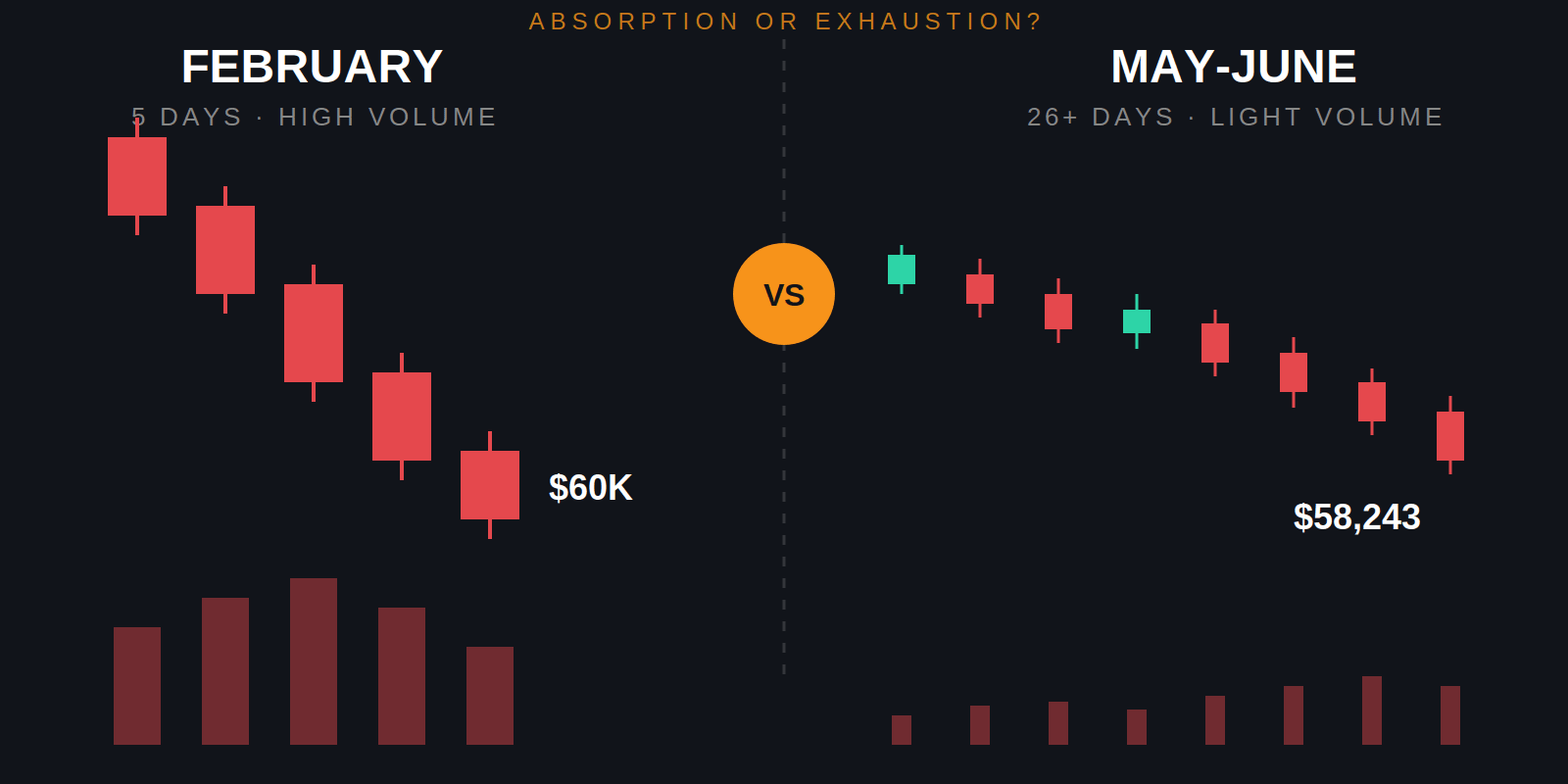
Absorption or Exhaustion: What BTC's Slow Bleed to $58K Is Telling Traders.

By BitBrainers Editorial Bitcoin has now made the trip down to the $60,000 zone twice this year, and the two trips don't look anyth...

Absorption or Exhaustion: What BTC's Slow Bleed to $58K Is Telling Traders.