₿ BTC Loading... via Binance

Monday, April 13, 2026

Understanding Crypto Fees: Gas Fees Network Fees and Exchange Fees

Understanding Crypto Fees: Gas Fees Network Fees and Exchange Fees

Ethereum users paid over $6.8 billion in gas fees in 2021 alone. Not to hackers. Not to scammers. To the network — just for the privilege of moving their own money. And most of those people had no idea how much they were actually paying before they hit confirm.

Fees are the silent tax on every crypto transaction you make. They don't show up in price charts. They don't make headlines. But if you're trading frequently, bridging tokens, or using DeFi without understanding the fee structure, you are absolutely leaving money on the table — sometimes hundreds of dollars on a single trade.

This post breaks down every type of fee you'll encounter in crypto: gas fees, network fees, and exchange fees. Not as a Wikipedia summary, but as a practical guide so you know exactly what you're paying, when you're overpaying, and how to stop.


Network Fees: The Cost of Moving Bitcoin

Start here, because Bitcoin is where fee dynamics matter most.

Every Bitcoin transaction gets broadcast to a global network of miners (and now validators on other chains). These people process your transaction, verify it, and include it in a block. They don't do it for free. They get paid in transaction fees, which you attach to your transaction as an incentive.

Think of it like a cab during rush hour. The cab exists. It can take you where you're going. But if ten other people are also trying to get in that cab, whoever tips the driver more gets the ride first.

Bitcoin blocks have a size limit — roughly 1 megabyte per block, processed roughly every 10 minutes. When demand spikes, transactions stack up in the mempool (memory pool — the waiting room for unconfirmed transactions). You either pay more to jump the queue, or you wait.

Real example: In April 2021, during the peak of that bull run, Bitcoin average transaction fees hit $62.78 per transaction. Someone moving $200 of BTC was paying a 30% fee without realizing it because they didn't check mempool congestion and their wallet auto-set the fee.

Bitcoin fees are measured in satoshis per byte (sat/vbyte). A satoshi is 0.00000001 BTC — the smallest unit. The bigger and more complex your transaction (based on inputs and outputs), the more bytes it takes up, and the more you pay. Tools like mempool.space show you live fee estimates so you're never flying blind.

The lesson: timing and awareness. Send Bitcoin during low congestion — typically late night UTC on weekdays — and you can move thousands of dollars for under a dollar.


Gas Fees: Ethereum's Infamously Broken Pricing System (That Actually Got Fixed)

Gas fees are Ethereum's version of network fees, but with extra complexity because Ethereum doesn't just move money — it runs programs.

Every action on Ethereum — swapping tokens, minting an NFT, depositing into a lending protocol — consumes computational work. Gas is the unit that measures that work. The more complex the operation, the more gas it requires. Sending ETH is simple. Executing a smart contract that touches multiple protocols? That's expensive.

Before August 2021, Ethereum used a pure auction model. You guessed how much to bid. Miners picked the highest bidders. The result was chaos — fees spiking to $200+ for a single Uniswap swap during peak periods.

The EIP-1559 upgrade changed this. It introduced a base fee (burned, not paid to miners) that adjusts algorithmically based on network demand, plus an optional tip for faster inclusion. This made fees more predictable — but not cheap.

Real example: During the Otherside NFT mint by Yuga Labs in May 2022, gas fees temporarily exceeded ETH transaction costs by 5x. Some users paid more in gas than the NFT itself cost. One wallet spent $14,000 in gas fees across multiple failed transactions trying to mint.

That's not a hypothetical. That's what happens when you don't understand gas.

Gas is denominated in Gwei — one Gwei equals 0.000000001 ETH. A typical Ethereum transfer might cost 21,000 gas units. If the base fee is 30 Gwei, that transaction costs 630,000 Gwei, or 0.00063 ETH. At $3,000 ETH, that's about $1.89. At $4,500 ETH, it's $2.84. Gas costs scale with ETH's price, which is a detail most beginners completely miss.

Layer 2 networks like Arbitrum and Base have slashed these costs dramatically — often to fractions of a cent — by batching transactions and settling them on Ethereum in bulk. But that's a separate rabbit hole.


Exchange Fees: Where Most Beginners Bleed the Most

If you're buying crypto through an exchange — which is how most people start — you're paying trading fees every time you buy or sell.

Exchanges typically use one of two models:

Maker-taker fees: You're a "maker" if you add liquidity to the order book (placing a limit order that doesn't fill immediately). You're a "taker" if you remove liquidity (market order that fills instantly). Makers typically pay less. Takers pay more.

Flat fee: A percentage of the transaction regardless of order type. Common on consumer-facing apps.

This is where the difference between platforms gets expensive fast.

Coinbase charges retail users up to 1.99% per transaction on its simple interface. Kraken's standard fees start at 0.26% for takers and 0.16% for makers — and drop further with volume. That's not a small difference. On a $10,000 Bitcoin purchase, Coinbase charges up to $199. Kraken charges $26. On the same asset, same day.

If you're using an exchange regularly, use Kraken. It's one of the most fee-competitive and security-conscious platforms available in the US and internationally. The fee structure is transparent, the trading interface is clean, and it doesn't bury the real costs inside a "simplified" UI designed to obscure what you're actually paying.

Spread is another sneaky fee that doesn't show as a fee. It's the gap between the buy price and the sell price. Some exchanges inflate this spread and pocket the difference. Always check whether you're trading at the actual market price or an inflated quote.


The Contrarian Insight Most Crypto Blogs Won't Tell You

Everyone talks about high fees as a pure negative. Here's what they miss: on Bitcoin, fees are a feature, not a bug.

When the last Bitcoin is mined around 2140, miners will have no block subsidy left. The only thing that keeps Bitcoin's network secure is transaction fees. A Bitcoin that costs nothing to transact is a Bitcoin with no mining incentive, which is a Bitcoin with a potential security crisis.

Consistently high Bitcoin fees — in the right context — mean the network is in demand. They signal that blockspace is valuable. The criticism of Bitcoin fees as "too expensive" ignores that cheap blockspace often means a chain nobody's using.

This isn't an argument to overpay fees carelessly. But the next time someone dismisses Bitcoin because "fees are too high," understand they're looking at a single data point without the full security context behind it.


How to Actually Minimize What You Pay

Be specific with your timing. Check mempool.space before sending Bitcoin. Use limit orders instead of market orders on exchanges to get maker fee rates. On Ethereum, use L2s for anything that isn't a large, infrequent transaction.

Once you've bought and moved your Bitcoin, get it off exchanges. Not eventually — promptly. Exchange fees are one problem. Exchange hacks and insolvencies are a bigger one (FTX, Celsius, Mt. Gox — the list is long). A Trezor hardware wallet puts you in complete control of your Bitcoin. You pay one network fee to move it there, and after that, nobody is charging you custody fees, withdrawal fees, or creating counterparty risk on your stack.


Key Takeaways

  • Bitcoin network fees are dynamic — they rise and fall with mempool congestion. Check before sending; timing saves real money.
  • Gas fees on Ethereum scale with both network demand and ETH's price — two variables, not one.
  • Exchange fees vary enormously — the "simple" interfaces on consumer apps often charge 5–8x more than a direct exchange like Kraken.
  • Spread is a hidden fee — always verify you're getting the actual market rate, not an inflated quote.
  • Getting your Bitcoin off exchanges saves you from more than fees — it eliminates counterparty risk entirely. Hardware wallets like Trezor exist for this reason.

Frequently Asked Questions

Why did my crypto transaction cost more than expected? Two reasons: either network congestion spiked between when you initiated and when you confirmed, or your wallet auto-set a fee based on outdated conditions. Always check current mempool congestion before sending, and use wallets that let you manually set or adjust fees.

What's the cheapest way to buy Bitcoin without getting wrecked by fees? Use an exchange with transparent, volume-tiered fees like Kraken, place limit orders instead of market orders to qualify for maker rates, and avoid consumer-facing "easy buy" interfaces that bury their real fee structure. Recurring buy features on reputable exchanges also tend to use competitive rates.

Do I pay gas fees to store crypto in a hardware wallet? No. Storing is free. You only pay a network fee when you move crypto on-chain — so one fee to transfer your Bitcoin to your Trezor, and one fee when you eventually move it again. After that, your Bitcoin just sits there — secured offline, zero recurring cost.


The One Thing You Must Remember

Fees aren't just inconvenient — they're the difference between a profitable position and a losing one. Know what you're paying, to whom, and why, before every single transaction.


Follow BitBrainers — crypto education without the condescension.

How to Use AI to Find Altcoins Before They Pump

How to Use AI to Find Altcoins Before They Pump

Most AI crypto tools are wrong more than 60% of the time — and the people selling them know it.

That stat comes from a 2023 analysis by Dune Analytics contributors who backtested dozens of "AI-powered signal" bots against actual price action. The results were ugly. The tools that went viral on Twitter? Bottom-tier accuracy. The ones nobody talks about because they're harder to use? Quietly printing.

I've been running automated systems since 2017. I've wasted money on garbage tools, and I've found a small handful that actually give me an edge. This post is about the latter — specifically, how to use AI intelligently to identify altcoins before they move, what the limitations are, and why most people approach this completely backwards.

Let's start with the foundational truth: Bitcoin leads everything. If BTC is in a downtrend or stuck in consolidation, almost no altcoin signal matters. AI tools are not magic — they can't override macro structure. The framework I'm going to give you only works when BTC is in a confirmed uptrend or early accumulation phase. Once that condition is met, then you hunt alts. Not before.


Why Most People Use AI Wrong

The default approach is to throw a token ticker into some ChatGPT wrapper and ask "will this pump?" That's not AI-assisted trading. That's astrology with extra steps.

AI becomes genuinely useful when you use it for pattern recognition at scale — specifically, tasks that would take a human analyst 40 hours per week to do manually. Scanning hundreds of tokens for on-chain anomalies. Parsing sentiment across thousands of social posts. Detecting wallet accumulation patterns before they hit price charts.

According to Messari's 2024 research report, wallets classified as "smart money" (early movers with consistent historical alpha) tend to accumulate a position 14 to 21 days before a token's major price breakout on average. That's the window AI tools are designed to help you find. Most retail traders don't even know that window exists — they see the pump on CoinGecko's trending page and buy the top.

The mistake isn't using AI. The mistake is using AI to confirm your bias instead of using it to surface information you wouldn't otherwise see.


The Three Layers That Actually Work

After years of testing, I've found that real signal comes from combining three distinct AI-assisted data layers. No single one is sufficient. Together, they create a picture that manual analysis would take days to build.

Layer 1: On-Chain Accumulation Detection

This is where I spend the most time, and it's where AI earns its keep.

Tools like Nansen and Arkham Intelligence use machine learning models to label wallet behavior and cluster addresses by historical track record. What you're looking for is a divergence: price is flat or slightly declining, but labeled "smart money" wallets are quietly accumulating. That divergence is your early signal.

In early October 2023, Nansen's smart money tracker showed significant accumulation in $JUP (Jupiter, the Solana DEX aggregator) wallets months before the token launched and immediately jumped over 100% on its airdrop announcement. Traders watching on-chain flows — not Twitter hype — had context that the Solana ecosystem was being quietly positioned by informed capital. That's not hindsight. That's the data being available in real time, just ignored by most people.

I use Nansen's "Smart Money" filter daily. It runs ML classification on millions of wallet addresses and flags unusual behavior. It's not cheap, but it's one of three tools I would not trade without.

Concrete stat: Nansen's own internal analysis shows that tokens flagged by their Smart Money Inflow alerts outperformed the broader altcoin market by an average of 34% over the following 30 days during the 2023 bull cycle. That's not guaranteed alpha, but it's a real edge.

Layer 2: Social Sentiment Analysis (With a Twist)

Everyone talks about sentiment analysis. Most people implement it wrong by tracking volume of mentions. Volume is a lagging indicator — by the time something is trending, you're already late.

What you want instead is velocity of sentiment shift in low-follower communities. That sounds abstract, so here's what it means practically: a token that went from zero mentions to 200 organic mentions in niche Telegram groups and Discord servers over 72 hours is more interesting than one trending on CT with 10,000 posts.

LunarCrush has an AI layer that tracks this kind of momentum shift, specifically the "AltRank" metric, which measures social engagement relative to market cap. Tokens with rising AltRank and flat price are the sweet spot. The AI component scores the sentiment quality — it filters out bot farms and coordinated shilling to a meaningful degree.

I cross-reference LunarCrush signals with actual on-chain data from Nansen. If both agree, I size in. If only social is moving but wallets are quiet, I pass. Coordinated social campaigns without smart money accumulation are almost always exit liquidity setups for insiders.

Concrete stat: LunarCrush data from Q1 2024 shows that tokens ranking in the top 10 of their AltRank improvement metric over a 7-day window saw an average 28% price increase over the following 14 days — compared to 6% for the broader altcoin index during the same period.

Layer 3: AI-Assisted Technical Scanning

I'm not going to tell you that AI-generated chart analysis is groundbreaking — most of it isn't. But running AI-powered screeners to flag specific technical setups across hundreds of tokens simultaneously is genuinely useful.

TradingView's Pine Script combined with Token Metrics' AI screener lets me run multi-condition scans: falling volume plus tight price range plus rising on-chain activity. That combination — compressed price with declining volume and rising chain activity — historically precedes breakouts across multiple market cycles.

The AI element here is speed and scale. I can't manually watch 400 altcoin charts. A script running on TradingView's infrastructure absolutely can.

When a token passes my technical scan AND shows smart money inflows on Nansen AND has rising LunarCrush AltRank, that's a three-layer confirmation. I trade with meaningful size. Those setups are rare — maybe two or three per month — but they convert at a rate I'm comfortable betting on.


The Contrarian Insight Most Crypto Blogs Miss

Everyone talks about finding altcoins before they pump. Nobody talks about filtering out the ones that pump and immediately die.

A pump without accumulation depth is a rug or a coordinated dump. The AI signal you actually want is not just "price is about to move up" — it's "price is about to move up AND there's holder distribution that suggests sustainability."

Nansen's "Smart Money Outflow" alert is actually more valuable than the inflow alert in certain contexts. When smart money starts leaving a token that's still in price discovery, that's your exit signal — often weeks before price reflects it. Most traders are so focused on entries they never build an AI-assisted exit framework. That's where real money is lost.

I learned this the hard way in 2021 with a Solana ecosystem token that hit every early signal perfectly and then lost 80% in three weeks because I ignored the on-chain outflow data that was clear as day two weeks before the collapse. The AI was right. I didn't listen.


Execution: Where You Trade Matters

Finding the signal is step one. Executing quickly and reliably is step two, and it's where a lot of people lose their edge.

I use Kraken for execution on my larger positions. The API stability is better than most major exchanges I've tested, which matters when you're running bots that need consistent uptime and fast fill confirmation. Their fee structure at volume tiers is competitive, and their altcoin listings — while more conservative than Binance — tend to list projects that have already cleared a real vetting process. For AI-assisted trading, you want reliability in execution, not just a long token list.

For anything I'm holding longer than a week, it goes off-exchange immediately. I keep significant positions in cold storage on a Trezor. AI tools can find great entries, but no algorithm protects you from an exchange insolvency event. FTX proved that permanently.


Key Takeaways

  • BTC structure comes first. No altcoin AI signal is worth acting on during a BTC downtrend. Confirm macro before running any of these tools.
  • On-chain is your foundation. Nansen's smart money tracking is the single highest-signal layer I've found. Social and technical scanning are supporting evidence, not primary.
  • Velocity beats volume in social data. Rising AltRank in niche communities before a token trends publicly is the signal. Trending tokens are almost always already priced in.
  • Build an AI-assisted exit framework. Smart money outflow alerts are as valuable as entry signals — more so, because most people skip this entirely.
  • Three-layer confirmation before sizing. On-chain accumulation + social momentum + technical compression is the setup. Two out of three gets a small position. All three gets a real one.

Frequently Asked Questions

Can I use free AI tools to find altcoins before they pump? Free tiers of LunarCrush and limited Nansen access give you partial signal, but the most valuable filters — smart money wallet labels and deep social analytics — are behind paid tiers. Start with free tools to learn the framework, then upgrade once you're generating consistent returns that justify the cost.

How far in advance can AI tools actually predict a pump? "Predict" is the wrong word — these tools surface probabilistic signals, not certainties. Smart money accumulation patterns typically appear 14 to 21 days before a major price move based on historical data. That's the realistic window you're working with, not hours, and not three months.

Is it legal to trade based on on-chain wallet tracking data? Yes. On-chain data is public by design — it's the entire point of a transparent blockchain. Tracking and analyzing public wallet behavior is completely legal and is standard practice among professional crypto traders and institutional desks. It is not insider trading in the legal sense.


Start Here

If you're going to try one thing from this post, set up a free Nansen account and spend one week doing nothing but watching the Smart Money Inflow dashboard without trading. Just observe. Learn which wallet types move before price moves. Build the pattern recognition manually before you automate anything.

Most people skip straight to "run the bot." The traders who print money understand why the signals work before they deploy capital on them. One week of observation will teach you more than six months of blindly following alerts.

When you're ready to execute, get your account set up on Kraken so you're not scrambling to onboard when a signal fires. And make sure anything you hold longer-term is secured on a Trezor — no AI tool is worth anything if the exchange holding your funds goes under.

The edge is real. It's just not where most people are looking.


Follow BitBrainers — we only write about tools we would actually use ourselves.

Crypto Cashback Cards: Are They Actually Worth It

Crypto Cashback Cards: Are They Actually Worth It

Most people chasing passive crypto income are grinding for scraps while the house takes the real margin. The average crypto cashback card returns between 1% and 5% in rewards — but the spread on the crypto conversions happening behind the scenes quietly eats 1% to 3% of every transaction. Do the math. You are sometimes breaking even. Sometimes losing.

I have carried three different crypto cashback cards over the past few years. I earned rewards on all of them. I lost money on one of them without realizing it for six months. That experience is what this article is about.

Crypto cashback cards are not a scam. But they are also not the passive income goldmine that card issuers want you to believe. Here is the actual breakdown — what works, what does not, and how to use these cards without getting quietly fleeced.


What Crypto Cashback Cards Actually Are (And How They Make Money Off You)

A crypto cashback card works like a standard Visa or Mastercard debit or credit card. You spend money, and instead of earning airline miles or hotel points, you earn a percentage back in cryptocurrency — usually Bitcoin, but sometimes platform tokens or stablecoins.

The mechanics sound simple. The business model behind them is less simple.

Card issuers typically make money in two places: the interchange fee from the merchant (standard for all cards, usually 1.5% to 3%) and the conversion spread when they purchase crypto to fund your rewards. That conversion spread is where users consistently get undercut. A company buying BTC at market price to credit your account is not doing it out of generosity — they are pricing that cost into the card's terms, staking requirements, or withdrawal minimums.

According to a 2023 report from Bankrate, the average cashback credit card in the US returns 1.67% on general purchases. The top crypto cashback cards advertise rates of 2% to 8% in BTC — but those headline rates almost always require you to hold or stake a specific platform token to unlock them. If that token drops 40% (and altcoin platform tokens have a habit of doing exactly that), your "8% cashback" just became effectively negative.


The Real-World Case Study: Crypto.com Visa Card

Crypto.com's Visa card is the most widely used crypto cashback card in the world and the most instructive example of how these products work in practice.

The card tiers range from "Midnight Blue" with 1% BTC cashback and no staking requirement, all the way to "Obsidian" with 8% cashback in CRO (their platform token) and a $400,000 CRO stake requirement.

In 2021, a user I know personally staked $4,000 worth of CRO to unlock the "Ruby Steel" card tier offering 2% cashback. Over 12 months, he spent roughly $24,000 on the card — groceries, subscriptions, travel — and earned approximately $480 in CRO rewards.

But CRO dropped roughly 85% from its November 2021 peak. His $4,000 staking position was worth around $600 by early 2023. His $480 in CRO rewards shrank proportionally. The cashback itself became worthless because the underlying asset collapsed.

The lesson is not that the card is a scam. The lesson is that cashback denominated in a volatile platform token is not equivalent to cashback denominated in Bitcoin. When your rewards are paid in CRO, NEXO, or any other issuer token, you are not earning passive income — you are taking a leveraged position on that altcoin every time you buy groceries.

If you are going to use a crypto cashback card, you want rewards in BTC, full stop. Bitcoin is the only asset in this space with enough track record, liquidity, and institutional backing to make reward accumulation meaningful over time.


The Contrarian Insight Most Crypto Blogs Miss

Everyone compares crypto cashback cards to each other. Almost nobody compares them to the alternative: a 2% flat cashback card that pays in USD, combined with a manual BTC purchase on a reputable low-fee exchange.

Here is the math. A standard 2% USD cashback card on $30,000 in annual spending returns $600 in cash. You take that $600 and buy BTC on Kraken — one of the lowest-fee major exchanges available, with maker fees starting at 0.16%. You are paying about $1 in fees on a $600 purchase. You now hold $599 in BTC.

Compare that to a crypto cashback card offering 2% in BTC with no staking requirement, on the same $30,000 in spending. On paper, identical. In practice, the cashback card company is buying that BTC through their own OTC or exchange desk, taking a spread, and crediting you after the fact. You have no control over when the BTC was purchased, at what price, or whether that price reflects actual market rate.

The manual method gives you full control over your BTC purchase timing, exchange, and custody. It is not as convenient. But for serious BTC accumulators, convenience is not the priority — stack size is.


How to Actually Start: Step-by-Step

If you have done the math and a crypto cashback card still makes sense for your lifestyle, here is how to approach it without getting burned.

Step 1: Decide what reward currency you will accept. Only consider cards that pay rewards in BTC or USDC. Avoid cards where the headline rate is in a platform token unless you are independently bullish on that specific token and understand you are making an investment decision, not earning passive income.

Step 2: Identify the staking requirement and calculate your true ROI. If unlocking 2% cashback requires you to lock $500 in a platform token for 180 days, calculate the opportunity cost. That $500 locked in a depreciating token is not free. It is capital that could be in BTC.

Step 3: Check the withdrawal and conversion terms. Some cards let you withdraw BTC to an external wallet immediately. Others make you cash out to fiat first or hold rewards in a custodial account. You want direct BTC withdrawal capability. The moment your BTC sits in a company's custodial account long-term, you are exposed to counterparty risk — see: BlockFi, Celsius, Voyager.

Step 4: Move your BTC rewards off the card platform regularly. This is non-negotiable. When your rewards accumulate to a meaningful amount, withdraw them to cold storage. A Trezor hardware wallet is the correct answer here. Not your phone wallet, not an exchange account — a hardware wallet where you control the keys. Crypto cashback becomes meaningless if the card issuer goes under and takes your reward balance with them.

Step 5: Track your actual reward yield quarterly. Build a simple spreadsheet. Log every month's total spending, rewards earned, and the USD value of those rewards at the time of receipt. At the end of each quarter, check whether the card is actually outperforming your next-best alternative. If it is not, switch.

Step 6: Combine with a low-fee exchange for larger BTC purchases. Use the cashback card for everyday spending and build your real BTC position through regular purchases on Kraken. The cashback is supplemental. It is not your primary accumulation strategy and should never be treated as one.


The Cards Worth Looking At (Without Overhyping Them)

The Fold Card pays BTC cashback on every purchase with no staking requirement and a straightforward spin-the-wheel rewards mechanic. The base rate is low but the structure is honest. For users who want BTC rewards without locking up altcoins, it is one of the cleaner options on the market.

The Crypto.com Midnight Blue tier (zero stake required, 1% in CRO) is fine if you immediately swap CRO for BTC upon receipt, but that requires active management that most people will not do.

BlockFi's card no longer exists as a cautionary tale worth remembering — 2.5% BTC cashback, genuinely good product, company went bankrupt. Any rewards sitting in custodial accounts vanished for users who had not withdrawn. Custody matters. It always matters.


Key Takeaways

  • Crypto cashback cards are only worth it if the rewards are paid in BTC or a stablecoin — platform tokens are altcoin bets disguised as passive income.
  • Always calculate your true ROI after accounting for staking requirements, conversion spreads, and opportunity cost of locked capital.
  • The best crypto cashback card cannot beat a disciplined BTC stacking strategy using a low-fee exchange like Kraken combined with a standard USD cashback card.
  • Never leave reward balances sitting in a card issuer's custodial account. Withdraw to a Trezor hardware wallet regularly. BlockFi users learned this the hard way.
  • Treat cashback rewards as supplemental BTC accumulation — not a primary income stream, not a retirement plan.

Frequently Asked Questions

Is crypto cashback taxable? In most jurisdictions, yes. In the US, the IRS treats crypto rewards earned through spending as ordinary income at the fair market value when received. This is the same treatment as cash back in most interpretations, except you also face a capital gains event when you eventually sell or spend the crypto. Track every reward receipt with a timestamp and USD value.

Which crypto cashback card gives the most Bitcoin back? The honest answer changes frequently as issuers adjust terms. Rather than chasing the highest headline rate, prioritize cards with no staking requirement, BTC-denominated rewards, and the ability to withdraw directly to a self-custody wallet. A lower rate on honest terms beats a higher rate tied to a platform token that can lose 80% of its value.

Can I use a crypto cashback card as my main BTC accumulation strategy? Not really. Even if you spend $50,000 a year and earn 2% back in BTC, that is $1,000 in BTC annually. Meaningful, but limited by your spending capacity. A proper DCA strategy through a low-fee exchange like Kraken lets you compound your BTC position independent of what you happen to spend on groceries and subscriptions.


Realistic Expectations

Crypto cashback cards are a legitimate tool for accumulating small amounts of BTC through spending you were going to do anyway. At best, they are a low-effort BTC stacking supplement. At worst, they are a mechanism for locking your capital into a depreciating platform token while you think you are earning passive income.

If you want to use one correctly: pick BTC rewards, skip the staking tiers, withdraw frequently, and never treat the rewards as anything more than a minor bonus on top of a real BTC investment strategy.

Your first action step: Before applying for any crypto cashback card, open a spreadsheet and calculate what 1.5% and 2% of your average monthly spending actually looks like in dollar terms. If the number is below $30 per month, your time is better spent setting up a $50/week BTC DCA on Kraken and forgetting the card entirely.


Follow BitBrainers — passive income strategies from someone who has lost money so you do not have to.

Automating Your Crypto Portfolio Rebalancing With AI

Automating Your Crypto Portfolio Rebalancing With AI

Most AI-powered crypto tools are glorified dashboards with a chatbot slapped on top. That's not an opinion — a 2023 study by the CFA Institute found that over 70% of retail algorithmic trading tools underperform simple buy-and-hold strategies over a 12-month period. Yet the marketing machine keeps churning out "AI-powered portfolio management" tools like they're printing money. Some of them are. For themselves.

I've been running bots since 2017. I've blown up accounts testing garbage tools so you don't have to. And I've also found a handful of approaches that genuinely move the needle — especially when it comes to portfolio rebalancing. This post is about the real mechanics of automating that process with AI, where the actual edge lives, and what you should do first if you're serious about it.


What Portfolio Rebalancing Actually Means in Crypto (Not the Textbook Version)

In traditional finance, rebalancing means selling your winners and buying your losers on a calendar schedule — quarterly, annually — to return to your target allocation. In crypto, that logic breaks down almost immediately.

Bitcoin is the anchor. Full stop. If you're not building your portfolio allocation model around BTC as the primary reserve asset, you're doing it wrong. ETH, SOL, and everything else are satellite positions — higher beta, higher risk, potentially higher reward, but they live in BTC's gravitational field. When BTC drops 20%, alts typically drop 40-60%. Your rebalancing strategy has to account for that asymmetry.

The problem with manual rebalancing in crypto is threefold:

First, the market never sleeps. A 15% swing at 3am on a Tuesday is completely normal. If you're rebalancing manually, you're either glued to your screen or you're always late.

Second, tax drag is brutal. Every time you sell a position to rebalance, that's a taxable event in most jurisdictions. Automated systems can be designed to minimize unnecessary churn in ways that humans, operating emotionally, rarely execute consistently.

Third, emotional bias kills returns. Humans let winners ride too long and dump losers too fast. Automation doesn't have feelings about that 3x alt it's been holding for eight months.

According to a Vanguard study applied to crypto portfolios by Bitwise Asset Management, disciplined rebalancing — even simple threshold-based rebalancing — can add 0.5% to 1.5% annually in risk-adjusted returns versus drifting allocations. That sounds small until you compound it over four years across a bull-bear cycle.


The Three Rebalancing Approaches: Only One Uses AI Properly

Let me break down what's actually available and what's worth your time.

Calendar Rebalancing (Don't Bother Automating This)

Rebalancing monthly or quarterly regardless of market conditions is the worst approach in crypto. You'll be selling BTC to buy alts right before an alt bleed, or panic-buying Bitcoin at local tops because your calendar said so. The only automation this requires is a reminder app, and it still performs badly.

Threshold Rebalancing (Where Automation Earns Its Keep)

This is the real baseline. You set target allocations — say 60% BTC, 25% ETH, 15% alts — and the system automatically triggers a rebalance when any position drifts beyond a defined threshold, typically 5% or 10%.

Tools like Shrimpy, 3Commas, and Pionex execute threshold rebalancing reliably. These aren't AI tools. They're rule-based automation. But they work. Don't confuse them with AI just because they have a slick interface.

If you're running these on an exchange like Kraken, you get excellent API reliability, institutional-grade liquidity, and tight spreads on BTC/ETH pairs — which matters when your bot is executing multiple small trades to rebalance. Slippage on a smaller exchange will quietly eat your rebalancing gains. I've run bots on five different exchanges. Kraken's API uptime and execution quality are consistently top-tier.

Adaptive AI Rebalancing (Where It Gets Interesting — And Complicated)

This is where actual machine learning enters the picture. Adaptive rebalancing uses AI models — typically reinforcement learning or time-series forecasting — to dynamically adjust target allocations based on market conditions rather than fixed percentages.

In practice, this means the system might increase your BTC allocation when on-chain signals show accumulation patterns and decrease alt exposure when funding rates spike. It's not predicting the future. It's pattern-matching on historical data to inform probabilistic allocation decisions.

This is where I run my own live systems. I use a combination of custom Python scripts that pull on-chain data (Glassnode API), sentiment signals (Santiment), and technical indicators to weight my BTC position more heavily during bear conditions and systematically rotate into higher-beta assets as momentum builds. The system rebalances dynamically, not on a schedule.

Does it always beat buy-and-hold BTC? No. But it significantly reduces drawdowns during alt bloodbaths, which matters more to me than marginal upside capture.


A Real Case Study: What Happened in Q4 2022

I'm going to get specific here because vague case studies are useless.

In Q4 2022, as the FTX collapse was unfolding, my automated threshold rebalancer was set to a 10% drift tolerance. When ETH dropped faster than BTC in the initial panic, the bot started buying ETH and selling BTC to rebalance — exactly the wrong move during a contagion event.

That experience forced me to build a sentiment override layer. Now, when extreme fear conditions are detected (using the Crypto Fear & Greed Index API combined with exchange inflow data), the system pauses rebalancing and holds positions. The AI component isn't trading — it's deciding when not to trade.

That lesson cost me about 8% in portfolio value before I corrected it. The fix added maybe two weeks of development time and has saved multiples of that since.

The takeaway: Automation without intelligent overrides is dangerous. The AI layer isn't there to trade for you — it's there to prevent you from making rules-based decisions during conditions the rules weren't designed for.


The Contrarian Insight Nobody Talks About

Here's what most crypto blogs completely miss: rebalancing too frequently in a trending market actively destroys returns.

Everyone focuses on the benefit of rebalancing — capturing gains, reducing risk. Almost nobody talks about the cost of rebalancing during a BTC bull run. If BTC is in a sustained uptrend and your system is automatically trimming it every time it exceeds your 60% target, you're systematically selling your best-performing asset to buy underperforming ones.

The research backs this up. A 2021 paper from the Journal of Financial Economics on momentum and rebalancing found that in trending markets, drift portfolios (those that don't rebalance) outperform rebalanced portfolios by an average of 2-4% annually.

The smarter approach — and what my current AI layer handles — is a regime detection model. When the system identifies a trending regime (based on moving average slopes, volume profiles, and on-chain accumulation scores), it widens the rebalancing thresholds significantly. During choppy or ranging markets, it tightens them. You're not applying one ruleset to all market conditions. You're letting the AI decide which ruleset applies.

This is the actual edge. Not some magic algorithm that predicts prices.


Keeping Your Stack Secure While You Automate

One more thing people skip over: your hot wallet exposure increases dramatically when you're running bots. Your exchange API keys are connected 24/7, and your funds have to be liquid to rebalance.

The way I handle this is a clear split: trading capital stays on Kraken for execution, but my long-term BTC stack — the core position I'm not actively trading — lives on a Trezor hardware wallet, completely offline. The rebalancing bot never touches it.

If your entire stack is on exchange to enable automation, you've built a system where one API breach or exchange insolvency event wipes out everything. Keep your reserve BTC cold. Trade with a defined percentage only. This isn't optional risk management — it's the foundation everything else sits on.


Key Takeaways

  • Threshold rebalancing beats calendar rebalancing in crypto — automation shines when it's triggered by drift, not time.
  • The real AI edge isn't prediction — it's regime detection. Knowing when to rebalance is more valuable than knowing how to rebalance.
  • Over-rebalancing in a trending BTC market destroys returns. Build in adaptive thresholds or you're fighting the trend with your own system.
  • Sentiment overrides are non-negotiable. During extreme fear events like exchange collapses, pure rule-based systems make mechanically correct but contextually disastrous decisions.
  • Never automate your entire stack. Keep your core BTC position on a Trezor and only run bots on capital you've defined as trading capital.

Frequently Asked Questions

Is AI rebalancing actually better than just holding Bitcoin? Over a full bull-bear cycle, well-implemented adaptive rebalancing typically reduces maximum drawdown by 15-25% compared to pure BTC hold — though it may underperform in the final stages of a bull market. The real advantage isn't raw returns; it's a smoother equity curve that keeps you from panic-selling at the worst moment.

What's the minimum portfolio size to make automated rebalancing worth it? Transaction fees and API overhead make frequent rebalancing mathematically pointless under about $5,000-$10,000. Below that threshold, threshold rebalancing with wider bands (15-20% drift) or a simple quarterly manual rebalance will serve you better. Automation has fixed costs — make sure your portfolio is large enough to absorb them.

Do I need to know how to code to automate my portfolio rebalancing? Not necessarily. Tools like Shrimpy and 3Commas offer no-code threshold rebalancing connected to exchanges like Kraken via API. True adaptive AI rebalancing with custom signals does require Python knowledge or hiring someone who has it — but most retail investors will get 80% of the benefit from well-configured threshold rules alone.


Start Here

If you're new to this, skip the fancy AI tools for now. Set up a Shrimpy account, connect it to your Kraken account via API, and run a simple 60% BTC / 40% ETH threshold rebalancer with a 10% drift trigger for 90 days. Watch it. Study what it does and when. Then start asking whether the decisions it's making actually make sense in context.

That experience will teach you more about AI-assisted rebalancing than six months of reading about it — because you'll start to notice exactly where the rules break down and where intelligence needs to replace automation.

That's when the real building starts.


Follow BitBrainers — we only write about tools we would actually use ourselves.

What Is Market Cap in Crypto and Why It Matters

What Is Market Cap in Crypto and Why It Matters

A coin trading at $0.001 made more people millionaires in 2021 than Bitcoin did. Not because it was a better investment — but because most people had no idea how to read market cap. They saw a low price and thought they found the next BTC. They hadn't. They'd found a trap.

Market cap is the single most misunderstood metric in crypto. It separates rational investors from people who get wrecked chasing cheap tokens. If you're going to put real money into this space, you need to understand it cold.


Price Means Almost Nothing on Its Own

Here's the mistake everyone makes at least once.

They see Bitcoin at $90,000+ and think it's "too expensive." Then they see some altcoin at $0.003 and think "this is cheap, I can get in early." They buy the cheap coin expecting it to do a 10,000x to Bitcoin's level.

That logic is completely broken.

Price per coin is meaningless without context. A coin priced at $0.001 with 100 trillion tokens in circulation is not cheap. It might already be overvalued. A coin at $50,000 per unit with only 21 million ever in existence might be one of the most rational buys in financial history.

The number that actually tells you the size of a project? Market capitalization.


What Market Cap Actually Is

Market cap is simple math.

Market Cap = Current Price × Circulating Supply

Bitcoin's circulating supply as of early 2025 sits at roughly 19.8 million BTC. Multiply that by the price at any given moment, and you get the total market value of all Bitcoin in existence. At $90,000 per coin, that puts Bitcoin's market cap around $1.78 trillion.

That number puts Bitcoin in the same conversation as the largest companies on earth. Apple, Microsoft, Saudi Aramco. That's not hype — that's what the market has collectively decided Bitcoin is worth.

Ethereum, for comparison, has a market cap that typically sits in the $300–$500 billion range. The entire crypto market has floated between $2 trillion and $3 trillion at peak periods. Bitcoin alone regularly accounts for 50–60% of that — a dominance metric worth tracking.

Circulating supply matters here. That's the number of coins actually available and trading in the market right now — not the total that will ever exist, not the ones locked in team wallets or vesting schedules. When someone throws around "total supply" or "max supply," those are different numbers and they affect valuation differently.


Why Market Cap Tells You What Price Can't

Let's use a real example from the 2021 bull cycle.

Shiba Inu (SHIB) hit a price of $0.00008845 at its peak. Reddit forums were full of posts asking if SHIB could reach $1. The logic was: it's at $0.00008, so a dollar is a 10,000x return.

What those posts ignored: SHIB had a circulating supply of nearly 550 trillion tokens at the time.

For SHIB to reach $1 per token, its market cap would need to be $550 trillion. The entire global GDP is roughly $100 trillion. The entire global stock market is around $100–120 trillion. SHIB at $1 would require a market cap five times the size of every stock on earth combined.

That's not a moonshot. That's mathematical impossibility.

Bitcoin reaching $500,000? That puts its market cap at roughly $9.9 trillion — aggressive, but within the realm of discussion given gold's market cap sits around $16 trillion. The comparison is at least coherent.

Market cap gives you the frame to assess whether a price target is ambitious or delusional.


The Three Market Cap Tiers and How to Think About Them

Not all crypto market caps are created equal. The industry loosely splits them into tiers, and each tier carries a different risk/reward profile.

Large Cap (Bitcoin, Ethereum — typically $10B+)

Bitcoin is the benchmark. At nearly $1.8 trillion market cap, it's the most liquid, most institutionally held, and most resistant to manipulation of any crypto asset. You won't get a 1000x from Bitcoin — but you also won't wake up to a 90% rug pull because some anonymous dev sold their allocation.

Ethereum sits in large-cap too. Different technology, different use case, but the same principle: high liquidity, high visibility, slower percentage gains.

Mid Cap ($1B–$10B)

This is where the risk starts climbing. Projects here have proven some level of traction but are still small enough that a single whale or a bad news cycle can move the price 30% in a day. Volatility is higher, potential upside is higher, and so is the chance of getting caught holding something that fades into irrelevance.

Small and Micro Cap (Under $1B)

High risk, high reward, and full of landmines. The 100x opportunities live here. So do the projects that disappear six months after launch. If you're going into small caps without understanding tokenomics, vesting schedules, and the team behind the project, you're gambling — not investing.

Bitcoin is still the anchor. A healthy market sees Bitcoin lead, and altcoins follow. When Bitcoin dominance drops hard and altcoin market caps spike, that's historically a late-cycle signal — not a reason to go all-in on micro caps.


The Contrarian Take Nobody Talks About: Market Cap Can Be Gamed

Every other crypto blog will tell you to "always check market cap before investing." Good advice. But here's what they won't tell you.

Market cap is gameable, and projects do it deliberately.

Here's how it works. A project launches 1 billion tokens but only releases 1 million into circulation. They do one trade at $10 per token. Technically, their market cap is now $10 billion — which makes them look like a serious top-20 project. But 99.9% of the supply is sitting with insiders, waiting to be dumped.

This is the difference between circulating supply market cap (what CoinGecko and CoinMarketCap usually show) and fully diluted valuation (FDV).

FDV = Current Price × Maximum Total Supply

When you see a project with a $500 million market cap but a $20 billion FDV, that gap is not just a number. That's the amount of sell pressure that can enter the market as tokens unlock. Projects with a massive FDV relative to their circulating market cap are structurally bearish — the early investors and team will eventually sell into you.

Bitcoin has no FDV trap. Its max supply is 21 million. Every coin is accounted for. You know exactly what you're dealing with. That's one of the underappreciated reasons institutional money keeps flowing into BTC over other assets.

When you're ready to actually buy, use a platform that gives you full visibility on order books and pricing. Kraken is where I trade — low fees, serious security, and they've been around since 2011. No sketchy offshore nonsense.


A Real Case Study: How Market Cap Context Would Have Saved You in 2021

Solana launched in 2020. By November 2021 it hit $259 per SOL. A lot of people looked at that price and thought it was "too high" to buy.

At the same time, there were dozens of Solana ecosystem tokens priced at fractions of a cent. Those looked "cheap."

SOL's market cap at its peak was around $75 billion — large, but still roughly 5% of Bitcoin's market cap at the same time. It had real on-chain activity, real developer adoption, and a genuine use case.

The cheap ecosystem tokens? Most of them had circulating supply market caps under $100 million — but their FDVs were in the billions. When the bear market hit in 2022, many of those tokens dropped 95–99%. The ones with tiny floats and massive FDVs got obliterated first and hardest as team tokens unlocked.

SOL itself dropped hard too — from $259 to under $10. But it came back. By early 2024 it was trading above $200 again. Projects with real market cap and real utility tend to survive bear markets. Micro-cap tokens with inflated FDVs mostly don't.


Key Takeaways

  • Market cap = price × circulating supply. Price alone tells you nothing about a coin's actual size or value.
  • Low price ≠ cheap. A token at $0.0001 with trillions in supply may already be more expensive relative to fundamentals than Bitcoin at $90,000.
  • Always check FDV alongside market cap. A huge gap between the two means massive potential sell pressure from insiders and early investors.
  • Bitcoin's fixed 21 million supply makes its market cap uniquely honest. No hidden dilution, no surprise unlocks, no team allocation time bombs.
  • Market cap tiers carry different risk profiles. Large cap gives you stability and liquidity. Small cap gives you volatility and landmines. Know which game you're playing.

Frequently Asked Questions

What's the difference between market cap and volume? Market cap is the total value of all circulating coins at the current price — it's a snapshot of size. Volume is how much of a coin traded in the last 24 hours — it's a measure of activity and liquidity. A high market cap with low volume can mean a coin is illiquid and hard to exit without moving the price.

Does a higher market cap mean a safer investment? Generally, yes — higher market cap means more liquidity and more resistance to manipulation. Bitcoin's ~$1.8 trillion market cap makes it nearly impossible for any single actor to crash the price with one trade. A $5 million market cap token can be wrecked by a single whale. Safer is relative in crypto, but market cap is one of the better proxies for stability.

Where can I check a coin's market cap and circulating supply? CoinGecko and CoinMarketCap are the two most-used tools. CoinGecko tends to be more thorough on FDV data. Always check both circulating supply market cap and fully diluted valuation before making any buy decision — especially on anything outside the top 20.


The One Thing You Must Remember

Market cap is the real price. The number next to the coin symbol is just a fraction of it. Before you buy anything, ask what you'd have to believe about the total market cap for your price target to be real — then decide if that belief is rational or delusional.

If you're getting into the market and need a trustworthy platform to start, Kraken is worth bookmarking. And once you've got something worth protecting, store it somewhere serious — Trezor is the hardware wallet that's been around long enough to have earned its reputation.


Follow BitBrainers — crypto education without the condescension.

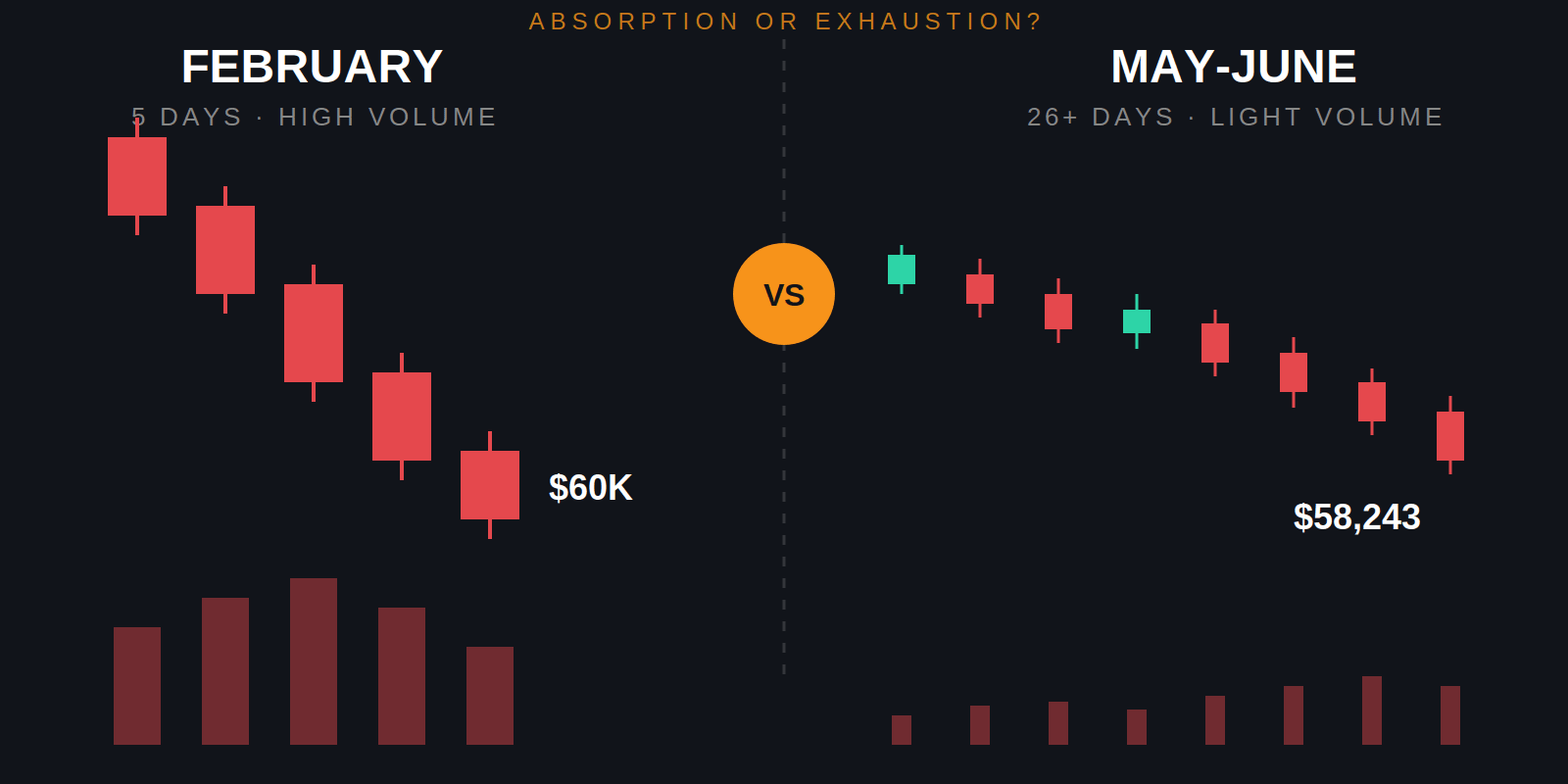
Absorption or Exhaustion: What BTC's Slow Bleed to $58K Is Telling Traders.

By BitBrainers Editorial Bitcoin has now made the trip down to the $60,000 zone twice this year, and the two trips don't look anyth...

Absorption or Exhaustion: What BTC's Slow Bleed to $58K Is Telling Traders.