₿ BTC Loading... via Binance

Sunday, June 21, 2026

Bot Signal Watch #4: I Put My Own Bot on Trial. It Lost.

In the last Bot Signal Watch, the bot almost won and I refused to call it one. A long that came a few dollars short of its target, reported as still open, because "almost" is not a fill. A few people told me I was being too hard on it.

This one is harder than that. I stopped watching individual signals and put the whole strategy on trial. The verdict is in, and it's not the one I was hoping for.

The question I should have asked sooner

Every Bot Signal Watch so far has tracked what the bot did this week. Won here, lost there, sat on its hands. That's fine for a diary, but it never answered the real question: does the strategy actually have an edge, or have I been narrating a coin flip?

There is a proper way to answer that, and it isn't "look at this month's trades." It's a walk-forward test. You take years of price data, split it in two, let the strategy pick its best settings on the first half, then run those exact settings on the second half it has never seen. If the edge is real, it survives on the unseen data. If it was just fitted to the past, it falls apart. And you apply real fees and slippage to every trade, because a strategy that's profitable before costs and negative after costs is just a donation to the exchange.

Ten tests, one answer

I ran the bot's EMA cross logic this way across Bitcoin and Ethereum, on three timeframes. Then I tested the opposite idea, mean reversion, the same way. Ten tests in total. Here is the part that matters, the out-of-sample result, the half the strategy never got to practice on:

Test Out-of-sample return Verdict
EMA cross, BTC 15m (the live bot)-52%Fails
EMA cross, BTC 4h-2.6%Fails
EMA cross, ETH 15m-27%Fails
Mean reversion, BTC (all timeframes)-14% to -77%Fails
Mean reversion, ETH 15m / 1h-63% to -79%Fails
One outlier (ETH 4h, both strategies)positiveToo few trades to trust

No version of the live bot's strategy survives. Not the 15-minute cross it actually runs, not a slower 4-hour version, not on Bitcoin, not on Ethereum. The single positive cell came from one corner of the data with so few trades that it tells you nothing, and I'll come back to why that one is a trap, not a discovery.

Why it loses, in plain terms

The cross strategy dies from a thousand small cuts. On 15 minutes, price chops back and forth across the moving averages constantly. The bot catches the occasional big move, those trades are real winners, but in between it gets whipsawed into dozens of tiny losses. The few wins can't outrun the steady bleed, and the fees finish the job.

Moving to a 4-hour chart fixes the chop, and for a moment it looked promising. But once the whipsaw was gone, what was left underneath was just a coin flip. Roughly equal wins and losses, and every flip costs you the spread. A coin flip that charges admission is not a strategy.

Mean reversion, betting that price snaps back to its average, was supposed to feed on exactly that chop. It didn't. It bleeds a different way: it wins small and often, then a real trend rips straight through the band and the stop-loss takes one brutal loss that erases a week of small wins. During the big moves of the last two years, price kept trending instead of reverting, and the strategy paid for it.

The trap I didn't fall into

One result came back glowing. Ethereum on the 4-hour chart showed a strong positive return and a high win rate, on both strategies. It would have been easy to point at that and say I'd found something.

It was built on fewer than forty trades. That is not enough to separate skill from luck. And here is the tell: it was the only positive cell across all ten tests, and it lit up for two completely different strategies in the same spot. When two opposite approaches both look good in the exact same corner of the data and nowhere else, that corner is a quirk of one period, not an edge. You need hundreds of trades before a number like that means anything. I have a few dozen. So I'm filing it as noise, which is what it is.

What I'm actually telling you

The bot does not have an edge. I tested it more honestly than most people ever test the systems they sell you, and the honest answer is no. That's the whole reason this series exists, to show the part nobody screenshots.

This isn't a sad ending. The point of running it as paper, in public, with nothing real on the line, was to find this out before it cost anything. It did its job. The infrastructure stays, the testing discipline stays, and the next thing I try will go through the exact same gauntlet before it earns a single dollar of risk.

If anyone ever shows you a bot with a perfect record and no losing weeks, ask them for the out-of-sample test with fees included. The silence that follows is the most honest data point you'll get.

Nothing here is financial advice. It's a record of testing a strategy and finding it wanting. Do your own research.

By BitBrainers Editorial
A Betting Line Is Not a Headline: Prediction Markets

BitBrainers - A Betting Line Is Not a Headline

Kraken added them. Binance added them. Arkham added them. In a matter of months, prediction markets went from a Polymarket-and-Kalshi curiosity to a feature nearly everyone in crypto suddenly wants in their product. And the financial press now quotes them the way it used to quote economists.

That second part is the problem.

When a market reads "63 percent chance Bitcoin hits 50k first," that number is a wager. People put money behind a guess. But by the time it reaches your feed, an account has screenshotted it, stripped the context, and posted it as if a crowd of bettors uncovered a fact. The wager becomes a forecast. The forecast becomes a headline. The headline quietly shapes what you believe the market already knows. None of it was knowledge. It was odds dressed for the evening news.

The Double Standard Nobody Says Out Loud

Here is the part worth sitting with. Crypto spent years being told to wait in the corner. Age gates, risk disclosures, restricted access, regulators warning retail away at every turn. Buy Bitcoin and you get a lecture about volatility.

Bet on Bitcoin's price on a prediction market and you get the lighter 18-plus finance treatment, aggressive expansion across every major venue, and a free pass into the news cycle.

The reason comes down to one word: classification. Prediction markets are regulated as derivatives, which means finance, which means the gentler rulebook and the lower age line. A sportsbook taking the same kind of bet on a game is gambling, which in many places means 21-plus and a heavier hand. Same act, betting on an outcome. Different label. The label decides the rules.

Age Limits Were Never the Real Safeguard

The usual defense is that protections exist, that there is an age limit. An 18 limit gets crossed the same way a 21 limit gets crossed. That was never where the safety lived.

The real question is not who is technically allowed to click the button. It is why these venues get to manufacture public opinion at all, while the asset they are wagering on stays under restriction and suspicion. One side of this gets to set the narrative. The other side gets policed for participating in it.

What This Actually Is

Prediction markets are not useless. At their best they aggregate information better than pundits, because money tends to be more honest than talk. The issue is not that a probability exists. The issue is the laundering. The moment a bet gets dressed up as analysis and pushed into your feed as if a crowd settled a question it only gambled on.

So the next time you see "the market is pricing in" sitting next to a clean percentage and a Bitcoin headline, ask the boring questions. Priced in by whom. With what money. And who screenshotted it for you. The honest answer is usually a betting line, an account chasing engagement, and you.

By BitBrainers Editorial

Disclosure: This is opinion and market commentary, not financial advice. Do your own research.

Saturday, June 20, 2026

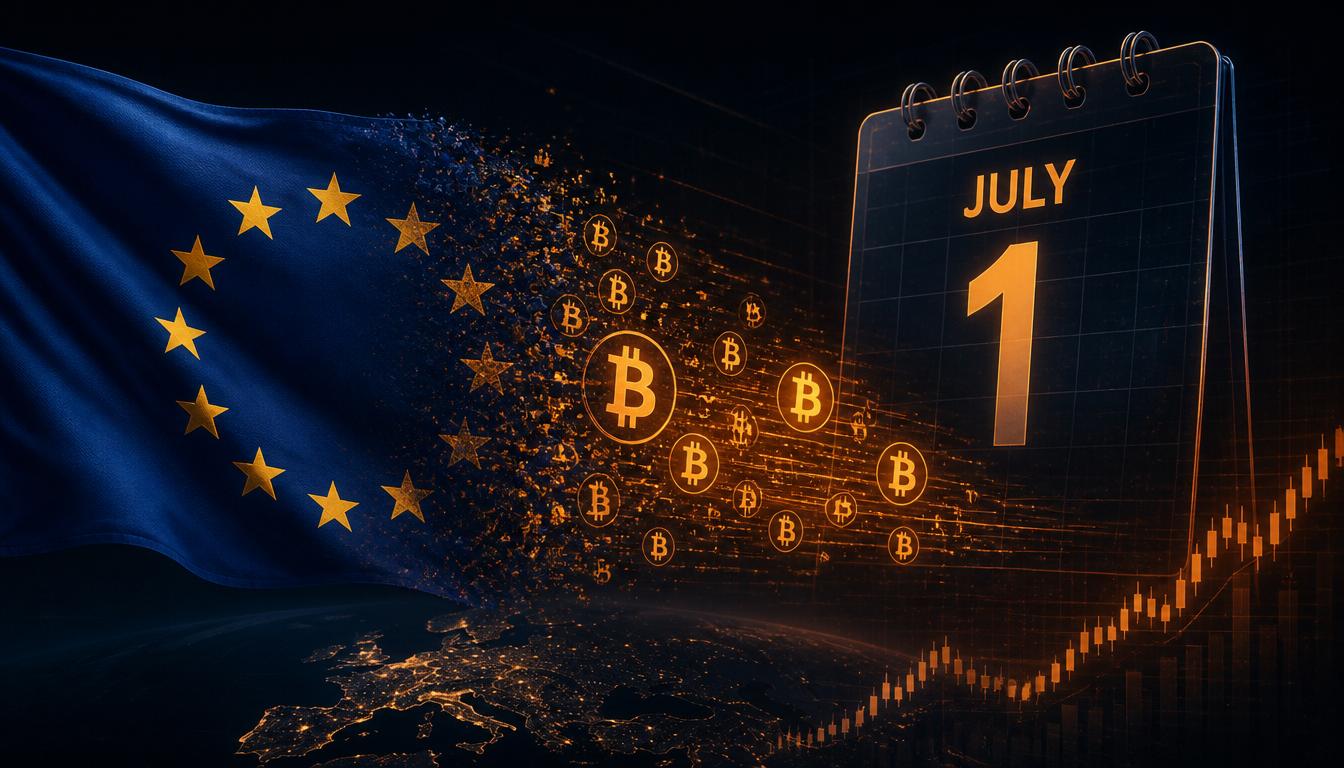
The EU's Crypto Deadline Is July 1 — What It Means for Your Money

EU MiCA crypto regulation July 1 2026 deadline

In eleven days, the way crypto works in Europe changes — quietly, but for good. On July 1, 2026, the EU’s big crypto law, MiCA, stops being a slow rollout and becomes a hard, enforced rule across all 27 member states.

You’ll see headlines calling it historic. What you won’t see is a plain answer to the question that actually matters: does this touch my money? Let’s fix that.

What MiCA is, in one breath

MiCA (Markets in Crypto-Assets) is the EU’s single rulebook for crypto. Instead of 27 countries each inventing their own rules, there’s now one license that lets a company operate across the whole bloc. The point is consumer protection: fewer scams, clearer disclosures, and platforms that can be held responsible when something breaks.

It’s been phasing in since 2023. July 1 is the day the training wheels come off.

What actually changes on July 1

Until now, many exchanges have been running under a temporary “grandfather” period — allowed to keep operating while their license application was processed. That window shuts completely on July 1, and no member state is permitted to extend it.

After that date, the rule is blunt: any company offering crypto services to EU clients without a MiCA license is breaking EU law and has to stop. A firm that didn’t apply in time, or whose application was refused, must cease operating across all 27 countries immediately.

Translation for your wallet: some platforms are licensed and carry on as normal. Others will restrict EU users, quietly exit, or be forced into a wind-down.

What this means for your money

You don’t need a law degree. You need to check a few things.

1. Is your exchange actually licensed?

This is the big one. If your platform didn’t secure MiCA authorization, it may restrict or close access for EU users after July 1 — frozen features, a withdrawal deadline, or a notice to move your assets out. Confirm now whether your exchange holds a MiCA license. Finding out when you can’t log in is the worst possible time.

2. Watch your stablecoins — this already happened

This isn’t hypothetical. Tether never applied for MiCA authorization, so through late 2024 and early 2025, major EU venues — Coinbase, Binance, Kraken, Crypto.com — pulled USDT trading pairs for European users to keep their own licenses. In some cases balances were auto-converted into compliant alternatives like USDC, and a few platforms briefly froze funds during the switch.

One nuance worth knowing: the restriction is on the venue, not the coin. You can still hold USDT in a self-custody wallet or trade it peer-to-peer. What you can’t do is rely on a MiCA-regulated EU exchange to keep listing it. If a stablecoin is core to how you move money, make sure it’s one the European platforms will still support.

3. Don’t get caught in a forced wind-down

Platforms that fail to qualify must wind down in an orderly way and migrate clients off. If you’re on one of those, be the person who moved early and calmly — not the one refreshing a withdrawal page on June 30 while everyone else does the same.

4. Expect friction first, stability later

Around the deadline, some platforms will tighten verification, pause certain tokens, or rewrite their EU terms. It’s irritating, but it’s the cleanup phase. For a long-term holder, the trade is clearer rules and fewer outright scams — a market that’s less exciting and a lot less dangerous.

The catch nobody advertises

MiCA was sold as harmonization — one rule for all. Reality has been messier. Member states ran different timelines (the Netherlands wrapped up in mid-2025, Italy by the end of the year, others stretched to July 2026), and Germany and France bolted on extra conditions. Licensing has moved faster in some countries than others, with Germany and the Netherlands issuing the most approvals so far.

So even past July 1, enforcement will stay uneven for a while. There’s already a live debate in Brussels about lifting supervision away from national regulators and centralizing it under ESMA — precisely because the country-by-country approach has been so inconsistent. Keep half an eye on it; it’s not settled yet.

Bottom line

You’re probably not a crypto company, so MiCA’s licensing rules don’t land on you directly. They land on the platforms you trust with your money — which is exactly why this is worth ten minutes of your attention.

Before July 1, do three things: confirm your exchange is MiCA-licensed, check that any stablecoin you hold is still supported on EU venues, and don’t leave assets parked on a platform that might be winding down. A short check today beats a forced scramble at the deadline.

Not financial advice. This is general information — verify your own platform’s status directly with the provider.

Get the macro read before the market moves.

Free weekly brief on BTC, ETH and the rules that move them. No fluff, no hopium.

Subscribe free

Friday, June 19, 2026

Stocks Threw a Party Today. Bitcoin Wasn't Invited.

BitBrainers - Stocks rally green while Bitcoin falls red on hawkish Fed policy, June 2026 divergence

Somebody signed a peace deal in Switzerland this morning and the stock market lost its mind with joy. Bitcoin looked at the same news, shrugged, and went back to staring at a man named Kevin Warsh.

That sentence is the entire crypto market today, so let me unpack it.

The S&P 500 is up 1.7 percent. The Nasdaq is up 3.1 percent. The US and Iran are signing a formal peace agreement today, the war premium that spooked markets for weeks is gone, and equity traders are buying everything in sight. Risk is back on. Except Bitcoin did not get the invitation. It is sitting near 63,900 dollars, down about 1.3 percent, and it dipped below 64,000 at the lows. On the single most risk-on day of the week, the supposed king of risk assets went the other way.

Why? Because stocks and Bitcoin are not reading the same headline anymore.

html

Get the macro read before the market moves.

Free weekly brief on BTC + ETH. No fluff, no hopium.

Subscribe free

Stocks are trading the peace deal. Clean story, easy trade. Bitcoin is trading the Federal Reserve, and on Tuesday the Fed turned cold in a way that still has not been priced out. Warsh held rates at 3.50 to 3.75 percent, which surprised nobody. The shock was everything around the decision. The committee's median forecast for where rates sit at the end of 2026 jumped to 3.8 percent from 3.4 percent in March. Nine officials now pencil in another hike this year. In March, the number who did was zero.

And then Warsh did the thing that actually rattled people. He scrapped forward guidance completely and became the first Fed chair in fourteen years to refuse to submit his own rate projection, telling markets flat out that he would not signal where rates are going. Equities can ignore that today because they have a peace deal to celebrate. Bitcoin cannot, because Bitcoin runs on liquidity, and a Fed that refuses to promise easier money is a Fed that just took the punchbowl and hid it.

The fund flows showed the hangover. Spot Bitcoin ETFs bled 82.2 million dollars net on June 17. But here is the detail most coverage skipped: it was not a clean exit. ARKB and IBIT took the redemptions while Fidelity's FBTC and MSBT actually pulled in fresh cash. That is not the whole market heading for the door. That is money shuffling between funds while the macro picture sorts itself out. Rotation, not capitulation, at least for now.

So that is the gloomy half. Here is the half nobody put on a front page.

While the price did nothing and the headlines stayed sour, long term holders quietly absorbed 125,000 BTC this month. One of the biggest monthly accumulation stretches of the entire cycle, happening in near silence, while leveraged traders got flushed and tourists got bored and left.

We have watched this exact thing play out before. We have held Bitcoin since it traded at 3,500 dollars, through every cycle since, and the rhythm never really changes. The loud green days are when latecomers buy the top. The flat, boring, nothing-is-happening stretches, the ones that produce no exciting headlines, are when coins quietly move from people who panic to people who do not. This feels like one of those stretches.

None of which requires you to do anything dramatic. The opposite, actually. A flat market with strong hands accumulating underneath is the single best backdrop for just buying a fixed amount on a schedule and ignoring the noise. You are not trying to time the bottom. You are trying to not be the person who panicked at it. Kraken lets you set a recurring buy and walk away, which is the entire point.

Set up a recurring buy on Kraken »

And once you own it, take it off the exchange. The lesson of every cycle, FTX and Celsius and the rest, is that coins on someone else's platform are coins you can lose overnight. A Trezor keeps your keys on a device that never touches the internet, which is the difference between owning Bitcoin and owning an IOU for it.

Move it to a Trezor Safe 3 »

The peace deal will fade from the headlines by next week. The Fed will still be there. And the long term holders will still be buying. Trade accordingly.

Affiliate disclosure: the Kraken and Trezor links above earn BitBrainers a commission at no cost to you. This is commentary, not financial advice. Prices accurate as of June 19, 2026.

Tuesday, June 16, 2026

Bot Signal Watch #3: The Bot Almost Won. Here's Why "Almost" Matters.

BitBrainers - Bot Signal Watch 3

Welcome back to Bot Signal Watch, the weekly report where we publish exactly what our automated trading bot did, with nothing polished and nothing hidden. Last week we ended on two open longs and a question hanging over both of them: a macro event was bearing down, and the bot doesn't read calendars. This week we have the answer. Both longs are green, the series record just flipped, and the thing that saved them is the same thing we keep telling readers not to trade on. Hope did not do it. A peace deal did.

Strategy Says Its Bitcoin Covers The Dividend For 32 Years. The Real Number Is Different.

Photo: Gage Skidmore , CC BY-SA 2.0 By BitBrainers Editorial Strategy says its Bitcoin reserve covers STRC's dividend for 32 years. ...

Strategy Says Its Bitcoin Covers The Dividend For 32 Years. The Real Number Is Different.