The fastest bank runs in American history were not caused by bad loans, fraud, or a housing crash. They were caused by a group chat and a mobile banking app. The FDIC has now put that on the record, and the implications for every Bitcoin holder, every community bank customer, and every regulator who spent the last several years blaming crypto for financial instability are enormous.
Let's break down what actually happened, what the FDIC actually said, and why the real story is almost nothing like the one being told in mainstream financial media.
The FDIC Got the Timeline Right but Blamed the Wrong Variable
When Silicon Valley Bank collapsed, depositors pulled billions in hours. Not days. Hours. The FDIC's own post-mortem analysis confirmed that social media and mobile banking created a withdrawal velocity that traditional regulatory frameworks had never modeled. A bank that might have survived a classic slow-motion run had no chance against a coordinated, app-powered exodus that moved faster than any risk team could respond.
Here is where the FDIC narrative starts to crack. They acknowledged that the tools of the run were digital. Mobile apps. Instant transfers. Real-time messaging. But rather than reckon with the fact that the entire modern banking infrastructure enabled this speed, regulators leaned hard into crypto as a convenient villain. Crypto was framed as the culture that normalized distrust of institutions, not the technology that made mass withdrawals instant.
That framing is doing a lot of heavy lifting for people who do not want to redesign their own systems.
Bank Runs Have Always Been About Confidence, Not Crypto
Bank runs predate Bitcoin by about a century. The 1930s saw runs that wiped out thousands of institutions before deposit insurance even existed. What changed with SVB was not the cause, which was interest rate risk and concentrated depositor bases, but the speed. And that speed came from the same digital infrastructure that every bank in America spent the last 15 years building to compete with fintech.
The FDIC is essentially saying that crypto culture desensitized people to institutional risk. There is a kernel of truth in that. Bitcoin holders who have self-custodied since the early 2020s absolutely do not trust banks the way their parents did. But the action of pulling $42 billion in a single day from SVB was executed through Zelle, wire transfers, and Chase business accounts, not through a Coinbase withdrawal.
Blaming crypto for bank run speed is like blaming car culture for road rage while ignoring that everyone is now driving a faster car.
Most People Do Not Know This: The FDIC Quietly Expanded Its Own Crypto Risk Framework in Early 2025
Here is the part almost no one is talking about. In early 2025, the FDIC began quietly revising the language in its risk examination guidelines to classify crypto-adjacent businesses, including companies that simply hold crypto on behalf of customers, as higher supervisory priority. This happened without major press coverage. It was buried in regulatory update filings.
The practical effect was that community banks that wanted to custody Bitcoin for local clients suddenly faced a much steeper compliance burden. That discouraged smaller institutions from entering the space. Which brings us to what is happening right now, in May 2026, in Minnesota.
Minnesota Just Moved to Give Community Banks a Fighting Chance Against Wall Street Crypto Dominance
A story published by CoinDesk on May 22, 2026 detailed why Minnesota is actively empowering local banks to compete for crypto revenue that is currently being captured almost entirely by large Wall Street institutions. The state is creating a regulatory pathway that allows community banks to offer crypto services, specifically to stop the wealth concentration dynamic where only the largest financial players profit from Bitcoin adoption.
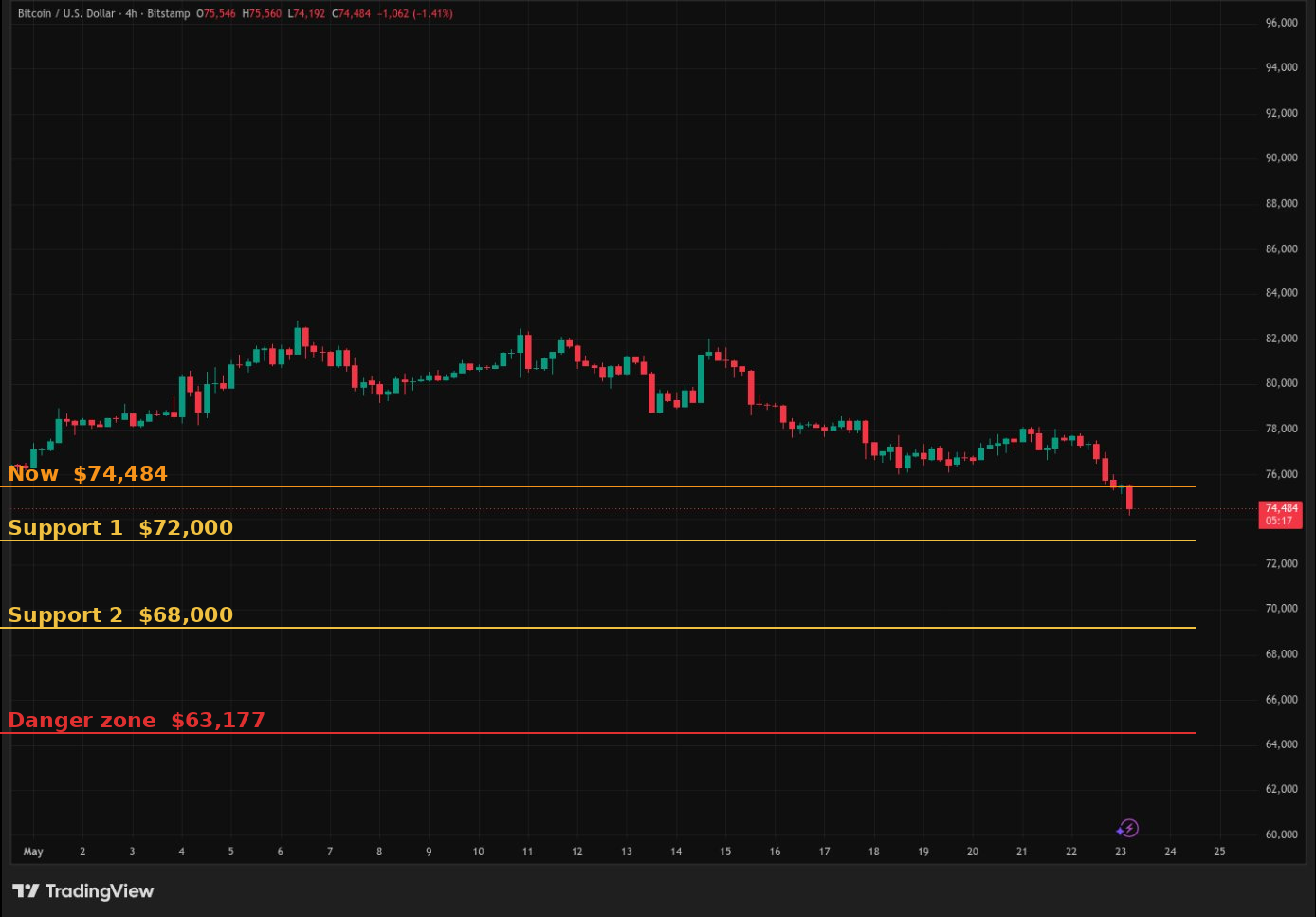
This is not a pro-crypto stunt. This is a state government watching its local banking sector get outcompeted and deciding to level the playing field. The timing is sharp. BTC is sitting at $74,533 today, and the revenue potential for custodial and exchange services is not trivial. Community banks want a piece. Wall Street already has it.
The FDIC's tendency to pile extra risk weight onto crypto has directly benefited the institutions it often claims to be checking. Compliance costs scale much better at JPMorgan than at a regional Minnesota credit union. That is not an accident. That is regulatory capture in motion.
Crypto Culture Did Change How People Think About Bank Risk, and That Is Actually Correct
Here is the contrarian take that most crypto blogs will not print because it makes readers uncomfortable. The FDIC is not entirely wrong. Bitcoin culture, since at least 2021, has actively promoted the idea that fractional reserve banking is a structural risk and that keeping your savings in an institution that lends out your deposits is a form of counterparty exposure you have voluntarily accepted.
That message reached people who had never owned a single satoshi. It spread on YouTube, on Reddit, in financial independence communities that had nothing to do with crypto. And when SVB showed signs of stress, some of those depositors did not wait. They moved first. They had absorbed the crypto lesson even without holding crypto.
The FDIC calling this cultural contamination is defensible. But the appropriate policy response is not to restrict crypto. It is to make banks structurally more resilient to fast outflows. If your institution cannot survive a 24-hour run, the problem is your capital structure, not someone else's ideology.
Self-Custody Is Not Paranoia Anymore, It Is Basic Risk Management
If any of this makes you reassess how much of your financial life depends on institutional goodwill, that is the correct takeaway. A hardware wallet like a Trezor means your Bitcoin does not have a counterparty. No bank run, no FDIC receivership, no wire transfer freeze touches it. That is not a pitch. That is the logical conclusion of everything the FDIC just described.
When institutions admit that digital infrastructure makes bank runs faster than any safety net can respond, holding your own keys stops being a libertarian fantasy and starts being rational portfolio construction.
Exchanges Are Not the Enemy Here, But Choose One That Plays Defense
If you are active in the market and need exchange exposure, the platform you use matters more than most people admit. Kraken has operated through multiple regulatory cycles without the implosion stories that hit other major platforms. That track record matters when regulators are actively revising what crypto-adjacent business risk looks like.
You do not leave everything on an exchange, but what you do leave there should be somewhere that has shown it can handle regulatory pressure without vaporizing customer funds.
The Assumption You Probably Walked In With Is Wrong
You probably assumed this was a story about regulators trying to restrict crypto. It is not. It is a story about regulators trying to explain their own institutional failures without accepting structural accountability. The FDIC oversaw a banking environment where interest rate risk was mismanaged at scale, where concentration risk was ignored, and where digital withdrawal infrastructure was allowed to evolve faster than any capital buffer requirement. Crypto did not create any of those conditions.
The next bank stress event will happen for exactly the same reasons as the last one. The mobile app will not be slower. The group chat will not wait for a regulatory review. And the post-mortem will once again look for something new to blame.
Watch the Minnesota Model Because It Is the Template
Keep your eyes on Minnesota's community banking crypto framework over the next 90 days. If it works, other states will copy it. If the FDIC pushes back, you will see the fault line between state-level crypto adoption and federal-level crypto resistance crack open in public. That fight will affect every institution trying to enter this market, and by extension, every holder trying to decide whether their Bitcoin can safely touch the banking system at all.
That is the actual story. Watch the regulators, not the price.
Disclosure: This post contains affiliate links to Trezor and Kraken. BitBrainers may earn a commission at no extra cost to you. This is not financial advice.
Sources
CoinDesk. Why Minnesota is empowering local banks to fight Wall Street for crypto revenue
BitBrainers. Because most crypto content is garbage.