
A privacy coin getting a clean bill of health from an AI auditor sounds like a headline worth celebrating. It is not. At least not yet.
Anthropic's Mythos AI completed a security audit of Zcash and found no more serious bugs. The operative word there is "more." That phrasing alone should tell you something. There were bugs before. Now there are fewer. That is progress, not perfection, and the privacy coin crowd is already acting like Zcash just became bulletproof.
Read also: Securitize Just Cleared the SEC for NYSE and Tokenization Bulls Are SalivatingIt did not.
An AI Audit Is Not the Same as a Human Audit
Mythos is Anthropic's AI system built for code analysis. It found no serious bugs in its latest pass through Zcash's codebase. That is genuinely good news for a protocol that has struggled with perception problems and developer interest for years.
Read also: Polymarket Accuses Kalshi of Corporate Espionage and the Receipts Are DamningBut AI auditing tools, even sophisticated ones, have known limitations. They are exceptional at catching pattern-based vulnerabilities, logic errors, and known exploit signatures. They are less reliable at catching novel attack vectors, social engineering risks baked into protocol design, or emergent bugs that only surface under specific network conditions.
The Ethereum DAO hack in 2016 passed through multiple human audits before a reentrancy bug drained 3.6 million ETH. That was human auditors missing something humans later caught. AI auditors are faster and more consistent, but they are not omniscient.
Zcash Has a History That Requires Context
Zcash launched with zk-SNARK technology that was genuinely groundbreaking. The protocol uses zero-knowledge proofs to shield transaction data, making it one of the only coins where privacy is actually baked into the cryptographic layer rather than bolted on top.
But Zcash has also lived with the Sprout vulnerability shadow. In its early days, a flaw in the original Sprout shielded pool could have theoretically allowed an attacker to mint unlimited ZEC without detection. The team discovered and quietly patched it before any exploit occurred. The flaw was only disclosed later. That history matters when evaluating how you interpret "no serious bugs found."
The Electric Coin Company, which develops Zcash, has been transparent about security issues compared to many projects. But transparency after the fact is a different thing from catching problems before deployment.
The Mythos Audit Tells Us Something Specific About AI in Crypto Security
Here is what most people are missing in this story. The fact that Anthropic built Mythos specifically for code auditing is a signal about where the entire security industry is heading, not just crypto. Traditional audit firms like Trail of Bits and Consensys Diligence employ teams of researchers who spend weeks reviewing code. Mythos can do a comparable pass in a fraction of the time.
That compression of audit timelines has real implications for the pace of protocol development. If AI can validate security faster, projects ship faster. Faster shipping means more attack surface emerging quicker than the broader community can absorb and stress-test. Speed is not always a feature in security.
Most people do not know this: the Zcash codebase is forked from Bitcoin Core, which means it inherits both Bitcoin's security track record and its architectural assumptions. Any bug that exists in Bitcoin's underlying UTXO model that has not yet been discovered could theoretically exist in Zcash too. An AI audit of Zcash's privacy layer does not audit Bitcoin's underlying bones.
Privacy Coins Are Under Regulatory Pressure Right Now
This audit lands at an interesting moment. Regulators across the US, EU, and Asia have been tightening their grip on privacy-enhancing technologies throughout 2025 and into this year. Several major exchanges delisted Zcash and Monero under compliance pressure. Kraken previously delisted ZEC for UK users under FCA guidance. Bittrex dropped multiple privacy coins ahead of its shutdown.
The result is that even a technically clean Zcash is still a liquidity problem for many traders. You can have the most secure privacy coin on the planet, but if you cannot move it through regulated rails without jumping through hoops, the security audit is almost irrelevant to your practical risk profile.
This is where the privacy maxis celebrating this news are getting ahead of themselves. A clean AI audit does not reverse regulatory pressure. It does not get ZEC relisted on Coinbase. It does not make compliance departments at institutional desks more comfortable. It is a technical win in a war that is currently being fought on regulatory and political grounds.
The Broader BTC Context You Should Not Ignore
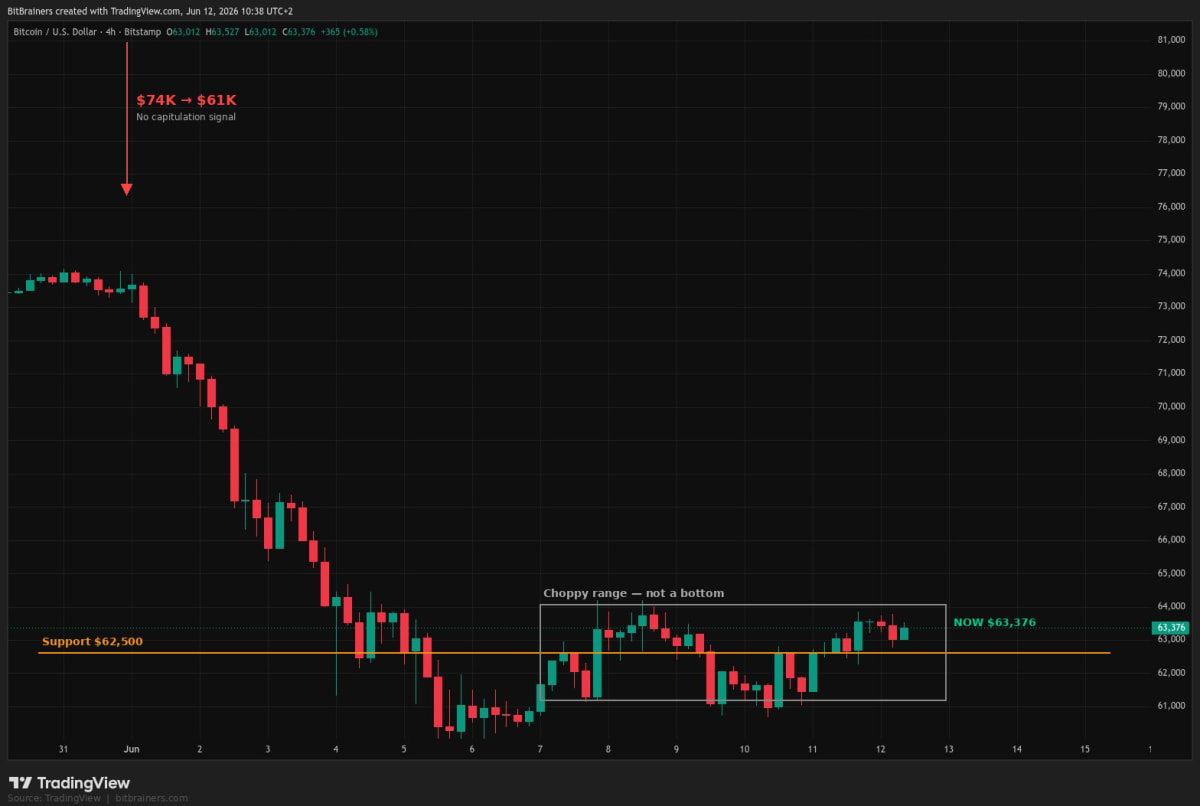
BTC is sitting at $64,486 today. The market is in a phase where altcoin narratives are being stress-tested against real liquidity and real adoption. Privacy coins are a niche inside an already niche market. Zcash's market cap is a fraction of Bitcoin's, its daily volume is thin, and its developer activity, while real, does not match what you see on chains like Ethereum or Solana.
When Bitcoin dominance is elevated and macro conditions are uncertain, capital does not flow into privacy coins on the back of a security audit. Traders chase narratives with momentum. A clean audit is a defensive narrative, not a growth narrative. There is a difference.
If you are holding ZEC as a speculative position and using this audit as your thesis for a run, you are probably reading the wrong signal. If you are holding it as a genuine privacy tool for specific use cases, the audit is legitimately useful information.
Storing Any Privacy Coin Requires You to Think About Custody Seriously
If you do hold ZEC or any shielded asset, custody matters more than most altcoin holders treat it. Exchange custody for privacy coins is especially risky given the delisting trend. A coin that gets delisted while sitting on an exchange puts you in a race against time to withdraw before trading is suspended.
Hardware wallets like Trezor support Zcash. If you are holding ZEC for any serious reason, get it off exchanges and into cold storage. That advice applies regardless of whether Mythos found bugs or not. Self-custody is the point of privacy coins. If you are trusting a third party to hold your privacy coin, you have already missed the point entirely.
The Assumption You Walked In With Is Probably Wrong
You likely came into this post thinking the question was whether Zcash is now safer because of this audit. That is the wrong frame. The real question is whether Zcash's value proposition is sustainable in a regulatory environment that is actively hostile to financial privacy tools, regardless of how technically sound the codebase is. Security and survival are two separate problems. Zcash may have just solved one while the other remains wide open.
Watch whether any major regulated exchange moves to relist ZEC following this audit. That will tell you more about Zcash's actual trajectory than any number of clean audit reports. If the audit triggers a relisting conversation, the news matters. If exchanges stay quiet, you have your answer.
On The Radar This Week
Bitcoin is holding a knife's edge below the $65,000 support level at $64,464, and a confirmed breakdown opens a fast path to $62,500 with little structural support in between. The BOJ rate decision lands June 15 to 16, with markets pricing a 64% probability of a hike to 1.0%, so watch USD/JPY closely on the evening of June 14 UTC for early positioning signals. ETF outflows of $2.30 billion in May, the heaviest monthly exit of 2026, suggest institutional hands are not catching this dip yet.
The CLARITY Act is grinding toward a Senate floor vote this summer, and the outcome will set the legal perimeter for which tokens qualify as commodities versus securities in the US. Tokenized Treasuries have already crossed $1.5 billion AUM, meaning real capital is moving on-chain regardless of how the legislative calendar plays out. Any clarity on security classification could unlock or freeze that pipeline fast.
Anthropic's Claude flagging zero critical vulnerabilities in Zcash's codebase is genuinely useful signal, but treat it as a starting point rather than a finish line for privacy protocol due diligence. AI-assisted audits compress timelines, not risk, and the history of "clean" audits preceding exploits is long enough to warrant skepticism. Privacy maxis booking victory laps this week should remember that threat models evolve faster than audit cycles.
BitBrainers. We check the facts so you don't have to.
Sources
Cointelegraph. Anthropic's Mythos AI finds no more 'serious' bugs in Zcash: Wilcox
Disclosure: This post contains affiliate links to Trezor and Kraken. BitBrainers may earn a commission at no extra cost to you. This is not financial advice.
— BitBrainers Editorial


No comments:
Post a Comment