32 BTC. That is what Strategy just moved off its books for $2.5 million. Small number relative to the hundreds of thousands of BTC the firm holds, but the timing is what has traders talking.
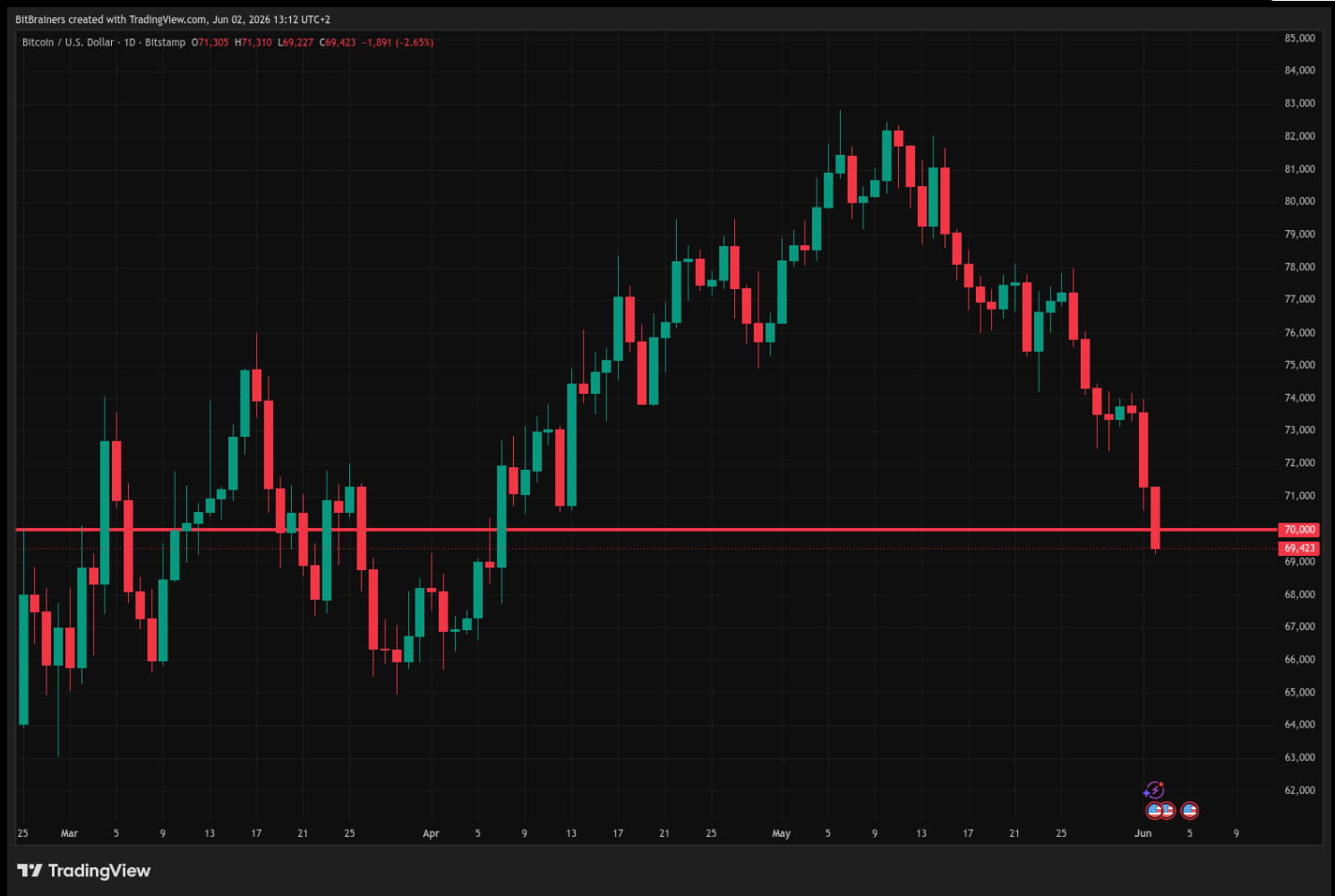
Bitcoin is sitting below $70,000 as of today. That is not a crash. But it is not a party either. It is the kind of price action that feels like standing on ice and wondering how thick it actually is.
The Strategy Sale Is Small But the Signal Is Loud
According to Decrypt, Michael Saylor's Bitcoin treasury firm Strategy sold 32 BTC for $2.5 million. Again, relative to their total stack, this is a rounding error. But perception in crypto markets does not scale proportionally to position size.
Strategy has spent years being the loudest institutional voice in the Bitcoin bull camp. Every sale, no matter how small, gets amplified because of that positioning. Markets are not rational in the short term and anyone who has been trading since 2017 knows that narrative moves price more than fundamentals on a week-to-week basis.
What this sale does is crack the monolith image. It introduces a question that was not there before.
ETF Outflows Are Telling a Clearer Story
Spot Bitcoin ETF outflows have been substantial over recent sessions. Multi-billion dollar outflows in a compressed period are not noise. That is institutional repositioning, or at minimum, institutional hesitation.
This matters because the ETF narrative was supposed to be the structural floor for Bitcoin demand in this cycle. The argument was straightforward: regulated vehicles bring patient capital from pension funds, family offices, and wealth managers who would hold through volatility. The past week has challenged that thesis at least temporarily.
ETF outflows at this scale during a price consolidation near $70,000 suggest some of that patient capital is not as patient as advertised. Or it was never patient capital to begin with. It was speculative capital wearing a suit.
Most People Missed What Drives Large Institutional ETF Exits
Here is something most crypto blogs will not tell you. A significant driver of ETF outflows during flat or declining price periods is not panic selling. It is options and derivatives positioning. Large players use the ETF as a hedge or a leg in a broader strategy. When they unwind one side of a trade, the ETF redemption shows up in the data and it looks like bearish sentiment when it is actually just mechanics.
This does not mean every outflow is benign. But treating outflow data as pure directional conviction is a mistake. You need to watch the basis trade, futures premiums, and open interest alongside ETF flows to get the real picture. Watch those three together and you will be ahead of most retail reads on the market.
Bitcoin at $70K Is Not the Same Story in Every Market Condition
Bitcoin trading below $70,000 in a period of rising ETF adoption and growing institutional participation should feel different from Bitcoin at $70,000 in a risk-off macro environment with credit stress. Right now the macro backdrop is doing real work on sentiment.
Rate expectations, dollar strength, and equity market volatility all bleed into crypto risk appetite. BTC does not trade in a vacuum and anyone still pretending it does is going to get caught on the wrong side of a macro flush. The correlation between Bitcoin and broader risk assets loosens over time but in the short term, especially at key psychological price levels, it tightens fast.
Watch the 10-year yield and the DXY alongside your BTC chart this week. Not because crypto is just a risk asset forever, but because right now the market is treating it that way.
The Contrarian Take Most Bulls Are Ignoring
Everyone is watching for a breakdown below $70,000 as the bearish trigger. That is the trade everyone has loaded up on mentally. When a level is that obvious, the market has a way of making it painful for both sides.
A wick below $70,000 that gets immediately bought does more damage to bears than any clean bounce from current levels. Liquidation cascades work both ways. If short positioning has stacked up anticipating a break, a reversal from just below $70,000 turns into a short squeeze that looks bullish on the chart but is really just a mechanics event.
The most dangerous assumption right now is that clean technical levels produce clean breakdowns. In a market where derivatives volume dwarfs spot volume, that assumption will cost you.
Saylor's Positioning Matters More Than 32 BTC
The detail buried in the Decrypt report is not the 32 BTC sold. It is that Strategy continues to operate as a Bitcoin treasury firm while executing what appears to be a tactical sale. Understanding how large corporate Bitcoin holders manage their exposure requires understanding their operational costs, debt servicing, and regulatory reporting requirements.
Strategy has used convertible notes and equity raises to fund Bitcoin purchases. Selling a small portion of holdings is within the normal range of treasury management for any firm that size. But the Bitcoin community built a mythology around the idea that Strategy would never sell. That mythology is now officially over.
If You Are Holding BTC Right Now, This Is Your One Watch Point
Stop watching the $70,000 level as a binary event. Instead, watch the ETF flow data daily for the next 5 trading sessions. If outflows reverse or slow significantly while price holds above $70,000, that is a structurally bullish signal worth paying attention to. If outflows continue at pace while price bleeds, you have confirmation that the demand side is genuinely weakening and not just mechanically repositioning.
For anyone not already holding BTC in cold storage, this kind of volatility is exactly why your keys need to live on a hardware wallet. A Trezor keeps your stack off exchanges and out of the counterparty risk equation entirely. When sentiment shifts fast, exchange risk becomes real fast. You do not want to learn that lesson the expensive way.
If you are actively trading around these levels, Kraken remains one of the more reliable platforms for executing during volatile sessions. Liquidity and uptime matter when price is moving.
The assumption most people came into this post with is probably that Saylor selling any BTC is a bearish capitulation signal. It is not. It is a reminder that even the most convicted holders operate within financial structures that require occasional liquidity events. What matters is the direction of conviction, not the absence of a single sale. Strategy still holds a significant Bitcoin position. One sale of 32 BTC does not change that picture. But the ETF outflow trend does deserve your full attention this week because that is where real demand pressure shows up first.
On The Radar This Week
Bitcoin broke below $70,000 on June 2 for the first time since early May, with the next support level watched closely around $67,800. ETF outflows have now stretched to 11 consecutive sessions totaling over $3.45 billion, with IBIT leading redemptions at $440M in a single day. Whether flows stabilize this week will determine if this is a shakeout or a genuine demand breakdown.
The Federal Reserve remains on hold with no cut expected before September at the earliest. Dollar strength and rising yields continue to pressure risk assets including crypto. Watch the 10-year yield and DXY alongside your BTC chart this week because correlation is tight at this level.
Strategy continues to hold its Bitcoin position despite the 32 BTC sale. The mythology that they would never sell is now officially over, but the direction of conviction has not changed
Disclosure: This post contains affiliate links to Trezor and Kraken. BitBrainers may earn a commission at no extra cost to you. This is not financial advice.
BitBrainers. We check the facts so you don't have to.
Sources
Decrypt. Michael Saylor's Bitcoin Treasury Firm Strategy Sells 32 BTC for $2.5M
You Might Also Like
— BitBrainers Editorial