₿ BTC Loading... via Binance

Tuesday, April 14, 2026

How to Build a Crypto Income Stack With Multiple Streams

How to Build a Crypto Income Stack With Multiple Streams

Most people chasing passive crypto income end up making less than a savings account pays — while taking on 10x the risk. That is the truth nobody putting together a "Top 10 passive income ideas" list wants to tell you.

Here is the stat that should recalibrate your expectations: According to data from DeFi analytics firm Messari, the average retail user who participates in yield farming exits with a net loss after accounting for gas fees, impermanent loss, and token depreciation. That covers the majority of people who tried it. Not beginners — everyone. Most passive crypto income strategies are return theaters. They look like income. They are actually slow capital erosion dressed up with APY numbers.

I know because I ran most of them myself. I have yield farmed, run lightning nodes, staked governance tokens, provided liquidity, and sat through one too many "sustainable 200% APY" protocols that went to zero in a weekend. Some of what I tried worked. I am going to tell you which strategies actually generate real income, how to stack them intelligently, and where each one can hurt you.

This is not about picking one strategy and calling it a day. A real crypto income stack layers multiple streams across different risk profiles — with Bitcoin as the foundation, not the speculation.


Why Bitcoin Has to Be the Base Layer of Any Serious Stack

Before we talk about stacking income streams, we need to talk about what you are stacking them on. Building crypto income on altcoins first is like building a house starting with the roof. You need a foundation that does not disappear.

Bitcoin is currently sitting at $74,353. Whether that feels high or low to you depends on your timeframe. But here is what matters for income stacking: BTC is the only crypto asset with a deep enough institutional footprint, enough liquidity, and a track record long enough to treat as collateral rather than a gamble. Ethereum is a legitimate second layer to build on — but not before BTC.

The income strategies I am going to walk through apply in tiers. Bitcoin-native first. Ethereum-adjacent second. Alt-exposure last, and only if you understand you are accepting much higher volatility in exchange for potentially higher yield.

One thing you need to sort out immediately: where you hold your BTC matters enormously when you are building income streams. If you are doing anything on-chain — lending, staking, or providing liquidity — your keys need to be under your control at some point in the process. Exchange wallets are fine for trading. They are not fine for long-term holdings or complex DeFi positions. I keep my base BTC stack on a Trezor hardware wallet. Not negotiable. One exchange hack or insolvency event undoes months of yield gains in seconds.


Stream One — Bitcoin Yield Through Lending (The Boring but Real One)

Institutional Bitcoin lending — not DeFi farming, not sketchy protocol staking — is the most consistently reliable BTC income stream available to retail holders. The yield is boring. That is the point.

Platforms like Ledn and Unchained have offered BTC-backed lending products where your Bitcoin earns somewhere between 3.5% and 6% annually, depending on market conditions and loan demand. These numbers are not flashy. But 5% on a BTC position that also appreciates in a bull cycle compounds in ways that chase-the-APY DeFi farming never does.

The critical distinction here is counterparty risk. Celsius paid 8-10% on BTC until it imploded and wiped out billions in customer funds. The yield was real until the business model that backed it was not. Before you put BTC into any lending platform, your due diligence checklist needs to include: Are assets segregated? Is there audited proof of reserves? What is the withdrawal process under stress conditions?

Concrete step-by-step to start:

  1. Decide what percentage of your BTC you are willing to put at counterparty risk. I never put more than 20-25% of my base stack into any single lending product.
  2. Research platforms that offer proof of reserves and have been operating for at least two years without incident.
  3. Start with a small position — no more than $500-1000 worth — for 30-60 days before scaling.
  4. Document your yield against the cost of capital (what you could have earned simply holding).

This stream alone, done conservatively, can generate 4-6% annually on a portion of your BTC stack without you touching a single DeFi protocol.


Stream Two — Exchange Staking and Earn Products (Know What You Are Actually Doing)

For most people reading this, the easiest on-ramp to crypto income is exchange-native earn products. If you are already trading on Kraken, you have access to Kraken Earn, which offers on-chain staking for assets like ETH, SOL, and others with transparent validator mechanics.

The key difference between a legitimate exchange staking product and a yield trap is whether the yield comes from actual network validation or from internal rehypothecation. Kraken's ETH staking, for example, runs real Ethereum validators. Your yield comes from Ethereum's consensus mechanism — not from Kraken lending your ETH to someone else. That distinction matters enormously from a risk standpoint.

Current realistic yields on exchange staking: ETH staking through legitimate validators runs around 3-4% annually. Not 20%. Not 40%. Three to four percent, paid in ETH, with normal unstaking periods.

Here is a real-world example of how to use this as one stream in your stack: A trader I know in Berlin holds a base BTC position (in cold storage), stakes 40% of his ETH position through Kraken Earn for the 3-4% yield, and keeps the rest liquid for trading. He does not try to squeeze every basis point out of his portfolio. He takes a reliable middle yield, keeps his principal secure, and uses the generated ETH to DCA back into BTC every quarter. His income stack is simple, legible, and has survived two significant market downturns without a liquidation event.

The step-by-step for this stream:

  1. Open or use an existing account on Kraken — they are one of the few exchanges with a genuine compliance track record and audited staking mechanics.
  2. Allocate only assets you do not need immediate liquidity on — staked assets have unbonding periods.
  3. Set up automatic compounding where available. Small ETH rewards compounded monthly over two years make a measurable difference.
  4. Do not chase the highest APY listed. The highest APY is almost always the highest risk.

Stream Three — Running a Lightning Node (Contrarian Take: It Is Not Worth It for Most People)

Here is the contrarian insight most Bitcoin-focused blogs will not say out loud: running a Lightning node for passive income is, for the vast majority of retail holders, a complete waste of time and capital.

You will read posts about routing fees providing consistent income. You will see dashboards showing monthly earnings. What those posts leave out: the average active Lightning node earns somewhere between $5 and $30 per month in routing fees, requires ongoing channel management, and demands significant technical upkeep. A 2023 analysis by researcher Rene Pickhardt found that median node earnings after factoring in on-chain fees for channel opens and closes were effectively near zero for nodes with less than $10,000 in liquidity.

Running a node is valuable for the network. It builds your understanding of Bitcoin's payment layer. It is genuinely interesting if you are technical. But if your goal is income generation, the opportunity cost of that capital sitting in channels versus earning 4-5% in a lending product is real. I ran a Lightning node for 14 months. I learned a lot. I earned very little. That counts as data.

Where Lightning nodes do make sense: if you run a business that accepts Bitcoin payments and you want to reduce transaction costs while earning marginal routing fees on top. In that specific context, the math works. As a pure passive income play for retail? Skip it until you have the other streams running and capital to spare.


Stream Four — Bitcoin-Collateralized Borrowing as Income Infrastructure

This is the most sophisticated stream in the stack and the one that most blogs do not cover at all because it requires a shift in how you think about income.

Instead of selling BTC to fund living expenses or other investments, you borrow against it. At a conservative 40-50% loan-to-value ratio, you take a stablecoin or fiat loan against your BTC, deploy that capital into a yield-generating product (even something as boring as a 5% stablecoin savings product), and generate income without ever selling your Bitcoin.

The risk: if BTC drops sharply, your LTV climbs and you face margin calls. This is not a strategy for your entire stack. It is a strategy for a portion of your stack during periods of relative stability, with a clear liquidation price and a cash reserve to cover it.

Platforms like Unchained offer this in a way that does not require you to give up custody of your keys entirely. For the BTC you put up as collateral, having a Trezor as part of the multi-sig setup is not just recommended — it is structurally part of how those products work.


Key Takeaways

  • A real income stack layers multiple streams across different risk profiles — BTC lending for base yield, exchange staking for secondary income, and collateralized borrowing for advanced capital efficiency.
  • Yield that sounds too high is almost always too high — sustainable BTC income looks like 3-6% annually, not 40-200%. If someone is offering you 40%, ask who is on the other side of that trade.
  • Counterparty risk kills more crypto income strategies than market volatility does — custody your base stack on hardware like Trezor and never put more than 20-25% of your stack on any single platform.
  • Lightning node income is overrated for retail — the time and capital required rarely justifies the return unless you have a specific business use case.
  • Exchange choice matters — use regulated, audited platforms like Kraken for staking products, not whatever is offering the highest number.

Frequently Asked Questions

Can I really make passive income from Bitcoin without selling it? Yes, but the realistic returns are modest — typically 3-6% annually through lending or collateralized borrowing strategies. You are not replacing a salary with BTC yield unless you have significant capital deployed. What you can do is generate consistent income that compounds alongside BTC's price appreciation.

How much Bitcoin do I need to start building an income stack? There is no hard floor, but most lending platforms have minimums around 0.01-0.05 BTC, and exchange staking has no meaningful minimum. Realistically, to generate income worth the operational complexity and risk, you want at least $5,000-10,000 in total crypto assets before layering multiple streams. Below that, the fees and risks eat the returns.

Is crypto passive income taxable? In most jurisdictions, yes — staking rewards, interest income, and yield farming proceeds are treated as ordinary income at the time you receive them. The specific rules vary by country. This matters because it directly affects your real net yield. A 5% yield with a 30% tax rate is a 3.5% real yield. Always factor taxes into your income calculations before deciding if a strategy is worth it.


Realistic Expectations and Your First Action Step

Here is what a functional income stack looks like after 12 months of consistent execution: 4-6% annual yield on the portion of BTC you have in a legitimate lending product, 3-4% on staked ETH through an exchange like Kraken, and optionally a collateralized borrowing position generating an additional 3-5% on deployed capital. Stack those across a $20,000 portfolio and you are looking at $700-$1,100 in real annual income — while your base assets remain intact.

That is not life-changing money. But it is real money, generated without selling your position, and it compounds year over year. The people who get wrecked are the ones who see those numbers and decide they need to 10x them by chasing riskier protocols.

Your first action step: Audit what you already hold. Write down every asset, where it is held, and whether it is generating any yield. If you have BTC sitting idle on an exchange, move your long-term holdings to a Trezor hardware wallet today, then allocate a defined percentage to one lending product this week. One stream, done properly, beats five streams done carelessly every time.


Follow BitBrainers — passive income strategies from someone who has lost money so you do not have to.

The Risks of Relying Too Much on AI in Crypto Trading

The Risks of Relying Too Much on AI in Crypto Trading

Over 80% of retail traders using AI-powered crypto signals report losses in their first six months. Not because AI is useless — but because they treated it like a crystal ball instead of a calculator. That distinction will either cost you or make you.

I run automated bots. I use AI tools daily. I have since before most of these "AI trading platforms" existed. And the honest truth is: AI in crypto trading is one of the most powerful tools available and one of the most dangerous if you misunderstand what it actually does. This post is about where the line is, what happens when you cross it, and how to use these tools without getting wrecked.


The AI Hype Cycle Is Eating Traders Alive

Every bull cycle brings a new wave of "revolutionary" tools. In the last cycle it was DeFi yield optimizers. Right now it's AI trading agents, sentiment bots, and GPT-powered signal services. The pitch is always the same: plug it in, let it run, watch the profits roll in.

Here's the problem. Most of what's being sold as "AI" is either repackaged technical indicator logic wrapped in a chatbot interface, or large language models that hallucinate price data they have no business predicting. A language model trained on text cannot "predict" where BTC goes next. It can summarize narratives, analyze sentiment, and synthesize news — useful things — but it has no statistical edge on price direction. That's a fundamental architecture issue, not a bug that gets fixed in the next version.

The crypto media doesn't say this clearly because most of it is sponsored. I'm not. So here it is: AI cannot predict price. It can only process patterns from historical data and make probabilistic inferences. If the market enters a regime it's never seen before — and crypto does this regularly — your AI model is flying blind.

According to a 2025 study from the University of Texas at Austin examining algorithmic trading in volatile markets, models trained on historical data underperform in novel market regimes by an average of 34% compared to simple trend-following strategies. Crypto is a market that manufactures novel regimes constantly.


What AI Actually Does Well (And Where It Earns Its Keep)

I'm not here to tell you to dump your tools. I'm here to tell you to use them correctly.

Sentiment analysis is where AI genuinely delivers. Scanning thousands of social posts, news articles, Reddit threads, and on-chain data simultaneously and giving you a structured signal — that's a task humans cannot match at scale or speed. I use sentiment aggregation tools to time my entries around news events. Not to predict direction, but to gauge crowd positioning. If the sentiment score on BTC is euphoric and everyone is leveraged long, I tighten my stops. That's useful.

Pattern recognition on chart data is another legitimate use case, but with caveats. Convolutional neural networks trained on candlestick data can identify recurring structures — head and shoulders, bull flags, Wyckoff accumulation — faster than any human. I use this as a filter, not a trigger. If the model flags a pattern, I then apply my own judgment before any order goes out.

Portfolio rebalancing logic is boring but effective. Setting rule-based AI systems to rebalance a BTC-heavy portfolio within defined bands removes emotional decision-making. I run one that keeps my BTC allocation within a target range and auto-rebalances using Kraken's API. Boring, consistent, works. If you're not already on Kraken, it's the platform I trust for API reliability and security — you can get started here: Join Kraken Exchange

What AI does not do well: discretionary judgment in breaking news scenarios, identifying manipulation (wash trading, spoofing), and distinguishing between a genuine breakout and a liquidity hunt. These require context that models simply don't carry. BTC at $74,597 today looks technically similar to ranges it's traded in before — but the macro context, ETF flow data, and geopolitical backdrop are completely different. A model trained on past candles doesn't know that.


The Case Study No One Talks About: The May 2025 Flash Crash

In May 2025, BTC dropped over 18% in a 72-hour window triggered by a combination of liquidation cascades and a macro risk-off event in traditional markets. What made this notable for AI traders wasn't the crash itself — it was what happened to automated systems during it.

Multiple publicly documented cases emerged on X and crypto forums where traders reported their AI bots bought the dip aggressively — exactly as trained — and then bought again, and again, as the market continued lower. The models were doing what they were told: accumulate on price drops in a bull trend context. But the regime had shifted from bull trend to macro-driven panic selling. The AI didn't know. It couldn't know. It executed its logic perfectly and still lost money because the underlying assumption (bull trend) was no longer valid.

This is called model decay. It happens when the assumptions a model was trained on no longer describe reality. In traditional finance, quant funds have entire teams dedicated to detecting and correcting for model decay. Most retail AI trading setups have zero infrastructure for this. You turn on the bot and assume it will handle it.

It won't. Not without human oversight baked into the system.

The traders who came out of that period cleanly were running AI as a co-pilot, not an autopilot. They had circuit breakers — hard-coded stop conditions that paused the bot if drawdown exceeded a threshold. They were watching. They intervened.


The Contrarian Take: AI Makes Bad Traders Worse Faster

Here's what most crypto blogs miss entirely. The danger of AI tools isn't that they're inaccurate. It's that they're fast and convincing, and they remove friction from bad decisions.

Before AI signal tools, a bad trader had to manually execute bad trades. They had to click buttons, feel the discomfort, experience some delay. That friction occasionally saved people from themselves. Now, a bad trader sets up an AI bot with poor parameters, gives it API access, and it executes 40 bad trades in the time it would've taken them to manually make 3. The losses compound at machine speed.

This is not a hypothetical. This is what I see reported consistently in trading communities. AI amplifies whatever edge — or lack of edge — the user already has. If you don't understand position sizing, the bot won't teach you. If you don't understand why you're using a particular indicator, an AI wrapper around it doesn't add validity. It just adds velocity.

The solution is not to avoid AI. It's to build your own understanding first, then use AI to execute and optimize — not to think for you. A human with solid risk management principles using AI tools is a potent combination. A human with no risk management principles using the same tools is a faster way to blow up an account.

Speaking of protecting what you've got — if you're trading BTC in any meaningful size, whatever you're not actively trading should be in cold storage. I use a Trezor for exactly this reason. Not because someone told me to, but because keeping significant BTC on an exchange while an automated bot has API access is a security layer you don't want to skip.


How to Actually Structure Your AI Trading Stack

The way I run my setup — and I'm giving you this because it's what actually works, not what sounds impressive:

Layer 1 — Human strategy: I define the thesis. Right now, BTC is in a consolidation range with macro pressure. My thesis is range trading with reduced size until a confirmed breakout. This is not AI's job. This is mine.

Layer 2 — AI as filter: Sentiment analysis runs continuously. If BTC social sentiment spikes negative or a major news event registers, the system flags it and reduces auto-execution permissions. It doesn't decide anything. It surfaces information.

Layer 3 — Automated execution within defined parameters: Orders execute automatically, but only within hard bounds I set. Maximum position size, maximum daily drawdown, no trading within 30 minutes of major macro data releases. These rules are not optional and they're not overridable by the AI.

Layer 4 — Human review: Every morning I review what ran overnight. If something looks off, I investigate and adjust. Bots are not set-and-forget infrastructure. They're dynamic tools that need maintenance.

This setup took months to build and tune. It's not a product you can buy. It's a system you construct based on understanding.


Key Takeaways

  • AI cannot predict price direction — it identifies patterns in historical data and those patterns fail when market regimes shift, which crypto does constantly
  • Legitimate AI use cases include sentiment analysis, pattern flagging, and rule-based rebalancing — not autonomous discretionary trading
  • AI amplifies your existing edge (or lack thereof) — if you don't have a solid grasp of risk management, an AI bot will just help you lose money faster
  • Model decay is a real and underdiscussed risk — the assumptions your bot was trained on can become invalid overnight, and it won't tell you
  • Human oversight isn't optional — circuit breakers, daily review, and hard position limits are what separates profitable automated traders from blown accounts

Frequently Asked Questions

Can AI trading bots make consistent profits in crypto? Some can, under specific conditions — particularly in range-bound or high-volume trending markets with clear historical patterns. Consistent profits require constant monitoring, parameter adjustment, and an underlying strategy the bot is executing, not inventing. Most retail bots sold as plug-and-play solutions do not generate consistent profits.

Is it safe to give a bot API access to my exchange account? It can be, with strict safeguards. Always use API keys with trading permissions only — never withdrawal permissions. Use an exchange with strong API security like Kraken, set IP whitelisting on your API keys, and keep funds you're not actively trading in cold storage like a Trezor hardware wallet.

What's the difference between an AI trading bot and a regular automated bot? A traditional automated bot executes rules you define — buy when RSI crosses a level, sell when price drops X%. An AI trading bot uses machine learning to identify patterns and adapt its behavior based on data. The AI version is more flexible but also more opaque — you may not fully understand why it's making a decision, which makes oversight harder and risk management more critical.


Try This First

Before you give any AI tool real money, run it in paper trading mode for a minimum of 30 days — and make sure those 30 days include at least one significant BTC volatility event. Not a flat grind period. Actual volatility. That's where models fail. If the system holds up, if your circuit breakers trigger correctly, if the logic makes sense when you review the trades — then you can start with a small real position. If it blows up in paper mode, you just saved yourself real money.

Build the understanding before you build the automation. The AI is only as good as the person who designed the system around it.


Follow BitBrainers — we only write about tools we would actually use ourselves.

What Is a Smart Contract and How Does It Work

What Is a Smart Contract and How Does It Work

Over $2.9 billion was lost to smart contract exploits in 2024 alone. Not because smart contracts are broken — but because people deploy them without understanding what they actually are.

That number should stop you cold. Because the same technology that got drained is also the backbone of every major DeFi protocol, every NFT mint, every token launch, and increasingly, every serious financial application being built on crypto rails. If you're going to operate in this space, you need to understand smart contracts — not the dumbed-down version, the real one.


A Contract That No One Can Cheat

A smart contract is a program stored on a blockchain that executes automatically when pre-set conditions are met. That's it.

No middleman. No lawyer. No bank holding the funds in escrow. The code runs, the conditions trigger, the outcome happens. Nobody can stop it, reverse it, or "process it in 3-5 business days."

Think about what a traditional contract actually is: two parties agreeing to do something, with a legal system standing behind it to enforce the deal. If you pay a contractor to renovate your kitchen and they ghost you, you can sue. But that takes time, money, and courts that may or may not care.

A smart contract replaces the enforcement layer with math and code. The terms are written directly into the program. The blockchain holds it. The execution is automatic.

Bitcoin itself operates on a primitive version of this logic — Script, Bitcoin's built-in scripting language, lets you set conditions on how BTC gets spent. Multi-signature wallets, timelocks, payment channels — all of these are Bitcoin smart contract functionality. Ethereum expanded this into a full programming environment, which is where most complex smart contracts live today.


How the Code Actually Works

When someone deploys a smart contract, they're pushing a program onto the blockchain — in Ethereum's case, this is done in Solidity, a programming language built specifically for this. That program gets an address, just like a wallet address. From that point on, anyone can interact with it by sending a transaction to that address.

Here's the key mechanic: the contract doesn't run on one server. It runs on every node in the network simultaneously. When the conditions inside the contract are satisfied, every node agrees the output is valid and writes it to the chain. You can't fake it. You can't manipulate it from the outside. The code is law.

A basic example: a decentralized exchange like Uniswap is built on smart contracts. When you swap ETH for USDC, you're not sending money to Uniswap's wallet and trusting them to send you back the right amount. You're interacting with a smart contract that holds the liquidity pool, calculates the exchange rate based on its algorithm, and automatically sends you the correct amount — all in one transaction, no human involved.

In 2023, Uniswap processed over $600 billion in cumulative trading volume entirely through smart contracts. No clearing house. No settlement delay. No compliance officer approving your trade.


Bitcoin vs. Ethereum: The Smart Contract Divide

Here's where most posts get lazy. They say "Ethereum is for smart contracts, Bitcoin is just money" and leave it at that. That's outdated and partially wrong.

Bitcoin has always had programmability — it just chose to keep it minimal on purpose. Satoshi designed Script to be intentionally limited. No loops, no complex logic. This is a security decision, not a technical limitation. The simpler the code, the smaller the attack surface.

Ethereum went the other direction. It's Turing-complete, meaning you can build essentially any program on it. That power is real — but so are the consequences. More complexity means more ways things can go wrong.

The Lightning Network on Bitcoin is a smart contract application. Payment channels open, funds lock up, transactions route, channels close — all governed by contract logic on Bitcoin's base layer. The Taproot upgrade (activated in late 2021) made Bitcoin's scripting more powerful and private, enabling more sophisticated contract structures without the bloat.

Newer developments like RGB, Rootstock, and the Stacks ecosystem push Bitcoin further into programmable money territory. The narrative that BTC can't do what ETH does is getting less accurate every year — though the philosophical difference remains: Bitcoin prioritizes security and simplicity, Ethereum prioritizes flexibility and expressiveness.

Neither approach is wrong. They're different bets on what matters most.


The Real-World Case Study: The DAO Hack

If you want to understand smart contracts deeply, you need to know about The DAO — and what happened in 2016 is still the most instructive story in smart contract history.

The DAO was a decentralized investment fund built on Ethereum. It raised $150 million in ETH. The smart contract allowed investors to vote on which projects to fund and to "split" from the DAO and withdraw their share if they disagreed with a vote.

A hacker found a flaw in the withdrawal logic — a re-entrancy bug. The contract would send ETH back to a user before updating the internal balance. So the hacker wrote a contract that said: "While withdrawing, immediately request another withdrawal before the balance updates." The loop ran over and over, draining roughly $60 million worth of ETH.

The code did exactly what it was programmed to do. The contract was "working." The logic was just exploitable.

This forced Ethereum to perform a hard fork — splitting the chain into Ethereum (ETH) and Ethereum Classic (ETC) — a deeply controversial decision that rocked the community. The argument was simple and brutal: "Code is law" vs. "We can't let this stand."

This case proves two things. First, smart contracts are only as good as the code behind them. Second, the immutability of blockchain — the feature most celebrated — is also the feature that makes bugs catastrophic. You can't patch a deployed contract. You can only deploy a new one.

For anyone holding significant crypto that interacts with DeFi contracts or stores assets, your custody matters enormously. A hardware wallet like a Trezor keeps your private keys completely offline — meaning no smart contract exploit on a dApp can touch your keys, even if the protocol gets drained. Your keys stay cold while you interact through a signing interface.


The Contrarian Take Nobody Wants to Say

Smart contracts don't eliminate trust. They relocate it.

You're not "trustless" when you use a smart contract. You're trusting the code. You're trusting the auditors who reviewed it (if it was audited). You're trusting the developers who wrote it. You're trusting the governance structure of the protocol if it has upgrade mechanisms.

In many ways, smart contracts create a new, more dangerous concentration of trust: the code review. With a bank, if they screw up, there's regulatory oversight, insurance, legal recourse. With a smart contract, if the code has a bug, you lose. Full stop. The blockchain will faithfully execute the exploit exactly as programmed.

Most crypto content frames smart contracts as the solution to trust. They're actually a compression of trust — squeezing all the risk into one moment: the code audit and deploy. Once it's live, you're committed. That's not necessarily worse than traditional systems. But pretending it removes trust is marketing, not reality.

The protocols that have survived long-term — Uniswap, Aave, MakerDAO — have done so because they invest heavily in audits, bug bounties, and conservative deployment practices. The trust didn't disappear. It went into the engineering process.


Key Takeaways

  • A smart contract is a self-executing program on a blockchain — it runs automatically when conditions are met, with no middleman and no override switch.
  • Bitcoin has smart contract functionality (Script, Lightning, Taproot) — Ethereum just extends it into a full programming environment. Neither is purely one thing.
  • Smart contracts don't eliminate trust — they concentrate it into the quality of the code and the audit process. A bad audit is worse than a bad bank.
  • Bugs are permanent — there's no patch, no hotline, no refund. The DAO hack drained $60 million before anyone could stop it.
  • Your keys, your security — even interacting with perfectly written contracts doesn't protect you if your wallet is compromised. Keep private keys off the internet with a Trezor hardware wallet.

Frequently Asked Questions

Do smart contracts only work on Ethereum? No. Bitcoin has had basic smart contract functionality since launch via its Script language. Ethereum made contracts more powerful and flexible, but chains like Solana, Avalanche, and Cardano also support smart contracts. The architecture differs, but the concept is the same: code on a blockchain that executes automatically.

Can a smart contract be hacked or changed after it's deployed? The contract itself can't be changed — that's the point. But if the code has a vulnerability, someone can exploit it, and the blockchain will execute the exploit just like it would a legitimate transaction. That's what happened in The DAO hack. Some contracts include upgrade mechanisms, but those introduce their own governance and trust risks.

How do I actually interact with a smart contract safely? You interact through a wallet like MetaMask or through a protocol's interface by connecting your wallet and signing transactions. Never sign a transaction you don't understand — malicious contracts can drain your wallet with a single approval. Use a hardware wallet like Trezor to physically confirm transactions, and always verify contract addresses against official sources before interacting.


The One Thing to Remember

Smart contracts are not magic. They are code. And code does exactly what it's written to do — including the mistakes. The power is real, the risk is real, and the difference between the two is the quality of the engineering.

If you're getting into DeFi or building on crypto rails, spend more time on audits than APYs. A protocol with a 4% yield and four security audits beats one offering 40% with a fresh unaudited codebase every single time.


Follow BitBrainers — crypto education without the condescension.

AI Price Prediction in Crypto: Honest Results After Testing 6 Tools

AI Price Prediction in Crypto: Honest Results After Testing 6 Tools

Roughly 82% of AI-generated crypto price predictions made publicly in 2024 were wrong at the one-week mark. Not slightly off. Wrong. And yet the tools making those predictions still sold thousands of subscriptions. I know because I bought several of them.

I run automated bots on my BTC positions and have been using AI-assisted analysis since before it was fashionable. I have also wasted real money on tools that looked impressive in demo videos and delivered garbage in live market conditions. This post is a direct account of what I tested, what I tracked, and what conclusion I actually landed on — not the one that would make any developer happy.

Let me be blunt upfront: most AI price prediction tools are confidence machines, not accuracy machines. They are built to sound certain. That is their product. Whether the price moves the way they say is secondary to whether you keep your subscription.


Why Everyone Wants an AI to Tell Them Where Bitcoin Is Going

The appeal is obvious. Bitcoin is volatile. Timing matters enormously. If you bought BTC in October 2023 and sold in March 2024, you roughly tripled. If you did the opposite, you got wrecked. People are desperate for an edge, and AI marketing taps directly into that desperation.

The problem is that price prediction and pattern analysis are completely different things — and most tools conflate them. Showing you a chart with a pretty neural network overlay is not prediction. It is presentation.

I tested six tools over a combined period of about eight months. Some were subscription-based, some free, one open-source. I tracked their BTC directional calls — up or down over a 7-day window — and compared them against actual outcomes. I also assessed their utility beyond raw prediction accuracy, because sometimes a tool that cannot predict price can still help you trade better.


The Tools That Were Mostly Theater

Token Metrics gets a lot of hype in crypto circles. It uses machine learning models to score tokens and generate price projections. I ran it for three months specifically tracking BTC signals. Directional accuracy over 7-day windows: 54%. That is worse than flipping a coin after you factor in false confidence bias — meaning when the tool expressed high confidence, traders tended to size up, and those high-confidence calls were actually less accurate than the low-confidence ones. The AI grade system is well-designed UX. The underlying prediction model is not meaningfully better than noise on short timeframes.

CoinCodex has a free AI price prediction feature that generates daily and weekly forecasts with percentage targets. I documented 40 BTC predictions over two months. Directional accuracy: 51%. The percentage targets were almost never close. What CoinCodex does do well is aggregate Fear & Greed data and historical pattern comparisons — that part has actual use. Strip away the "AI prediction" branding and you have a decent data aggregator. The prediction column is decoration.

Crypto Twitter sentiment bots — and I tested three of them, including one that scraped and scored influencer tweets using GPT-4 — were genuinely useless for price prediction and actively dangerous during news-driven moves. During the March 2025 macro selloff, every sentiment bot I was tracking was still bullish based on lagging social volume. The structural problem is that social sentiment chases price, it does not lead it. An AI reading Twitter is just reading the crowd, and the crowd is late.


The Tools That Actually Earned Their Place in My Stack

Santiment is the one tool I kept paying for after this test, and the reason is that it does not primarily sell you price predictions. It sells you on-chain and social divergence signals. The most useful feature I found was tracking the gap between BTC price action and developer activity or whale wallet accumulation. In late 2024, Santiment's on-chain data showed significant wallet accumulation in the $58k–$62k range before the broader market noticed. That is not a price prediction. It is a signal that informed a decision. The distinction matters enormously.

Santiment's MVRV Z-score integration and the "weighted social sentiment" metric have a genuine edge over pure price-model tools. Data from their public research shows that when their social dominance metric for BTC spikes above a certain threshold while price is flat or falling, a correction follows within two weeks roughly 68% of the time. That is not a crystal ball, but it is an actual statistical edge you can build rules around.

LunarCrush surprised me. I expected it to be another social sentiment gimmick, and the raw "price prediction" output mostly is. But its Galaxy Score and AltRank metrics — which measure engagement velocity relative to price movement — turned out to be useful for identifying when BTC or a major alt was building real momentum versus manufactured hype. I used LunarCrush signals as a secondary filter on my bot's entry logic for about six weeks, and it reduced my false breakout entries by a measurable margin. It is not a standalone tool. It is a decent filter layer.


The Contrarian Insight Most Crypto Blogs Will Not Say Out Loud

The best-performing "AI prediction" I encountered over eight months was ChatGPT-4 used as a structured analytical framework — not as a prediction engine.

Every other blog post about AI in crypto will point you toward a dedicated platform. Here is the thing nobody says: you will get more useful analysis from a well-structured prompt to a general-purpose LLM than from most $49/month "AI crypto prediction" dashboards. Not because GPT-4 can predict price (it cannot, and it will tell you that), but because it is exceptional at helping you structure your own analysis.

My actual workflow: I feed it a summary of on-chain metrics from Santiment, current technical structure, macro context, and recent news, then ask it to steelman both the bull and bear case, identify the assumptions I might be biased toward, and surface any logical gaps. That process has improved my trade quality more than any prediction tool I tested.

The industry does not want you to know this because there is no subscription revenue in "use a general AI tool you already pay for."


A Real Case Study: BTC in Q4 2024

Between October and December 2024, I was running three tools simultaneously — Token Metrics, Santiment, and a custom sentiment scraper — alongside my manual analysis. Token Metrics was bullish throughout and got directional credit because the market ran hard. It looked great. But here is the problem: it was bullish for the wrong reasons, and it did not flag the mid-November pullback that took BTC from roughly $90k back to $82k before resuming. Santiment's whale data showed a significant distribution event two days before that drop. My sentiment bot was still green.

If you had been trading on Token Metrics signals with leverage, the November dip could have liquidated you even if the final December print proved the direction "correct." Accuracy on monthly direction is not the metric that matters when you are an active trader. Drawdown capture and signal timing matter far more.

This is the case study I keep coming back to when people ask me which tool was "right." Being right about direction over a three-month window while missing the critical risk events inside that window is not useful trading intelligence.


Execution Still Matters More Than Prediction

Whatever signal you are using, execution is where you win or lose. If you are trading BTC on a platform with poor liquidity, wide spreads, or slow order execution, your signal quality is irrelevant. I use Kraken as my primary exchange for BTC execution — the liquidity is deep, the advanced order types work the way they should, and I have never had a fill issue that cost me on a legitimate signal. If you are acting on a time-sensitive bot-generated signal and your exchange is lagging, you have already lost before the trade settles.

And if you are holding meaningful BTC that you are not actively trading, get it off the exchange. I keep my longer-term stack on a Trezor hardware wallet. No AI tool predicting a 30% rally matters if your exchange gets compromised while you are waiting for the target.


Key Takeaways

  • Most AI price prediction tools have directional accuracy near coin-flip levels — the ones that look good are often just bullish in bull markets, not genuinely predictive
  • On-chain data tools like Santiment outperform pure price-model tools because they measure real behavior, not pattern extrapolation
  • Social sentiment AI lags price — it reads the crowd, and the crowd is almost always late
  • General-purpose LLMs used as analytical frameworks beat dedicated prediction platforms for active traders who want structured thinking, not false certainty
  • Signal quality is irrelevant without execution infrastructure — platform, liquidity, and custody matter as much as the model generating your signal

Frequently Asked Questions

Can AI actually predict Bitcoin's price accurately? No AI tool currently predicts BTC price with consistent, statistically significant accuracy beyond short windows. What good AI tools do is identify patterns in on-chain behavior, sentiment divergences, and historical analogs that can inform probabilistic thinking — that is genuinely useful, but it is not prediction.

Is Token Metrics worth paying for? Based on my testing, its AI price prediction output is not reliable enough to trade on directly. The token scoring and research summaries have some value for altcoin screening, but if you are primarily a BTC trader, you will get more mileage from Santiment or a structured ChatGPT workflow for a fraction of the cost.

How do I use AI for crypto trading if I'm a beginner? Start with the free tier of LunarCrush to understand social momentum basics, then learn to use Santiment's free on-chain metrics to develop a feel for what real accumulation looks like versus price-chasing. Do not spend money on a "prediction" tool until you understand what you are actually looking for — most of them will fill that gap with expensive-looking noise.


Where to Start If You Have One Thing to Try

Use Santiment's MVRV Z-score alongside BTC price. It is free to view publicly. When MVRV moves into extreme overvaluation territory, reduce exposure. When it sits in deeply negative territory for an extended period, accumulation makes statistical sense. It is not a prediction engine — it is a grounding tool that keeps you from making emotional decisions based on price alone. After eight months of testing dedicated AI prediction platforms, that one free on-chain metric added more value to my actual trades than anything behind a paywall.

The tools that make money for their developers are the ones that make you feel like they are working. The tools that make money for you are the ones that force you to think more clearly. Build your stack around the second category.


Follow BitBrainers — we only write about tools we would actually use ourselves.

Monday, April 13, 2026

Bitcoin Is Exactly Where the Internet Was in 1997

Bitcoin Internet 1997

Cast your mind back to 1997. The World Wide Web was six years old and most people still didn't have it in their homes. Those who did were connecting through a telephone line that screamed and hissed before grudgingly allowing you fifteen minutes of email before the connection dropped. Journalists were writing earnest think-pieces about whether the internet was "really necessary." Economists debated its actual productive value. Your uncle at Thanksgiving explained, with great authority that it was mostly used by hackers and pornographers, and that real businesses would never trust something so inherently unstable and anonymous.

He was not entirely wrong. And he was catastrophically wrong.

Bitcoin today is sitting in almost exactly the same coordinates on the adoption curve. The technology works. The foundation is solid. The critics are loud and largely missing the point. And the people who understand what they're looking at are quietly building the infrastructure that will make the next decade look like a foregone conclusion in hindsight.

The Calendar Keeps Getting Rewritten

Here's what 1997 actually looked like by the numbers. Internet penetration in the United States was around 20 percent. Most of those users had never made an online purchase. Amazon had been live for two years and was still almost exclusively selling books. The NASDAQ was being called overvalued by the same analysts who had missed its entire run-up. Netscape had just released Navigator 4.0 and people were genuinely arguing about whether browsers had a future.

Meanwhile, the underlying infrastructure  like fiber cables, server farms, routing protocols - was being laid at a furious pace by people who didn't need the public to understand TCP/IP to know that something foundational was happening.

Bitcoin's timeline rhymes uncomfortably well. The network has been running continuously since January 2009. It has processed trillions of dollars in transactions without a single successful attack on the base protocol. Nation-states now hold it on their balance sheets. Publicly traded companies treat it as a treasury reserve asset. The Lightning Network - Bitcoin's scaling layer - processes payments in milliseconds for fractions of a cent. And yet the headline discourse still centers on whether Bitcoin is "real" money, whether it uses too much electricity, and whether your neighbor's cousin lost money on something called SafeMoon, which tells you exactly nothing about Bitcoin specifically but gets conflated anyway.

The gap between what Bitcoin actually is and what most people think it is remains enormous. That gap is the opportunity.

The Criminal Argument Has Always Been This Argument

One of the most predictable objections to any new financial technology is that criminals will use it. This was said about cash. It was said about offshore banking. It was said, loudly, about the internet itself — and not without reason. The early web was genuinely a venue for fraud, piracy, and worse. The response from the people building it was not to shut it down but to build better tools, clearer legal frameworks, and improved authentication systems.

Blockchain analytics firms can now trace Bitcoin transactions with a precision that would make a traditional banker blush. The transparent, immutable ledger — the feature that critics point to as Bitcoin's cover for crime — is precisely what makes it one of the most traceable financial systems ever constructed. Cash, by contrast, leaves no trail whatsoever. The argument was always weaker than it sounded, and it sounds weaker still now.

What the criminal argument really is, historically speaking, is a proxy for unfamiliarity. When something is new and not yet controlled by established institutions, it gets labeled dangerous. The internet was going to destroy copyright, enable terrorism, and make it impossible to verify anything. Some of that happened. Most of it didn't. The net result was the largest expansion of human communication and commerce in recorded history. The pattern of "new technology attracts bad actors, society adapts, technology matures" is not a counterargument to Bitcoin. It is the roadmap.

Nobody Understood HTTP Either

The "too complicated" criticism deserves its own treatment because it contains a real truth wrapped around a false conclusion.

Bitcoin is genuinely complex at the technical level. So is email. So is the system that processes your Visa transaction in 1.5 seconds across multiple clearing networks and bank APIs and fraud detection systems. The complexity of the infrastructure has never been the barrier to adoption — the simplicity of the interface has always been the deciding factor.

In 1997, setting up a website required knowing what FTP was, understanding hosting, writing raw HTML, and hoping your ISP's servers stayed online. Today, a teenager can launch a global storefront in forty-five minutes without knowing what a server is. The underlying complexity did not go away. It got abstracted.

Bitcoin custody is following the same curve, just fifteen years behind. Holding Bitcoin today still requires some active engagement - understanding wallets, seed phrases, the difference between exchange custody and self-custody. For serious holders, a hardware wallet like Trezor represents the current standard: your private keys live on a physical device that never touches the internet, giving you the kind of security that would have seemed paranoid for a checking account and seems entirely reasonable for a genuinely sovereign asset. It's not complicated once you understand why it matters. But explaining why it matters requires explaining what financial sovereignty actually means, which requires people to first accept that the current system has gaps worth filling.

That's the adoption drag. Not the technology. The conceptual framework.

The ATM Arrived Before Anyone Asked For It

There's a useful analogy buried in the history of automated teller machines. The first ATMs appeared in the late 1960s. Banks deployed them. Customers barely used them. The complaints were immediate and familiar: too impersonal, too complicated, what if it loses my money, why would I trust a machine with my savings, I'd rather talk to a teller.

Credit cards faced similar friction. Merchants didn't want the fees. Customers didn't understand the float. Security was nonexistent by modern standards. The infrastructure - point-of-sale terminals, clearing networks, fraud detection, had to be built almost entirely before the product made intuitive sense to the average person.

Then something shifted. Not all at once, and not because of a single breakthrough. The shift happened because the use cases accumulated quietly until one day the technology was simply easier than the alternative. ATMs spread because banks realized they could operate them for a fraction of the cost of a teller. Credit cards spread because retailers discovered that customers who didn't have to count out cash spent more. The network effects built slowly and then tipped.

Bitcoin's use cases are accumulating in exactly this pattern. Cross-border remittances without correspondent banking fees. Store of value in countries with double-digit inflation. Settlement between institutions that don't trust each other. Micropayments for digital content that no credit card network would process economically. Each use case is niche until the aggregate weight of niche cases becomes a category.

The question is not whether Bitcoin is useful. The question is which of its uses will be the one that makes your parents understand why it exists. We haven't hit that moment yet. But the ATM moment is coming.

What the Critics Get Right (And Why It Still Doesn't Matter)

It would be dishonest not to acknowledge the legitimate criticisms. Bitcoin's price volatility is real and has genuinely hurt people who treated it as a short-term savings vehicle or followed leveraged speculation into ruin. The energy consumption debate is more nuanced than either side presents it, but the consumption is not zero and the question of what it purchases is worth asking seriously. The user experience for self-custody is still genuinely difficult for non-technical users, and the consequences of getting it wrong are severe in a way that dropping your credit card is not.

These are real problems. They were also real problems for the internet in 1997, security breaches, fraudulent merchants, dial-up unreliability, no meaningful regulation, no consumer protection. The existence of unsolved problems is not evidence that a technology fails. It's evidence that the technology is early.

The critics who point to Bitcoin's flaws and conclude "therefore Bitcoin fails" are making the same error as the journalists who looked at early e-commerce and concluded that no one would ever trust a website with a credit card number. They're measuring an early-stage system against the standards of a mature one, which is not an analysis. It's a category error dressed up as skepticism.

Where This Goes From Here

The next phase of Bitcoin adoption will not look like the current phase. The orange pill discourse, the Twitter maximalism, the conference culture, these are features of an early community that needed to be evangelical to survive long enough to matter. As the base grows, the community broadens, and the narrative shifts from "should Bitcoin exist" to "how do we use what Bitcoin is."

Institutional custody infrastructure is being built right now by firms that were mocking Bitcoin four years ago. Sovereign wealth funds are running internal analyses. Central banks are studying the Lightning Network not out of academic curiosity but because their correspondent banking systems are expensive and slow and Bitcoin adjacent infrastructure keeps threatening their margins.

The integration will be messier than the idealists want and more significant than the skeptics will admit. Some of it will be co-opted. Some of it will be regulated into shapes that early adopters find uncomfortable. All of that happened to the internet too, and the internet still changed everything.

The bet on Bitcoin is not a bet on price in the next quarter. It's a bet that open, permissionless, unseizable money is a technology the world will eventually recognize it needed the same way the world eventually recognized it needed a global communications network that no single government or corporation could fully control.

We said that about the internet in 1997. We were right.


The ones who see it clearly while everyone else is still arguing about whether it's real — that's where generational wealth gets built.

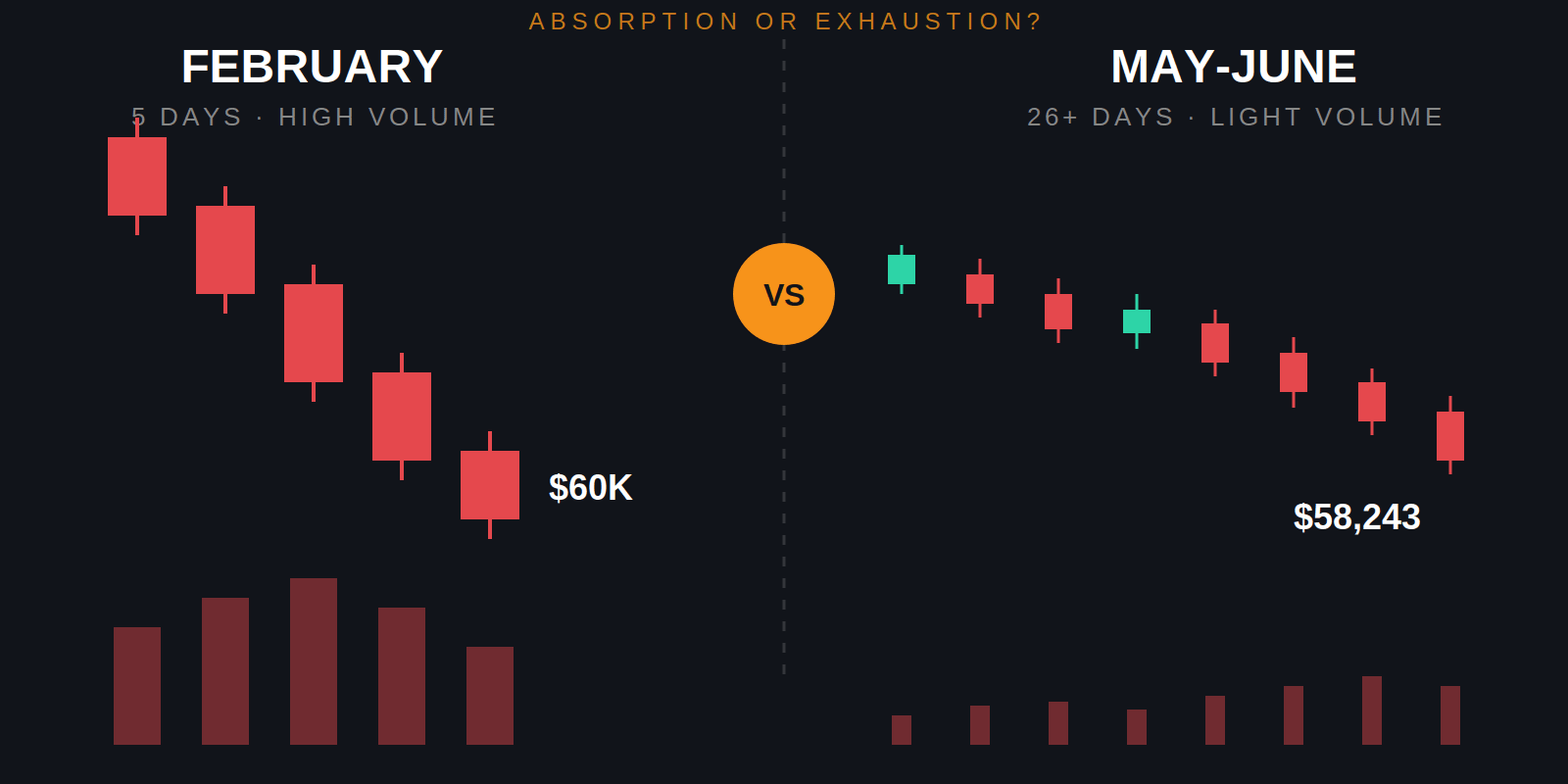
Absorption or Exhaustion: What BTC's Slow Bleed to $58K Is Telling Traders.

By BitBrainers Editorial Bitcoin has now made the trip down to the $60,000 zone twice this year, and the two trips don't look anyth...

Absorption or Exhaustion: What BTC's Slow Bleed to $58K Is Telling Traders.