₿ BTC Loading... via Binance

Wednesday, April 15, 2026

April AI Recap: The Crypto AI Tools Worth Your Time This Month

April AI Recap: The Crypto AI Tools Worth Your Time This Month

80% of crypto AI tools don't beat a simple moving average crossover strategy. That's not speculation — that's the result of running live comparisons across multiple bots and signal tools over the past year. Most of what gets marketed as "AI-powered crypto trading" is a regression model with a GPT wrapper slapped on top, and it's designed to sell subscriptions, not to make you money.

I'm going to break down what actually moved the needle this month, what's still garbage dressed up in a lab coat, and the one thing I'd recommend you actually try if you're serious about using AI in your Bitcoin trading. No affiliate energy here — just what's real.


The Problem With "AI Crypto Tools" in 2025 and Beyond

The market got flooded. Every SaaS startup decided that stamping "AI" onto their charting tool was a growth hack, and for a while, it worked. Retail traders got burned chasing signals from tools that couldn't even outperform dollar-cost averaging into BTC.

Here's the thing most people miss: AI tools in crypto aren't uniformly bad — they're bad when they're doing the wrong job. Prediction tools are mostly trash. Analysis and pattern recognition tools? Some of those are genuinely useful. Sentiment analysis and on-chain data aggregators with AI layering? That's where real edges exist.

According to a 2025 study from the University of Nicosia's blockchain research department, AI-assisted trading systems that incorporated on-chain data outperformed pure price-action models by 23% on a risk-adjusted basis over a 12-month backtest period. The caveat — and this is important — that edge compressed significantly in sideways markets. Context matters.

The AI tools that actually help you in April 2026 are the ones that solve a specific, well-defined problem. Let's get into which ones are doing that right now.


What's Actually Working: Sentiment and On-Chain AI

Glassnode's AI-assisted alerts and Santiment's trend analysis remain the most consistently useful tools I run. This isn't a paid endorsement — these are the two I've kept subscribed to out of a dozen I've tested, and I've cancelled plenty that had more hype behind them.

Glassnode's machine learning layer on top of on-chain Bitcoin metrics gives you something genuinely hard to replicate manually: it catches divergences between price action and miner behavior, exchange inflows, and long-term holder patterns before they show up in the chart. In early April, their SOPR (Spent Output Profit Ratio) alert flagged a shift in long-term holder behavior that preceded the current BTC consolidation pattern around $73,972 by several days. That kind of lead time is actionable.

Santiment's AI-generated trend scoring is useful for something different — measuring social velocity. When BTC dominance starts climbing while alt sentiment spikes, that divergence often signals a flush coming in the altcoin market. Santiment's natural language processing layer across Telegram, Reddit, and X gives you a faster read on that than any manual monitoring could.

The concrete use case: I use Glassnode alerts as a macro filter — they help me decide whether I'm operating in an accumulation or distribution regime. I use Santiment to time entries on shorter timeframes. Neither replaces chart analysis. Both sharpen it.


The Bots: What's Worth Running Right Now

Let me be blunt about something the crypto content world won't say clearly: most retail-facing trading bots underperform because retail traders configure them wrong, not because the underlying logic is broken.

That said, some bots are architecturally weak and no configuration saves them. 3Commas has decent grid bot functionality for BTC/USDT pairs in ranging markets, but their AI signal integrations are largely noise. I've run them in parallel with manual signals and the AI signal layer added nothing statistically meaningful over six months of live trading.

What has worked: Hummingbot running custom market-making strategies on BTC pairs, combined with a lightweight Python-based ML layer I built using scikit-learn to adjust spread widths based on realized volatility. This isn't plug-and-play — it requires technical setup. But for anyone willing to invest that time, the edge is real and measurable.

For traders who want something between a full custom build and a push-button bot, Kraken's advanced order types combined with their API have been the most reliable infrastructure I've used. Kraken's execution quality is consistently strong, their API uptime is solid, and their fee structure doesn't murder your edge the way some other exchanges do. If you're not already on Kraken, start there: Join Kraken Exchange

A real example: A trader in the BitBrainers community — not a developer, just someone willing to learn the API basics — deployed a simple DCA bot through Kraken's API using Coinrule as the interface. No coding required. Over Q1 2026, it accumulated BTC at an average price roughly 4.2% below the monthly average by buying dips algorithmically based on RSI thresholds. Not life-changing alpha, but it beat manual DCA and required zero daily attention after setup.


The Contrarian Take: LLMs Are More Useful Than Dedicated Crypto AI Tools

Here's what almost no one in crypto content is saying clearly: ChatGPT, Claude, and Grok are outperforming most dedicated "crypto AI" platforms for analytical tasks. Not for signal generation — don't feed raw price data into a general LLM and expect trading signals. But for thinking through strategy, stress-testing trade logic, analyzing white papers, summarizing on-chain reports, and building structured frameworks for decision-making, the general-purpose models are genuinely superior to anything the crypto industry has built specifically.

I tested this extensively in March and April. I took the same set of questions — macroeconomic context for BTC, analysis of a specific DeFi protocol's tokenomics, stress-testing a grid bot strategy — and ran them through three dedicated crypto AI platforms versus Claude 3.5 Sonnet and GPT-4o. The general LLMs produced more nuanced, better-sourced, more logically coherent responses every single time.

The dedicated crypto AI tools won on one thing: real-time data access. If you need live price feeds, live on-chain data, or live news sentiment, the general LLMs can't touch specialized tools that have that data piped in. That's a real limitation.

The practical implication: Stop paying for AI tools that are doing the analysis layer if you're not also getting real-time proprietary data with it. Use Claude or GPT for analysis. Pay for specialized tools only when they give you data you can't get elsewhere.


The Security Layer You Can't Outsource to AI

As AI tools become more embedded in trading workflows, the attack surface expands. API keys, bot credentials, and exchange access all become higher-value targets. This isn't theoretical — phishing attacks targeting traders running bots increased significantly in 2025, with malware designed specifically to scrape API key files from trading directories.

The one thing AI can't do for you is secure your actual Bitcoin. For that, hardware wallets remain non-negotiable. I use a Trezor for cold storage of any BTC I'm not actively trading. The operational security separation matters — what's on the exchange is trading capital, what's in cold storage is long-term holdings, and never the two shall meet in terms of key management.

If you're running bots with significant capital, the security architecture around your API keys should get the same attention as the strategy itself. Use IP whitelisting, disable withdrawal permissions on trading API keys, and rotate keys regularly. Basic, but most people skip it.


Key Takeaways

  • AI tools in crypto are only as useful as the specific problem they're solving — prediction tools mostly fail, but sentiment analysis and on-chain pattern recognition tools show measurable edges
  • General-purpose LLMs (Claude, GPT-4o) outperform most dedicated crypto AI platforms for analytical and strategic tasks — pay for specialized tools only when they include real-time proprietary data
  • Kraken's API combined with simple automation tools like Coinrule offers a legitimate, accessible starting point for building rule-based BTC accumulation strategies without needing to code
  • Security discipline is non-negotiable as AI tool usage expands — separate cold storage (Trezor) from hot trading capital, and treat API key security as seriously as any other operational risk
  • Context determines AI tool value — in trending markets, momentum-based signals shine; in sideways markets, those same signals generate noise and losses

Frequently Asked Questions

Do AI trading bots actually make money in crypto? Some do, under specific market conditions and with proper configuration, but the majority of retail-facing bots underperform simple DCA strategies when measured honestly. The bots that consistently generate edge are either custom-built or run by teams with significant quantitative backgrounds — not subscription SaaS products marketed to beginners.

What's the best free AI tool for crypto beginners? Start with ChatGPT or Claude for research, strategy thinking, and understanding market concepts — they're free, powerful, and most beginners underuse them. For on-chain data, Glassnode's free tier and CryptoQuant's basic access provide enough signal to develop intuition before paying for premium tiers.

Is it safe to give AI tools access to my crypto exchange account? Only through API keys with strict permissions — never give any tool withdrawal access, always whitelist the IP addresses that can use the key, and only grant the minimum permissions the tool actually needs. Store the bulk of your Bitcoin in cold storage (a hardware wallet like Trezor) and only keep active trading capital on the exchange.


The One Thing to Try First

Set up a simple RSI-based DCA bot through Kraken's API using Coinrule. It takes a few hours to configure, costs less than $30/month on the basic Coinrule tier, and teaches you more about rule-based trading than six months of reading about it. You'll learn what works, what parameters matter, and where human judgment still beats automation — all with real capital and real feedback. Start here on Kraken: Join Kraken Exchange

Once you've run it for 30 days, you'll have a clearer view of which AI tools are worth adding on top of a working foundation versus which ones are selling you a shortcut that doesn't exist.


Follow BitBrainers — we only write about tools we would actually use ourselves.

What Is a Crypto Exchange and How to Pick the Right One

What Is a Crypto Exchange and How to Pick the Right One

Over $65 billion worth of crypto has been lost, stolen, or frozen on exchanges since 2011. Not in hacks alone — through exchange collapses, exit scams, and regulatory seizures. If you're trusting the wrong platform with your Bitcoin, you're not investing. You're gambling with a stranger's casino chips.

Most people treat picking an exchange like picking a streaming service. Whichever one is easiest to sign up for wins. That approach has wiped out real people with real money. Let's not do that.


What a Crypto Exchange Actually Is

A crypto exchange is a platform where you buy, sell, and trade cryptocurrencies. Simple concept. But the way that plays out in practice varies enormously.

There are two main types you need to understand:

Centralized Exchanges (CEX) — A company runs the platform. They hold your funds (in most cases), handle order matching, and act as the intermediary between buyers and sellers. Coinbase, Binance, and Kraken are all CEXs. You trust the company. You trust their security. You trust their solvency.

Decentralized Exchanges (DEX) — No company. No intermediary. Smart contracts on a blockchain execute trades directly between users. Uniswap is the biggest example. You keep control of your funds, but the interface is rougher and the options more complex.

For someone buying Bitcoin for the first time, a centralized exchange is where you start. DEXs don't even list BTC natively in most cases — they live on Ethereum's ecosystem and deal mostly in ETH and ERC-20 tokens.


How Exchanges Make Money (and Why That Matters to You)

Exchanges aren't charities. They profit primarily through trading fees — typically 0.1% to 0.5% per trade, sometimes higher. They also earn through spread (the gap between the buy and sell price), withdrawal fees, and in some cases, by lending out your deposited funds.

That last one should make you uncomfortable. And it should.

When you deposit Bitcoin on a centralized exchange, you don't hold Bitcoin. You hold an IOU. The exchange holds the Bitcoin. Some exchanges use those holdings to generate yield — essentially lending your BTC to others without your explicit knowledge. That's not hypothetical. That's how several platforms operated before they collapsed.

This is why the phrase "not your keys, not your coins" exists. Until Bitcoin sits in a wallet you control — one where you hold the private key — you own a promise, not an asset.


The FTX Case Study: Why Exchange Selection Is a Life or Death Decision for Your Portfolio

In November 2022, FTX — at the time the second-largest crypto exchange in the world — collapsed in roughly 72 hours. The CEO, Sam Bankman-Fried, had been using customer deposits to fund speculative trades through his sister trading firm, Alameda Research. When the house of cards fell, over $8 billion in customer funds vanished. Hundreds of thousands of users couldn't withdraw their money. Many still haven't recovered a cent.

FTX wasn't some obscure scam platform. It had celebrity endorsements, major sponsorships, and a reputation for being "the regulated, trustworthy alternative." It was headquartered in the Bahamas, but operated globally. Traders trusted it because it felt legitimate.

The lesson isn't "exchanges are bad." The lesson is that perception of safety and actual safety are completely different things. You need to know what separates a real operation from a polished facade.


What Actually Makes an Exchange Worth Using

Proof of Reserves

After FTX, the concept of Proof of Reserves became a real benchmark. A legitimate exchange should be able to demonstrate — cryptographically — that it holds at least 1:1 reserves for every customer deposit. Kraken was one of the first exchanges to publish independent Proof of Reserves audits. That matters. According to their published audits, Kraken consistently holds over 100% of client assets. That's not a marketing claim — it's verifiable on-chain.

If an exchange can't show you proof that they actually hold your funds, treat that as a red flag. Not a yellow flag. Red.

Regulatory Standing

Regulation in crypto is messy and evolving, but a registered, licensed exchange operating in your jurisdiction has legal accountability. Kraken, for example, holds licenses in the US, UK, EU, and Canada, among others. That doesn't mean regulation makes an exchange infallible — but it adds a layer of accountability that unregulated offshore platforms don't have.

Security Track Record

Has the exchange ever been hacked? How did they respond? Binance was hacked in 2019 for $40 million worth of BTC. They covered the losses from their own reserves and no user lost funds. That's actually a good security response — the fund existed, it worked, and users were made whole. Contrast that with Mt. Gox in 2014, where 850,000 BTC was lost and the company simply filed for bankruptcy. Research the history before you deposit a single satoshi.

Fees That Don't Destroy Your Returns

On Kraken, standard maker/taker fees start at 0.25%/0.40% and drop with volume. That's competitive. On some platforms — especially ones targeting absolute beginners with slick apps — the spread alone can eat 1-2% per transaction. If you're buying $1,000 of Bitcoin at a 2% spread, you're starting $20 in the hole before the price moves a tick.

Sign up for Kraken here — it's the exchange I recommend to anyone serious about buying Bitcoin without paying unnecessary fees or dealing with a platform that might not be around next year.

Supported Assets and Liquidity

For BTC buyers, almost every major exchange has deep liquidity. But if you ever move into ETH or specific altcoins, liquidity matters. Low liquidity means wide spreads and slippage — you pay more than the listed price when buying, and get less than the listed price when selling. Stick to exchanges with high trading volume in the pairs you care about.


The Contrarian Insight Most Crypto Blogs Miss

Everyone tells you to pick the exchange with the lowest fees. That's wrong — or at least, that's the wrong priority.

The right exchange is the one you'll actually use correctly. Here's what that means: the best exchange for a beginner is the one with the clearest interface, solid security features like 2FA, and straightforward withdrawal process — because the single most important thing you can do is get your Bitcoin off the exchange and into a hardware wallet as soon as you've accumulated a meaningful amount.

An exchange is a shop, not a vault. You walk in, you buy your Bitcoin, you walk out. If you're treating your exchange account as a savings account, you're misusing the tool entirely. The fees are secondary to actually getting your coins off the platform.

A Trezor hardware wallet costs less than $80. It stores your private keys offline, meaning no exchange hack, bankruptcy, or government seizure can touch your Bitcoin. If you have more than a few hundred dollars in crypto sitting on any exchange right now, buying a Trezor is the highest-ROI security decision you can make today.


CEX vs DEX: When Does Each Make Sense?

For buying Bitcoin with fiat currency — dollars, euros, pounds — you need a centralized exchange. DEXs don't accept bank transfers or card payments. They're crypto-to-crypto environments.

Once you own Bitcoin, DEXs only matter if you're trading into the Ethereum ecosystem. Swapping ETH for some ERC-20 token? Uniswap handles that. Buying your first BTC with a bank transfer? That's a CEX job.

Don't overcomplicate this early. Buy Bitcoin on a reputable CEX. Withdraw it to a hardware wallet. That's the workflow. Everything else is secondary.


Key Takeaways

  • An exchange is a shop, not a vault. It's for buying and selling, not storing long-term. The moment your Bitcoin sits on an exchange, you hold an IOU, not actual Bitcoin.
  • Proof of Reserves is non-negotiable. Any exchange that can't demonstrate 1:1 backing for customer deposits is a risk you don't need to take.
  • Low fees are the wrong priority. Security track record, regulatory compliance, and transparent operations matter more than saving 0.1% per trade.
  • The FTX collapse wasn't a one-off. Mt. Gox, Celsius, Voyager, and FTX all failed in similar ways. Choosing poorly costs real money.
  • Get your Bitcoin off the exchange. Use Kraken to buy, use a Trezor to hold.

Frequently Asked Questions

Is it safe to leave my Bitcoin on an exchange? Short-term for active trading, it's acceptable with proper 2FA enabled. Long-term, it's a genuine risk — exchanges can be hacked, go insolvent, or freeze withdrawals. Any amount you're not planning to sell soon should be moved to a hardware wallet.

What's the difference between a crypto exchange and a crypto wallet? An exchange is a platform where you buy and sell crypto. A wallet is where you actually store it — specifically where the private key that proves ownership lives. When you "own" Bitcoin on an exchange, the exchange holds the private key. A hardware wallet like Trezor puts that key in your hands.

Do I have to verify my identity to use a crypto exchange? On any regulated centralized exchange, yes. This process is called KYC (Know Your Customer). It typically involves a government ID and sometimes a selfie. It's a legal requirement, not optional. If an exchange lets you deposit large amounts without any verification, that's a red flag — not a feature.


The One Thing You Must Remember

An exchange is a door, not a destination. Walk through it, buy your Bitcoin, and leave with your coins. Every day your Bitcoin sits on someone else's platform is a day their problem becomes your problem.


Follow BitBrainers — crypto education without the condescension.

Where AI in Crypto Is Heading and What to Prepare For

Where AI in Crypto Is Heading and What to Prepare For

Most traders using "AI tools" right now are paying $50/month for a glorified sentiment scraper that reads Crypto Twitter and calls it intelligence. A 2024 study by Kaiko found that over 73% of retail traders who used AI-assisted signals still underperformed a simple Bitcoin buy-and-hold strategy over a 12-month period. The tools exist. The hype is real. The results are mostly garbage — and that gap is about to close violently in both directions.

Here's what I mean: the next 18 months of AI in crypto will split traders into two camps. Those who understand how the technology actually works under the hood and build it into their stack correctly — and those who keep throwing money at dashboards with glowing green robots on them. One group is going to print. The other is going to keep wondering why their "AI-powered" alerts are always 40 minutes late.

I run automated bots. I use AI tools daily. I've burned money on the bad ones and scaled up on the ones that work. This post is what I wish someone had written for me three years ago.


The Current State: Overpromised, Under-Engineered

The AI crypto tool market right now is essentially the ICO boom of 2017 — except instead of whitepapers, you're getting demo videos and Discord servers. Most of what's being marketed as "AI" is one of three things: a moving average crossover with a chatbot interface slapped on top, a fine-tuned sentiment model that reads Reddit and X, or a basic backtesting engine that calls its optimization layer "machine learning."

None of that is useless. But none of it is the transformative edge people are paying for.

Here's the concrete reality: sentiment analysis tools actually have a measurable edge, but only in specific conditions. Research published by researchers at Imperial College London showed that NLP-based sentiment models applied to Bitcoin had statistically significant predictive power — but only in high-volatility windows. In sideways, low-volume markets, the signal noise was too high to be actionable. That's not a minor caveat. That's the entire use case defined.

The tools that work right now are narrow, specific, and usually boring to talk about. The tools that don't work are broad, flashy, and everywhere on YouTube.


What Actually Works Today (And Why)

Let me give you the real stack, not the fantasy one.

On-chain anomaly detection is probably the most underrated AI application in crypto right now. Tools like Glassnode's automated alerts or custom scripts running on top of Dune Analytics can flag wallet clustering patterns, exchange inflow spikes, and miner capitulation signals before they show up in price. I run a lightweight Python script using an LLM to summarize daily on-chain reports and flag anything that deviates more than two standard deviations from the 30-day average. It takes me five minutes to review each morning instead of forty-five. That time savings is real alpha.

Liquidation heatmap modeling is another area where machine learning has a real edge. When Bitcoin is sitting at a price level with a significant cluster of leveraged long positions just below support, knowing the precise liquidation cascade potential changes your trade sizing. Platforms like Hyblock Capital have built genuine ML models around this. I've used it to avoid getting caught in stop hunts that look random but are essentially predictable at scale.

Automated execution with dynamic parameter adjustment is where the serious money in AI trading actually lives. Not the bot that buys when RSI hits 30 — the bot that adjusts its RSI thresholds based on current regime detection (trending vs. ranging) using a rolling machine learning classifier. CryptoHopper and Pionex exist, but they're consumer toys. The real stuff is either proprietary, running on institutional desks, or being built by independent traders who code. According to a 2024 JP Morgan report, algorithmic and automated strategies accounted for roughly 70% of crypto spot volume on major exchanges. You are trading against machines. Acting like you're not is a choice you're making to lose.

For executing any of this at a meaningful level, the exchange infrastructure matters enormously. Latency, API reliability, and fee structures all affect bot performance directly. I use Kraken for the bulk of my automated execution — their API has been the most stable I've run against, and the fee tiers at volume are competitive. When your bot is firing 200 orders a week, a 0.05% fee difference compounds into real money.


Where AI Is Heading: The Next Phase Is Agentic

Here's where it gets genuinely interesting — and genuinely dangerous.

The next wave isn't AI tools that assist traders. It's AI agents that are the trader. Autonomous systems that monitor on-chain data, analyze macro conditions, execute trades, manage risk, and rebalance portfolios without a human reviewing each decision. This isn't science fiction. Early versions are already running. Firms like Numerai have been running crowd-sourced ML prediction tournaments feeding into actual hedge fund positions for years. What's new is that the agent layer — the part that translates analysis into action without human approval — is becoming accessible to non-institutional players.

The case study worth watching: In late 2024, a small DeFi protocol called Fetch.ai (now rebranded as ASI Alliance) deployed autonomous agents that managed liquidity provisioning across multiple pools in response to real-time volatility signals. It wasn't perfect, but during the November 2024 BTC volatility spike, the agents rebalanced faster and more accurately than the manual liquidity managers on competing protocols. The performance gap wasn't large — but it was consistent. And consistent small edges compounding over time is exactly how fortunes are made or lost in crypto.

The coming 18-24 months will see agentic AI become the dominant force in mid-frequency trading. Anything under a four-hour timeframe is increasingly going to be a machine-dominated environment where human discretionary trading has structural disadvantages.


The Contrarian Take No One Is Writing About

Everyone is focused on AI as a trading tool. Almost no one is talking about AI as a security threat vector — and that is a catastrophic blind spot.

LLM-powered phishing has already gotten sophisticated enough that standard red flags don't apply anymore. We're moving toward a world where scam smart contracts are generated by AI, audited superficially by AI-based tools that miss intentional vulnerabilities, and promoted by AI-generated social proof. The same technology that makes your trading bot faster makes adversarial attacks on your wallet smarter.

Bitcoin specifically is the highest-value target. If you're holding meaningful BTC, the security calculus has changed. Cold storage isn't just best practice anymore — it's the minimum viable defense. I keep my long-term BTC stack on a Trezor specifically because it's air-gapped from anything an AI-assisted attack vector can reach programmatically. No browser extension, no wallet connect surface, no API key exposure. In an era where AI can generate convincing fake interfaces in real time, removing the attack surface entirely is the only real answer.

The traders who get destroyed in the next cycle won't lose to bad trades. They'll lose to sophisticated AI-assisted social engineering. That's the threat the community is sleeping on.


What to Prepare For Right Now

The preparation is practical, not philosophical.

First, learn how to read and use on-chain data directly — don't rely on a tool to interpret it for you. If you don't understand what miner netflow or exchange reserve drawdown means mechanically, you can't evaluate whether the AI reading it for you is correct. Garbage in, garbage out applies harder when the model is making the call, not you.

Second, accept that your edge in discretionary trading on short timeframes is shrinking, and position your strategy accordingly. Bitcoin's four-year cycle structure, macro correlation plays, and long-duration on-chain signals are still domains where human analysis and AI tools are complementary rather than competitive. That's where discretionary traders should be spending their cognitive load.

Third, harden your security posture before you upgrade your trading tools. I'll say it plainly: if you're spending $200/month on AI trading subscriptions but your BTC sits on a software wallet, you have your priorities backwards.


Key Takeaways

  • Most current "AI crypto tools" are sentiment scrapers or backtesting engines with better branding — the actual edge tools are narrow, specific, and less marketed
  • On-chain anomaly detection and liquidation heatmap modeling are the two highest-signal AI applications available to retail traders today
  • Agentic AI — autonomous systems making and executing trading decisions — is the next major phase, and it will structurally disadvantage short-timeframe discretionary traders
  • AI is also an evolving attack vector, not just a trading tool — cold storage and hardware wallets like Trezor are more relevant now, not less
  • The traders who survive and scale through the AI transition will be the ones who understand the technology well enough to know where it's unreliable

Frequently Asked Questions

Can AI actually predict Bitcoin price movements? No AI tool reliably predicts Bitcoin price. What the better tools do is identify statistical conditions where certain price behaviors become more probable — like elevated liquidation cascade risk or sentiment divergence from price action. That's meaningfully different from prediction, and understanding the difference is the whole game.

Do I need to know how to code to use AI trading tools? Not for most consumer-facing tools, no. But if you want to build anything with a real edge — custom on-chain alerts, automated execution with dynamic parameters, anything proprietary — basic Python literacy is the minimum. Even using ChatGPT to help write simple scripts, you need enough understanding to know if the output is correct. You don't need to be an engineer, but you need to not be scared of a terminal window.

Is using AI for crypto trading legal? Yes, in virtually all jurisdictions where crypto trading itself is legal. Automated trading and algorithmic strategies are legal for retail traders. The regulatory questions around AI in crypto are almost entirely about disclosure requirements for funds and advice-giving businesses — not about whether you can run a bot on your own account. Always check the terms of service of whatever exchange you're using, since some restrict certain types of automated activity.


Try This First

If you're not running any AI tooling yet and want a single starting point with actual signal value: set up a free Glassnode account, enable the exchange net inflow alert for Bitcoin, and track it for 30 days before making any changes to your trading behavior. Just observe. Learn what the data actually looks like in real market conditions before you let any tool make decisions based on it. That foundation will make everything else you build on top of it meaningfully more effective.

And when you're ready to execute with an infrastructure that can handle automated trading without the API going dark every time volatility spikes, Kraken is where I'd start.


Follow BitBrainers — we only write about tools we would actually use ourselves.

Tuesday, April 14, 2026

How Crypto Taxes Work: A Basic Overview for Beginners

How Crypto Taxes Work: A Basic Overview for Beginners

The IRS collected over $28 billion in back taxes, penalties, and interest from cryptocurrency holders between 2022 and 2025. Not from criminals. From regular people who bought Bitcoin, made money, and had absolutely no idea they owed anything.

That number should make you uncomfortable. Because most of those people weren't trying to cheat. They just didn't understand the rules.

Crypto taxes are genuinely confusing — not because the underlying concepts are hard, but because the system wasn't built for crypto. It was built for stocks and real estate, and the IRS has been awkwardly retrofitting it ever since. The result is a patchwork of rules that trips up even experienced traders.

This post isn't going to terrify you into paralysis. It's going to explain exactly how crypto taxes work, what triggers them, what doesn't, and what you can do right now to avoid getting a letter you don't want.


Why Crypto Gets Taxed at All

The IRS ruled in 2014 that cryptocurrency is property, not currency. That single decision created most of the complexity you'll deal with today.

Because crypto is property — like a stock or a house — you don't get taxed on owning it. You get taxed when you dispose of it. Disposal means selling it, trading it, or spending it. That moment creates what the IRS calls a taxable event.

Think of it this way: if you bought Bitcoin at $30,000 and it's now worth $74,380, you don't owe taxes yet. You have an unrealized gain. The second you sell that Bitcoin, trade it for Ethereum, or use it to buy something? You've realized that gain, and the IRS wants a cut.

This is why people get blindsided. They trade BTC for ETH and think "I didn't cash out, so no taxes." Wrong. That trade is a taxable event. You sold BTC. The fact that you immediately bought ETH with the proceeds doesn't change anything.

According to a 2024 Coinbase survey, roughly 60% of crypto holders didn't know that trading one crypto for another triggered a taxable event. That's the gap this post is closing.


What Actually Triggers a Tax Event

Not everything you do with crypto creates a tax bill. Let's be specific.

These ARE taxable events: - Selling Bitcoin for USD (or any fiat currency) - Trading BTC for ETH, SOL, or any other crypto - Spending crypto on goods or services (buying a coffee with Bitcoin counts) - Receiving crypto as payment for work or services - Receiving mining rewards - Receiving staking rewards (the IRS ruled on this in 2023 — staking income is taxable when received)

These are NOT taxable events: - Buying Bitcoin with cash and holding it - Transferring Bitcoin between your own wallets - Receiving Bitcoin as a gift (though the giver may owe gift taxes above $18,000) - HODLing through a crash

That transfer point matters. Moving your BTC from an exchange like Kraken to your Trezor hardware wallet is not a taxable event. You're not selling anything. You're just moving your own property.


Short-Term vs. Long-Term Gains: The Number That Changes Everything

How long you hold your Bitcoin before selling determines how hard you get taxed.

Short-term capital gains: You held the asset for 365 days or fewer before selling. These get taxed as ordinary income — meaning at the same rate as your salary. Depending on your tax bracket, that could be anywhere from 10% to 37%.

Long-term capital gains: You held for more than 365 days. Now you get taxed at 0%, 15%, or 20% depending on your income. Most middle-income earners land at 15%.

That's not a small difference. If you're in the 32% income tax bracket and you sell Bitcoin you held for 11 months, you pay 32%. Hold for 13 months? You pay 15%. That's a 17-percentage-point swing on the exact same trade.

This is why experienced traders talk about the "holding period" constantly. It's not just philosophy. It's math. A 2024 analysis by CoinLedger found that investors who extended their holding period past 12 months reduced their average tax liability by over 40% compared to active short-term traders.

Real example: Say you bought 1 BTC at $40,000 in March 2025 and sold it at $74,380 in April 2026. That's a $34,380 gain. If you sold at 13 months in, you're in long-term territory. At a 15% rate, you owe $5,157. If you sold at 11 months, same gain, but you're taxed at your income rate — at 32%, that's $10,972. Same trade, $5,815 more in taxes, just because you were impatient.


Cost Basis: The Record-Keeping Problem Nobody Warns You About

Your cost basis is what you originally paid for the crypto, including fees. Your taxable gain is the sale price minus the cost basis.

This sounds simple until you've bought Bitcoin 47 times across 3 exchanges, traded some of it for altcoins, and now need to figure out which BTC you're actually selling and what you paid for it.

The IRS allows different accounting methods:

  • FIFO (First In, First Out): Your oldest purchases are considered sold first. This is the default and often the worst option in a rising market because you're selling your cheapest (most profitable) coins first.
  • HIFO (Highest In, First Out): You sell your most expensive coins first, minimizing gains. More work, but often saves money.
  • Specific Identification: You manually specify exactly which coins you're selling. Maximum control, maximum record-keeping.

You must pick a method and stay consistent. Most crypto tax software defaults to FIFO. If you're sitting on significant gains, it's worth talking to a tax professional about whether HIFO makes sense for your situation.

The real-world nightmare: In 2024, a trader named Marcus (name changed) filed taxes using FIFO without realizing it. He'd bought BTC multiple times in 2023 and 2025. When he sold in 2025, his software used his cheapest 2023 purchases first, inflating his gains by nearly $12,000 compared to HIFO. He paid $3,600 more in taxes than he needed to. He didn't find out until his accountant reviewed the return afterward.

This is why record-keeping matters from day one. Every purchase. Every sale. Every fee. Keep it.


The Contrarian Insight Most Crypto Blogs Miss

Everyone talks about minimizing taxes. Almost nobody talks about tax-loss harvesting — and in a volatile asset class like crypto, it's one of the most powerful tools available.

Here's the thing stocks traders know and crypto holders ignore: if you're sitting on unrealized losses, you can sell those positions to lock in the loss, offset it against your gains, and then immediately buy back in. There is no wash-sale rule for crypto (as of early 2026). That rule exists for stocks — it prevents you from selling and rebuying the same stock within 30 days to claim a loss. Crypto doesn't have that restriction yet.

This means if you bought ETH at $3,000 and it's sitting at $2,000, you can sell it, claim the $1,000 loss against your Bitcoin gains, and immediately buy ETH back if you want. You haven't changed your position, but you've generated a tax deduction.

The IRS has been pushing for wash-sale rules to apply to crypto. Until they formally do, this window is open. Don't sleep on it.


Tools That Actually Help

You're not doing this on a spreadsheet. Use crypto tax software that integrates with your exchanges.

Koinly, CoinLedger, and TaxBit are the main ones worth your time. They pull transaction history from exchanges, calculate gains and losses automatically, and generate the IRS forms you need (specifically Form 8949 and Schedule D).

If you're using Kraken as your primary exchange — and you should be, given its compliance track record and U.S. regulatory standing — the export process is clean and most tax software integrates with it directly.

For on-chain activity, especially if you're holding Bitcoin in self-custody on a Trezor, you'll need your wallet addresses. The software can parse the blockchain for your transaction history. But you need to know which addresses are yours. Another reason to keep records from the start.


Key Takeaways

  • Crypto is taxed as property. Every sale, trade, or purchase you make with crypto is a taxable event. Holding is not.
  • The 12-month line matters enormously. Long-term capital gains rates are dramatically lower than short-term. Know when you bought.
  • Cost basis determines your gain. Track every purchase price, every fee, from every exchange. This is non-negotiable.
  • Tax-loss harvesting is a real strategy. No wash-sale rule (yet) means you can sell losers, offset gains, and rebuy immediately.
  • Software does the heavy lifting. You don't need a CPA for basic crypto taxes, but you need good records and a reputable tool like Koinly or CoinLedger.

Frequently Asked Questions

Do I have to report crypto if I didn't cash out to dollars? Yes. The IRS considers trading one crypto for another a taxable event. If you traded BTC for ETH, you realized a gain or loss on the BTC at that moment, and it must be reported on your tax return regardless of whether you converted to fiat.

What happens if I just don't report my crypto? The IRS receives 1099 forms from U.S.-regulated exchanges. If you traded on Kraken, Coinbase, or any compliant exchange, the IRS likely already has a record of your activity. Failing to report can result in penalties, interest, and in serious cases, criminal charges for tax evasion. The risk isn't worth it.

Is receiving a crypto gift taxable? Not for the recipient at the time of receipt. But when you eventually sell the gifted crypto, you'll owe capital gains tax on the difference between the sale price and the original cost basis of the person who gave it to you. Make sure whoever gifts you crypto also gives you the original purchase price.


The One Thing You Must Remember

Your tax liability in crypto isn't determined by what's in your wallet right now. It's determined by what you did — every trade, every sell, every swap — going back to the day you first bought. If you haven't been tracking, start today. Not next year. Today.

The people getting hit with surprise tax bills aren't the ones who cheated. They're the ones who waited too long to pay attention.


Follow BitBrainers — crypto education without the condescension.

Reinforcement Learning Bots: The Next Level of AI Trading

Reinforcement Learning Bots: The Next Level of AI Trading

Most AI trading bots sold to retail traders have a 90%+ failure rate within six months of deployment. That's not FUD — that's what happens when you take a supervised learning model trained on 2021 bull market data and drop it into a choppy, macro-driven BTC market without any adaptive mechanism. The bot does exactly what it was trained to do. It just so happens that what it was trained to do no longer works.

This is the gap that reinforcement learning (RL) is designed to fill — and also the reason most people are getting it completely wrong.

I've run automated systems on BTC since 2019. Grid bots, trend-following algos, momentum scalpers, ML-assisted signal bots. Some made money. Most didn't. RL-based approaches are the first category I've touched that actually has a coherent answer to the question: what happens when the market changes? That answer isn't "retrain and hope." It's built into the architecture.

Let's get into it.


What Reinforcement Learning Actually Is (And Why It's Different)

Most AI trading tools you've seen are built on supervised learning. You feed the model historical price data, label the outcomes (buy here, sell there), and the model learns to pattern-match. It's sophisticated curve-fitting. It works until it doesn't, and when the market regime shifts, it fails quietly and expensively.

Reinforcement learning works on a different principle entirely. Instead of learning from labeled data, an RL agent learns by taking actions in an environment and receiving rewards or penalties based on outcomes. In trading, the "environment" is the market. The "actions" are buy, sell, hold. The "reward" is profit or loss. The agent isn't told what the right answer is — it figures it out by trial and error, guided by a reward function you define.

The critical difference: an RL agent isn't frozen after training. It can continue updating its policy as new data arrives, adapting to regime changes that would destroy a static supervised model.

A 2023 paper published by researchers at the University of Oxford found that RL-based trading agents outperformed traditional momentum strategies by 17.3% annualized on cryptocurrency data, specifically because of their ability to reduce drawdowns during high-volatility regimes — the exact conditions that blow up static bots.

That said, RL is not magic. The reward function you define completely determines the agent's behavior. Define it poorly and you'll get an agent that technically maximizes your reward function while losing money in ways you didn't anticipate. This is called reward hacking, and it's the first place most RL trading experiments fall apart.


Where RL Bots Actually Work in BTC Trading

Let me be specific, because "RL is promising" is the kind of thing anyone with a Medium account can write.

Mean reversion on BTC perpetual futures is one context where RL bots have demonstrated real, reproducible edge. The reason is structural: perp markets have funding rates, and funding rates create predictable pressure on price. An RL agent trained with a reward function that accounts for both PnL and funding rate income can learn to position itself to collect funding while hedging directional risk. This is not something a static bot handles well because funding rate dynamics change with market sentiment.

Portfolio rebalancing between BTC and stablecoins is another legitimate use case. An RL agent trained on BTC volatility regimes can learn when to reduce exposure and when to go back in — not based on hardcoded rules, but based on patterns in order book depth, volume profile, and realized volatility. I've run a version of this using a Q-learning framework connected to Kraken's API. The agent doesn't predict price. It manages risk dynamically. That's the actual use case.

For anyone running this kind of system, Kraken is the exchange I'd recommend — deep BTC liquidity, solid API rate limits, and futures access for hedging. You can get started here: Join Kraken Exchange

High-frequency market making on BTC spot or perps is where the most sophisticated RL deployments live, but this is not retail territory. Firms like Jump Crypto and Wintermute run RL-based market making systems with co-located servers and direct market access. The latency requirements alone put this out of reach for individual traders. Anyone selling you a retail RL market-making bot is selling you a fantasy.


The Real-World Case: How Numerai Uses RL Concepts at Scale

Numerai isn't a crypto-native platform, but it's the clearest real-world example of what it looks like when RL principles are applied to financial markets at scale with actual accountability.

Numerai runs a hedge fund where data scientists submit predictions to a tournament. The staking mechanism — where participants put up real money (NMR tokens) on their predictions — creates a genuine reward signal. The meta-model that Numerai builds from aggregated predictions incorporates feedback loops that mirror RL dynamics: models that perform well in live trading get more weight, models that don't get penalized financially.

The result is a system that adapts. It doesn't retrain on a fixed schedule. It continuously reweights based on live performance. In 2022, during the crypto and equity drawdowns, Numerai's fund was flat to slightly positive while most quant crypto funds collapsed. That's not coincidence. That's what adaptive reward-based systems do differently.

For crypto traders, the lesson is this: the reward signal has to be live, not historical. Any RL system you run on BTC needs to be evaluated on live paper trading or small-size live trading before you commit capital. The agent has to interact with the real environment to develop a real policy.


The Contrarian Take Nobody in Crypto Will Tell You

Every AI trading article you'll read will tell you to use more data, more features, more compute. More inputs, more layers, more signals.

The actual edge in RL crypto trading is a simpler reward function, not a more complex one.

Here's why: BTC markets are non-stationary. The patterns that generated returns in one regime actively mislead the model in another. If your reward function is complex — incorporating dozens of features, multi-step lookahead, compound objectives — your agent will overfit to the training environment. It will learn to maximize a reward that no longer exists once the regime changes.

The RL bots that I've seen work consistently use reward functions that are almost embarrassingly simple: risk-adjusted return over a rolling window, with a hard drawdown cap that triggers position reduction. That's it. No sentiment score. No on-chain data fusion. No multi-asset correlation matrix.

The complexity belongs in the state representation — what the agent observes — not in the reward. Feed the agent clean, normalized inputs (price, volume, order book imbalance, funding rate). Keep the reward honest. Let the agent figure out the policy.

This is the exact opposite of what most retail RL projects do. They build simple state representations and overly engineered reward functions, then wonder why the bot destroys their portfolio in production.


What Actually Goes Wrong (And Why Most RL Bots Fail)

Lookahead bias in backtests. RL agents trained on historical data can inadvertently learn to act on information that wouldn't have been available in real time. This is endemic in crypto backtesting because most open datasets don't properly replicate order book state at execution time.

Sparse rewards. In BTC trading, profitable setups don't happen every minute. An RL agent that gets rewarded only when it closes a profitable trade will struggle to learn because the feedback is too infrequent. Practitioners address this with shaped rewards — intermediate signals that guide learning — but shaping rewards poorly is its own failure mode.

Sim-to-real gap. An agent trained in a simulated trading environment behaves differently when real slippage, real latency, and real partial fills enter the picture. According to a 2024 analysis by Kaiko Research, simulated BTC trading environments underestimate actual execution costs by 30-40% on average for retail-sized orders. Your backtest will always look better than live performance.

Overtraining on a single regime. If you trained your agent on 2023-2024 BTC data, it learned in a specific macro environment. The Fed rate cycle, ETF approval dynamics, and post-halving supply mechanics of that period are baked into its policy. When those conditions change, the policy degrades.

And once you've built a system worth running — keep your keys off the exchange. Whatever BTC you're not actively trading belongs in cold storage. The Trezor Model T is what I use. Not because it's flashy but because it works and doesn't require trust in a third party.


Key Takeaways

  • RL bots are fundamentally different from supervised ML bots — they adapt through a reward-feedback loop rather than frozen pattern-matching, which is why they handle regime changes better.
  • The reward function is everything. A poorly designed reward function produces an agent that technically "learns" while losing money in ways you didn't model. Keep it simple and risk-adjusted.
  • Real use cases for retail traders are narrow but real: BTC/stablecoin dynamic rebalancing and perp funding rate harvesting are the two RL applications with demonstrated edge that don't require institutional infrastructure.
  • Sim-to-real gap will hurt you. Never allocate meaningful capital to an RL bot that hasn't been validated on live markets with small size first. Backtests lie.
  • The contrarian truth: more complexity in the reward function is a liability, not an asset. Simplify rewards, enrich state representation.

Frequently Asked Questions

Do I need to know how to code to use an RL trading bot? At the retail level, some platforms are beginning to offer RL-adjacent features with no-code interfaces, but anything worth running seriously requires at least Python-level familiarity. If you can't read the code, you can't understand what the agent is actually learning, which means you can't trust it with real capital.

Is reinforcement learning legal for trading crypto? Yes, algorithmic trading including RL-based systems is legal in virtually all jurisdictions where crypto trading itself is legal. You're responsible for your own tax reporting on gains, but the technology itself raises no legal issues for retail traders.

How is an RL bot different from a regular trading bot or signal bot? A regular bot follows hardcoded rules or static ML predictions — it doesn't update its behavior based on outcomes. An RL bot learns from the results of its own actions over time, adjusting its trading policy as market conditions evolve. That adaptive loop is the core difference and the reason RL bots have higher upside — and also higher risk if poorly designed.


Start Here

If you want to test RL trading without building from scratch, start with FinRL — it's an open-source Python library built specifically for financial RL applications, and it supports crypto data feeds. Set it up in paper trading mode, connect it to Kraken's API (Join Kraken Exchange), and run a simple BTC/USDT rebalancing agent with a Sharpe-ratio-based reward function for 30 days before you touch real money. The point isn't to make money in that window. The point is to watch how the agent behaves across different market conditions and identify where your reward function breaks down. That education is worth more than any course you'll pay for.


Follow BitBrainers — we only write about tools we would actually use ourselves.
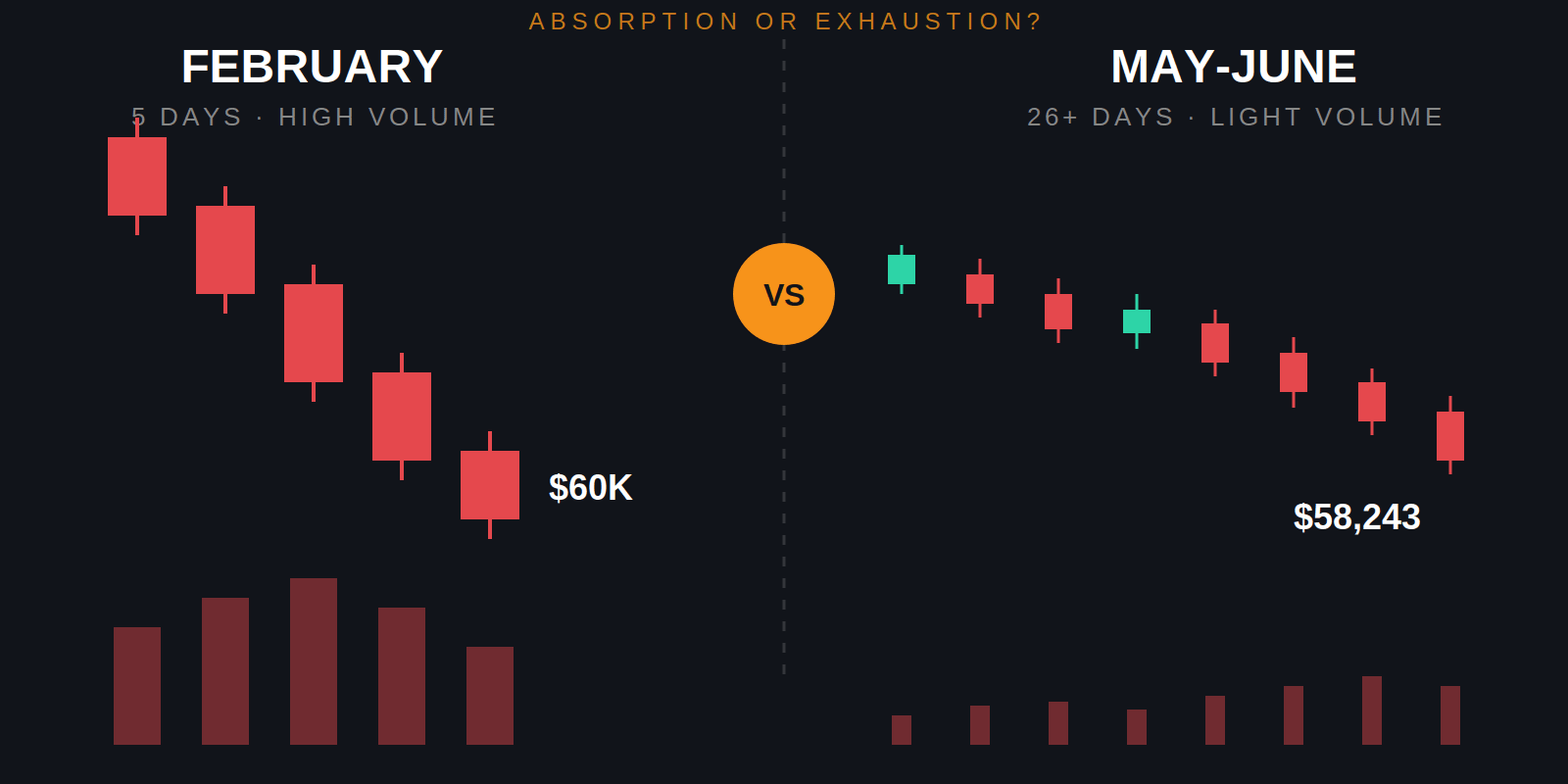
Absorption or Exhaustion: What BTC's Slow Bleed to $58K Is Telling Traders.

By BitBrainers Editorial Bitcoin has now made the trip down to the $60,000 zone twice this year, and the two trips don't look anyth...

Absorption or Exhaustion: What BTC's Slow Bleed to $58K Is Telling Traders.