₿ BTC Loading... via Binance

Saturday, May 16, 2026

The Traders Who Survive AI Will Not Be the Ones Who Out-Trade It

BitBrainers - When AI Manages Your Portfolio Better Than You Do, What Is Your Job analysis and insights

AI portfolio management is not a future concept. Platforms running algorithmic and AI-driven rebalancing now manage billions in digital assets across institutional and retail accounts. Most people still think they are competing with other humans when they trade Bitcoin. They are not. They are competing with systems that process thousands of data points per second without emotion, ego, or sleep deprivation.

The Gap Between Human Traders and Algorithmic Systems Is Already Structural

Retail traders average significantly higher drawdowns during volatile events than algorithm-managed portfolios, not because humans are dumb but because human cognition was not designed for 24/7 markets with millisecond feedback loops. Bitcoin does not close at 4pm. Human attention does. That structural gap compounds every single day.

The events of this past week illustrate the point sharply. Bitcoin slid toward the $77,000 range as geopolitical tension escalated around potential US and Israeli military action against Iran. Retail traders panic-sold. Algorithmic systems recognized the volatility pattern, adjusted exposure limits, and waited. That is not speculation. That is the observable difference between reactive and systematic decision-making.

AI Already Runs Real Capital in Crypto, Not Just Backtests

Firms like Numerai have been running AI-generated hedge fund strategies since 2015, and by 2024 they had paid out over $60 million in rewards to data scientists contributing models. That is not a lab experiment. That is a live, production-grade system where machine-generated signals control real capital.

On the DeFi side, protocols like Gauntlet have been running on-chain risk parameter management for Aave and Compound since 2020. They use agent-based simulations to recommend liquidation thresholds and collateral ratios. This is AI with direct governance influence over billions in locked value. Most crypto Twitter does not even know Gauntlet exists.

Coinbase Asset Management launched institutional crypto strategies that incorporate quantitative and algorithmic layers. The infrastructure already exists at scale. The question is not whether AI manages money. The question is what happens to the 50 million retail traders who still think gut feeling is an edge.

Most People Do Not Know This About How Algorithmic Systems Actually Fail

Here is what almost no one talks about: AI portfolio systems fail not in calm markets but in regime changes. A regime change means the underlying relationship between variables shifts. Bitcoin in a macro risk-off event behaves differently than Bitcoin in a crypto-native bear market. Models trained on one regime misfire badly in another. The best human crypto traders are not better at execution. They are better at recognizing regime shifts before models recalibrate. That specific skill, regime identification, is where human judgment still has edge. For now.

The window for that edge is probably 3 to 5 years. Once AI systems ingest enough cross-regime data from multiple full Bitcoin cycles, including 2018, 2020, 2022, and beyond, the pattern recognition will outpace human intuition even there. Traders who understand this and are retraining now will survive the transition. Traders waiting to see if it happens will not have time to catch up.

Your Job Is Not to Pick Assets Anymore, It Is to Set Constraints

When AI manages execution, the human role shifts from picker to architect. You define the risk envelope. You decide what Bitcoin allocation range you can psychologically and financially tolerate. You set the rules about when to exit a strategy entirely if macro conditions cross certain thresholds. The machine follows the rules. You write them.

This is not a demotion. It is actually a more sophisticated job. Most retail traders skip the constraint-setting phase entirely and go straight to picking assets. That is why they get wrecked. A system without constraints is just gambling with extra steps.

Think of it like this. A pilot on a modern commercial aircraft does not manually fly most of the route. They monitor, intervene in edge cases, and make judgment calls on situations the autopilot was not designed to handle. Nobody says the pilot lost their job to automation. They evolved into a higher-order function.

The Contrarian Position That Most Crypto Blogs Completely Miss

Everyone frames this as AI versus human. That is the wrong frame. The real disruption is that AI commoditizes the execution layer of investing, which means alpha moves entirely into the structural layer. Structural alpha means things like: which exchange has the most reliable infrastructure during high-stress events, which custody solution survives regulatory and security shocks, and which networks are actually building real-world utility versus narrative.

This is why where you hold your Bitcoin matters as much as when you trade it. During volatile periods, the investors who keep their long-term Bitcoin in self-custody on a hardware wallet like Trezor are not affected by exchange liquidations, freezes, or counterparty failures. That is structural alpha. It does not show up in a trading algorithm because it is not a trading decision. It is an architecture decision.

The traders who lose to AI are the ones trying to out-trade it. The ones who survive are the ones who stop trading their Bitcoin core position entirely and let systematic tools handle the noise around the edges.

What Happens to Portfolio Strategy When Execution Becomes Free

If AI handles rebalancing, tax-loss harvesting, risk adjustment, and entry and exit timing, the cost of those functions approaches zero. That deflationary pressure on execution services is already visible. Trading fees at major platforms have collapsed over the past 5 years. Coinbase charges institutional clients a fraction of what they charged retail in 2019. Kraken has consistently been one of the lowest-fee major exchanges for active traders, and that trend continues downward as automation reduces the cost of processing trades.

When execution is free, the premium moves to trust and reliability. Which platform does not go down when Bitcoin drops $5,000 in an hour? Which exchange has proven its security architecture under real attack conditions? These are the questions that matter more as the execution layer gets commoditized. You can use Kraken at https://invite.kraken.com/JDNW/r5djazxy to access one of the more battle-tested trading environments currently available to retail users.

Bitcoin Specifically Becomes the Base Layer for AI-Managed Portfolios

AI systems building diversified crypto portfolios will default-weight Bitcoin heavily because its liquidity depth, price history, and on-chain data richness make it the most modelable asset in the space. Ethereum has smart contract data that adds complexity. Altcoins introduce tail risk that increases model error. Bitcoin is the cleanest signal.

This is not a personal preference for Bitcoin maximalism. It is a modeling reality. The longer the price history and the deeper the order book, the more training data a model has to work with. Bitcoin has both at a scale no other crypto asset matches. By the time AI portfolio management becomes mainstream retail infrastructure, Bitcoin's structural dominance in model portfolios will be baked in algorithmically, not just ideologically.

The Assumption You Came In With Is Probably Wrong

Most readers assume that the primary risk of AI portfolio management is underperformance. That is not the real risk. The real risk is concentration. If millions of retail traders adopt similar AI tools built on similar models trained on similar data, they create synchronized behavior. Synchronized behavior means cascading liquidations, correlated drawdowns, and flash crashes that no individual user's AI anticipated because the risk was systemic, not individual. The 2010 Flash Crash in equities was a preview. In a market that never closes and has no circuit breakers, the consequences of model herding could be significantly more severe.

What You Should Do Today Before the Transition Completes

Stop trying to beat the machine at its own game. Concentrate on the decisions that AI cannot make for you: how much of your net worth is appropriate to hold in Bitcoin, what your actual risk tolerance is under stress conditions rather than what you think it is on a calm day, and whether your custody setup can survive a black swan event.

Move your long-term Bitcoin holdings into self-custody. A hardware wallet like Trezor at https://affil.trezor.io/aff_c?offer_id=137&aff_id=135511 is the most direct way to ensure that no exchange insolvency, AI trading error, or platform freeze touches your core position. That is not a trading decision. That is infrastructure hygiene.

Learn enough about quantitative thinking to write your own constraints. You do not need to code a model. You need to be able to say: my Bitcoin allocation never goes below X or above Y, and I reassess if Z macro condition changes. That is the skill set that survives the AI transition. Everything else is being automated.

Disclosure: This post contains affiliate links to Trezor and Kraken. BitBrainers may earn a commission at no extra cost to you. This is not financial advice.

BitBrainers. No hype. No fluff. Just crypto that matters.

Bittensor Is Quietly Building the AI Economy Wall Street Doesn't See Yet

BitBrainers - Bittensor Explained: The Decentralized AI Network Every Crypto Trader Should Know analysis and insights

Most crypto traders still think of AI tools as ChatGPT wrappers slapped onto a trading dashboard. Bittensor is doing something structurally different, and if you are running bots or automated systems, ignoring it is a mistake you will feel later.

Centralized AI Has a Monopoly Problem Bittensor Was Built to Break

Every major AI model right now sits behind a corporate API. OpenAI, Google, Anthropic, they all control access, pricing, and what the models can do. If you build a trading system on top of one of those APIs, you are one policy change away from losing a core function. Bittensor, which runs on the TAO token, creates a decentralized marketplace where AI models compete to provide outputs, and validators reward the best performers with TAO. No single company owns the intelligence layer.

The Bittensor mainnet launched and has been running with real validator and miner activity for a meaningful period now. Subnet 8, which focuses on time-series prediction, has been used by traders looking for forecasting models that are not gatekept by a Silicon Valley terms-of-service agreement. The economic incentive structure means the models have to actually perform or they stop getting rewards.

TAO Is Not Just Another Governance Token, It Is the Network's Fuel

Most crypto governance tokens are glorified voting tickets. TAO actually functions as the incentive mechanism for the entire intelligence market. Miners submit AI model outputs, validators score them, and TAO flows to the best performers. The network mints TAO similarly to how Bitcoin mints BTC, with a capped supply and a halving schedule built in.

The total TAO supply is capped at 21 million, a deliberate structural choice that mirrors Bitcoin's design. That is not a coincidence. The Bittensor founders were clear about positioning TAO as a deflationary asset tied to productive AI work rather than speculation alone. For a crypto trader, this creates a different kind of supply dynamic than inflationary tokens that dilute you every quarter.

The Subnet System Is Where Bittensor Gets Genuinely Interesting

Bittensor is not one AI network, it is a network of networks. Each subnet is a specialized competition for a specific type of AI task. Subnet 1 handles general text prompting. Subnet 13 focuses on data scraping and retrieval. Subnet 18 is specifically built for audio processing. By May 2026, there are over 60 active subnets running on the network, each with its own validator economy and model competition.

This matters for crypto traders because it means you can tap into specialized intelligence rather than a general-purpose model that is mediocre at everything. A subnet dedicated to financial data analysis is going to produce outputs calibrated for that domain, not outputs trained on Reddit posts and recipe blogs. The specialization is structural, not just a marketing claim.

Most People Do Not Know This About How Bittensor Validators Actually Work

Here is what almost no one explains clearly. Validators on Bittensor do not just passively score models. They stake TAO to gain voting power, and their stake is at risk if they score poorly or act maliciously. This creates a double-sided accountability system where both miners and validators have skin in the game. Bad validators lose influence and potentially stake over time through the weight-setting mechanism.

This is fundamentally different from how most blockchain oracle or data networks operate, where validators are often just running scripts that rubber-stamp outputs. On Bittensor, a validator who consistently rewards low-quality models gets out-competed by validators who reward high-quality ones, because the miners stop routing to them. The whole thing self-corrects without a central referee.

The Chainlink Comparison Is Instructive and Most Analysts Are Getting It Wrong

The Bittensor vs. Chainlink framing keeps coming up in crypto circles, and it mostly misses the point. Chainlink secures data feeds. Bittensor produces intelligence. These are different layers of infrastructure. This week, Lombard Finance dropped LayerZero and moved to Chainlink to secure cross-chain messaging for over $1 billion in Bitcoin assets. That is Chainlink doing exactly what it was designed for, reliable data verification across chains.

Bittensor is not trying to replace that. It is trying to create the layer above it, where the actual decision-making intelligence lives. Think of Chainlink as the pipe and Bittensor as the brain that interprets what flows through the pipe. Traders who understand this distinction will know which infrastructure plays to watch for their actual use cases.

Running AI Trading Bots on Bittensor Is Not Plug-and-Play Yet

Let me be straight with you. Accessing Bittensor subnets as a trader is not as simple as signing up for an API key. You either need to run a validator node with staked TAO, or you use one of the front-end interfaces being built on top of the network. Projects like Corcel have built chat and API interfaces on top of Bittensor subnets to make access easier, but the ecosystem is still early enough that technical friction is real.

If you are running Python-based trading bots, integrating Bittensor subnet outputs directly into your strategy requires work. The bt Python library exists and is functional, but you are not going to find a no-code drag-and-drop solution here in May 2026. If you are a non-technical trader, your best entry point right now is TAO as an asset exposure play rather than direct infrastructure use.

TAO Liquidity and Where You Actually Trade It Matters

TAO trades on centralized exchanges including Kraken, which gives you clean fiat on-ramps and solid liquidity without having to wrestle with bridging. Given the volatility inherent in AI narrative tokens, having a reliable exchange matters more than people give credit for. Slippage on low-liquidity venues can kill a position before the thesis even plays out.

For traders holding TAO as a longer-term position, keeping assets off exchanges is non-negotiable. A Trezor hardware wallet handles TAO storage securely and keeps your position out of exchange counterparty risk. Given that Bittensor is still a maturing ecosystem with smart contract and network upgrade risks, not holding your own keys is a mistake you cannot undo.

The Contrarian Take Nobody in Crypto AI Is Saying Out Loud

Every bull case for Bittensor assumes that decentralized AI will outcompete centralized AI because of censorship resistance and open access. That assumption is probably wrong in the short term. OpenAI and Google have orders of magnitude more compute, training data, and talent. Where Bittensor actually wins is not in raw model quality right now. It wins in composability and financial alignment.

Because TAO rewards the best models economically, Bittensor creates an incentive structure that centralized companies cannot replicate without destroying their own profit model. Over time, this should attract serious AI developers who want direct compensation for their work rather than a salary from a corporation that owns everything they build. The 21 million cap on TAO means that if the network captures even a fraction of the AI services market, the scarcity math becomes very different from where it sits today.

The One Thing You Should Try First

Do not start by trying to run a miner or a validator node. Start by getting TAO exposure through a trusted exchange like Kraken, then spend time inside the Bittensor dashboard and the subnet explorer at taostats.io to understand which subnets are growing in validator participation and miner count. Growing validator participation on a subnet is a leading indicator that serious operators are betting on that subnet's outputs being valuable. That is your signal layer before you commit deeper capital or technical resources.

The Assumption You Walked In With Is Probably Wrong

You likely came into this thinking Bittensor is another speculative AI token riding a narrative wave, the same category as dozens of tokens that pumped on AI hype and then collapsed. That framing is too simple. Bittensor has working infrastructure, active subnets processing real model outputs, and an economic model that creates genuine alignment between AI quality and token reward. That does not mean TAO cannot still be volatile and high-risk, it absolutely can and will be. But dismissing it as pure narrative play means you miss what is actually being built underneath the price chart.


Disclosure: This post contains affiliate links to Trezor and Kraken. BitBrainers may earn a commission at no extra cost to you. This is not financial advice.


BitBrainers. We check the facts so you don't have to.

Your Bank Charges You to Hold Your Own Money. Lightning Network Doesn't.

BitBrainers - Your Bank Charges You to Hold Your Own Money. Lightning Network Doesn't

Most people who spin up a Lightning Network node do it expecting easy, hands-off Bitcoin income. Most of them quietly shut it down within 90 days. That is not cynicism. That is the pattern. And if you understand exactly why that happens before you start, you might be one of the few who actually makes it work.

Let me walk through what running a node actually involves, who it makes sense for, and what nobody in the "passive income with Bitcoin" content space will tell you upfront.

The Lightning Network Exists Because Bitcoin's Base Layer Has a Throughput Problem

Bitcoin processes roughly 7 transactions per second on its base layer. Visa handles tens of thousands. That gap is not a bug waiting to be fixed. It is a deliberate design choice that prioritizes decentralization and security over speed. Lightning was built on top of Bitcoin to handle small, fast, frequent transactions by routing them off-chain through a network of payment channels. Final settlement happens on-chain, but the day-to-day movement of satoshis happens instantly and with near-zero fees.

As of May 16, 2026, Bitcoin sits at $78,405. At that price, even small fractions of a BTC carry real-world value. Moving $5 worth of BTC on-chain right now would cost a disproportionate fee depending on network congestion. Lightning makes micropayments viable. That is its entire job.

Running a node means you operate one of the routing points in that network. Other users route payments through your channels, and you collect a tiny fee for each one. That is the pitch. Here is what the pitch leaves out.

Channel Liquidity Is a Full-Time Problem That Nobody Warned You About

When you open a Lightning channel, you lock BTC into it. That BTC becomes your outbound liquidity. Payments can flow out through you, but once your side of the channel is depleted, nothing flows until the balance shifts back. Maintaining balanced, active channels requires constant attention, rebalancing fees, and real capital sitting idle.

You need at least 2 to 3 million satoshis in capital just to be a useful routing node. At current prices, that is real money you are not trading, not staking, not doing anything with except sitting in channels waiting to be routed through. The opportunity cost alone deserves serious thought before you start.

Most people do not know this: the nodes that make meaningful routing fees are not random operators running a cheap VPS. They are large, well-capitalized nodes strategically positioned between high-traffic hubs. The network has gravitational centers. If your node is not well-connected to those centers, payments simply never flow through you. You can have perfect uptime for 60 days and earn almost nothing.

What the Hardware and Setup Actually Costs You

Lightning is not a set-it-and-forget-it system. Your node needs to stay online 24/7. If it goes offline while channels are open, you risk a scenario where a channel counterparty attempts a fraudulent channel close. The Lightning protocol has mechanisms like watchtowers to guard against this, but they are not automatic unless you configure them.

Here is what a functional setup looks like in practice:

Step 1: Choose your node software. The most widely used implementations in 2026 are LND (developed by Lightning Labs), Core Lightning (formerly c-lightning from Blockstream), and Eclair. LND has the largest tooling ecosystem and is the best starting point for new operators. Download it directly from the Lightning Labs GitHub repository.

Step 2: Choose your hardware or hosting environment. Running on a dedicated home device like a Raspberry Pi 5 with a fast SSD is the cheapest long-term option at roughly $150 to $200 in hardware costs. Alternatively, you can run on a VPS for around $10 to $20 per month. Home hardware gives you more sovereignty. Cloud hosting gives you more uptime reliability if your power or internet is unstable.

Step 3: Sync a full Bitcoin node first. Lightning requires a fully synced Bitcoin node as its foundation. This is non-negotiable. Bitcoin Core is the standard. The initial sync takes 1 to 3 days depending on hardware and bandwidth. Do not skip this step or use a pruned node configuration unless you know exactly what the limitations are.

Step 4: Fund your Lightning wallet and open channels. After your node is running, you deposit BTC to your on-chain wallet, then open channels to well-connected routing nodes. The nodes with the highest channel counts and traffic volume are publicly listed on tools like 1ML and Amboss. Start with 2 to 3 channels at minimum. Opening too few channels means you have no routing paths.

Step 5: Set your routing fees. You control the fees you charge per routed payment. Set them too high and nobody routes through you. Set them too low and you earn fractions of fractions per payment. The middle ground takes experimentation and weeks of data to find.

Step 6: Monitor and rebalance. Use tools like Ride The Lightning or ThunderHub to monitor your node. When channels become one-sided and liquidity drains to one direction, you need to rebalance. This can be done manually or through automated tools, but it costs fees either way.

The Contrarian Take Nobody Publishes About Lightning Income

Here is the insight that most Lightning Network content buries or ignores entirely: routing fees are not the primary value proposition for most node operators in 2026. The actual value is sovereignty over your own payments.

If you regularly send or receive Bitcoin, running your own node means zero reliance on custodial wallets, zero counterparty risk for your payment routing, and full privacy over your payment graph. The Lightning fees you save by routing through your own node rather than paying a custodial service add up faster than the routing fees you collect from others. Framing this as passive income is the wrong lens entirely for most operators.

That said, operators running large, well-managed nodes with strong uptime and strategic channel placements do report meaningful routing income. The threshold to get there is higher than almost any guide admits upfront.

Venezuela Is Already Showing What This Infrastructure Looks Like at Scale

Bitcoin adoption in Venezuela has accelerated well beyond speculative investment. Reports of Coinbase co-founder Brian Armstrong meeting with both US and Venezuelan officials around major investment initiatives signal that institutional interest in Bitcoin infrastructure in unstable-currency economies is no longer theoretical. It is policy-level conversation. Lightning Network is the layer that makes BTC usable for daily commerce in those environments. Regions with dollar-deprived economies and mobile internet infrastructure leapfrog the base-layer fee problem by going directly to Lightning. Understanding that context matters because it tells you where network volume actually flows.

The Assumption You Need to Reconsider Before You Start

You probably came into this expecting that running a Lightning node was a version of staking or yield farming. It is not. There is no protocol-level reward for operating a node. You are not validating blocks. You are providing liquidity and routing infrastructure in a competitive, peer-to-peer market. Your income depends on positioning, capital size, fee strategy, and uptime. Operators who treat it like a passive income product fail. Operators who treat it like a small business with real overhead and active management sometimes build something genuinely useful and profitable.

If you are running this as a sovereignty tool for your own payments, the calculus is different and more immediately worthwhile. If you are running it purely to earn routing fees with minimal capital, the math rarely works out.

Realistic Expectations and Your First Action Step

Do not expect to cover your hardware costs in the first 3 months. A new node with 3 million satoshis in channel capacity and average positioning will earn very little in routing fees initially. Building routing volume takes months of active channel management, fee tuning, and network reputation. The operators making real money on Lightning have been at it for over a year with significant capital deployed.

Before you touch any of this, make sure the BTC you are allocating to channels is secured properly before it enters the Lightning system. Cold storage for your main stack is non-negotiable. A hardware wallet like Trezor keeps your main Bitcoin holdings offline and out of reach while your smaller Lightning allocation sits in hot channels. Check it out here: Trezor hardware wallets.

Your first action step is concrete: install Bitcoin Core on a spare machine or VPS today, start the blockchain sync, and run the node for 30 days with zero Lightning channels open. Just observe. Monitor the mempool, watch transaction patterns, understand what you are working with before you lock any capital into channels. That 30-day period will teach you more than any blog post.


Disclosure: This post contains affiliate links to Trezor and Kraken. BitBrainers may earn a commission at no extra cost to you. This is not financial advice.


BitBrainers. Because most crypto content is garbage.

Friday, May 15, 2026

AI Agents in DeFi: What Is Already Live and What Is Coming

BitBrainers - AI Agents in DeFi: What Is Already Live and What Is Coming analysis and insights

Autonomous software is rebalancing liquidity pools, executing arbitrage, and managing risk on-chain right now while most retail traders are still manually clicking swap buttons. This is not a roadmap. This is not a pitch deck. AI agents in DeFi have crossed from proof-of-concept into live capital deployment, and the gap between traders who understand this and those who do not is already costing people real money. If you are still treating AI agents as a "coming soon" feature, you are already behind.

AI Agents in DeFi Exist Because Human Reaction Time Has a Fatal Flaw

A human trader monitoring a yield position on Aave cannot act in under one second. An AI agent can. DeFi liquidity conditions, funding rates, and on-chain gas costs shift within block times measured in seconds, not minutes. The design flaw is not the human trader's fault. It is a structural mismatch between the speed of decentralized markets and the biology of the people trying to trade them.

This is the core reason autonomous agents gained serious traction in DeFi infrastructure in 2025. Protocols like Uniswap V4 with its hooks architecture and Aave V3's cross-chain liquidity layer created programmable surfaces where agent logic could attach directly to on-chain execution. That opened a door that institutional builders and solo developers both ran through. The result is a live ecosystem with real capital at stake, not a demo environment.

What Is Actually Live Right Now

Automated market maker rebalancing is the most established use case. Protocols like Arrakis Finance and Gamma Strategies have deployed agent-style vault logic that continuously adjusts Uniswap V3 concentrated liquidity ranges based on price movement. These are not bots in the old sense. They use on-chain data feeds and off-chain compute to make probabilistic positioning decisions across thousands of active positions simultaneously.

MEV bots powered by reinforcement learning represent another live category. Flashbots, the research and development organization that helped bring order to Ethereum's MEV supply chain, documented the shift toward learned strategies in its public research. Searcher bots in 2025 moved from hardcoded arbitrage paths to adaptive strategies trained on historical block data. This is AI in the functional sense, not the marketing sense.

Cross-protocol yield optimization is the third live category. Platforms like Yearn Finance and Beefy Finance run strategy logic that monitors APY across lending and LP protocols, rotates capital when thresholds are met, and handles compounding without human input. The agent is the strategy contract itself. It executes based on parameters, not instructions.

The Infrastructure Layer Nobody Talks About

Here is something most traders have no idea about. The AI agents running in DeFi today do not all live on-chain. The compute-heavy reasoning happens off-chain, with only the transaction execution hitting the blockchain. This matters because it means the intelligence layer is upgradeable without redeployment. A protocol can improve its agent logic without touching the smart contract.

This architecture is called the hybrid agent model. The off-chain component handles data aggregation, model inference, and decision scoring. The on-chain component handles authorization and execution. Projects like Autonolas, formerly known as Valory, built an open framework specifically for this design pattern. Autonolas agents were running live on Gnosis Chain as early as mid-2025, handling multi-party coordination tasks like decentralized oracle price feeds and DAO treasury management.

The significance here is that most DeFi users interact with agent outputs constantly without realizing it. Every time you use a DEX aggregator like 1inch or Paraswap, the routing engine behind it is agent-like logic optimizing your swap path in real time. The line between smart contract, bot, and AI agent is blurring faster than the naming conventions can keep up.

The Case Study That Shows What Agents Can Actually Do

The Gauntlet Network case is worth examining in detail. Gauntlet is a financial modeling firm that specializes in risk parameter optimization for DeFi protocols including Aave, Compound, and MakerDAO. Their system uses simulation-based agents to stress test protocol parameters, then submits governance recommendations based on risk scoring across thousands of market scenarios.

This is not a bot clicking buttons. It is an AI agent system running economic game theory at scale, generating outputs that go into live governance votes affecting billions in total value locked. Gauntlet's agent infrastructure ran continuously through the 2025 market volatility cycles, adjusting collateral factor recommendations in near-real time as asset correlations shifted. The protocols using Gauntlet did not suffer the same liquidation cascade severity as protocols running static parameters during the same period.

That is the clearest real-world demonstration of what agents bring to DeFi. Not speed alone. Adaptive risk management that no human team could execute at that resolution.

What Is Actually Coming and Why Most of It Is Still Hype

Intent-based trading is the next major unlock. Projects like Anoma, Essential, and CoW Protocol are building systems where users express desired outcomes rather than specific execution paths. An AI agent then finds the optimal route, timing, and counterparty to fulfill that intent. The technology is partially live but not fully generalized. The agent reasoning layer is still catching up to the protocol infrastructure.

Fully autonomous DeFi portfolios managed by AI agents with no human oversight are the overhyped end of the spectrum. The problem is not the AI. The problem is that DeFi smart contracts are still exploitable, oracle failures still happen, and no AI agent can prevent a rug pull or an audit miss on a protocol it is deployed into. Agents amplify both good strategy and bad infrastructure risk. Deploying an AI agent into a low-quality protocol just automates your losses faster.

Natural language interfaces for DeFi agent deployment are coming but are not ready for serious capital. Several teams built demos in early 2026 showing conversational AI interfaces that could deploy yield strategies based on plain English prompts. The demos looked impressive. The risk frameworks behind them were thin. Until formal verification of agent decision logic is standard, natural language control over live capital is a demo, not a product.

DeFi Agents Change the Security Threat Model Completely

If you are running any kind of automated agent strategy over a significant wallet, your security model needs a rethink. An agent operating autonomously has permission to move funds. That means if the agent's private key or authorization logic is compromised, an attacker does not need to social engineer you. They attack the agent.

Hardware wallet isolation for signing authority is the current best practice mitigation. Using a Trezor to hold the root key with agent signing delegated to a hot wallet with strict spending limits is the architecture serious operators use. The agent gets operational authority. The Trezor holds the keys to the kingdom and stays offline. This is not theoretical security advice. It is the model that professional DeFi teams actually deploy.

The One Assumption You Probably Walked In With That Is Wrong

Most people assume AI agents in DeFi are primarily a tool for sophisticated institutional players. That assumption is already outdated. The tooling democratized faster than expected. By early 2026, retail-accessible agent vaults on platforms like Yearn and Beefy were already running agent-managed strategies with no minimum deposit beyond gas costs. The barrier is not access. The barrier is understanding what the agent is actually doing with your capital and whether the underlying protocol risk is acceptable.

The real institutional edge is not access to agents. It is access to better training data, faster model iteration, and deeper integration with protocol governance. Retail agents are running on public on-chain data. Institutional agents are running on aggregated off-chain order flow, CEX positioning data, and proprietary sentiment feeds. That data gap is where the real asymmetry lives, not the tool availability gap.

For execution of strategies that move between CEX and DeFi rails, having a reliable centralized exchange with deep liquidity matters. Kraken supports API-based trading that integrates cleanly with custom agent frameworks for traders building hybrid on-chain and off-chain strategies. The CEX layer often functions as the exit liquidity rail that agent strategies depend on during volatility spikes.

Even with all the serious infrastructure development in AI agents, the crypto space does not stop producing noise. The same week that serious DeFi agent protocols were processing live governance updates, Drake dropped an album with a track calling for Sam Bankman-Fried's release, a move that got panned by critics and reminded everyone that the crypto narrative always runs on two tracks simultaneously. One is real infrastructure. The other is spectacle. Knowing which is which remains the skill.

The One Thing to Try First

Deploy a single position into a managed Uniswap V3 vault on Arrakis or Gamma Strategies. Use a small amount you are comfortable losing. Watch how the range rebalancing logic behaves over 30 days across different volatility conditions. You will understand agent-driven liquidity management faster from one live position than from reading any number of whitepapers. That direct experience is the foundation for everything else in this space.


Disclosure: This post contains affiliate links to Trezor and Kraken. BitBrainers may earn a commission at no extra cost to you. This is not financial advice.

BitBrainers. No hype. No fluff. Just crypto that matters.
Three Bond Markets Are Breaking at Once. Bitcoin Is the Only Exit.

Stock market crash red chart - bond markets breaking

Something unusual is happening today and it is not getting enough attention.

Three sovereign bond markets on three different continents are breaking at the same time. Not one of them is a small economy. Not one of them is a crisis state. These are the United States, the United Kingdom, and Japan — the three most important bond markets in the world — and all three are repricing simultaneously.

That does not happen often. When it does, it means something.


The Numbers

The US 30-year yield is at 5.085%. The 20-year at 5.092%. The 10-year at 4.538%. Every maturity rising together. The government is running a $2 trillion annual deficit and borrowing more every day to fund a war.

UK 10-year gilt yields hit 5.13%, the highest since 2008. UK yields now exceed the US, Germany, and every other major advanced economy. Every 1% yield rise costs the British Treasury £15 billion annually in debt interest by 2030.

Japan's 10-year bond yield climbed above 2.6%, the highest since 1997. Japan spent three decades in deflation. It borrowed accordingly. Now inflation is arriving and the bill is coming due.


The Common Thread

Japan imports more than 90% of its crude oil from the Middle East. The spike in oil prices from the effective closure of the Strait of Hormuz has hit Japan harder than almost any other major economy.

The Strait of Hormuz is the single thread connecting all three crises. When it closes, oil spikes. When oil spikes, wholesale prices follow. When wholesale prices follow, central banks face a choice between hiking rates into a slowing economy or letting inflation run. Neither option is good. Both options are bad for sovereign debt markets that borrowed at near-zero rates for a decade.

Trump left China today saying he and Xi agreed Iran must reopen the Strait. No timeline. No mechanism. No deal. Yields will keep climbing.


Why This Is Not a Normal Repricing

Bond markets reprice all the time. What is different today is the simultaneity and the structural nature of what is being priced.

The US is borrowing to fund a war. The UK is dealing with political chaos that threatens to install a more fiscally liberal government at exactly the moment borrowing costs are surging. Japan is the world's largest holder of US Treasuries, and when Japanese yields rise, Japanese investors sell US bonds to bring money home — which pushes US yields higher still.

These are not independent events. They are a feedback loop. And the feedback loop is just getting started.


What Bitcoin Does in This Environment

Bitcoin dropped today along with everything else. That is the short-term correlation trade — when liquidity tightens and investors need cash, they sell whatever is liquid. Bitcoin is liquid. So it sells off.

But the medium-term picture is different. In 2022, when the UK gilt market nearly collapsed under Liz Truss, Bitcoin gained roughly 20% in the weeks that followed. The pattern is consistent: initial sell-off on liquidity fear, followed by accumulation as the structural argument for hard assets becomes undeniable.

The structural argument is not complicated. Every bond yield climbing simultaneously means the cost of holding fiat debt is rising. Governments that borrowed cheap are now paying expensive. The only way out of that trap is to inflate the debt away — which means printing money — or to default — which destroys trust in the system entirely.

Bitcoin does not inflate. It does not default. It does not have a central bank trying to thread an impossible needle between growth and inflation. Its supply is fixed. Its rules do not change based on who is in office or what the energy market is doing.

That is not a price prediction. It is a structural observation. And right now, with three bond markets breaking at once, the structural observation has never been more relevant.


The Strait of Hormuz Is the Variable Nobody Can Control

Everything else in this story — the political chaos in London, the deficit spending in Washington, the inflation shock in Tokyo — is downstream of one chokepoint in the Persian Gulf.

If the Strait reopens, oil falls, inflation pressure eases, bond markets stabilize. The crisis gets delayed, not resolved, because the debt is still there.

If the Strait stays closed, oil stays elevated, inflation stays hot, central banks keep hiking, and governments that borrowed trillions at near-zero rates face an increasingly uncomfortable arithmetic problem.

Bitcoin was not designed to solve this problem. But it turns out that a monetary system with no central bank, no sovereign debt, and a fixed supply is exactly what you want when the alternative is three bond markets breaking at once.

If you are accumulating Bitcoin through this volatility and moving it to cold storage, a Trezor hardware wallet keeps your stack outside any system that can be hacked, manipulated, or inflated. And if you want to trade the near-term volatility while the larger story plays out, Kraken is where we do it.

The future showed up. The bill is on the table.


Disclosure: This post contains affiliate links to Trezor and Kraken. BitBrainers may earn a commission at no extra cost to you. This is not financial advice.

Sources

  1. Reuters/Yahoo Finance — Global shares drop, bond yields climb on inflation worries
  2. Britain Today News — UK Gilt Yields Hit 2008 High on Starmer Turmoil
  3. Trading Economics — Japan 10 Year Bond Yield
  4. CNBC — Japan risks Trump's ire as Iran war fallout sparks currency intervention
  5. Crypto Briefing — UK Borrowing Costs Hit 18-Year High, Bitcoin Benefits
  6. Goldman Sachs — Why Are UK Gilt Yields So High?

BitBrainers. We check the facts so you don't have to.

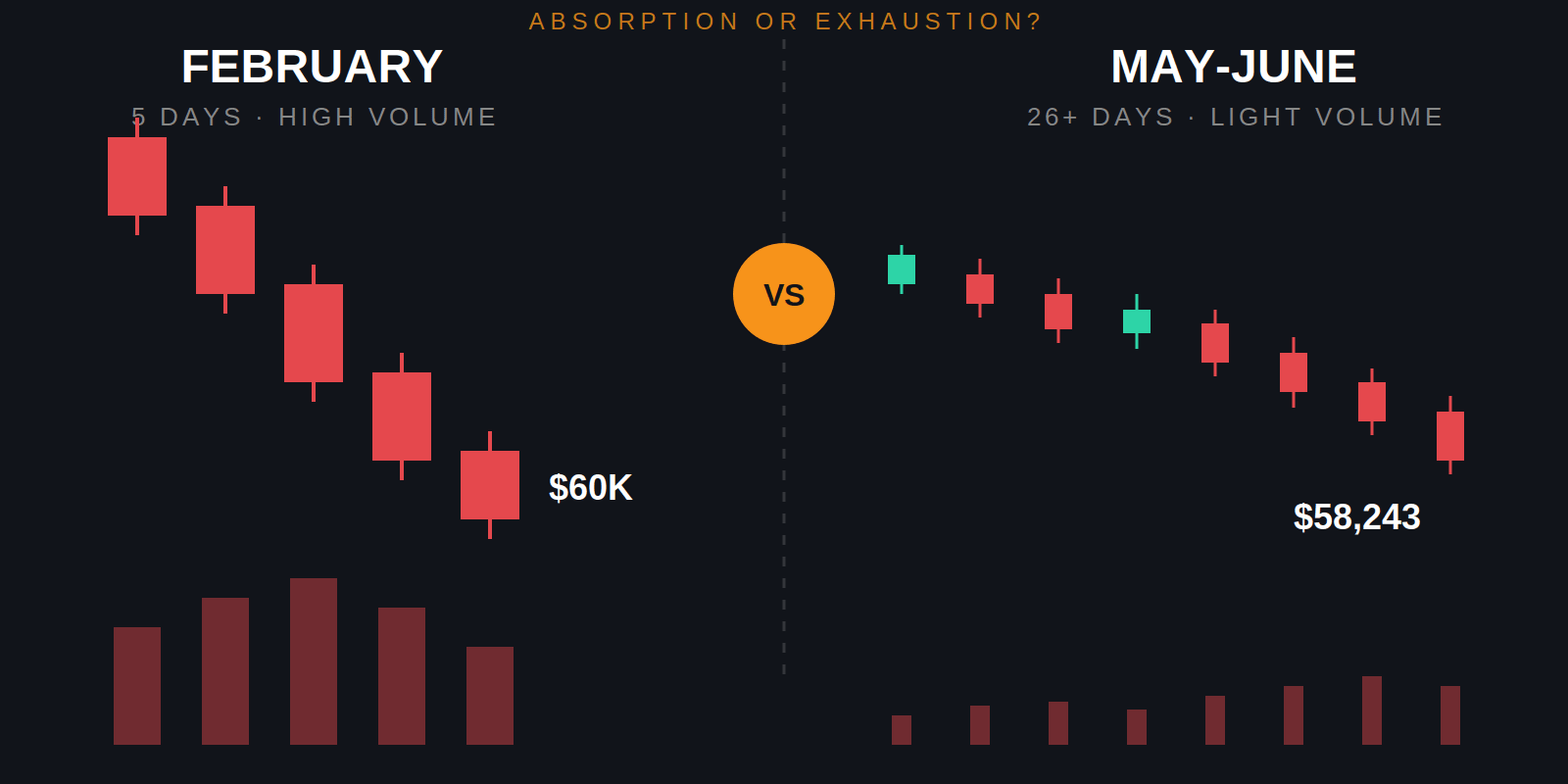
Absorption or Exhaustion: What BTC's Slow Bleed to $58K Is Telling Traders.

By BitBrainers Editorial Bitcoin has now made the trip down to the $60,000 zone twice this year, and the two trips don't look anyth...

Absorption or Exhaustion: What BTC's Slow Bleed to $58K Is Telling Traders.