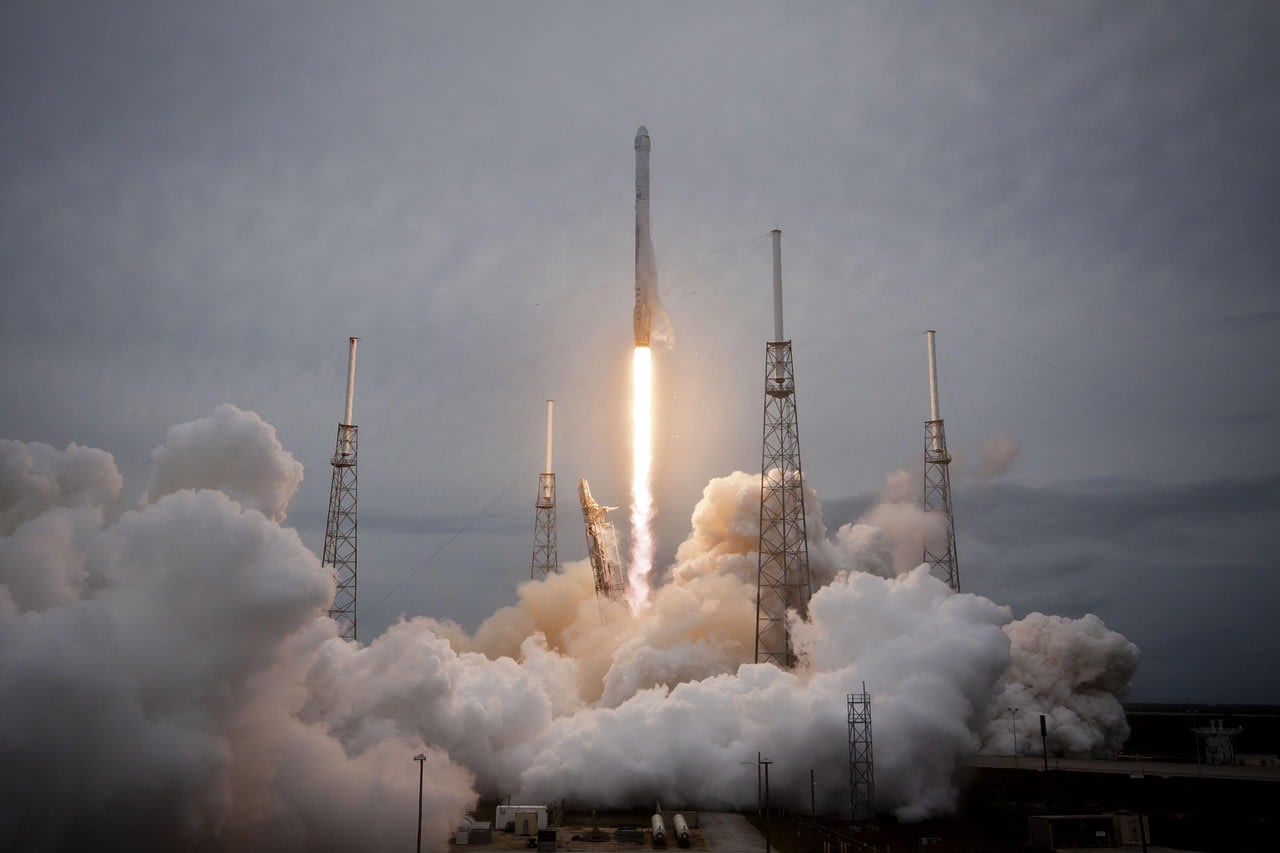
A Bitcoin mining co-founder boarding a SpaceX rocket to Mars is not a metaphor. It is a scheduled mission. Chun Wang, co-founder of F2Pool, one of the largest Bitcoin mining pools on the planet, has confirmed he is joining SpaceX's two-year crewed mission to Mars. This is not a PR stunt or a vanity press release. This is a guy who has spent years controlling a significant portion of Bitcoin's global hashrate, and he is now pointing that energy toward a different kind of frontier entirely.
Let that sink in for a second. Not an influencer. Not a VC who bought some bags at the top. One of the actual architects of Bitcoin's mining infrastructure.
F2Pool Is Not Some Scrappy Side Project
F2Pool has been one of the dominant forces in Bitcoin mining for years. It consistently ranks among the top mining pools globally by hashrate contribution. When you talk about who actually secures the Bitcoin network at an infrastructure level, F2Pool's name comes up in every serious conversation.
Chun Wang co-founded the pool and has been a central figure in how proof-of-work mining scaled from a hobbyist activity to a global industrial operation. This is someone with direct operational skin in the game, not a speculator talking about Bitcoin from a podcast studio.
For context, mining pools aggregate individual miners' computational power to smooth out income variance. The bigger the pool, the more consistent the block rewards. F2Pool's size means Wang has had a front-row seat to every major shift in Bitcoin's mining economics, from the early ASICs era through multiple halving events.
The Mars Mission Is Real and the Timeline Is Brutal
SpaceX's mission to Mars is not a distant concept. It is a two-year commitment. Wang is not going for a weekend trip. He is committing to a mission that will take him roughly 140 million miles from the nearest Bitcoin node on Earth.
Two years is a long time in crypto. BTC is sitting at $75,484 as of May 23, 2026. Nobody knows where it trades when Wang returns. The market could be in a completely different cycle. A new halving could have already restructured miner economics again.
The fact that he is willing to step away from active involvement in a major mining operation for two years says something. Whether that something is confidence in his team, a personal legacy play, or genuine belief in the Mars project depends on how you read it.
Most People Miss This About Mining Pool Founders
Here is the insider angle most crypto blogs skip entirely. Mining pool co-founders are not passive investors. They are protocol-level participants. Wang's decision to leave is not like a hedge fund manager taking sabbatical. It is more like a central bank governor walking out mid-cycle.
The people who run large mining pools make decisions that affect fee markets, block timing, transaction ordering, and occasionally, network politics. During contentious protocol debates, mining pools are not neutral. They vote with hashrate.
The fact that someone operating at this level of Bitcoin infrastructure views the Mars mission as a higher-priority use of the next two years of his life is worth paying attention to, regardless of your opinion on space exploration. It signals something about how he views the current Bitcoin landscape and where the real frontier is.
What This Tells Us About Bitcoin's Maturity
Ten years ago, the people building Bitcoin infrastructure were all-in, every hour, no distractions. The network was fragile, the regulatory environment was hostile everywhere, and the technology was constantly under attack. You could not take two years off.
The fact that a co-founder of one of the largest mining operations in the world can now plan a two-year absence suggests a level of operational maturity that the early Bitcoin community would not have believed possible. The systems are more robust. The teams are deeper. The infrastructure runs without any single person's constant oversight.
This is not a criticism. It is actually a signal about Bitcoin's network resilience. When the founders can leave and the network keeps producing blocks every ten minutes without interruption, that is proof of work functioning exactly as designed.
The Contrarian Read Nobody Is Publishing
Everyone is framing this story as a feel-good crossover between crypto and space exploration. That framing misses the harder question. If Wang is stepping back from active mining operations for two years, what does that mean for F2Pool's governance and decision-making during that window?
Large mining pools wield real influence over the Bitcoin network. The transition of operational leadership, even temporarily, is not a trivial event. Bitcoin governance is informal and coordination-heavy. The people who hold hashrate have structural power in any scenario involving a soft fork proposal, a contentious upgrade, or an emergency network event.
Nobody is asking who runs F2Pool while Wang is on Mars. That question matters more than the headline.
Security Becomes Even More Critical When Key People Move
When major figures in the Bitcoin ecosystem make moves this significant, it is a reminder that your personal Bitcoin security does not depend on what happens at the institutional level. Mining pool operators and protocol developers come and go. Your keys are your problem.
If you are holding any meaningful amount of BTC and it is still sitting on an exchange, this is the kind of news cycle that should push you to act. Not because of Wang specifically, but because operational transitions at major mining pools historically coincide with increased volatility and occasionally increased network stress. A hardware wallet like a Trezor removes your funds from any custodial risk entirely and puts control back where it belongs. That is the baseline for anyone taking Bitcoin seriously.
The Trading Angle for the Next 24 Months
If you are actively trading BTC, the story here is not about Wang personally. It is about what a two-year Mars mission timeline implies for the broader macro cycle. We are currently in a post-halving window. The next major network event is roughly two years out in terms of cycle maturity.
Wang's two-year absence almost perfectly overlaps with the period where historically Bitcoin either completes a bull cycle peak or begins a significant correction. Whether that correlation means anything is up to you to decide. But the timing is not nothing.
For traders watching setups, BTC at $75,484 is a number worth anchoring to right now. If you are looking for a reliable exchange to manage positions without unnecessary complexity, Kraken remains one of the more serious platforms for traders who want depth and regulatory clarity rather than gimmick features.
The Current Market Is Already Pricing in Uncertainty
This week's broader market sentiment reflects exactly the kind of low-conviction range-bound trading that happens when macro uncertainty collides with a post-halving consolidation phase. BTC has not broken cleanly in either direction. Volume is inconsistent. The narrative vacuum is real.
Stories like Wang's Mars mission fill that narrative vacuum. That is not a knock on the story. It is just how crypto market psychology works. When price action is flat, the ecosystem generates human interest content. Smart traders separate the headline from the signal.
The signal here is operational continuity questions at a major mining pool during a sensitive cycle window. Everything else is entertainment.
The Assumption You Probably Came In With Is Worth Questioning
You probably arrived here thinking this story is fundamentally about the intersection of crypto wealth and space tourism. A rich Bitcoin guy gets to go to Mars. Fun story, back to the charts. That assumption undersells what is actually happening.
Chun Wang is not a passive Bitcoin holder with extra cash. He is an operator at the infrastructure layer of the most important monetary network built in the last 50 years. His decision to commit two years to a Mars mission is a statement about where he believes leverage over the next decade actually lives. Whether he is right or wrong about Mars, the fact that someone with his position in Bitcoin is making that bet is a data point most people are too busy laughing at the headline to process.
Disclosure: This post contains affiliate links to Trezor and Kraken. BitBrainers may earn a commission at no extra cost to you. This is not financial advice.
Sources
The Block. 'No longer a distant place': F2Pool Co-founder Chun Wang joins SpaceX's 2-year mission to Mars
BitBrainers. Follow the data, not the noise.