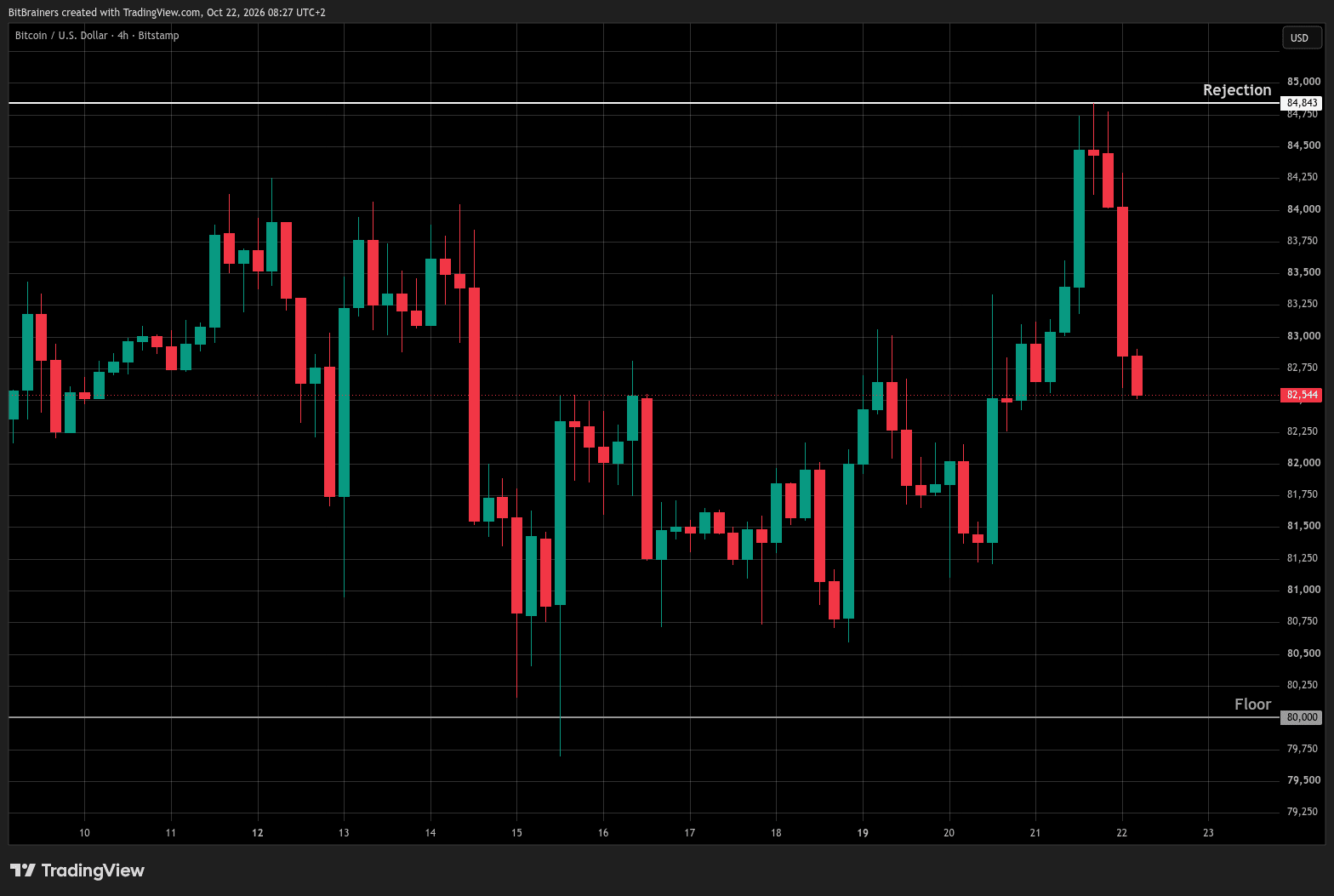
Bitcoin has dropped for five consecutive days. It is down 13% this year. Retail sentiment is in the gutter. And yet, on Bitfinex, one of the oldest and most closely watched crypto exchanges in the world, leveraged traders are doing the opposite of panicking.
They are buying more.
The Number That Matters
Margin long positions on Bitfinex have climbed to 80,636 BTC, their highest level since December 2023. That is a two-and-a-half year high, reached during one of the weakest stretches of price action Bitcoin has seen all year.
To understand why this is significant, you need to understand what a margin long actually represents. These are not spot purchases. These are leveraged bets, positions opened with borrowed funds, placed by traders who are confident enough in Bitcoin's upside to take on amplified risk at exactly the moment when most people are reducing exposure.
The traders doing this on Bitfinex are not retail. The exchange has historically attracted sophisticated, high-capital participants. When margin longs on Bitfinex spike during a downturn, the market pays attention.
This Has Happened Before
The pattern is not new. Bitfinex margin longs have a documented history of expanding during periods of maximum fear and contracting near local market tops. It happened during the FTX collapse in November 2022. It happened during the August 2024 carry-trade unwind. It happened again during the tariff-driven selloff in April 2025.
In each of those cases, the buildup of leveraged longs on Bitfinex preceded a significant price recovery.
That does not guarantee the same outcome this time. But it is a pattern worth understanding before you decide whether to sell.
Where Bitcoin Actually Stands
The current price weakness has pushed Bitcoin into a technically important zone. The asset is now testing two critical levels simultaneously: the True Market Mean, which represents the aggregate cost basis across all Bitcoin holders, and the short-term holder realized price, which tracks the average acquisition price of anyone who bought Bitcoin in the last 155 days. Both sit near $78,000, just above current spot prices.
Above that, the 200-day moving average sits at roughly $81,000. That is three levels of resistance stacked within a $4,000 range. Getting through all three cleanly would signal a meaningful shift in momentum. Failing to do so would put further downside pressure on the price.
The Bitfinex whales are betting on the former.
The Caveat You Need to Know
Here is where it gets more nuanced. Not all Bitfinex margin longs are pure directional bets on Bitcoin going up. Some of these positions are part of cash-and-carry strategies, where traders buy spot Bitcoin on margin while simultaneously shorting BTC futures to capture the spread between the two. The net effect on price is essentially neutral.
This matters because it means the 80,636 BTC figure is not a clean bullish signal. It is a signal that sophisticated traders see value in the current price range, whether through outright accumulation or through arbitrage. Both interpretations suggest the same thing: this is not a market where the smart money is running for the exit.
What the Rest of the Data Says
The Bitfinex longs do not exist in isolation. Other indicators are pointing in the same direction. Glassnode's RHODL ratio, which measures the relative holdings of long-term versus short-term Bitcoin holders, recently hit its third-highest reading in Bitcoin's history. The only comparable prior readings occurred at the 2015 cycle bottom and the 2022 cycle bottom.
April spot ETF inflows reached $2.44 billion, the strongest institutional month since October 2025. Whale wallets holding more than 1,000 BTC have grown by 142 addresses over the past six months. Exchange reserves continue to fall, meaning less Bitcoin is sitting where it can be sold quickly.
Every one of those metrics points in the same direction. Accumulation, not distribution.
What This Means for You
None of this tells you where Bitcoin is going next week. The short-term picture is messy. Geopolitical noise from Trump's Iran warnings continues to rattle risk assets. The 200-day moving average is still overhead. Five consecutive red days leave momentum traders cautious.
But the medium-term signal is clear. The people with the most capital, the most data, and the most experience are not treating $77,000 Bitcoin as a crisis. They are treating it as an opportunity.
Whether you agree with them is your call. But you should at least know what they are doing.
What On-Chain Data Is Telling You That Price Is Not
The Bitfinex margin long data is one signal. It becomes significantly more meaningful when it aligns with other on-chain indicators pointing in the same direction.
Long-term holder supply is the most reliable of those indicators. Long-term holders are defined as wallets that have not moved their Bitcoin in at least 155 days. These are conviction holders who have lived through multiple cycles and have demonstrated by their inaction that they do not panic sell during drawdowns. When long-term holder supply is increasing during a price decline, coins are transferring from short-term holders who are selling out of fear to long-term holders who are accumulating at lower prices. That transfer is the on-chain definition of a healthy correction.
Exchange reserve data tells the complementary story. When Bitcoin moves off exchanges into cold storage wallets, it is leaving the immediately sellable supply. Declining exchange reserves during a correction means that despite the negative price action, holders are choosing to remove coins from trading platforms rather than positioning to sell. That behavior is inconsistent with the distribution pattern you would expect at a genuine market top.
Funding rates on perpetual futures give you the leverage positioning context. When funding rates are negative, shorts are paying longs to hold their positions. Negative funding during a price decline means the market is heavily short, which creates the conditions for a short squeeze when buying pressure returns. When funding is positive and rising, the market is increasingly leveraged long, which creates the conditions for a liquidation cascade when price drops.
The Bitfinex margin long spike, combined with declining exchange reserves and neutral-to-negative funding rates, is the combination that has historically preceded recoveries from fear-driven corrections. No combination of on-chain signals is a guarantee. But this one has a better track record than any single price-based indicator.
The Practical Application
Watching smart money behavior on-chain is not useful if you have no plan for what to do when you see it.
The traders who benefit from these signals have defined their entry criteria in advance during calm conditions, not in the middle of a downturn when emotions are running high. They know before the correction starts what combination of signals would make them comfortable adding to a position. When those signals appear, they execute the plan they already built rather than making an emotional decision in real time.
For most Bitcoin holders the right response to a correction with strong on-chain accumulation signals is simple: do nothing if you are already positioned, and consider adding to your position through Kraken if you have dry powder and the signals align. Move anything you add directly to a Trezor and treat it as long-term cold storage from the moment you buy it.
The smart money is loading. Whether you load alongside them or sell into their bids is the decision that separates the two groups every cycle.