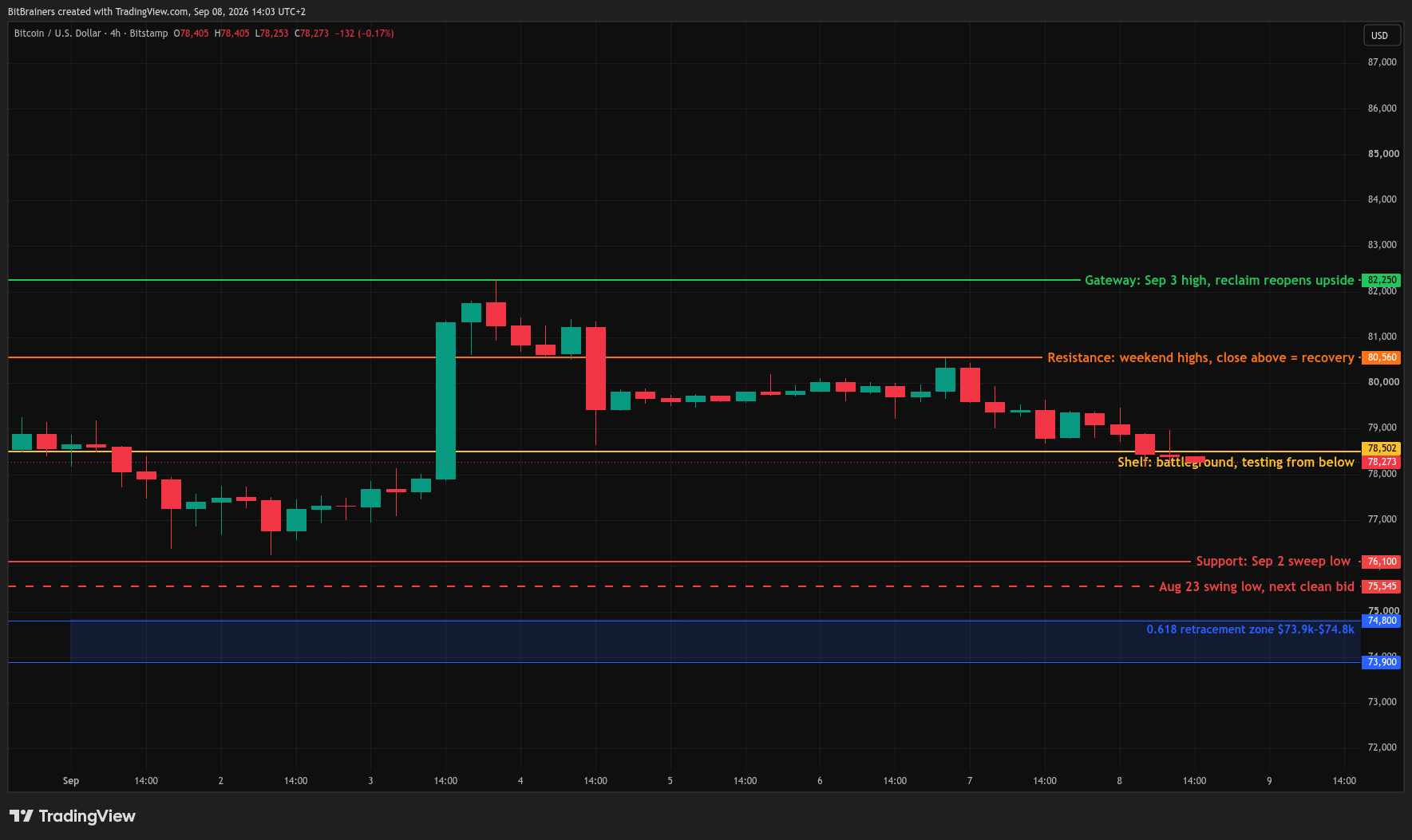
$80,000. Bitcoin has touched it, flirted with it, and bounced off it like a wall. Right now, with BTC sitting at $78,022, the same tired drama is playing out again. Most traders are staring at the chart asking why. The real question is how the mechanism actually works, because once you understand it, you stop trading against it.
Round Number Rejection Is a Market Structure Problem, Not a Psychology Problem
Everyone says round numbers are "psychological resistance." That framing is lazy. It reduces a complex mechanical process to vibes and feelings. The reality is more specific and more useful to you as a trader.
At every major round number, you have a convergence of three separate forces hitting at the same time. Options market makers hedging delta exposure. Large institutions placing limit sells at clean levels for order management. Retail momentum traders setting profit targets at the obvious number. These three groups do not coordinate. They just all show up at $80,000 on the same day, and the math does the rest.
Options Market Makers Are the Part Nobody Talks About
Here is the insight most crypto blogs miss entirely. At major round numbers, the concentration of open interest in options contracts is enormous. Market makers who sold those options are short gamma near those strikes. When price approaches $80,000, they are forced to sell spot Bitcoin to hedge their exposure. They are not bearish. They are not making a prediction. They are running risk management software that tells them to sell.
This is not unique to crypto. It happens in equities, forex, and commodities wherever options markets are liquid. But in Bitcoin, because the market is relatively thin compared to traditional assets, the impact of that hedging pressure is outsized. You are not fighting traders at $80,000. You are fighting a mathematical obligation.
$20,000 Was the First Major Teaching Moment
The $20,000 level was the clearest early example of how this dynamic plays out. BTC approached that level multiple times, rejected hard each time, and then eventually broke through and accelerated violently to the upside. The rejection was not a ceiling. It was a compression zone. When the options market finally repriced and the hedging flow dried up, there was no natural supply left to stop the move.
The same pattern repeated at $50,000, at $60,000, and most famously at $69,000. Each of these levels had months of failed attempts followed by either a decisive break or a brutal reversal. The chart pattern looks like indecision. The underlying mechanic is actually a battle between directional buyers and forced hedgers.
The $100,000 Break Tells You Everything About What Comes After
When Bitcoin finally broke $100,000, the move above it was violent and fast. That is exactly what you would expect if the rejection mechanism is primarily mechanical rather than fundamental. Once the gamma exposure at a strike cluster is cleared, the forced selling stops. If organic demand still exists, price fills the vacuum quickly.
The implication for $80,000 right now is direct. Either Bitcoin grinds through it and accelerates, or it loses $80,000 and we see a flush toward the next significant level where buyers are sitting. There is no slow drift in either direction. These breaks or rejections at round numbers tend to resolve with conviction once the compression period ends.
Macro Noise Amplifies Every Rejection
This week, news broke that Trump's Bitcoin ETF plans likely collapsed before getting off the ground. That kind of headline lands differently when BTC is already stalling at a round number. It does not create the resistance. But it feeds the narrative that gives hesitant sellers a reason to act, and hesitant buyers a reason to wait.
Institutional positioning is sensitive to headline risk in a way retail positioning is not. A fund manager who was planning to add at $79,000 sees that headline and decides to wait for clarity. That marginal demand disappearing at exactly the wrong level is how sentiment amplifies a mechanical dynamic into a longer consolidation. The story becomes the justification for something that was already happening in the order book.
What the Flush Looks Like When It Comes
When Bitcoin breaks convincingly below a contested round number, the move is almost always faster than traders expect. The reason is that most stop losses cluster just below the round number. When those triggers trip, they create market sell orders that accelerate the move downward. What looks like a minor breach of $80,000 can turn into a $5,000 to $7,000 drop within hours as those stops chain together.
This is not a prediction about where BTC goes from $78,022 today. It is a description of the mechanical anatomy of what a failed round number looks like after the fact. Knowing the shape of the move in advance is more useful than guessing direction.
Consolidation Around Round Numbers Has a Specific Time Pattern
Most significant round number consolidations in Bitcoin history have lasted between 2 and 8 weeks before resolving. After 8 weeks of price compression near a major level, the structure typically breaks one way or the other with significant follow-through. If you are watching a chart that has been grinding around the same number for over a month, you are close to a resolution.
What traders miss is that the length of compression correlates with the size of the move that follows. A 6-week consolidation at $80,000 stores more energy than a 2-week one. The longer the market structure builds, the more stop clusters accumulate on both sides, and the more violent the eventual break becomes.
The Contrarian Read on Round Number Fear
Here is the part most traders get completely wrong. They treat round number rejection as bearish signal. They see BTC hit $80,000, pull back, and assume the market is telling them something negative about underlying demand.
The opposite framing is more accurate. The fact that Bitcoin is close enough to $80,000 to trigger the gamma hedging mechanism means buyers have been strong enough to push price into that zone. The mechanical selling you see at the round number is not evidence of weak demand. It is evidence of price being in the range where demand is strong enough to compress against forced supply. Every test of a major round number is actually a stress test of the buy-side. Multiple failed tests do not necessarily mean the buyers are losing. They mean the buyers are absorbing.
Here Is What You Need to Actually Watch Right Now
Stop watching the candle at $80,000. Watch the depth of pull-backs when BTC rejects. Shallow pull-backs after rejection, where price only drops a few hundred dollars before buyers step in, indicate that the buying pressure is still intact. Deep pull-backs, where price drops multiple thousands of dollars on low volume before finding support, indicate the buy-side is thinning out.
If you are holding BTC through this compression, you already know the security setup matters as much as the trading setup. A hardware wallet like Trezor keeps your stack offline and out of reach during the kind of volatile swings that round number rejections produce. And if you are actively trading this structure, Kraken gives you the order types and liquidity depth to actually execute around these levels without getting wrecked by slippage.
The Assumption You Walked In With Is Probably Wrong
You probably came into this post believing that breaking above a round number is the hard part. That once Bitcoin clears $80,000 or $100,000 or whatever the current target is, the work is done. The data says the opposite. The break above a round number is often the easy part. The retest after the break is where most traders give back their gains, because they assume the level is now support when it is still a high-density option strike zone. The mechanics do not flip instantly just because price closed above a number. The real confirmation comes when BTC retraces to a former round number, consolidates above it for at least 2 full weeks, and then resumes the uptrend. That is the signal. Not the initial break.
Disclosure: This post contains affiliate links to Trezor and Kraken. BitBrainers may earn a commission at no extra cost to you. This is not financial advice.
Sources
CoinDesk. Why Trump's bitcoin ETF plans likely collapsed before getting off the ground
BitBrainers. Follow the data, not the noise.