Every six months, a new passive income meta emerges in crypto. Yield farming, liquidity provision, staking derivatives, real-world asset protocols. Each one gets packaged as "set it and forget it" wealth. Most of them quietly drain your portfolio while you sleep. After nearly a decade in this space and a graveyard of failed strategies behind me, here is what I actually know.
Most Yield in Crypto Pays You With Your Own Money
This is the part nobody explains clearly when they are selling you on a protocol. A significant portion of yield in decentralized finance comes from token emissions. The protocol mints new tokens, distributes them to liquidity providers, and calls it a reward. What actually happens is your share of the pool inflates while the token price drops. You earn 40 tokens a week. The token loses value faster than you accumulate it. Net result: you lost money while technically earning yield.
This is not a fringe problem. It is the structural reality of most DeFi protocols built between 2020 and 2025. The projects that survived that period are the ones with actual fee revenue, meaning real users paying for real activity, not ponzinomics dressed up as innovation.
The lesson here is blunt. Before touching any yield product, ask one question: where does the yield actually come from? If the answer involves a native governance token with no clear utility, walk away.
Liquid Staking Is the One Strategy That Held Up
Let us be specific. Proof-of-stake networks that generate staking rewards through transaction fees and validator incentives produce real yield. Ethereum shifted to proof-of-stake in September 2022. Since then, liquid staking has become one of the most legitimate passive income mechanisms in crypto. Protocols like Lido and Rocket Pool allow users to stake ETH without locking it, receiving a liquid token in return.
Bitcoin does not have native staking. That is worth saying plainly. Anyone telling you they are staking BTC through some wrapper protocol is either confused or misleading you. What they are actually doing is lending BTC, wrapping it in a smart contract, or using a custodial product. Each of those carries a different risk profile and most carry substantially more risk than native staking.
For ETH holders, liquid staking through established protocols with multi-year track records is the most defensible passive income strategy available. It is not risk-free. Smart contract exploits happen. Slashing events happen. But the mechanics are transparent and the yield source is real.
The Contrarian Take Nobody Publishes About Staking Rewards
Most people do not know this: validator centralization is the hidden risk that makes liquid staking yield less secure than it appears. When a large portion of staked assets concentrate with a single protocol, that protocol gains outsized influence over network consensus. Ethereum researchers have flagged this as a systemic concern for years. If a dominant staking provider gets compromised or acts maliciously, the damage is network-wide, not just limited to that protocol's users.
This is not theoretical. Lido at one point controlled a significant fraction of all staked ETH, enough that Ethereum's own developers publicly debated whether this concentration posed an existential risk to the network's neutrality. Ethereum founder Vitalik Buterin has actively discussed using AI-based verification systems to help secure crypto networks against exactly these kinds of structural vulnerabilities. His reasoning, covered in a recent Decrypt report, points toward a future where automated systems can audit network behavior at a scale humans cannot. That work matters for passive income participants because the security of your staking rewards ultimately depends on the health of the network you are staking on.
The contrarian insight is this: diversifying your staking across multiple validators or protocols is more important than maximizing APR. A slightly lower yield from a more decentralized setup is genuinely safer than chasing the highest number on a dashboard.
Bitcoin Holders Have Three Legitimate Options and None of Them Are Easy
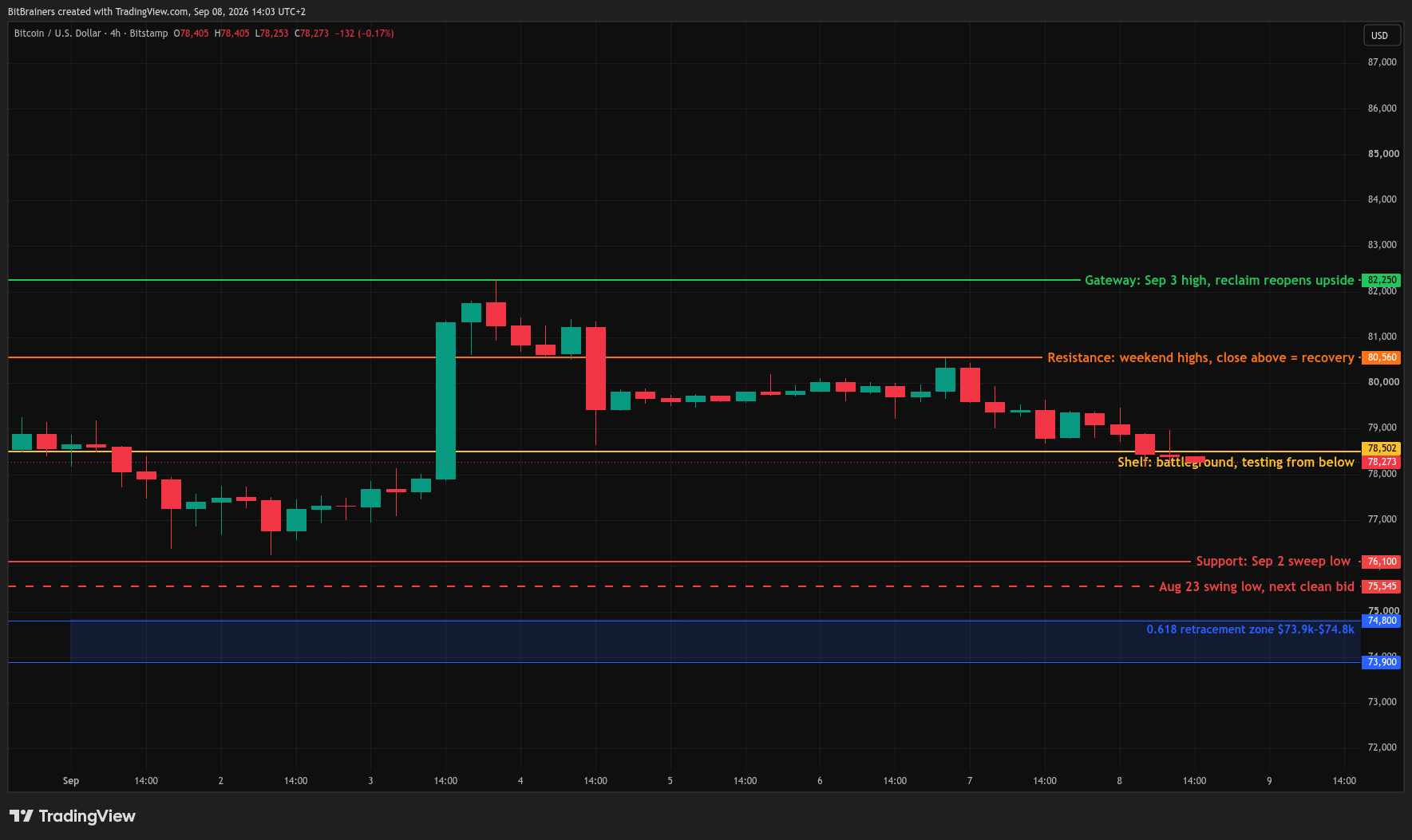
BTC sits at $77,461 as of May 20, 2026. If you are holding Bitcoin and want to generate income, your options are narrow and all of them involve tradeoffs.
Option 1: Lending through regulated platforms. Centralized lending platforms allow you to lend BTC and earn interest. The risk is counterparty failure. The collapses of Celsius and BlockFi taught this lesson the hard way. If you cannot verify that your collateral is segregated and your counterparty is solvent, you are exposed.
Option 2: Covered calls on Bitcoin. This is an options strategy where you hold BTC and sell the right to buy it at a higher price. You collect the premium. If BTC rises past the strike price, you miss the upside above that level. This strategy works in sideways or slowly appreciating markets. It requires understanding options mechanics and active management. It is not passive.
Option 3: Running a node on a Bitcoin Layer 2. Networks like Stacks allow participants to earn BTC yield by locking STX tokens through a mechanism called Stacking. The yield comes from BTC transferred by miners. It is real. It is also complex, involves locking tokens for defined cycles, and carries smart contract risk. Not for beginners.
None of these are plug-and-play. Anyone selling you a BTC passive income product with no complexity is either simplifying aggressively or hiding something.
How to Actually Start Without Blowing Up Your Portfolio
Here is a step-by-step approach that does not assume you have everything figured out.
Step 1: Separate your core holdings from your yield-seeking stack. Decide what percentage of your crypto you will never touch for yield purposes. For most people this should be the majority of their BTC. Keep it cold. A hardware wallet like a Trezor keeps your long-term stack genuinely safe from platform collapses, hacks, and smart contract failures. Your passive income attempts should only involve capital you can afford to lose or lock up.
Step 2: Start with native staking on a proof-of-stake network. If you hold ETH, move a portion to a reputable liquid staking protocol and observe how it works for 90 days before scaling up. Understand the mechanics before you increase your position.
Step 3: Track yield sources, not just yield numbers. For every product you use, document where the yield comes from. Token emissions, trading fees, validator rewards, lending interest. Each source has a different risk profile. Token emissions are the most fragile. Fee-based yield is the most durable.
Step 4: Set a re-evaluation schedule. Passive income in crypto is not set-and-forget. Protocols get exploited. Tokenomics change. Governance votes can alter reward structures overnight. Check your positions monthly at minimum and understand what changed.
Step 5: Never stake or lend more than you would be comfortable losing. This is not pessimism. It is position sizing. Every yield product in crypto carries tail risk that traditional finance products do not.
The Assumption You Walked In With Is Probably Wrong
You likely came here believing passive income in crypto is either completely broken or that some new protocol has finally solved the problem. Neither is accurate. The reality is more specific. Passive income strategies tied to real network activity, such as validator rewards and genuine fee revenue, have held up. Strategies built on token inflation, artificial APR, and undercollateralized lending have collapsed repeatedly since 2021. The split is not between old and new or between DeFi and CeFi. It is between protocols with real revenue and protocols that print yield from nothing. One of those is an income strategy. The other is a slow liquidation dressed up in a dashboard.
A development worth watching right now: in May 2026, AI-assisted network verification is moving from research to early implementation across several blockchain projects. If Buterin's vision for AI-based security auditing gains traction, it could change how staking security is assessed and how risk in liquid staking protocols gets priced. That is not reason to act today. It is reason to stay informed.
Realistic expectations: Building meaningful passive income from crypto takes capital, time, and tolerance for complexity. It is not a shortcut. The strategies that work require active monitoring and periodic rebalancing. Start with a small allocation, learn the mechanics of one strategy properly, and expand only after you understand the risks.
Your first action step: Audit every yield product you currently use. Write down the yield source for each one. If you cannot explain where the yield comes from in one sentence, you do not understand the risk you are taking.
Disclosure: This post contains affiliate links to Trezor and Kraken. BitBrainers may earn a commission at no extra cost to you. This is not financial advice.
Sources
Decrypt. Ethereum Founder Vitalik Buterin Says AI Verification Could Help Secure Crypto Networks
BitBrainers. The crypto analysis you wish you had yesterday.