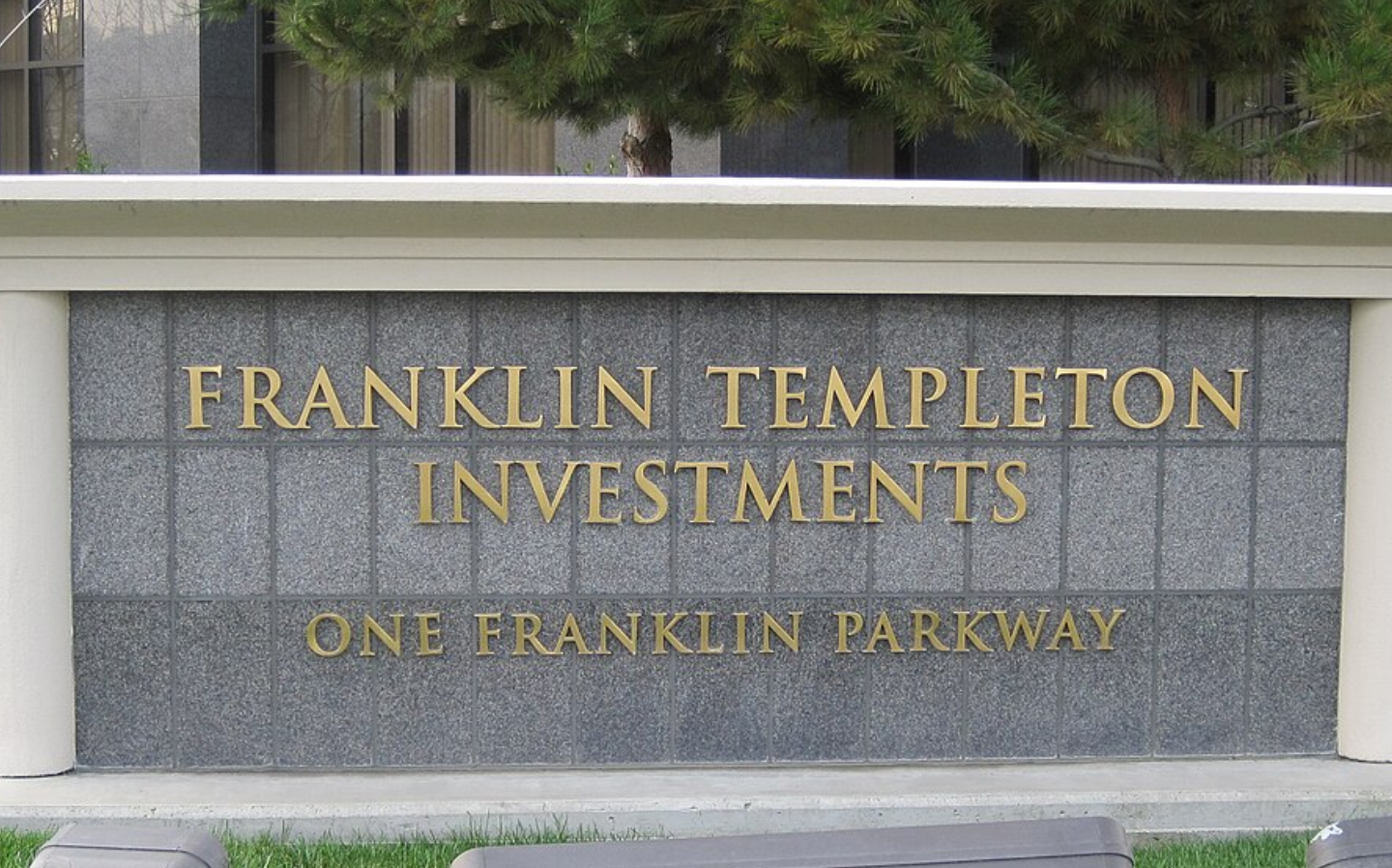
Photo: © BrokenSphere / Wikimedia Commons — CC BY-SA
A $1.5 trillion asset manager just put a tokenized fund on a crypto payments platform. Not a press release. Not a pilot. A live product move. If that does not register as signal, you are reading crypto wrong.
Franklin Templeton's BENJI fund is now accessible through MoonPay. That one sentence should reframe how you think about the next 18 months of institutional movement.
This Is Not a Blockchain Experiment, This Is a Distribution Play
Franklin Templeton has been running BENJI as a tokenized money market fund for a while now. The move to MoonPay is not about technology. It is about distribution. MoonPay is one of the most widely used crypto payment gateways in the world, embedded in wallets, exchanges, and apps that serve tens of millions of retail users.
Franklin Templeton is not experimenting with blockchain. They are using blockchain rails to reach customers that traditional fund distribution never could. That is a completely different motivation than what most crypto media is framing this as.
The Quiet Part Is That TradFi Needs Crypto Infrastructure Now
Here is what nobody in mainstream finance wants to say out loud. Traditional asset managers are not building their own distribution infrastructure because it is slow, expensive, and they are already behind. MoonPay gives Franklin Templeton instant access to a crypto-native audience without building a single line of front-end code.
This is a one-way door. Once TradFi firms wire their products into crypto payment infrastructure, they do not go back. The compliance, legal, and reputational investment is too significant to reverse.
Watch how many other fund managers start eyeing MoonPay, Transak, and similar on-ramps in the next 6 months. Franklin Templeton just became a case study in how legacy finance plugs into Web3 distribution.
What BENJI Actually Represents for Bitcoin Holders
BENJI is a tokenized money market fund. In plain English, it is a yield-bearing instrument sitting on blockchain rails. The yield comes from short-term government securities. This is not a Bitcoin product and it is not an Ethereum product. But its presence in crypto infrastructure matters enormously for BTC holders.
Why? Because every dollar that enters the crypto ecosystem through a product like BENJI normalizes the infrastructure. MoonPay becomes stickier. Wallets get more feature-rich. The on-ramp and off-ramp layer that Bitcoin depends on becomes more robust and better funded. Franklin Templeton's brand sitting next to BTC in the same app shelf is not a coincidence. It is the convergence playing out in real time.
Most People Do Not Know This About Tokenized Fund Infrastructure
Here is something that almost nobody talks about. The blockchain infrastructure that tokenized funds like BENJI run on is being built and maintained with fees generated from crypto traders. Every swap, every bridge, every gas fee on the networks hosting these tokenized instruments is funded by the same community that traditional finance spent years dismissing.
Wall Street is renting infrastructure that crypto builders paid for. Franklin Templeton did not build the network. They did not fund the validators. They showed up when the roads were already paved. That is worth keeping in mind when the narrative swings toward "institutions are saving crypto." No. Institutions are arriving late to something that already worked.
The Retail Angle Nobody Is Covering
MoonPay's core audience is retail. Someone setting up their first crypto wallet. Someone buying BTC for the first time through a mobile app. Someone who has never heard of a money market fund in their life. Franklin Templeton just put their product in front of that audience.
The conventional wisdom is that tokenized funds are for institutional money. Large minimums, complex onboarding, accredited investor requirements. If BENJI through MoonPay breaks that mold and makes tokenized yield accessible to a retail crypto user, that is genuinely new territory. The traditional financial services industry has been trying to crack mass-market fund distribution for decades. Crypto infrastructure might solve it faster than any fintech app did.
Bitcoin Sits Above All of This and That Is the Point
Right now, BTC is sitting at $67,042. The market is not pricing in euphoria. It is grinding. And in that grind, the structural moves are the ones that matter most. Franklin Templeton connecting to MoonPay is structural. It does not move the price today. It builds the architecture for the next wave.
Bitcoin does not need BENJI to succeed. BTC survived without a single institutional product for years. But every legitimate financial product that touches crypto infrastructure increases the surface area of the ecosystem. More users. More liquidity paths. More regulatory pressure to get clear rules in place. All of that is a long-term tailwind for the asset with the hardest supply cap in the market.
Custody Becomes the Real Conversation Here
When institutional-grade products live on blockchain rails and get distributed through consumer-facing apps, the custody question becomes unavoidable. Who holds the keys? Where does the BENJI token actually live? If it is custodied by a third party, the user has counterparty exposure, full stop.
This is where the difference between real crypto ownership and tokenized paper on a blockchain becomes very concrete. If you hold Bitcoin on a hardware wallet like a Trezor, nobody can freeze your position, block your access, or go bankrupt and take your funds. If you hold a tokenized fund token through a custodied app, you are back in the traditional finance trust model. The infrastructure is new. The counterparty risk is not.
This matters for how you think about your own holdings. Not everything on a blockchain is self-sovereign. Knowing the difference is not optional anymore.
Franklin Templeton Is Validating Crypto Trading Infrastructure Too
If you are actively trading around these macro developments, using a platform with real depth and institutional-grade security matters. Kraken consistently shows up as one of the better options for traders who want clean execution without the drama that plagued other exchanges over the past few years. As more TradFi products embed into crypto infrastructure, the exchanges that survive will be the ones built on operational discipline, not hype.
The Assumption You Walked In With Is Wrong
You probably came into this post thinking this is another "institutions are coming" story. Bullish vibes, rocket emojis incoming. But challenge that framing for a second. Franklin Templeton using MoonPay is not proof that traditional finance is embracing crypto's values. It is proof that traditional finance has identified crypto's distribution infrastructure as useful. Those are two completely different things. One is a philosophical alignment. The other is a tactical extraction.
The firms arriving now are not here to decentralize anything. They are here to distribute their existing products more efficiently. Bitcoin does not care about their motivation. The network runs either way. But you should understand what is actually happening so you are not surprised when the same firms that just plugged into MoonPay lobby for stricter crypto regulations next year. Both things can be true at the same time.
Watch this: Track how many additional traditional asset managers file to list tokenized products on consumer-facing crypto platforms over the next 90 days. That number, not price, is the signal to follow right now.
On The Radar This Week
Franklin Templeton's BENJI move is the first domino. Watch whether any other major asset manager files to list a tokenized product on a consumer-facing crypto platform before June 30. That count, not price, is the real signal this week.
Bitcoin is grinding between $67,000 and $70,000 after failing to hold $74,000 support. The $65,000 level is the line that matters next. A high-volume close below it reopens the conversation around $62,500. ETH is trading near $1,920 with the $2,000 level now acting as resistance after flipping from support.
BOJ rate decision is June 15-16. The August 2024 playbook is still relevant — a 0.15% raise triggered a 15-20% BTC drop within 24 hours. Watch USD/JPY and Bitcoin open interest the evening of June 14. The trade is entry after the drop, not the short before it.
The tokenized Treasury market just crossed $1.5 billion total. If that number doubles before year-end, the on-ramp infrastructure story becomes the dominant institutional narrative for Q3 2026.
Sources
The Block. Franklin Templeton brings BENJI tokenized fund to MoonPay
BitBrainers. No hype. No fluff. Just crypto that matters.
Disclosure: This post contains affiliate links to Trezor and Kraken. BitBrainers may earn a commission at no extra cost to you. This is not financial advice.
— BitBrainers Editorial