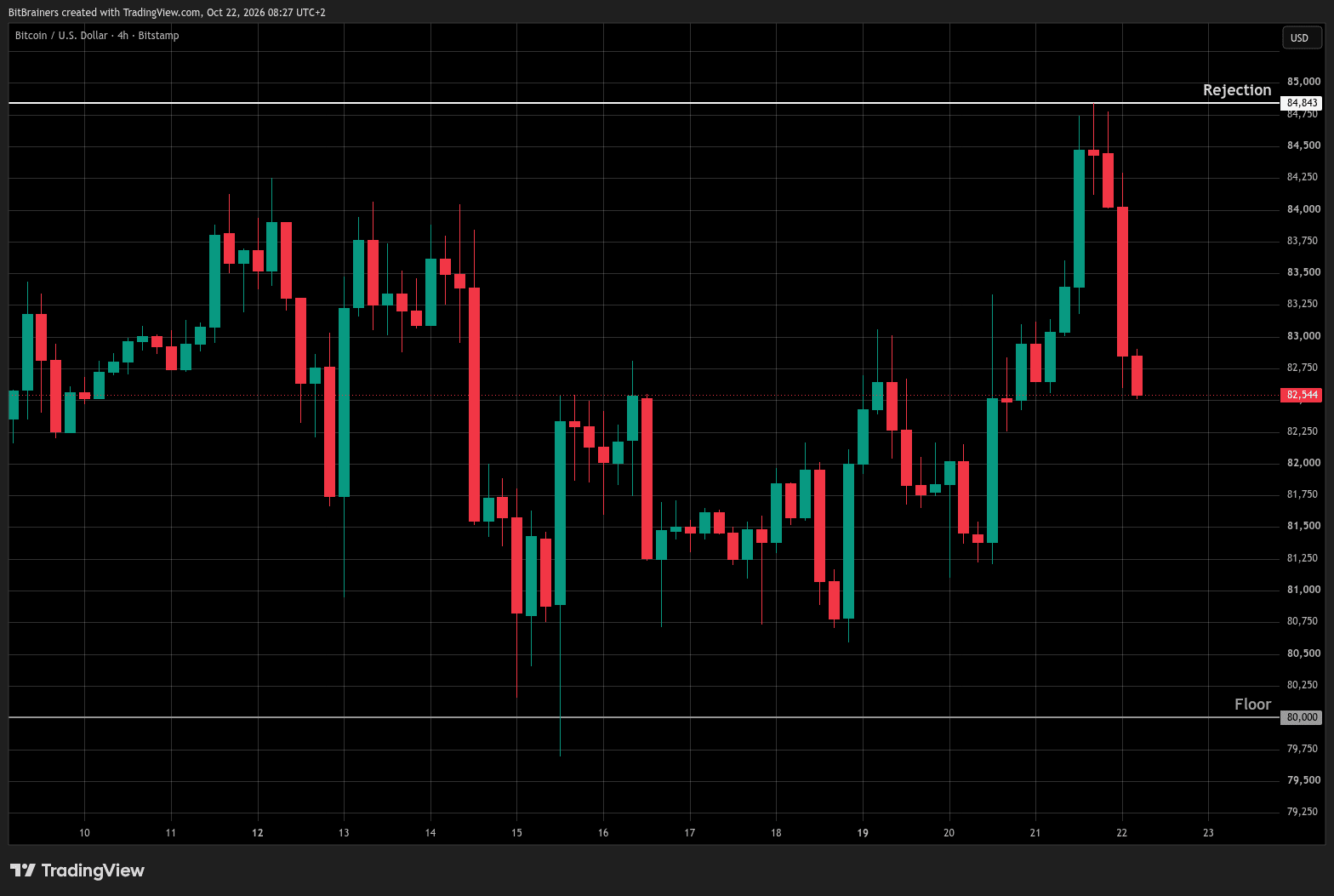
Multiple AI models just flagged Bitcoin as a high-probability continuation breakdown. The target prices vary. The consensus does not. Every model trained on historical crypto data is currently pointing in the same direction: lower.
Before you act on that, you should understand what those models actually learned and where they consistently fail.
What the Data Actually Contains
When an AI analyzes Bitcoin price history, it is not reading charts. It is reading human behavior compressed into numbers. The 2018 crash from $20,000 to $3,200 is in there. So is the March 2020 COVID flush to $3,800. The 2022 collapse from $69,000 to $15,500. Every single one of those events was driven by the same mechanism: humans reaching a psychological threshold where holding became more painful than selling.
The AI learned that when RSI hits extreme lows, when ETF outflows accelerate, when sentiment reads Extreme Fear, prices tend to go lower before they go higher. That is what the training data shows. And right now, every one of those signals is firing simultaneously.
So the models output bearish targets. They are not wrong to do that. They are doing exactly what they were built to do.
The Variable the Model Cannot Price
Here is what no AI model trained on historical data can tell you: when the last seller sells.
Capitulation is not a technical event. It is a human one. It happens when the final wave of overleveraged longs gets liquidated, when the last retail holder who bought near the top finally gives up, when the news cycle shifts from "Bitcoin crashes" to "Bitcoin is dead" and the people who were going to sell have already sold.
That moment does not appear in the training data as a signal. It appears as the candle immediately before the reversal. The AI cannot see it coming because it has never been able to see it coming. Every bottom in Bitcoin history was invisible to the models until it was already over.
What History Shows About AI and Algorithmic Models at Market Extremes
This is the part that does not get written about enough, because it is inconvenient for everyone selling AI-powered trading tools.
In November 2018, Bitcoin was at $6,000 and every quantitative model was projecting continuation to $3,000 or lower based on momentum, volume, and sentiment data. The models were right about direction for exactly six more weeks. Then Bitcoin found its floor at $3,200 and every model that had been confidently bearish had nothing useful to say about the reversal until it was already 40% complete.
In March 2020, Bitcoin dropped from $9,000 to $3,800 in 48 hours. Every algorithm designed to detect capitulation missed the actual bottom by days. The signals they were trained to recognize — sustained volume, RSI divergence, order book recovery — all lagged the actual price reversal by sessions. Traders following algorithmic signals bought back in after a 30% recovery from the low.
In June 2022, after the Luna collapse and the Three Arrows Capital implosion, sentiment was the worst it had been since 2018. Models trained on that 2018 data were projecting $10,000 Bitcoin. It bottomed at $15,500 in November and never saw $10,000 again. The models were wrong by 55% on the downside target.
The pattern is consistent. AI and algorithmic models trained on historical crypto data are reasonably good at identifying that a breakdown is in progress. They are systematically poor at identifying where it ends. The reason is structural: the data they were trained on does not contain the internal human experience of exhaustion that precedes a reversal. It only contains the price aftermath.
The Circular Problem With AI Price Predictions
Think about what the training data actually represents. Every price bottom in Bitcoin history was created by humans who believed the price was going lower. They sold. The price went lower. More people believed it was going lower. They sold too. That cycle continued until it stopped.
The AI learned that pattern. Now it is applying it. But in doing so, it is potentially becoming part of the same cycle. When enough people read an AI prediction pointing lower and sell, the prediction becomes partially self-fulfilling. The model predicted human behavior and then influenced human behavior. The data that created the prediction is now being recreated by the prediction itself.
That is not a flaw. That is a feature of any widely distributed price prediction in a sentiment-driven market. And it is exactly why the most dangerous moment to follow an AI price model is when everyone else is already following it.
Here is the controversy nobody wants to engage with directly: if AI models are now sophisticated enough to move retail sentiment at scale, and retail sentiment is what creates the price data those models are trained on, then the models are no longer predicting markets. They are partially creating them. That feedback loop has no clean resolution and no one building these tools is publicly acknowledging it exists.
What This Actually Means for Your Decision
If you are holding Bitcoin right now and every AI model is telling you prices are heading lower, you have two choices. You can treat the prediction as information, or you can treat it as a mirror.
As information it tells you: historical patterns suggest further downside. RSI, sentiment, and flow data are aligned bearishly. Risk management matters here.
As a mirror it tells you something more uncomfortable: you are currently inside the exact psychological setup that created every Bitcoin bottom the AI was trained on. The discomfort you feel reading a bearish AI prediction is the same discomfort felt by every person who sold at the bottom of every previous cycle.
The AI is not predicting a crash. It is predicting that you will behave the way humans have always behaved at this point in the cycle. Whether you do is entirely up to you.
For anyone navigating this with real Bitcoin holdings, cold storage removes exchange risk entirely regardless of what happens on any platform during a flush. A Trezor hardware wallet means your stack stays yours. That is not a trade recommendation. It is basic asset hygiene at a moment when counterparty risk becomes real fast.
If you are actively trading around these levels, Kraken remains one of the more reliable platforms for execution when volatility is high.
Disclosure: This post contains affiliate links to Trezor and Kraken. BitBrainers may earn a commission at no extra cost to you. This is not financial advice.
Sources
Finbold — AI Bitcoin price prediction, June 2026
BeInCrypto — Bitcoin ETF outflow data, May 2026