By BitBrainers Editorial
If you spent any time in crypto feeds this weekend, you saw the war. Hashtags in display names, "power to the plebs," Michael Saylor and Adam Back wading in against it, accounts with six-figure followings declaring victory. The fight is over BIP-110, and judged purely by volume, it looks like the biggest thing happening to Bitcoin right now.
Then you look at the actual network, and the fight almost doesn't exist. That gap is the story.
What BIP-110 Actually Is
BIP-110, formally the Reduced Data Temporary Softfork, is a proposed one-year change to Bitcoin's consensus rules that would cap how much arbitrary data a transaction can carry. Most new outputs would be limited to 34 bytes, OP_RETURN to 83 bytes, and data pushes to 256 bytes. The targets are Ordinals inscriptions, BRC-20 tokens, Runes, and anything else that stores images or token data in block space. The rules would expire on their own after roughly a year.
It exists as a direct reaction to Bitcoin Core v30 removing the 80-byte OP_RETURN limit last October, a decision that split the community hard enough that Core's share of reachable nodes fell from around 98% to roughly 77%, with the stricter Bitcoin Knots client absorbing most of the difference. The proposal was published by a pseudonymous developer called Dathon Ohm, first circulated as BIP-444, and ships through Knots, not Core. Even the BIP editor who assigned it a number called it careless while publishing it anyway, because it met the repository's formal criteria.
One housekeeping note, because mainstream syndication is already garbling this: at least one widely republished article describes BIP-110 as a proposal to let miners vote on which valid block to accept. That is flatly wrong. It is a data-limit soft fork. If you see the miner-voting description, you are reading an outlet that did not check.
The Numbers The Hashtags Don't Mention
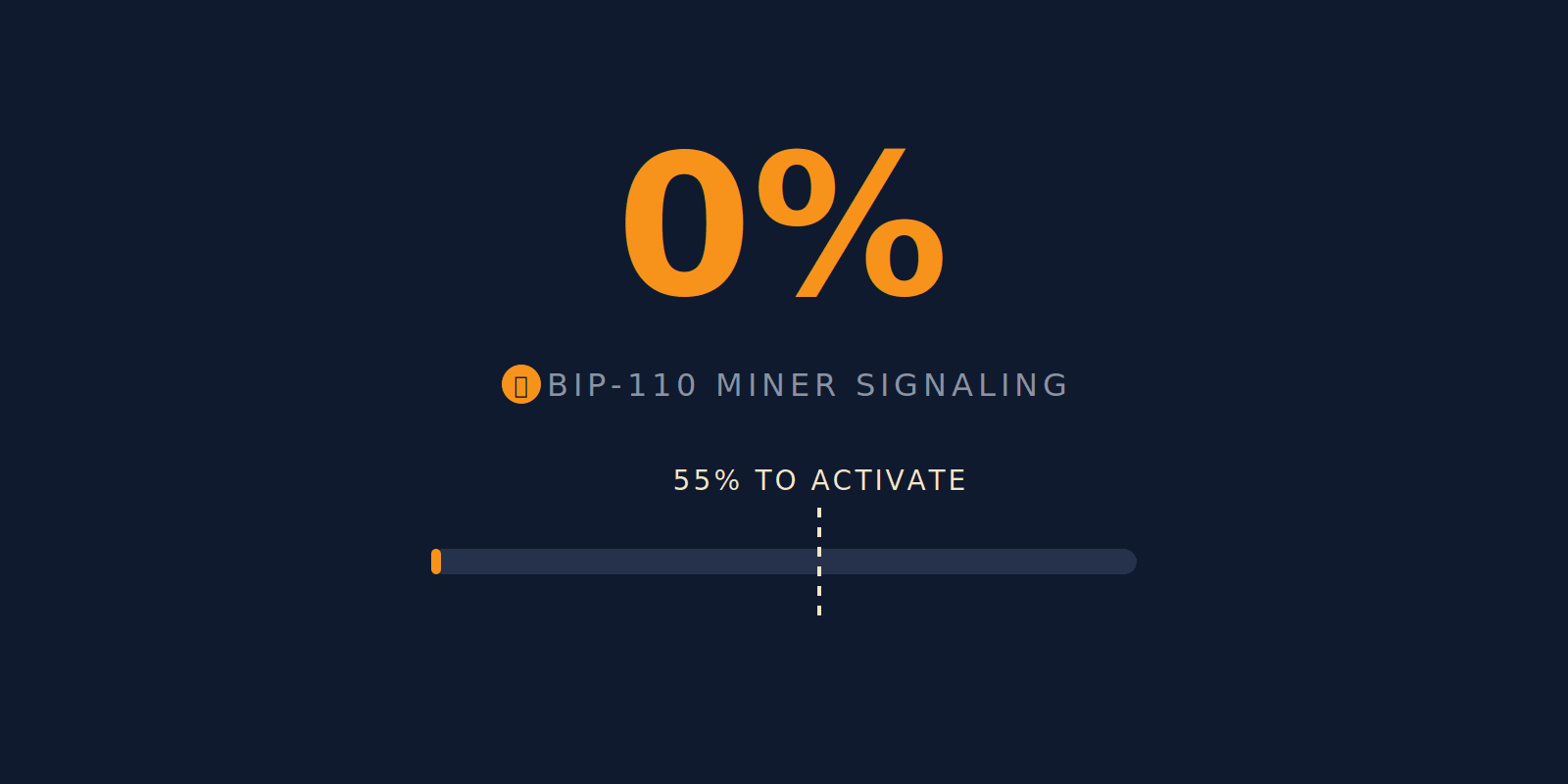
For BIP-110 to lock in, 55% of blocks in a single difficulty period need to signal support. That is 1,109 out of 2,016 blocks, and it is already a heavily discounted bar: traditional Bitcoin upgrades have used a 95% consensus standard.
Actual miner signaling has never risen above about 1% in any period since it began in March. In the current period it sits at zero. Not low. Zero.
No major mining pool has committed. Foundry USA, which controls about a third of network hashrate, has not moved. Antpool, at roughly 14%, has not moved. F2Pool refused outright. The signaling that does exist has come almost entirely from Ocean, the pool that mined the first supporting block on March 1.
Node numbers look better for supporters until you squint. Knots runs on somewhere between 8% and 23% of reachable nodes depending on the metric, but only an estimated 2% to 8% of listening nodes run software that can actually enforce BIP-110. Critics, including Jameson Lopp, point out that cheap Tor nodes make raw counts easy to inflate, and independent analysis suggests many BIP-110 nodes trace back to a small number of operators.
The Timeline Is Loud. The Data Is Quiet. We Read Both.
One weekly email separating what the feeds are shouting from what the network is actually doing.
SubscribeWhy The Big Names Picked This Weekend
The volume spiked now because the clock forces it. Enforcing nodes treat blocks 961,632 through 963,647 as a mandatory signaling window, which lands in early August, with activation projected around block 965,664 near September 1. This is the supporters' last stretch to build momentum, which is why the campaign is everywhere right now.
It is also why the heavyweights finally engaged. On Saturday, Michael Saylor posted that there are 110 things more dangerous to Bitcoin than spam, arguing the proposal turns a spam dispute into a consensus change that would invalidate currently valid, fee-paying transactions, and that the precedent is the real danger. Two days earlier he had posted fee data showing the network at 1 sat/vB, his evidence that Bitcoin has no spam problem worth a consensus change in the first place.
Adam Back's opposition cuts deeper, because he cannot be dismissed as a spam apologist. He invented Hashcash fighting spam three decades ago and has said Ordinals-style traffic has no place in the timechain. His position is that a consensus-level fix is worse than the disease: a quest to police other people that trades Bitcoin's credible neutrality for a filter that would not even filter well. His closing message to supporters was that they are free to fork away, but Bitcoin won't be joining them.
The supporters' case deserves a fair statement too, because it is not pure noise. Their argument is that a miner collects a fee once while every node stores the data forever, that filters at the policy level stopped working once Core removed them, and that Bitcoin's identity as money is worth defending at the consensus layer. Reasonable people hold that view. The network, so far, is not signing up for their remedy.
What Actually Matters In August
Whatever your politics on data in blocks, one practical fact survives the noise: enforcing nodes will start rejecting non-signaling blocks in early August. With signaling near zero, that does not change Bitcoin. It splits a small minority of nodes onto their own view of the chain while the rest of the network carries on.
But the transition window is not nothing. Core developer Jon Atack has publicly suggested pausing transfers around the mandatory signaling period, flagging the possibility of short reorgs, slower confirmations, and mempool divergence while the two node populations disagree. Supporters dispute the risk. The cheap insurance either way: avoid large or time-sensitive transactions in that window, and wait for extra confirmations if you can't.
The bigger takeaway is the one this whole episode keeps teaching. Follower counts, hashtags, and pile-ons measure tribal energy. Consensus is measured in signaled blocks, and right now those two numbers are off by orders of magnitude. When the discourse and the data disagree this badly, trust the data. It's the only participant that doesn't have an account.
Sources:
CoinDesk, Bitcoin's BIP-110 fork deadline nears with miner support at zero
Bitcoin.com News, Michael Saylor Declares Bitcoin Has 'No Spam Problem' as BIP-110 Debate Escalates
Cointelegraph, Solution worse than problem? Adam Back opposes BIP-110 Ordinals fix
Bitcoin.com News, Bitcoin Core Developer Warns Users to Pause BTC Transfers When BIP-110 Deadline Nears
This is market commentary, not financial advice. Nothing here is a recommendation to buy or sell any asset. Do your own research.
— BitBrainers Editorial