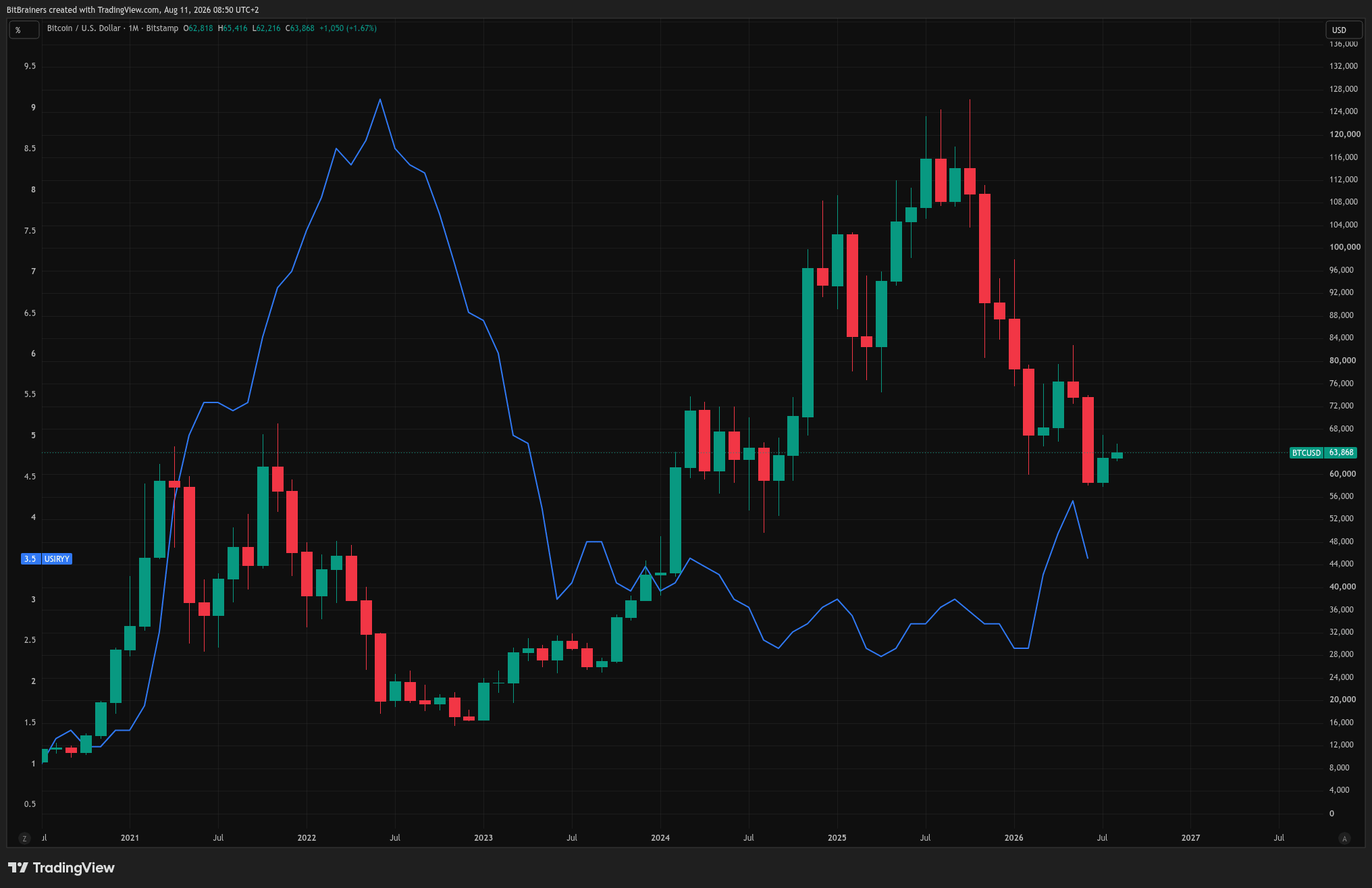
BTC/USD vs US CPI YoY (USIRYY), monthly. BitBrainers via TradingView, Aug 2026.

BTC/USD vs US CPI YoY (USIRYY), monthly. BitBrainers via TradingView, Aug 2026.
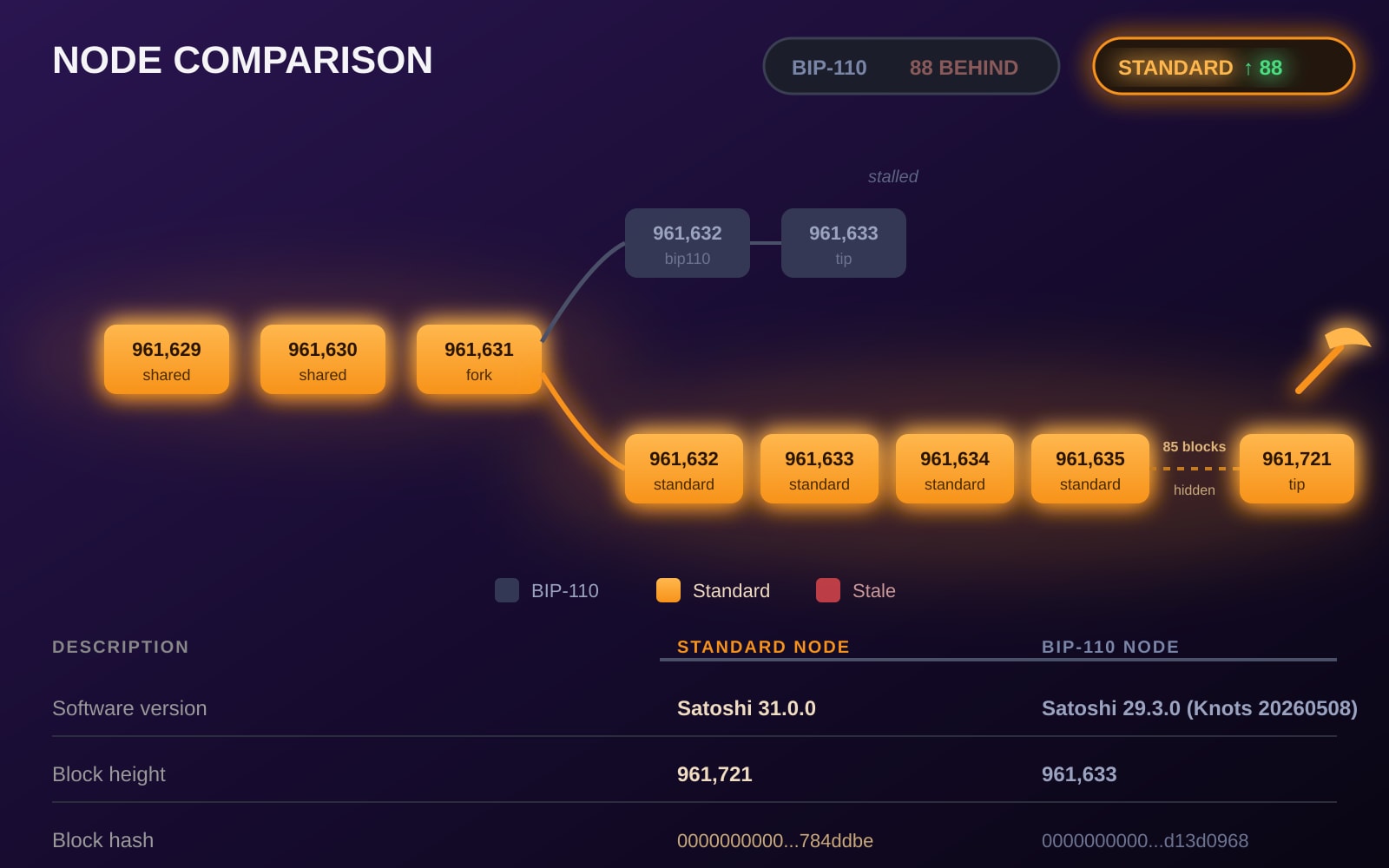
The BIP-110 chain split off from Bitcoin at block 961,632 and stalled at 961,633 after its only miner stopped. The main chain kept building normally, reaching 961,721 by publish. Data: mempool.space.
By BitBrainers Editorial
Most people holding Bitcoin are doing the equivalent of keeping cash under a mattress and calling it an investment strategy. The asset sits. The months pass. The opportunity cost stacks up quietly in the background.
There are real, functional ways to generate cash flow from Bitcoin without ever selling a single satoshi. Some of them are battle-tested. Some are newer and carry serious risks worth understanding before you touch them. This post covers both, in plain language, with no sugar coating.
Bitcoin is sitting at $72,795 today, June 1, 2026, and spot ETF outflows just hit a record high according to CoinDesk. Wall Street is rotating into AI plays instead. That combination is pushing price down and shaking out weak hands who bought purely on momentum.
Here is the thing. That environment is exactly when you do not want to sell. You want to hold through the noise. But holding passively feels painful when you watch price slide and your stack produces zero income. This is the exact scenario where cash flow strategies start making sense, not as a get-rich shortcut, but as a way to stay patient and funded while the market works itself out.
Options trading on Bitcoin has matured significantly. Platforms like Deribit allow holders to write covered call options against their BTC, collecting premium upfront in exchange for agreeing to sell at a higher target price if the market hits it before expiry.
Here is the mechanics in plain terms. You hold 1 BTC. You sell a call option with a strike price above current market, say 15-20% higher. Someone pays you a premium today for that right. If BTC never reaches that strike before expiry, you keep the premium and your BTC. If it does, you sell at the agreed price, which is still above where you bought if you set it right.
The risk is real. If BTC rips hard and fast above your strike, you miss the upside beyond that level. You sold the ceiling on that move. That is not a theoretical risk. It has happened to holders repeatedly during vertical rallies. Know this before you touch options. The premium income is real, but so is the ceiling you are putting on your gains.
The step-by-step to get started with covered calls:
Centralized Bitcoin lending is largely dead after the wave of platform collapses in recent years. What remains is mostly DeFi lending protocols and a handful of institutional desks. On the DeFi side, you can deposit wrapped Bitcoin (WBTC) on platforms like Aave or Compound and earn yield from borrowers using BTC as collateral.
The yield on BTC lending is historically lower than on stablecoins because demand to borrow BTC is lower than demand to borrow cash equivalents. Do not expect life-changing returns here. What you get is a modest passive yield in exchange for smart contract risk, oracle risk, and liquidity risk.
If this route interests you, use a hardware wallet to manage your assets properly before moving anything on-chain. The Trezor hardware wallet handles this well and keeps your signing keys off any exchange or browser-connected device. That matters enormously when you are moving BTC into protocols.
Most articles on Bitcoin yield treat the yield itself as the product. The actual product is time. Here is what that means.
A Bitcoin holder who generates even modest monthly cash flow from their stack extends their runway by months or years without ever touching principal. In a bear market or consolidation, that cash flow covers living costs, tax bills, or reinvestment opportunities. The yield is not the point. The point is that you do not have to sell BTC at the wrong time just to cover expenses.
This reframes the entire conversation. You are not trying to maximize yield on BTC. You are trying to minimize forced selling pressure on yourself. Even small consistent cash flow from your stack can make the difference between holding through a 40% drawdown and panic selling at the bottom.
Here is the insider-level play that rarely gets explained in plain language. A basis trade involves holding spot BTC while simultaneously shorting an equivalent amount of BTC in the futures market. When futures trade at a premium to spot, which they often do in bull markets, you collect that premium as the spread converges at expiry.
You are not directionally long or short. You are neutral. You earn the spread between the futures price and spot price. This is how institutional desks and crypto funds generate yield without taking on price risk.
The execution requires a platform that supports both spot and perpetual or dated futures. Kraken offers both spot trading and futures in one account, which simplifies this significantly. The risk here is not price direction. It is execution risk, margin requirements, and the fact that the premium can compress or disappear quickly if market conditions shift. In a flat or backwardated market, this trade stops working. You need to monitor it actively, not treat it like a savings account.
Step 1: Determine which portion of your BTC you are willing to put to work. Treat this like a separate allocation. Start with no more than 20-25% of your holdings.
Step 2: Choose a single strategy. Do not combine covered calls, lending, and basis trading simultaneously until you fully understand each one in isolation.
Step 3: For covered calls, open a Deribit account and paper trade for 30 days before putting real BTC on the line. Understand the greeks at a basic level. Delta and theta matter here.
Step 4: For lending or on-chain yield, set up a hardware wallet first. The Trezor setup takes under 30 minutes and removes the most common point of failure for DeFi participants.
Step 5: For basis trading, open a Kraken account, get verified, and study the current futures premium across different expiry dates before placing anything.
Step 6: Keep records. Every premium collected, every yield earned, every trade. Tax treatment of BTC options income and lending yield differs by jurisdiction and gets complex fast.
You probably came into this post believing that generating yield on Bitcoin is inherently risky and should be avoided by conservative holders. That assumption deserves pressure. Holding Bitcoin with zero strategy is not a risk-free baseline. It is a choice to absorb 100% of price volatility with zero downside mitigation and zero cash flow. The real question is not whether to put your stack to work. The question is which strategies match your actual risk tolerance and time availability. Passive holding feels safe because it is familiar. It is not the same as being protected.
Realistic expectations here: none of these strategies are passive income buttons. They require active management, platform risk tolerance, and the discipline to know when to stop. The cash flow potential exists. The work to capture it correctly is real and ongoing.
Your first action step: calculate exactly how many BTC you own, then decide the maximum amount you are comfortable putting to work. Write it down. That number is your ceiling. Every decision after that flows from it.
Disclosure: This post contains affiliate links to Trezor and Kraken. BitBrainers may earn a commission at no extra cost to you. This is not financial advice.
Sources
CoinDesk. Bitcoin extends slide as spot ETF outflows hit a record while Wall Street rips on AI
BitBrainers. The crypto analysis you wish you had yesterday.
Bitcoin is pressing against the $72,000 resistance zone that capped price action through most of Q4 2024, and a clean weekly close above it would shift the macro structure convincingly bullish. Options open interest is clustering around the $75,000 strike for the March 28 expiry, meaning market makers will be managing significant delta exposure into that date. Watch realized volatility closely: if it compresses below 40 annualized, covered call premiums tighten and the yield math on any BTC income strategy gets harder to defend.
The Federal Reserve meets March 18 and 19, with fed funds futures currently pricing just one cut before July. A hawkish hold or any revision to the dot plot projections will pressure risk assets and likely push BTC spot demand lower in the short window after the announcement. Lending rate benchmarks on major platforms have been running between 4% and 8% annualized for BTC collateral, and those rates compress when sentiment softens, so the Fed meeting is a direct input to your yield expectations this month.
The SEC's deadline to respond to several spot Bitcoin ETF options approval requests falls before March 22, and a green light would meaningfully expand institutional hedging activity on-chain. More institutional hedging means more counterparty demand for structured BTC products, which is exactly the environment where yield-generating strategies on existing holdings perform best. Keep that date circled alongside the FASB fair-value accounting rules taking effect for fiscal years starting after December 15, 2024, since corporate treasury adoption accelerating from here directly affects BTC supply dynamics.
— BitBrainers Editorial

Most people who buy Bitcoin think about price. Very few think about what happens when they sell it, swap it, or spend it. Tax authorities in the US, UK, Australia, and the EU have been building crypto-tracking infrastructure for years. The assumption that crypto is anonymous and untaxed is one of the most expensive mistakes new holders make.
This post covers how crypto tax works in most major countries, what actually triggers a taxable event, and what most guides conveniently leave out.
The IRS in the United States classified Bitcoin as property in 2014. HMRC in the UK took a similar position. The Australian Taxation Office followed. What this classification means is that every time you dispose of crypto, including selling, trading, or spending it, you potentially trigger a capital gains event.
This is not the same as how your bank account works. When you spend dollars, you do not owe capital gains tax. When you spend Bitcoin, in most jurisdictions, you do.
The European Union has been tightening its framework under DAC8, a directive that requires crypto exchanges operating in the EU to report user data to tax authorities. The reporting net is getting wider, not smaller.
This is where most new holders get caught. Swapping Bitcoin for Ethereum on an exchange is a taxable event in the US, UK, and Australia. You are disposing of one asset and acquiring another, and the capital gain or loss is calculated at the moment of the swap.
If you bought 1 BTC at $30,000 and swapped it for ETH when BTC was worth $76,325, you have a realized gain on that BTC. It does not matter that you never touched fiat. The gain is still taxable.
Spending crypto on goods or services triggers the same mechanism. In the US, this has been the IRS position since at least 2019.
Most countries distinguish between assets held for a short period versus a longer period. In the US, assets held for less than 12 months are taxed at ordinary income rates. Assets held longer than 12 months qualify for preferential long-term capital gains treatment.
The UK uses a different system under Section 104 pooling rules, where HMRC calculates your average cost basis across all purchases of the same asset. Australia has a similar long-term discount structure for assets held over 12 months.
The specific rates vary by income bracket and country. What stays consistent across jurisdictions is that the holding period affects how much you owe.
If someone pays you in Bitcoin for work, or you earn crypto through staking, mining, or yield farming, most tax authorities classify that as income, not capital gain. You pay income tax on the fair market value of the crypto at the time you receive it.
Then, when you later sell or swap that crypto, you also potentially owe capital gains tax on any appreciation from the original income value. This means a single unit of crypto can be taxed twice in two separate categories before you ever see fiat.
Staking rewards in particular are a grey area that different countries handle differently. The UK's HMRC has issued guidance treating most staking rewards as income on receipt.
Moving Bitcoin from one wallet you own to another wallet you own does not trigger a capital gains event in the US, UK, or Australia. The IRS, HMRC, and ATO are consistent on this point.
Where people trip up is failing to document that both wallets belong to them. If your records are messy and you cannot prove wallet ownership, an auditor may treat a transfer as a sale or gift. Keep a clear record of every wallet address you control and when you created it.
This matters especially as more Bitcoin holders move to self-custody using hardware wallets. The act of moving from an exchange to a hardware wallet is not a taxable event. The paperwork you keep proving that is what protects you.
Cost basis is what you originally paid for your crypto. Your taxable gain is the difference between what you paid and what you received when you disposed of it. Sounds simple. In practice, it is a mess.
If you bought Bitcoin 40 times over three years at different prices, your cost basis is not straightforward. Different accounting methods, FIFO (first in, first out), LIFO (last in, first out), and specific identification, produce different tax outcomes. The US allows specific identification if you can document it properly. The UK mandates its own pool calculation method.
With BTC currently at $76,325, any long-term holder sitting on gains is also sitting on a tax liability they will realize the moment they sell. That number is not hypothetical, it is baked into every wallet that has appreciated.
This is the contrarian point most crypto blogs miss. Many holders still operate as if self-reporting is optional or unlikely to get checked. That assumption is outdated. Coinbase has been reporting user data to the IRS since at least 2016 under legal order. Exchanges operating in the EU are mandated to report under DAC8. The OECD's Crypto-Asset Reporting Framework is being adopted by over 50 countries to enable automatic cross-border data sharing.
The era of crypto being invisible to tax authorities is effectively over for anyone using a regulated exchange. The only people this does not apply to are those who have never touched a KYC (Know Your Customer) exchange, and that group is a fraction of total holders.
The practical implication is that inaction is not the same as safety. Tax authorities are building backward-looking cases using exchange data, blockchain analytics companies, and international cooperation agreements.
Selling crypto at a loss lets you offset capital gains elsewhere in most jurisdictions. This is called tax loss harvesting and it is a legitimate strategy used by accountants worldwide.
If you made gains on BTC but took losses on an altcoin position, you may be able to net those against each other. In the US, capital losses first offset capital gains of the same type, then can offset up to $3,000 of ordinary income per year, with excess losses carried forward.
With BTC trading at $76,325 in mid-May 2026, anyone who entered at higher prices during previous cycle peaks may actually be sitting on unrealized losses worth documenting. A qualified crypto tax accountant, not a general accountant who has never touched crypto, is worth the cost in this situation.
Crypto tax software like Koinly, CoinTracker, and TaxBit imports exchange history and wallet transactions to calculate your liability automatically. These tools save enormous time. They also make errors when exchanges format data inconsistently, when DeFi transactions are complex, or when chain data is incomplete.
Never submit a tax report generated by software without reviewing it. One miscategorized transaction can throw off your entire cost basis calculation.
For anyone buying or selling regularly, keeping a clean paper trail from the moment you start is the difference between a two-hour tax filing and a nightmare audit.
You probably came here thinking that crypto taxes are a problem for people who made a lot of money. That assumption is wrong in two directions. First, even small gains are reportable in most countries. Second, even people who lost money have obligations, including documenting and reporting those losses, because losses have tax value.
The tax system does not care whether you feel like you made meaningful money. It cares about what you disposed of and what it was worth at the time. If you traded, swapped, spent, or earned crypto in any tax year, you have a filing obligation in most major jurisdictions regardless of whether the net result was profitable.
Disclosure: This post contains affiliate links to Trezor and Kraken. BitBrainers may earn a commission at no extra cost to you. This is not financial advice.
The one thing to remember: Every disposal of crypto, not just selling to fiat, is a taxable event in most countries. Know your cost basis, track every transaction, and do not confuse inaction with invisibility.
BitBrainers. Follow the data, not the noise.

Over $3 billion was stolen from crypto protocols and exchanges in a single year alone. Not from beginner mistakes. Not from phishing scams targeting grandmothers. From deep systemic failures that developers, executives, and regulators all saw coming and did nothing about. That number should make you angry, not scared.
This isn't a scare post. It's a forensic look at why some of the biggest crypto heists in history happened, what the industry learned, and honestly, what it still refuses to learn.
Mt. Gox was once handling the majority of all global Bitcoin trades. When it imploded, approximately 850,000 BTC belonging to customers disappeared. The exchange had been bleeding funds through a bug in how it processed withdrawal transactions for years before anyone noticed. Bitcoin itself kept running. Every block confirmed. Every transaction settled. The protocol did exactly what it was built to do.
The failure was entirely human and organizational. Poor internal auditing, zero transparency, and a leadership structure that prioritised growth over security. This set the pattern for nearly every major exchange hack that followed.
Bitfinex used a multi-signature wallet setup with BitGo. Multi-signature means a transaction needs approval from multiple private keys before it can execute. It sounds bulletproof. It wasn't.
Attackers identified a flaw in how the system was configured rather than in the cryptography itself. Around 120,000 BTC were stolen. The interesting part? Bitfinex issued a token called BFX to creditors representing the debt, then bought those tokens back at face value over the following year. Most people write off exchange hacks as permanent losses. Bitfinex partially rewrote that narrative, though it took significant time and the approach was controversial.
Ethereum launched with an ambitious concept: smart contracts execute automatically based on code, with no human interference. A project called The DAO raised a massive amount of ETH to fund decentralised proposals. Then someone found a re-entrancy bug. This is where a smart contract can be tricked into sending funds multiple times before it updates its own internal balance. The attacker drained roughly a third of The DAO's funds.
The Ethereum community made a controversial decision to hard fork the blockchain and reverse the hack. Not everyone agreed. The group that rejected the fork kept the original chain running as Ethereum Classic. One hack literally split a blockchain into two separate assets that still trade today.
The Ronin Network hack sits near the top of the all-time list by dollar value. Ronin was the blockchain underlying the Axie Infinity game. Attackers compromised validator nodes, the entities responsible for approving transactions on the network. They gained control of enough validators to approve fraudulent withdrawals of approximately 173,600 ETH and 25.5 million USDC.
Cross-chain bridges, the infrastructure that moves assets between different blockchains, have consistently been the most targeted attack surface in crypto. They hold large concentrations of funds. They involve complex code. They connect systems with different security assumptions. Every serious developer in the space knows bridges are dangerous. The market keeps building them anyway because users demand cross-chain functionality.
Here's something that rarely makes it into mainstream coverage. Many exchanges historically stored private keys in hot wallets because cold storage creates operational friction. A hot wallet is connected to the internet. A cold wallet is not. Moving funds to a cold wallet means a human has to physically interact with the signing device. Exchanges optimised for withdrawal speed over withdrawal security.
The business logic made sense in the short term. The security logic was a disaster waiting to happen. The best exchanges today use a tiered system where only a small percentage of total funds sit in hot wallets at any given time. The rest stay in cold storage. But this only protects you if the exchange actually follows through on it, and you have no way to verify that from the outside.
Wormhole is a bridge connecting Solana to other blockchains. In early 2022, an attacker found a flaw in the signature verification logic. This means the code that checks whether a transaction has been properly authorised had a bug that allowed someone to bypass the check entirely. The attacker minted 120,000 wrapped ETH on Solana without actually depositing the real ETH on the Ethereum side. They then redeemed that synthetic ETH for real assets.
Jump Crypto, the firm behind Wormhole, replenished the funds within days. That response surprised the industry. It also confirmed that some serious institutional money now backs crypto infrastructure, and those institutions have reputational and financial reasons to make users whole when things break.
Every hack covered here involved a third party holding assets on behalf of users. That's the common thread. When you leave Bitcoin on an exchange, you hold an IOU, not Bitcoin. The exchange holds the actual private keys. If the exchange gets hacked, mismanages funds, or goes insolvent, your Bitcoin is part of the mess.
Hardware wallets like Trezor put the private keys under your physical control. The keys never touch an internet-connected device. An attacker cannot remotely steal what they cannot remotely access. This isn't a marketing talking point. It's the direct lesson from every exchange hack ever documented.
The Bank of England is currently reconsidering its approach to sterling stablecoin regulation following pushback from the industry, according to a report in the Financial Times covered by The Block this week. Regulators globally are tightening their grip on crypto infrastructure, and part of that pressure comes directly from the hack history we've been through.
Regulation will not prevent technical exploits in smart contracts. It will not stop a determined nation-state attacker. It adds accountability and oversight to centralised actors, which is better than nothing, but it doesn't solve the core problem of holding private keys securely.
Most crypto commentary treats hacks as anomalies. Rare events caused by unique circumstances that the industry is slowly closing off. That framing is wrong. Hacks are a structural feature of any high-value permissionless system. Bitcoin has survived for years without its base layer being compromised. But everything built on top of it, custodians, bridges, smart contracts, DeFi protocols, has a consistent track record of failure.
The lesson isn't that crypto is unsafe. The lesson is that the security guarantee Bitcoin offers at the base layer does not automatically extend to every product built around it. The protocol is not the product. Most people conflate the two.
Before major DeFi protocols launch, they typically commission smart contract audits from security firms. Firms like Certik, Trail of Bits, and OpenZeppelin have reviewed thousands of contracts. Audited contracts still get hacked regularly. An audit is not a security guarantee. It's a documentation of the security assumptions a firm reviewed at a single point in time. Code changes. New interactions between protocols create new attack surfaces. Auditors are not adversarial the way real attackers are.
This doesn't mean audits are useless. It means treating an audit as a final seal of safety is dangerously naive.
You probably came into this post assuming the biggest lesson from crypto hacks is to use better passwords or avoid shady projects. That's surface-level thinking. The deeper lesson is about custody architecture. Who holds the keys, under what conditions, with what oversight, and what happens when that arrangement fails? Every hack in crypto history traces back to a bad answer to one of those four questions.
Bitcoin doesn't care who holds the keys. It will process whatever transaction is signed with the correct private key. The human systems wrapped around that cryptographic truth are where everything goes wrong.
If you're buying Bitcoin and holding it on an exchange, you're trusting that exchange's security decisions completely. If you want to actually hold Bitcoin, use a hardware wallet like Trezor and be responsible for your own keys. If you're still at the stage of buying and want a reliable exchange to get started, Kraken has a strong security track record compared to most competitors.
The one thing to remember: an exchange holding your Bitcoin isn't storing it for you, it's replacing it with a promise.
Disclosure: This post contains affiliate links to Trezor and Kraken. BitBrainers may earn a commission at no extra cost to you. This is not financial advice.
BitBrainers. No hype. No fluff. Just crypto that matters.
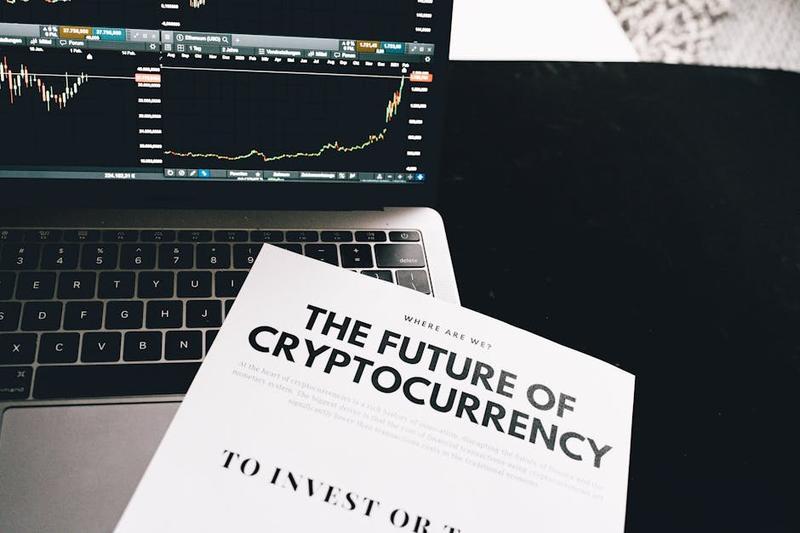
Uniswap has processed hundreds of billions in trading volume. UNI token holders have collectively voted to keep the fee switch off for years. The people generating that revenue do not hold UNI. The people holding UNI do not benefit from that revenue. That is governance in crypto.
When a protocol launches a governance token, it hands out voting rights over protocol parameters. Things like fee structures, treasury spending, adding new assets, or changing smart contract rules.
The token itself does not represent equity. It does not give you a cut of protocol revenue by default. It gives you the right to vote, and that is often where the usefulness ends.
Compound launched COMP in 2020 as one of the first major governance tokens. The concept spread fast. Every new DeFi protocol copied the model. Most of them had no serious thought put into what token holders would actually decide, or why anyone would care.
Here is the structural problem. Governance tokens get distributed through liquidity mining, airdrops, and team allocations. Venture capital firms and early insiders consistently end up with the largest voting blocks.
On Compound, a handful of institutional addresses have historically controlled enough voting power to pass or block proposals unilaterally. Most retail holders own too few tokens to reach the minimum threshold required to even submit a proposal.
On Uniswap, you need 2.5 million UNI just to submit a governance proposal. At any price above a few dollars, that is a multi-million dollar barrier. That is not decentralized governance. That is a veto system designed to keep power where it already sits.
Uniswap has collected enormous fees since it launched. Those fees go entirely to liquidity providers. UNI holders get nothing.
There is a fee switch built into the protocol that could redirect a portion of fees to the governance treasury, which UNI holders control. The community has debated activating it for years. It has not happened, partly due to regulatory concerns around whether that would make UNI a security.
This is the core contradiction. Governance tokens promise holders influence over valuable protocols. But activating that value triggers regulatory scrutiny that developers want to avoid. So the token sits in limbo, powerful on paper, inert in practice.
Here is the insider insight most posts skip. Low participation in governance votes is not a bug most teams want to fix. High voter turnout requires engaging retail holders. Retail holders are unpredictable. They can vote against protocol changes that VCs want pushed through.
Quorum thresholds are set high enough to fail without institutional participation, and low enough that institutions can pass things without retail. This architecture gives the appearance of community governance while keeping actual control concentrated.
Aave governance operates on this model. A proposal needs a specific token threshold to reach quorum. Retail holders are technically eligible to vote but structurally irrelevant unless they organize through delegation.
MKR is one of the few governance tokens with real, embedded utility. MKR holders govern the Maker protocol, which controls the DAI stablecoin peg. Bad governance decisions directly reduce the value of MKR through a dilution mechanism.
This creates actual skin in the game. If MKR holders vote poorly and the protocol takes on bad debt, the system mints new MKR to cover losses, which dilutes existing holders. If they govern well, surplus revenue buys and burns MKR, which reduces supply and increases value.
That feedback loop is why MakerDAO governance has historically been more serious than most. The token has consequences attached to it. Most governance tokens carry no such weight.
While governance tokens shuffle voting power around, actual financial infrastructure is being built on top of stablecoins. This week, Stables announced it tapped the T-0 Network as stablecoin payment infrastructure, targeting Asia where stablecoins already account for a significant share of crypto payment volume.
That is the contrast that matters. Stablecoin payment rails are processing real economic activity. Governance tokens are processing votes that often change nothing. One has product-market fit. The other mostly has marketing.
The infrastructure being built around USDT and USDC in Asia represents the kind of utility that creates sustained demand for a token. A governance token for a protocol nobody uses has no equivalent demand driver.
When protocols airdrop governance tokens to early users, most recipients sell immediately. They earned the tokens through usage, not conviction. They have no reason to hold.
This dynamic hits every new governance token launch. The token spikes on day one, dumps over the following weeks as recipients sell, and stabilizes at a fraction of its launch price. The community left holding are the ones who bought into the narrative after the airdrop.
dYdX dropped its governance token to early traders. The price action followed the exact pattern described above. Most governance token launches follow the same arc. The protocol might be excellent. The token economics are structured to punish retail buyers.
Projects that launch governance tokens often try to add utility retroactively. Staking rewards. Buyback programs. Revenue sharing proposals. These are patches on a flawed original design.
When a team needs to invent reasons for people to hold their token, that is not a good sign. The token was not designed with clear value capture from day one. It was designed to attract liquidity, distribute ownership on paper, and create a fundraising mechanism that avoided being called a fundraising mechanism.
Compare this to BTC. Bitcoin does not require governance theater to justify its value. The scarcity, the security model, and the network effect do that work. A governance token for a protocol with low usage and no fee capture has none of these fundamentals underneath it.
Holding a governance token also means you are exposed to smart contract risk on that protocol. If the protocol gets exploited, the governance token often goes to near zero. You took the risk of a DeFi hack and received voting rights you probably never used as compensation.
Beanstalk, a stablecoin protocol, was drained through a governance attack. An attacker took out a flash loan, acquired enough governance tokens in a single transaction to pass a malicious proposal, drained the treasury, and repaid the loan. Governance itself became the attack vector.
This is not a hypothetical. Governance tokens can be used by adversaries to steal from the protocol they are supposed to protect. The same mechanism that lets holders vote lets a well-capitalized attacker weaponize voting rights in a single block.
Most analysis frames this as a problem to be solved. It is not. Governance token distribution is an elegant solution for protocols that want decentralized ownership narratives without giving up actual control.
The protocol captures liquidity, creates a distributed holder base that defends the protocol from criticism, and avoids securities classification by ensuring the token does not represent equity. Holders receive influence over parameters that rarely change and economic rights that rarely pay out.
The protocol wins. The early insiders win. The retail holder who bought on exchange after the hype cycle started is carrying all the risk with almost none of the upside. Understanding this reframes every new governance token launch you see.
You probably assumed that governance tokens exist primarily to give communities control over protocols. They do not. They exist primarily to distribute protocol risk to the public while keeping decision-making power concentrated among insiders. The community framing is real in some protocols, especially smaller ones. But at scale, it consistently breaks down along the lines described above. The assumption that voting rights equal real power is the mistake most token holders make before they learn it the expensive way.
Disclosure: This post contains affiliate links to Trezor and Kraken. BitBrainers may earn a commission at no extra cost to you. This is not financial advice.
The one thing you must remember: A governance token is only as valuable as the protocol's revenue, the credibility of its fee capture mechanism, and the seriousness of its voter participation. If any of those three are weak, the token is speculation, not ownership.
BitBrainers. No hype. No fluff. Just crypto that matters.
One developer disagreement split Bitcoin's network overnight and handed every holder a brand-new coin they didn't ask for. That's not a hypothetical. That happened in August 2017. If you weren't paying attention, you either claimed free money or left it rotting in an exchange wallet forever.
Hard forks are one of the most misunderstood events in crypto. Most beginner guides reduce them to "free coins!" and move on. That's lazy, and it misses the part that actually matters.
A hard fork happens when a blockchain's code changes in a way that makes the new version permanently incompatible with the old one. It's not a software patch. It's a split.
Think of it like this: Bitcoin is a rulebook shared by thousands of computers worldwide. If a group of developers and miners decide to change a fundamental rule, say, the block size limit, and other nodes refuse to follow, you get two separate chains from that point forward. Both chains share all the history up to the split, then they go their own way.
This is different from a soft fork, which is a backward-compatible change. Soft forks tighten the rules. Hard forks change them in a way that older nodes will outright reject.
In August 2017, a faction of the Bitcoin community hard forked the network to create Bitcoin Cash (BCH). The core disagreement was over block size. The original Bitcoin block size was capped at 1MB, which limited how many transactions could be processed per block. BCH boosted that limit to 8MB immediately.
Holders of Bitcoin at the time of the fork received an equal amount of BCH, one BCH for every one BTC. Sounds clean. In practice, claiming those coins required accessing your private keys, which created serious security risks if you did it wrong. More on that in a minute.
BCH then forked again in November 2018 into Bitcoin Cash ABC and Bitcoin SV (BSV). BSV later got delisted from multiple major exchanges. A coin born from ideological conflict can fracture again just as easily. This isn't stability. It's a chain of disagreements wearing a ticker symbol.
Ethereum Classic (ETC) exists because of a hard fork too, but the reason was different and messier. After the DAO hack drained roughly $60 million worth of ETH in 2016, the Ethereum core team proposed a fork to reverse the stolen transactions. Most of the community went along with it, creating what we now call Ethereum (ETH). The minority that refused to rewrite history kept running the original chain. That became Ethereum Classic.
This fork wasn't about scaling. It was about whether a blockchain should be truly immutable or whether the community gets to undo transactions it doesn't like. That philosophical split is still debated today. ETH took the pragmatic route. ETC held the ideological ground. Neither answer is obviously wrong, but the market has been fairly clear about which it prefers.
Most people think the dangerous moment is during the fork. It's not. The dangerous moment is the weeks after, when people start trying to claim their forked coins.
To claim coins on a new fork chain, you typically need to use your private key on the new chain's software or a third-party claiming tool. If the fork coin has low developer security standards, and many do, you risk exposing your private key to malicious code. There have been documented cases of people losing their original Bitcoin while chasing forked coins worth far less.
The rule that serious holders follow is to move their original coins to a fresh wallet before interacting with anything fork-related. If you hold BTC in self-custody, hardware wallets handle fork claims with significantly better isolation than hot wallets or exchange accounts. A device like Trezor keeps your private keys offline and gives you far more control over how you interact with fork chains. You can check that out at affil.trezor.io.
Here's something the free-coins narrative conveniently skips: if your BTC sits on an exchange during a fork, the exchange decides whether to credit you. Many exchanges have declined to support certain fork coins, meaning holders on those platforms got nothing.
In 2017 and 2018, some exchanges credited BCH to holders. Others did not. Coinbase initially said it wouldn't support BCH, then reversed course under user pressure. The point isn't which exchange did what. The point is that your fork eligibility was entirely in someone else's hands.
If you don't control your private keys, you don't control your fork coins. This is one of the strongest arguments for self-custody. Not your keys, not your coins applies before the fork and after it.
Here's the contrarian take that most crypto content ignores: the new coin that emerges from a hard fork is almost never what matters. What matters is what the fork reveals about the original chain's governance structure.
The Bitcoin Cash fork exposed that Bitcoin had no clear mechanism to resolve major protocol disagreements. The community had argued about block sizes for years with no resolution. The fork was the blowout, not the argument itself. When you see a hard fork forming, the right question isn't whether the new coin has value. The right question is: what does this fight tell me about who actually controls this network?
Bitcoin has had over 70 attempted forks since its launch in 2009. The vast majority are abandoned or trade with negligible volume. The ones that survive reveal that a meaningful faction of the community held a different vision for long enough to maintain infrastructure.
It's worth separating contentious forks from planned ones. Some hard forks happen because the entire community agrees a change is necessary and coordinates around a specific block height. These go smoothly. There's no chain split because no faction refuses the upgrade.
Bitcoin's Taproot upgrade, which improved scripting flexibility and privacy, activated in November 2021. It was a soft fork, not a hard fork, but the point stands: upgrades can happen without drama when developers, miners, and node operators align. The fireworks happen when they don't.
With BTC sitting at $80,837 on May 10, 2026, fork discussions are always cycling through developer forums and social channels. The Bitcoin developer community has ongoing conversations about future upgrades. None of them involve the kind of ideological split that produced BCH. That's worth noting. The Bitcoin ecosystem today is significantly more institutionally mature than it was in 2017, which makes a chaotic contentious fork less likely, though never impossible.
If a credible fork proposal gains traction, it will show up in Bitcoin's GitHub repository discussions and mailing lists long before any media outlet covers it. Watching those sources is how you get ahead of the noise, not by waiting for a headline.
Here's the assumption worth challenging before you close this tab. If you're newer to Bitcoin and you think hard forks are a 2017-era problem that doesn't concern you, that thinking is wrong. Forks can happen to any chain at any time as long as people disagree about protocol direction. The bigger the community, the more potential vectors for conflict.
Right now the broader crypto ecosystem has hundreds of active chains, each with their own governance dynamics and developer factions. The probability of a fork touching something in your portfolio at some point is not small. Knowing how forks work before one hits a chain you hold is how you avoid making expensive decisions in the first 24 hours of chaos.
The new coin is bait. The fork itself is the signal. What a hard fork tells you about a network's governance, its community cohesion, and its ability to resolve disagreements is worth far more than whatever the forked token trades at on day one.
Keep your coins in self-custody before, during, and after a fork. Know which chain your wallet supports. Never interact with a fork chain using your original private keys until you've moved your original holdings to a clean address.
Disclosure: This post contains affiliate links to Trezor. BitBrainers may earn a commission at no extra cost to you. This is not financial advice.
BitBrainers. The crypto analysis you wish you had yesterday.
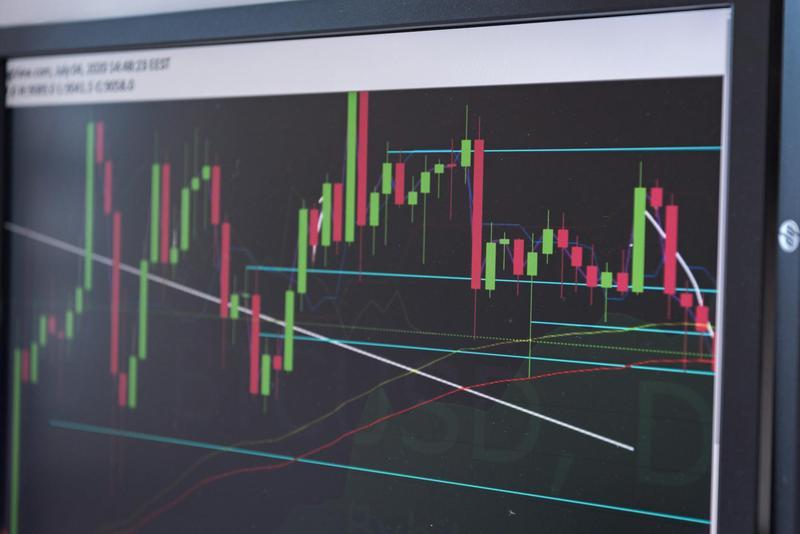
90% of new crypto investors lose money in their first two years. Not because crypto is a scam. Because they allocate their capital like they're playing a scratch lottery instead of building actual wealth.
Portfolio allocation is the single decision that determines whether you survive a bear market or get wiped out. Most beginner guides skip past it to tell you which coins are "hot right now." That is exactly the wrong way to learn this.
You could pick the right coin and still lose money. If you put 80% of your portfolio into a solid project right before a 70% correction, you're still ruined psychologically. Most people sell at the bottom because they sized in wrong.
Allocation is about how much of what you hold, and why. It controls your risk exposure whether markets go up or down. Get this wrong and it doesn't matter how smart your picks are.
This isn't a cliché. This is math. If you invest $5,000 that you actually need in six months, you will panic sell when BTC drops 30%. If you invest $2,000 you genuinely don't need, you hold through the drop and come out fine.
Never allocate rent money, emergency funds, or short-term savings to crypto. The volatility isn't the problem. Your timeline is. Crypto rewards patience and destroys impatience.
Here's the framework most serious allocators use. It's not glamorous. It's not going to make you rich overnight. But it works.
For a beginner portfolio, allocate 60% to 70% to Bitcoin. BTC is the most liquid, most regulated, most institutionally held crypto asset. It has the longest track record, the deepest liquidity, and the lowest correlation to individual project failure. When altcoins collapse 90%, BTC typically drops less and recovers faster.
Put 15% to 20% in Ethereum if you want exposure to smart contract infrastructure. ETH is the second most proven asset in the space. It's not Bitcoin, but it has real network usage, developer activity, and institutional holding. Beyond that, most beginners should stop.
Allocate no more than 10% to 15% of your total portfolio to altcoins. That includes Solana, Avalanche, BNB, and everything else. I don't care how bullish the Reddit thread is.
Altcoins can 10x. They can also go to zero. Both things happen regularly and often in the same year. Treating altcoins as lottery tickets with a small allocation is the right mental model. Treating them as your core holdings is how people go broke.
In late 2021, a wave of retail investors piled into Solana, Luna, and Avalanche after seeing 500% to 1000% returns. Many reallocated out of BTC entirely. Luna was widely praised as a "safer" stablecoin-adjacent bet.
By May 2022, Luna had collapsed to essentially zero. Solana dropped from roughly $260 to under $10. Investors who had kept a heavy BTC allocation saw pain, but they survived. Investors who had rotated fully into altcoins saw their portfolios evaporate. The lesson wasn't that those coins were fraudulent. The lesson was that concentration in high-volatility assets without a BTC anchor destroyed risk tolerance.
Most crypto blogs tell you to "diversify" across 10 to 20 tokens. That is terrible advice. It's borrowed from stock market logic and it does not translate.
In crypto, most altcoins are highly correlated. When BTC drops 30%, almost every altcoin drops 50% to 80%. Holding 15 altcoins instead of 3 doesn't reduce your risk. It increases your complexity, your tax reporting burden, and your emotional stress. True diversification in crypto means holding fewer positions with higher conviction, not spreading thin across coins you don't actually understand.
"Bitcoin is a remarkable cryptographic achievement and the ability to create something that is not duplicable in the digital world has enormous value." — Eric Schmidt, former CEO of Google
The exchange you use matters because fees compound. A platform charging 1.5% per transaction is taking a significant cut of your capital before you even start. Over time that destroys returns.
Use an exchange with low maker fees, strong regulatory standing, and real liquidity. Kraken has been operating since 2011, is regulated in multiple jurisdictions, and offers some of the lowest fees in the industry. You can sign up through this link and get started without the bloated fee structures that eat into smaller portfolios.
Set up recurring buys instead of trying to time the market. Dollar cost averaging, meaning buying a fixed amount at regular intervals regardless of price, removes the emotional component of allocation. You stop asking "is now a good time?" because you're buying every week no matter what.
Bitcoin runs 40% in two months. Now it's 80% of your portfolio instead of 65%. You're overexposed. Do you rebalance?
Yes. Not immediately and not obsessively. But if your allocation drifts more than 15% from your target, trim the winner and redistribute. This forces you to take partial profits into strength and add exposure in weakness. It's counterintuitive, which is why most people never do it.
Set a schedule. Quarterly rebalancing is a reasonable default. Rebalancing monthly is too frequent and creates unnecessary taxable events. Rebalancing annually may let your exposure drift too far.
Here's something most allocation guides ignore. Where you hold your crypto affects your risk as much as what you hold.
Keeping everything on an exchange means you're exposed to exchange insolvency, hacks, and withdrawal freezes. These are not theoretical risks. They have happened multiple times. The second your portfolio grows beyond what you'd be comfortable losing overnight, move your BTC to cold storage.
A hardware wallet like Trezor keeps your private keys offline and under your control. Nobody can freeze it. Nobody can hack it remotely. That changes your actual risk profile in a way that no allocation percentage can compensate for.
Stablecoins like USDC are worth holding as a cash position within your crypto portfolio. Keeping 5% to 10% in stablecoins gives you dry powder to buy dips without having to send fiat from a bank account. That matters because bank transfers take time and dips don't wait.
Don't go above 15% in stablecoins unless you're deliberately parking capital during a bear market. Stablecoins don't generate returns by sitting there. They're a tool, not a strategy.
Your allocation has to match your risk tolerance or you will not follow it. This sounds obvious. Nobody actually does it.
If you can't sleep when your portfolio is down 25%, you are over-allocated to crypto. Reduce your position until the drawdowns feel manageable. There is no correct allocation that exists independent of your mental and financial situation. Someone with $500 in crypto and $40,000 in savings has a different risk profile than someone with $5,000 in crypto and $8,000 in savings.
Write your allocation down before you buy anything. Then write down the conditions under which you'll change it. Markets will throw volatility at you designed to make you deviate from your plan. Having it written makes you accountable to something other than your own emotions in the moment.
Allocation is not exciting. It's not the part of crypto Twitter anyone brags about. But it's the only reason some people come out of bear markets with portfolios intact while others are destroyed.
Heavy BTC first. Small altcoin exposure. Rebalance quarterly. Keep dry powder in stablecoins. Move real money off exchanges into cold storage. Do those five things and you are already ahead of 80% of crypto beginners who never thought about any of it.
Disclosure: This post contains affiliate links to Trezor and Kraken. BitBrainers may earn a commission at no extra cost to you. This is not financial advice.
BitBrainers. The crypto analysis you wish you had yesterday.

A $500 million Bitcoin sell order hit Binance in March 2025 and moved the price less than 0.3%. That same week, a $2 million sell order on a mid-cap altcoin nuked its price by 34% in under four minutes. Same asset class. Wildly different outcomes. The difference had nothing to do with price. It had everything to do with liquidity.
Most new crypto traders obsess over price charts. They watch BTC tick up and down, screenshot green candles, and argue about whether $100K is coming. Meanwhile, the single most important variable determining whether they actually make or lose money sits completely ignored in the background.
Liquidity is simply how easily you can buy or sell an asset without moving its price. That's it. A liquid market absorbs large orders with minimal price impact. An illiquid market gets wrecked by relatively small orders.
Think of BTC right now sitting at $78,530. The daily spot volume across major exchanges runs in the billions. If you want to buy $50,000 worth of Bitcoin right now, the market barely flinches. You get filled close to the quoted price, and life goes on.
Now try doing that with a $200M market cap altcoin. Your $50,000 order represents a meaningful percentage of what trades in an entire day. You push the price up buying it, then push it down trying to sell it. You just ate yourself alive.
The price you see quoted on any exchange is the last traded price. It is not necessarily the price you will get. What matters is the order book, which is the live list of buy and sell orders stacked at various price levels.
Depth is the word traders use. A deep order book means thick clusters of buy and sell orders sitting near the current price. You can move large amounts without slipping far from where you wanted. A thin order book means a handful of orders spread across wide price gaps.
BTC has a deep order book on every major exchange. That depth is a feature, not an accident. It took years of institutional adoption, market maker participation, and trading volume to build it.
Slippage is what happens when the price you expect and the price you get are different. You see $78,530 on the screen. You hit buy. Your order fills at $78,610. That 80-point difference is slippage, and it just quietly took a chunk of your trade.
On Bitcoin, slippage for a typical retail order is negligible. On low-liquidity tokens, slippage can be 2%, 5%, even 15% on a single trade. You walk in paying 15% more than the quoted price, then need a 15% gain just to break even before fees.
This is not a theoretical risk. Traders posting losses on forums regularly had no idea slippage was silently destroying their edge on every entry and exit.
This is the case study that should be permanently tattooed on every crypto trader's brain. In May 2025, the anniversary of the original Terra Luna collapse still circulates in crypto circles as a reminder of what happens when liquidity evaporates.
The original Luna did not just fall in price. Liquidity dried up at every level simultaneously. Sell pressure hit, market makers pulled their bids, exchange order books became ghost towns, and anyone trying to exit found themselves selling into a void. The price did not drop gracefully. It collapsed in a near-vertical line because there were no buyers willing to absorb the sell orders at any reasonable price.
People who understood liquidity either were not holding Luna, or got out early when the depth of the order book started thinning. People who only watched the price chart waited for "a bounce" that never came.
Bitcoin's liquidity profile is different from every other crypto asset in a structural way. Market makers on both sides of BTC order books are institutions, algorithmic trading firms, and professional desks. They do not panic and pull their bids the way retail does.
This structural depth means BTC can absorb selling pressure that would detonate any other crypto asset. When macro fear hit markets hard in early 2025, Bitcoin sold off but maintained orderly price action. Several altcoins with far lower liquidity experienced gapping price action, meaning the price jumped in chunks with no trades in between. You simply could not exit at the price you wanted because no bids existed at those levels.
This is one major reason serious capital allocates to BTC first. Not just because it might go up. Because it can be exited when needed, at scale, without self-destruction.
Here is what most crypto blogs miss entirely. Price and liquidity are not correlated in any reliable way. A token can be priced at $50 and have almost no liquidity. Bitcoin at $78,530 has more genuine market depth than the entire altcoin top 50 combined in many scenarios.
New traders assume an expensive asset must be a liquid one. They see a token sitting at $40 and think its market cap is substantial enough to mean real trading depth. Market cap is shares outstanding times price. It says nothing about actual tradeable volume or order book depth. A project can have a billion dollar market cap with only $500K of real daily volume. That is a trap, not a trophy.
The metric to check is 24-hour spot volume relative to market cap, combined with order book depth data that exchanges like Kraken make available. Anything with a volume-to-market-cap ratio below 1% deserves serious scrutiny before you touch it.
Stop looking only at price. Start opening order books before you place trades. Most traders never do this and pay for the oversight on every single transaction.
For Bitcoin, check bid-ask spread. On any reputable exchange, BTC spread is often a few dollars or less. That tightness reflects genuine depth. For altcoins, if the spread is 1% or more, you are already behind before your trade even executes.
Volume consistency matters too. A coin that shows $50M in 24-hour volume but only $2M in the prior 23 hours probably had one anomalous spike. Artificial volume is a known manipulation tactic. Consistent volume across rolling time periods is the signal worth trusting.
The speed at which liquidity can disappear in crypto is genuinely dangerous. A token can go from functional to illiquid in minutes when a whale dumps, a protocol exploit hits the news, or a coordinated sell triggers a cascade of stop-losses.
By the time you see the price cratering and try to sell, you are already competing with every other holder trying to exit simultaneously. The order book absorbs the first few sellers. Everyone else gets progressively worse fills until the bids disappear entirely.
This is why position sizing relative to a token's average daily volume matters. A general rule serious traders use is never hold a position larger than 5% of average daily volume if you expect to exit in a crisis. Anything beyond that and you become your own exit problem.
Not all exchanges offer the same depth, even on the same assets. BTC liquidity is distributed across multiple venues, and on legitimate exchanges like Kraken, order book data is transparent and the spread on BTC is consistently tight. Offshore exchanges with inflated volume numbers are a different story entirely.
Fragmented liquidity means the same asset can have different effective prices across venues simultaneously. Arbitrage bots close those gaps quickly on liquid assets like BTC. On illiquid tokens, gaps can persist long enough to hurt real traders.
For retail traders, this means sticking to regulated, high-volume exchanges for any meaningful position. The few dollars in fees you save on some discount platform disappear instantly in wider spreads and worse fills.
Liquidity determines whether your theoretical gains are real gains you can actually collect. Price tells you what something is worth on paper. Liquidity tells you whether you can convert that paper into cash when it counts. Every other metric you track is noise if you cannot exit a position without destroying its value in the process.
Bitcoin's deep, institutional-grade liquidity is not a footnote. It is one of the most compelling arguments for treating BTC as the core of any crypto portfolio. Everything else is speculation on top of a liquidity risk you need to consciously price in.
BitBrainers. The crypto analysis you wish you had yesterday.
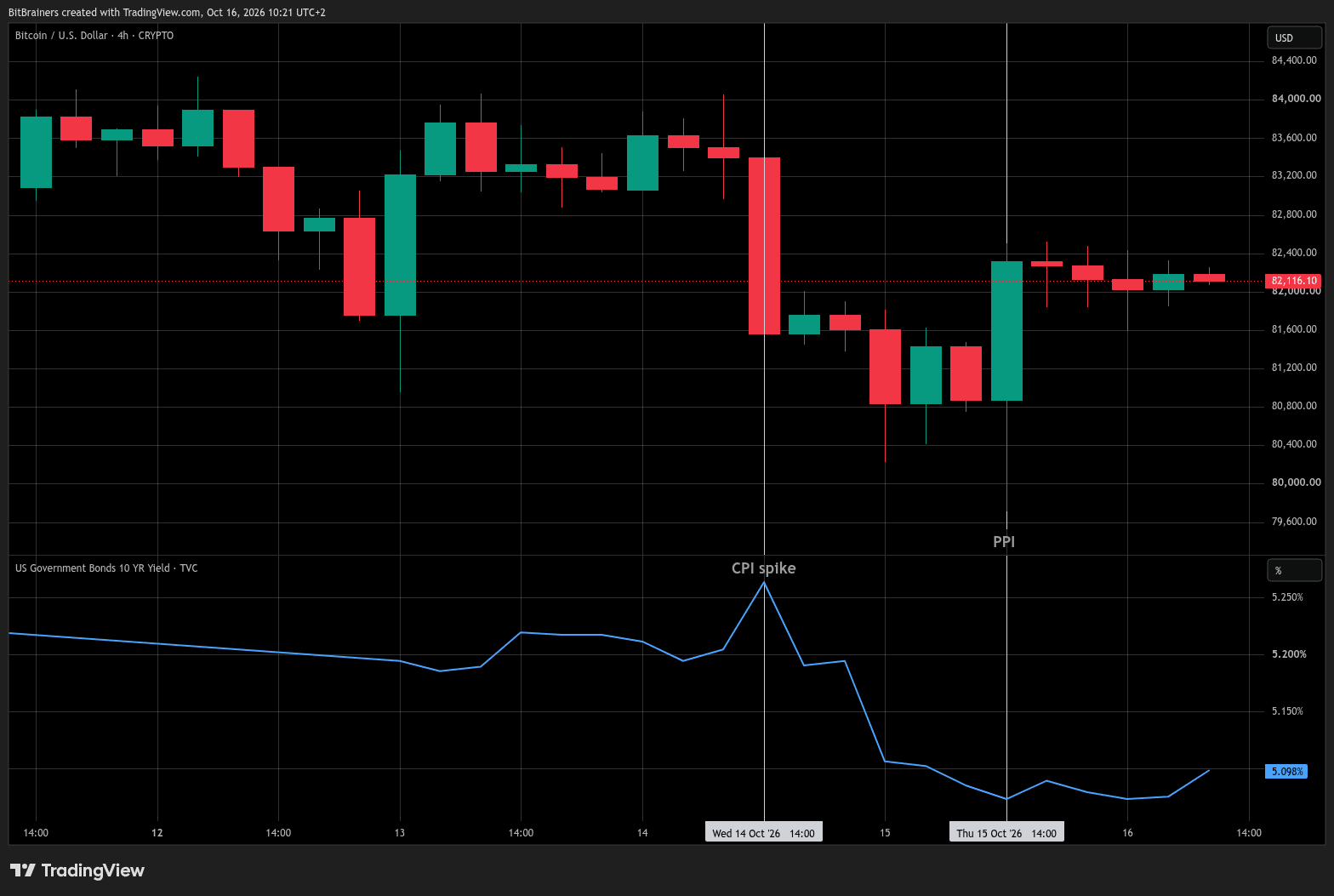
Bitcoin 4H (top) and US 10-year yield (bottom), October 12-16, 2026. CPI spiked the yield, PPI sent Bitcoin below $80,000, and neither hel...