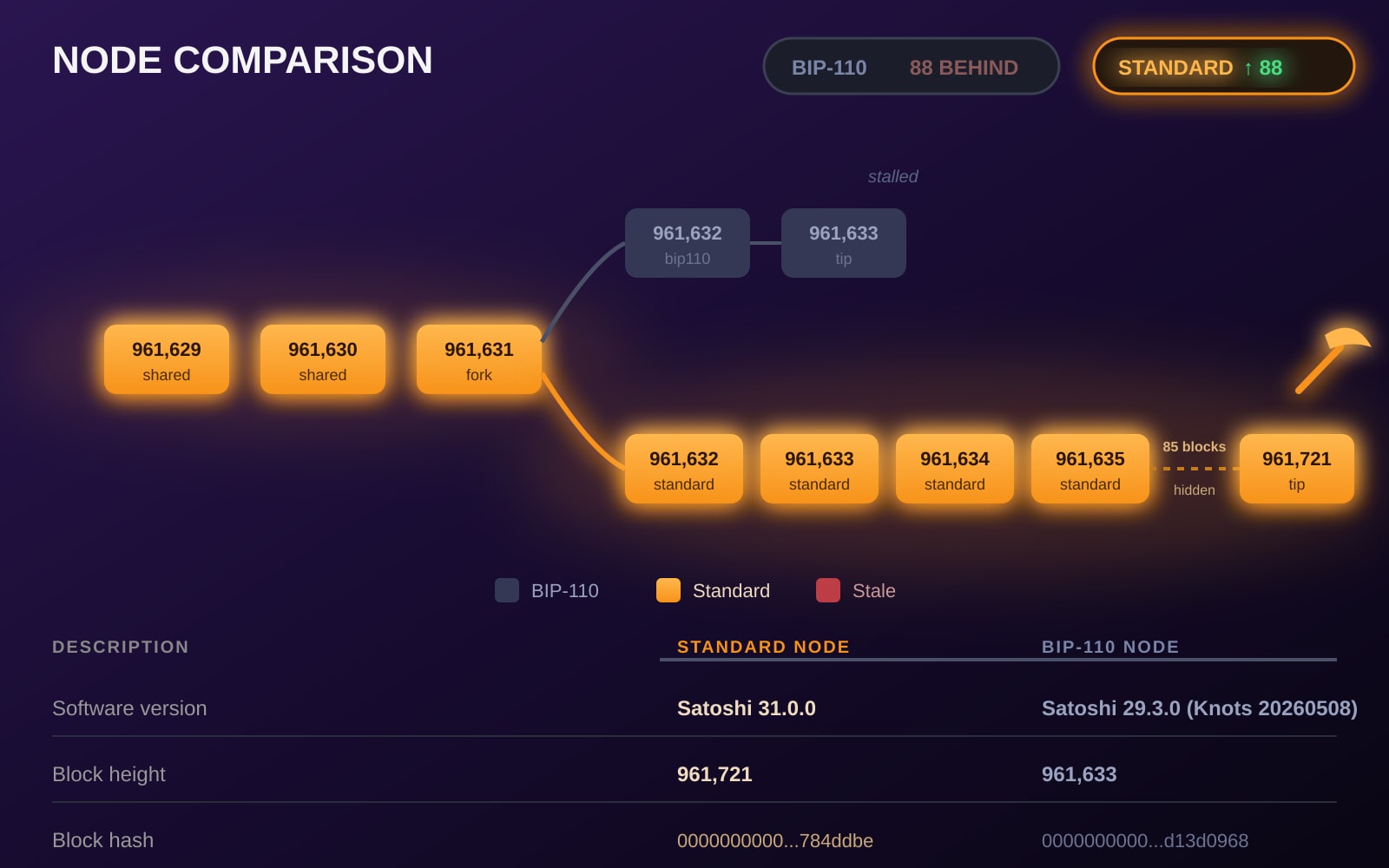
The BIP-110 chain split off from Bitcoin at block 961,632 and stalled at 961,633 after its only miner stopped. The main chain kept building normally, reaching 961,721 by publish. Data: mempool.space.
By BitBrainers Editorial
How The Split Actually Happened
BIP-110 is a one-year restriction on storing non-financial data, mainly Ordinals inscriptions, inside Bitcoin transactions. Supporters wanted it locked in through voluntary miner signaling. When that never reached the 55% threshold, the proposal's own rules forced a mandatory signaling period instead.
That period started August 7 at block 961,632. Nodes running BIP-110 software began rejecting any block that didn't signal support. Every other node kept validating normally, which is how you end up with two chains sharing one history up to a single block.
Support going into the deadline was thin: 2.53% of blocks signaled in the final two-week window, and the average since May sat closer to 0.42%. Ocean Pool provided most of what little signaling existed. We flagged this exact gap back in July, when support was still parked near zero.
The split didn't need majority support to trigger, only to lock in cleanly. Miners who reject non-signaling blocks simply start building their own chain the moment the deadline passes. Bitcoin Knots is the software behind that decision.
At block 961,632, AntPool mined the version the main network followed. Roughnecks, mining through Ocean, produced the signaling alternative that BIP-110 nodes accepted instead.
Ocean's own hashrate didn't move as one bloc, though. Its DATUM system lets individual miners set their own block templates, including whether to flip the BIP-110 signal. Simple Mining, which routes through Ocean, mined the very next block on the main chain instead. Even inside BIP-110's biggest backer, support was split.
The gap kept opening. By early Sunday afternoon the main chain had reached block 961,721 while the BIP-110 chain sat frozen at 961,633, the last block Roughnecks mined before it stopped. Eighty-eight blocks is several days of normal production on one side and nothing on the other.
Bitcoin has done this before without a split. Taproot activated at block 709,632 in November 2021 after building broad miner support first, and it never produced a persistent minority chain. BIP-110 entered its mandatory phase with a fraction of that support behind it, so the outcome here was closer to a default than a surprise.
Chain Splits Don't Wait For You To Catch Up
Get the mechanism explained before the headlines catch up. Free, straight to your inbox.
SubscribeWhat This Means For Your Coins
Exchanges and ETF holders are not exposed to any of this. The people who need to pay attention are self-custody users running full nodes, especially anyone who updated to Bitcoin Knots to signal support. Replay protection is not automatic between the two chains, so moving coins carelessly during the split window can expose funds on both sides at once.
If you hold your own keys through a hardware wallet like Trezor, the fix is simple. Don't move anything until your node software and wallet firmware agree on which chain you're actually on.
Who's Saying What
Reaction split along predictable lines. Blockstream's Adam Back, who'd argued for months that a breakaway chain was the likely endgame, called the outcome settled and urged BIP-110 supporters back into the main ecosystem.
Strategy's Michael Saylor brought the clearest numbers: about 99.85% of Bitcoin's hashpower on the main chain, the minority branch stuck at two blocks and already more than 80 behind, figures that line up closely with what's above.
He followed with the math that matters. At roughly 0.15% of network hashpower, the minority chain needs 2,015 more blocks to reach its first difficulty adjustment, which at the current pace works out to about 25 years. His framing was blunt: "Consensus is earned, not declared."
There's a wrinkle if you mine through Ocean specifically. The pool switched its default endpoint to signal for BIP-110 on July 15, so anyone pointed at Ocean who never opted into the non-signaling endpoint has been mining the minority chain without realizing it. Developer Peter Todd flagged this over the weekend, estimating roughly $43,000 a day in hashpower value going to blocks the main network will never recognize.
The question of whether the minority chain would keep going got answered fast. Roughnecks, the pool behind both of its blocks, posted early Sunday that it was stopping mining under its own name after an internal team meeting around 3:40am UTC.
The post called it an escalation rather than a retreat and told anyone still mining BIP-110 blocks to stand down for now. Either way, the chain that split off at 961,632 no longer has an active miner behind it.
What Actually Got Resolved Here
Not much, honestly. The mandatory signaling period settled a governance mechanism, not the underlying argument. Whether non-financial data belongs in Bitcoin blocks is the same fight it was in March, and Ordinals volume has already been falling on its own for unrelated reasons.
The other side of this fight didn't need a fork at all. Ordinals advocate Leonidas proposed a client called DOG Mode in July that changes nothing about consensus rules. It just raises the transaction size Bitcoin Core will relay and drops the dust limit to one satoshi, making Ordinals and Runes cheaper to broadcast. DOG Mode needs one willing miner, not 55% of the network, which is the exact asymmetry BIP-110 just ran headfirst into.
With Roughnecks gone, the minority chain isn't fading out gradually so much as it just stopped. A chain with zero active miners doesn't creep toward its next difficulty adjustment. It sits frozen at whatever block it last reached, waiting for someone to pick the work back up.
The real story is what BIP-110 proved about changing Bitcoin's rules going forward. Getting 55% of hashrate to agree on anything in 2026 is a different bar than it was during Taproot, and the next controversial proposal will be measured against this exact outcome.
Sources
CoinDesk: Controversial Bitcoin fork BIP-110 mines two blocks, then stops
The Block: Bitcoin's BIP-110 supporters split onto minority chain as main network pulls ahead
KuCoin: Bitcoin BIP-110 Fork Fails as Mainnet Outpaces Minority Chain by 26 Blocks
ForkLog: Bitcoin network splits over BIP-110 soft fork
Binance Square (via Odaily): Roughnecks Stops Mining Operations Under BIP-110 Protocol
This is market commentary, not financial advice. Nothing here is a recommendation to buy or sell any asset. Do your own research.