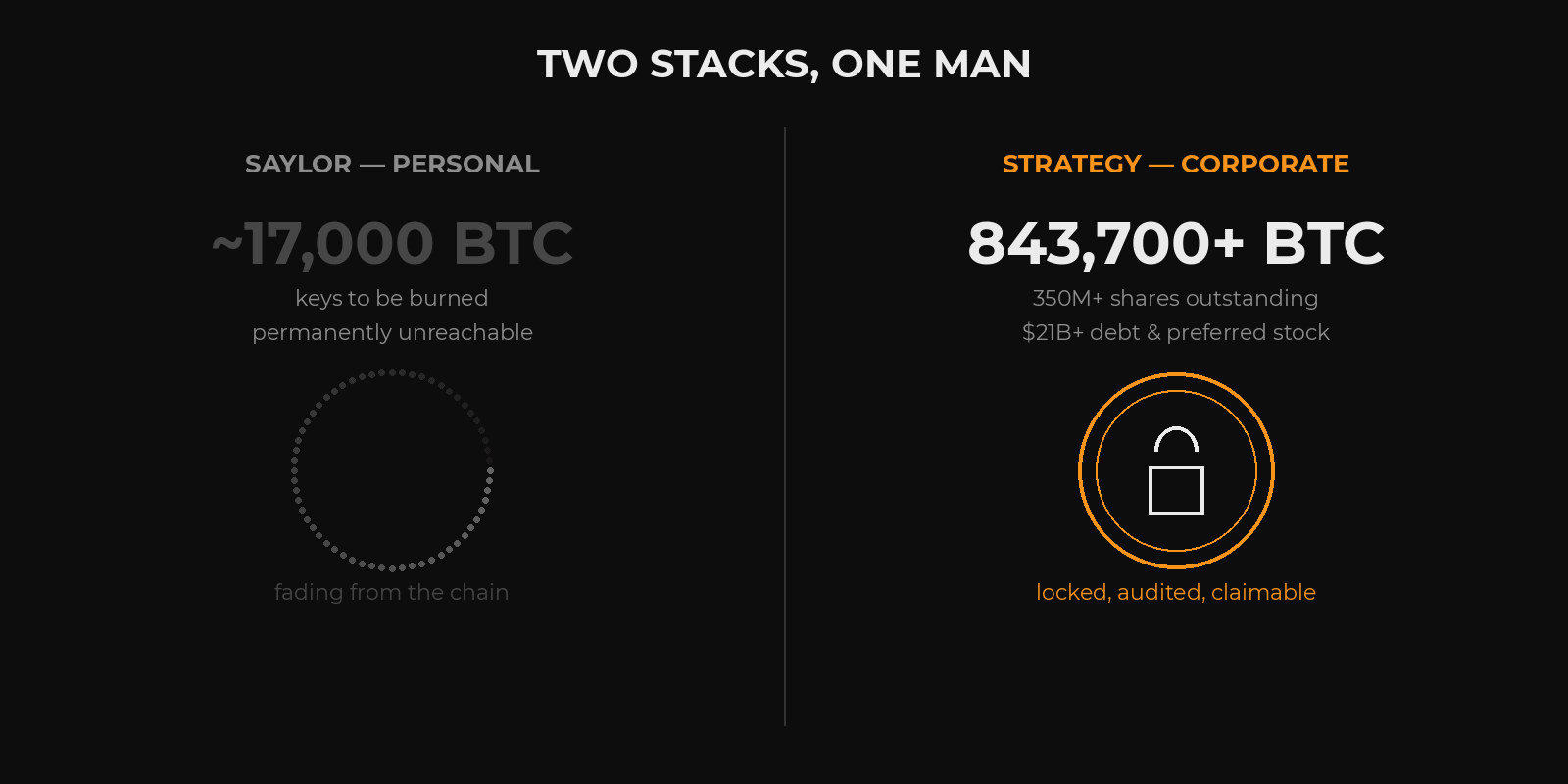
Strategy's Bitcoin holdings versus its share count and debt load, 2020 to 2026. Source: Strategy SEC filings.
By BitBrainers Editorial
Meanwhile the company he built raises billions in debt and issues hundreds of millions of new shares to buy Bitcoin it will never let anyone touch directly. Same man, same asset, two structures built to do opposite things with it.
Three Ways a Fortune Disappears
Money in a bank disappears slowly. Inflation runs 2 to 7 percent a year depending on the currency, and nobody signs up for that, it's just the default setting of the system. Saylor watched MicroStrategy's own cash reserves erode this way for years before he pivoted the company to Bitcoin in 2020.
Money on an exchange disappears suddenly. FTX, Celsius, and Mt. Gox all proved the same point: the coins are there until the platform isn't, and depositors never got a vote on the timing.
Money in self-custody disappears differently. It's not on any bank's ledger or exchange database, and that absence is a choice, not a failure. Because it's a choice, it can be reversed. A holder with their own keys can move coins to anyone, at any time, for any reason. Or to no one at all. Taken to its logical end, self-custody isn't just the power to hold wealth outside the system. It's the power to delete it.
A Plan That Got More Extreme
That third option is what Saylor described to the New Zealand Herald in October 2024. "I'm a single guy, I have no children, when I'm gone, I'm gone. Just like Satoshi left a million Bitcoin to the universe, so I'm leaving whatever I've got to the civilization." At a Bitcoin conference weeks earlier he'd framed it as a charitable structure: his shares and assets flowing into a public foundation dedicated to Bitcoin adoption.
By early 2025 the framing changed. In interviews since January, Saylor has described burning his own private keys outright rather than routing the coins through any foundation. He's specific about the number: roughly 17,000 BTC, the personal stack he disclosed back in 2020 before Strategy started buying. He calls burning it a "pro rata contribution," destroying access so every other holder's coins become proportionally scarcer. A charity can spend a donation. Nobody can spend a burned key. The plan didn't just continue, it hardened into something more extreme.
Both statements are real and both are his. What they share matters more than which one is current: whether given away or destroyed, the coins leave his control entirely, permanently, and by his own decision. Self-custody is what makes either version possible.
Get the Weekly Brief
One email. Monday morning. The macro events that move Bitcoin this week.
SubscribeWhat Strategy Actually Sells
Strategy holds roughly 843,700 BTC as of its latest capital structure update. An investor who buys MSTR doesn't hold any of those coins. They hold shares in a company that holds the coins, which is a different asset with a different set of risks attached.
Those risks are visible in the filings. Shares outstanding have climbed from under 200 million in 2024 to somewhere near 350 million today, more than a 50 percent increase in a single year. Convertible debt stands at $6.7 billion. Preferred stock across four separate series adds well over $15 billion more in notional obligations, some paying dividends above 11 percent annually. None of that is hidden. It's disclosed every quarter. It's also the exact opposite of a structure built for release.
Coins in cold storage, audited, reported, financed against, are coins built to stay put. That's not a flaw. Institutions that can't legally custody Bitcoin directly need exactly this kind of wrapper, and it's why Strategy has become the largest corporate holder in the world. But it's a structure engineered for permanence, sitting downstream of a founder who has twice, in two different ways, said permanence is the last thing he wants for his own coins.
Put plainly: Saylor the individual wants his coins to be unspendable, gone from circulation, gone from reach. Strategy the company makes its coins, short of extreme legal or regulatory action, functionally impossible to render unspendable the same way. They're seizable by courts, claimable by shareholders, collateral for debt covenants. Regulators can see every one of them. Nobody is burning anything on a public company's balance sheet. MSTR is Bitcoin with the burn button disabled.
The split shows up in Strategy's own trading, not just in Saylor's stated plans. He spent years insisting the company would never sell. In 2026 it sold Bitcoin three separate times anyway, including 1,638 BTC in late July to help fund preferred-stock dividends. When asked about it, Saylor's answer was direct: "Strategy is not my wallet." That's not a contradiction he's trying to hide. It's the same line drawn twice, once for the keys he'll burn, once for the company he runs. His conviction and the company's obligations are two different things, and he's told people that himself, in public, more than once.
The Part That Actually Matters For Your Money
This isn't an argument that MSTR is a bad investment or that self-custody is morally superior. It's that they end differently, and the difference shows up exactly when it counts most. It also reframes what the MSTR premium actually prices in. Part of it is leverage, and that part gets discussed constantly. A less discussed part is that the premium buys Bitcoin exposure with the one feature Saylor personally values most stripped out: the ability to disappear on command. Investors are paying extra for permanence from the same person who's paying nothing, deliberately, to make his own stack vanish.
A self-custodied stack passes to whoever the holder names, with a seed phrase and, if they set it up that way, a time lock. It can be donated in one transaction. It can be destroyed in one transaction. The holder decides, right up until they don't need to decide anymore.
An MSTR position passes through probate as a security. It's subject to estate tax, brokerage restrictions, and whatever Strategy's balance sheet looks like the day the estate gets settled. It cannot be donated as Bitcoin, because it was never Bitcoin. It was always a claim on a company that owns Bitcoin, and a claim on a company carries every risk the company carries.
Saylor has been consistent about which structure he wants for himself, even as the specific plan evolved. The open question is whether everyone buying MSTR because they believe in his Bitcoin conviction understands they bought the one structure he's actively planning to avoid.
Sources
Decrypt Michael Saylor Says He'll Give Away His Bitcoin, Like Satoshi Nakamoto
SEC EDGAR Strategy Inc. Filings
Benzinga Michael Saylor's Unusual Bitcoin Plan For The Afterlife
Tools: Kraken for trading. Trezor for storage.
This is market commentary, not financial advice. Nothing here is a recommendation to buy or sell any asset. Do your own research.