By BitBrainers Editorial
This is an honest walkthrough of what Section 11 actually says, what problem it solves, and why the answer to that problem is the reason you wait for six confirmations before treating a Bitcoin transaction as final.
What the First Ten Sections Actually Do
Sections one through ten build the argument. Nakamoto describes the problem with double-spending, introduces the concept of a chain of proof-of-work, explains how nodes reach consensus without a central authority, and walks through the incentive structure that keeps miners honest.
It is a compelling design document. Every piece fits logically. But by Section 10, Nakamoto has only argued that the system should work. Section 11 is where he proves it cannot be broken, mathematically, given a specific assumption about the attacker's share of hash power.
The Problem Section 11 Is Solving
Imagine you receive a Bitcoin payment. The sender broadcasts the transaction, it gets included in a block, and the block gets added to the chain. You ship the goods. Then the sender quietly mines an alternative version of the chain that does not include your transaction, catches up to the honest chain, and broadcasts it. Your payment disappears. The sender has their Bitcoin back.
This is the double-spend attack. It is the fundamental threat Nakamoto needed to make practically impossible for the system to work.
The question Section 11 answers is precise: if an attacker controls q percent of the network's total hash power and the honest chain is already z blocks ahead, what is the probability the attacker ever catches up?
The Gambler's Ruin Problem
Nakamoto frames this as a version of the gambler's ruin problem. A gambler with finite resources plays against a casino with infinite resources. Even if the gambler has a near-even chance of winning each hand, the casino will eventually bankrupt them because the casino can absorb losses and the gambler cannot.
In Bitcoin, the honest chain is the casino. It has more hash power than the attacker by assumption, so it mines blocks faster on average. The attacker is the gambler, trying to close the gap against a chain that keeps moving forward.
Nakamoto models the number of blocks the attacker mines using a Poisson distribution. The Poisson distribution is the right tool here because it models the number of times a random event occurs in a fixed interval when that event has a known average rate. Mining a block is exactly that kind of event.
The attacker mines blocks at rate q. The honest chain mines blocks at rate p, where p plus q equals 1 and p is greater than q. For each block the honest chain adds, Nakamoto calculates the probability the attacker closes the gap entirely and overtakes the chain.
What the Formula Produces
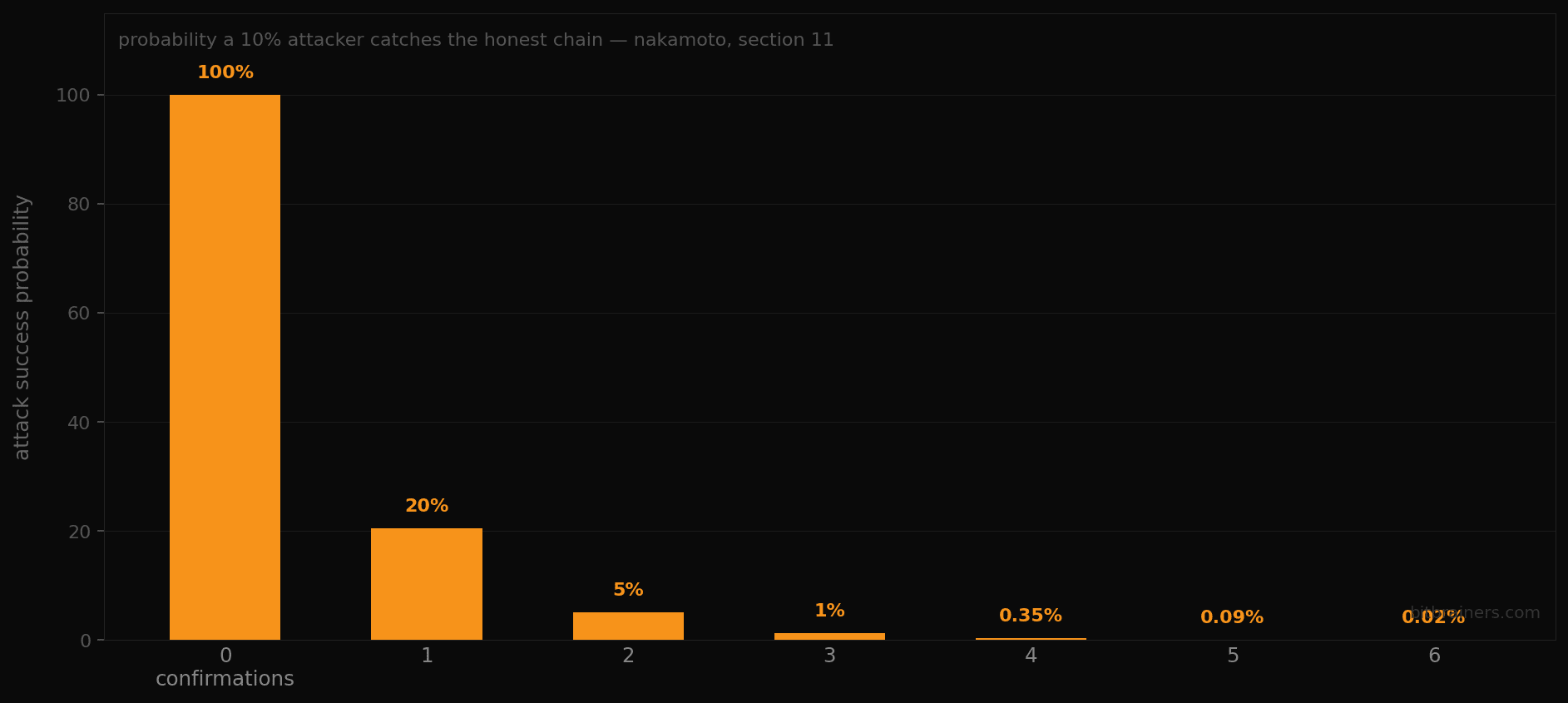
The result is this: the probability the attacker ever catches up from z blocks behind drops exponentially as z increases. Not linearly. Exponentially. Each additional confirmation multiplies the difficulty of a successful attack.
Nakamoto runs the numbers in Section 11 for a specific scenario. If the attacker controls 10 percent of hash power and the recipient waits for 0 confirmations, the attacker succeeds roughly 45 percent of the time. Wait for 1 confirmation and that drops to around 20 percent. At 6 confirmations with a 10 percent attacker, the probability of a successful double-spend is approximately 0.024 percent — two hundredths of one percent.
At 30 percent attacker hash power, the same 6 confirmations holds the probability in the low double digits, around 10 to 12 percent. It is only when the attacker approaches or exceeds 50 percent that the math breaks down fundamentally, because at that point the expected value of the attack becomes positive.
Six confirmations is not an arbitrary convention. It is the point at which the attack probability becomes economically irrational for any attacker controlling a realistic share of hash power.
This also explains why different participants use different thresholds. A merchant accepting a small payment might accept one or two confirmations — the potential loss is too low to justify waiting. An exchange receiving a large transfer might wait for 20 or 30. Six became the industry default because it represents the rational threshold for a realistic attacker, not because Nakamoto mandated it.
Bitcoin basics without the hand-waving.
Every Monday we break down what actually matters in markets and on-chain. No hopium, no noise.
Subscribe FreeWhy This Was a Genuine Intellectual Achievement
Nakamoto did not invent the Poisson distribution or the gambler's ruin problem. Both are classical probability theory. What he did was recognize that these tools mapped precisely onto the double-spend problem and apply them correctly in nine pages.
The insight is that you do not need to prevent attacks from being attempted. You only need to make them unprofitable. The math in Section 11 proves that with honest majority hash power, the cost of a successful double-spend attack grows faster than the potential gain as confirmations increase.
That is the security model. Not cryptography alone. Not decentralization alone. A probability calculation that makes cheating economically self-defeating.
What It Means Today
The model holds as long as no single entity controls more than 50 percent of hash power. That assumption has been under pressure as mining has concentrated in large pools. Two or three major pools coordinating would theoretically cross the threshold.
In practice, the economics still work in Bitcoin's favor. A successful 51 percent attack would destroy the value of the asset the attacker spent resources to mine. The incentive to attack is undermined by the attack's own success. Nakamoto noted this too, in Section 6.
But the honest read is that the security guarantee in Section 11 is a probabilistic one, not an absolute one. Six confirmations makes attack economically irrational under normal conditions. It does not make attack physically impossible.
That distinction is what most white paper summaries quietly omit. Nakamoto did not omit it. He put the exact numbers in a table and let the math speak.
The One Line Worth Remembering
Section 11 closes with this: "We can see that the probability drops off exponentially with z."
That sentence is the entire security argument in eleven words. Every six-confirmation standard, every exchange policy, every custody procedure in the industry is downstream of that one observation. Most people who have "read" the white paper read around it.
Now you have not.
Sources
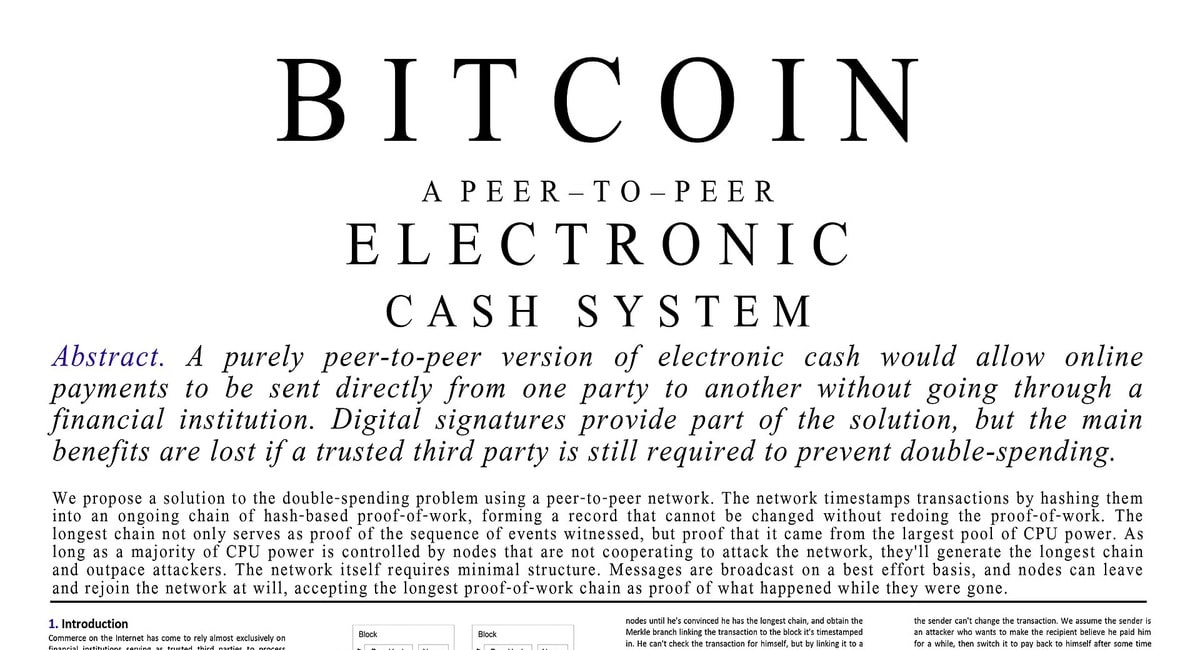
Satoshi Nakamoto: Bitcoin: A Peer-to-Peer Electronic Cash System (2008)
Bitcoin Wiki: Confirmation — security model and confirmation thresholds
Bitcoin Wiki: Double-spending — attack mechanics and historical context
Disclosure: This article is for informational purposes only and is not financial advice. We may earn commissions from affiliate links. Always do your own research before making investment decisions.