₿ BTC Loading... via Binance

Tuesday, April 21, 2026

How to Set Up a Free Crypto Alert Bot With Python and Telegram

How to Set Up a Free Crypto Alert Bot With Python and Telegram

Most crypto traders pay between $20 and $80 per month for alert platforms that run four lines of logic under the hood. That's not an exaggeration. Tools like Coinbase Advanced, TradingView Pro, and various SaaS alert bots are all doing one thing: checking a price API and firing a notification. The code behind that feature is not complex. It's not proprietary. And it's not worth your subscription fee when you can build the same thing in an afternoon with Python and Telegram for exactly $0.

This is not a tutorial for developers. This is for traders who are tired of paying for something they can own.


Why Most Alert Tools Fail You at the Exact Moment You Need Them

Third-party alert services have a dirty little secret: they throttle notifications during high-volume market events. That's the moment BTC drops 12% in 90 minutes and every retail trader is hammering the same alert conditions simultaneously. The platforms slow down. You get your "BTC fell below $X" notification 20 minutes late. The trade is gone.

According to a 2025 analysis by Messari, over 60% of retail crypto traders cite missed or delayed alerts as a direct cause of at least one significant missed trade in the prior 12 months. That's not a tool problem. That's an architecture problem. When thousands of users share the same alert infrastructure, you are always in a queue.

When you run your own Python bot on a VPS or even your home machine, you are the only user. Your bot checks the price. Your bot sends the message. Nobody else's conditions slow yours down.

That's the first reason to build your own. The second reason is customization. Most SaaS alert tools let you set price thresholds and maybe RSI. Your own bot can alert you on:

  • BTC moving more than 3% in under 15 minutes
  • Volume spiking beyond a rolling 7-day average
  • The spread between BTC and ETH diverging past a set threshold
  • Any combination of conditions that match your actual strategy

You are not boxed into what a product manager decided to build.


What You Actually Need to Build This

No CS degree required. Here's the real stack:

Python 3.10+ - Free. You likely already have it.

python-telegram-bot library - Open source, well-documented, actively maintained.

CoinGecko API or Binance API - Both have free tiers. CoinGecko's free tier gives you real-time BTC prices with no API key required for basic calls. Binance's public endpoints give you deeper market data including volume, order book depth, and candlestick data.

A Telegram account and a bot token - Free. You create a bot through Telegram's BotFather in under two minutes.

A place to run the script - This can be your laptop while you're at your desk, but if you want 24/7 alerts, a cheap VPS works. DigitalOcean, Linode, and Hetzner all have plans starting under $5/month. That's still a fraction of what most alert platforms charge.

The full setup from zero to first alert takes most people 45 to 90 minutes the first time.


Building the Bot: The Actual Code Logic

Here's what the script does at a high level, written in plain English first:

  1. Every 60 seconds, the script calls the CoinGecko API and pulls the current BTC price
  2. It compares that price against your defined conditions
  3. If a condition is met, it sends a message to your Telegram chat via your bot
  4. It logs the alert and resets the condition so you don't get spammed

Here's a minimal working version:

```python import requests import time from telegram import Bot from telegram.ext import Application

TELEGRAM_TOKEN = "your_bot_token_here" CHAT_ID = "your_chat_id_here" ALERT_PRICE_BELOW = 70000 ALERT_PRICE_ABOVE = 85000 CHECK_INTERVAL = 60 # seconds

bot = Bot(token=TELEGRAM_TOKEN)

def get_btc_price(): url = "https://api.coingecko.com/api/v3/simple/price?ids=bitcoin&vs_currencies=usd" response = requests.get(url) data = response.json() return data["bitcoin"]["usd"]

async def send_alert(message): await bot.send_message(chat_id=CHAT_ID, text=message)

def main(): alerted_below = False alerted_above = False

while True:
    price = get_btc_price()
    print(f"BTC Price: ${price}")

    if price < ALERT_PRICE_BELOW and not alerted_below:
        import asyncio
        asyncio.run(send_alert(f"ALERT: BTC dropped below ${ALERT_PRICE_BELOW}. Current: ${price}"))
        alerted_below = True
    elif price >= ALERT_PRICE_BELOW:
        alerted_below = False

    if price > ALERT_PRICE_ABOVE and not alerted_above:
        import asyncio
        asyncio.run(send_alert(f"ALERT: BTC crossed above ${ALERT_PRICE_ABOVE}. Current: ${price}"))
        alerted_above = True
    elif price <= ALERT_PRICE_ABOVE:
        alerted_above = False

    time.sleep(CHECK_INTERVAL)

if name == "main": main() ```

This is production-usable logic. It's not a toy. Add error handling around the API call for production use, and wrap the main loop in a try/except that catches connection timeouts so a momentary internet hiccup doesn't kill your bot.


A Real Use Case From My Own Trading

In early 2025, BTC was consolidating between $92,000 and $98,000 for about three weeks. I had a version of this bot running with a volume condition layered on top of the price condition. My rule was simple: alert me only if BTC breaks below $92,000 AND 1-hour volume on Binance is more than 40% above the 7-day average for that hour.

Volume spikes alongside price breaks are meaningful. Volume spikes without price movement are noise. A plain price alert would have fired multiple false positives during that range. My combined condition fired twice in three weeks. Both times were real, tradeable moves.

I executed both trades on Kraken because the order execution and fee structure are more favorable for the trade sizes I run. If you're not using Kraken yet, it's worth the switch. You can sign up here: Join Kraken Exchange

The entire alert setup that supported that trade took me one afternoon to build. No subscription. No third-party dependency. No latency queue.


The Contrarian Point Most Crypto Blogs Miss

Everyone talks about alert fatigue as a problem of receiving too many notifications. The actual problem is the opposite.

Most traders set their alerts too far from current price because they don't want to get pinged constantly. So they set a BTC alert at $65,000 when price is at $76,000. Then they forget about the market. Then price drifts to $72,000. Then it moves fast to $68,000. By the time the $65,000 alert fires, the setup they wanted to trade has already played out and they're chasing.

A well-built custom bot solves this with dynamic alerts. Instead of a static price level, you alert on percentage moves from a rolling reference point. If BTC moves more than 4% in either direction from the price at 9am UTC, you get an alert. That keeps your alert proximity relevant no matter what the market does overnight.

No SaaS tool on the market does this out of the box at the free tier. Every one of them charges you for dynamic or conditional alert logic. Your Python bot does it in ten extra lines of code.


Security: Don't Build This and Leave Your Assets Exposed

Building a bot that monitors your trading conditions is one thing. Making sure that bot doesn't become a vulnerability is another.

Your Telegram bot token is essentially a password. Store it in an environment variable, not hardcoded in your script. Use a .env file and the python-dotenv library. If you push your code to GitHub with a hardcoded token, bots will find it within minutes.

For your actual BTC holdings, the bot should only ever have read access to price data. It should not connect to your exchange wallet or have withdrawal permissions. Keep your keys off the machine running the bot.

Hardware wallets are still the only answer for anything you're not actively trading. Trezor keeps your keys physically isolated from everything. Check them out here: Get Trezor Hardware Wallet

A 2025 report from Chainalysis found that over 34% of self-reported crypto losses from individual traders involved compromised API keys or bot credentials. Your alert bot is not a risk vector if you treat its credentials the same way you treat your exchange passwords.


Key Takeaways

  • SaaS alert tools fail under load. During fast market moves, shared infrastructure creates notification delays. Your own bot runs independently and alerts you first.
  • Custom logic beats preset conditions. Combining price thresholds with volume or percentage move conditions cuts false positives dramatically and improves trade quality.
  • The build cost is almost zero. Python, Telegram, and CoinGecko's free API tier cover everything. A VPS for 24/7 uptime costs less per month than a single TradingView alert tier upgrade.
  • Dynamic alerts beat static ones. Alerting on percentage moves from a rolling reference point keeps your alerts relevant as price evolves. Static levels become useless fast.
  • Security is not optional. Store credentials as environment variables. Never connect your bot to withdrawal-enabled API keys. Keep long-term holdings on a hardware wallet.

Frequently Asked Questions

Do I need to know how to code to build this? You need basic Python familiarity at a minimum. If you can copy, paste, and edit variable names, you can get this running. ChatGPT and Claude are both genuinely useful for helping debug the script if you get stuck. Most people hit their first working alert within two hours of starting.

Is the CoinGecko free API reliable enough for real trading alerts? For price-level alerts, yes. CoinGecko's free tier allows around 10 to 30 calls per minute and has solid uptime. For high-frequency checks under 30 seconds, move to Binance's public WebSocket API instead. It streams real-time price data without polling and has no rate limit concerns for personal use.

What happens if the bot crashes at 3am and I miss a move? You add a process manager. On Linux, use systemd or PM2 to auto-restart the script if it exits. On Windows, Task Scheduler handles this. A two-minute restart lag during a crash is far better than a 20-minute notification delay on a busy SaaS platform. Uptime monitoring services like UptimeRobot can also ping you if the bot stops sending heartbeat messages.


Start Here

Run the basic price script locally tonight. Set one alert above and one below the current BTC price, close enough that you'll actually see it fire within a few hours. Watch the Telegram message come through. Once you see it work, you'll immediately start thinking about the conditions you actually want to monitor. That's the moment this goes from a tutorial to a real tool.

Follow BitBrainers. Analysis that asks the questions mainstream crypto media won't.

Monday, April 20, 2026

Dune Analytics for Beginners: How to Read On-Chain Data Without Code

Dune Analytics for Beginners: How to Read On-Chain Data Without Code

Most retail traders react to price. On-chain analysts react to data. That gap is why the same group of people seems to always buy the bottom and sell the top while everyone else is reading headlines.

Here is the hard truth: 90% of crypto education focuses on chart patterns and price action. That stuff is useful. But it is lagging data. You are always looking at what already happened. On-chain data shows you what is happening right now, at the wallet level, before it shows up in price. Dune Analytics is the tool that puts that data in your hands without requiring you to be a blockchain developer or a SQL genius. If you have never opened it, you are trading with one eye closed.

This is not a sponsored post. Nobody paid me to write this. I have been running automated trading bots and stacking on-chain intel since 2017, and Dune is one of the few tools I actually keep open during active market cycles. Let me show you exactly how it works and what to do with it.


What Dune Analytics Actually Is (And What It Is Not)

Dune Analytics is a blockchain data platform that lets anyone query on-chain data and build dashboards from it. The public library of dashboards is the part that matters most for beginners. Thousands of analysts have already written the complex SQL queries. You just read the results.

Think of it like this: every transaction on Bitcoin, Ethereum, and dozens of other chains is permanently recorded. Dune connects to those records and lets you slice them any way you want. Who is moving coins? How much? From where to where? Are whales accumulating or distributing? Are exchange inflows spiking, which typically signals sell pressure? All of that is sitting in on-chain data. Dune just makes it readable.

What Dune is NOT is a trading signal generator. It does not tell you to buy or sell. It shows you raw behavioral data, and your job is to interpret it. That distinction matters. Any tool that claims to give you automatic signals based on on-chain data is usually selling you someone else's interpretation wrapped in a pretty interface. Dune skips the middleman.

Over 500,000 dashboards have been created on Dune as of early 2025. Most of them are public and free to view. That means a massive amount of analytical work is already done for you.


The Four Dashboards You Actually Need to Bookmark

You do not need to become a Dune power user to get value from it. You need about four dashboards and the discipline to check them regularly.

1. Bitcoin Exchange Flows

Search for "BTC exchange inflows and outflows" on Dune. What you are looking at is how much Bitcoin is moving onto exchanges versus off exchanges. When BTC moves onto exchanges in large volumes, holders are preparing to sell. When BTC moves off exchanges into cold storage, like a Trezor hardware wallet, it signals accumulation and long-term conviction. In Q1 2025, exchange BTC reserves hit multi-year lows while price climbed steadily. That was not a coincidence. Coins leaving exchanges means reduced sell pressure. Dune showed that trend weeks before mainstream financial media reported it.

2. Whale Wallet Activity

There are dashboards that track wallets holding over 1,000 BTC. These entities are not retail. They are institutions, funds, and early adopters with serious capital. When these wallets increase their holdings, that is meaningful. When they start distributing, pay attention. Tracking 30-day and 90-day trends in large wallet cohorts gives you a sentiment read that no price chart can replicate.

3. Stablecoin Supply on Exchanges

This one is underrated. When USDC and USDT balances on exchanges spike upward, that means dry powder is sitting ready to deploy. High stablecoin balances on-chain and on exchanges historically precede buying pressure. The logic is simple. People do not park stablecoins on exchanges to hold stablecoins. They are waiting to buy something. Dune dashboards tracking Tether and USDC inflows by exchange give you an early view of incoming demand.

4. Gas and Transaction Fee Trends

This is more relevant for Ethereum and the broader altcoin ecosystem, but it matters for understanding overall market activity. Spikes in transaction fees signal network congestion, which usually means high user activity. High user activity precedes or coincides with price volatility. During the DeFi surge in early 2025, gas fees on Ethereum spiked two full weeks before mainstream coverage picked up the narrative. Dune had it in real time.


Real Case Study: How On-Chain Data Predicted the January 2025 BTC Surge

In December 2024, Bitcoin sat in consolidation, and social media was full of bearish takes. Price looked tired. Technical analysts were drawing descending triangles and calling for a pullback. But on Dune, something different was happening.

Exchange BTC reserves were dropping consistently for six straight weeks. Large wallet cohorts were accumulating, not distributing. Stablecoin inflows to major exchanges were climbing. These three signals together formed a clear picture. Sophisticated buyers were pulling coins off exchanges, reducing available supply, while fresh capital in the form of stablecoins was building up waiting to buy more.

Anyone reading those Dune dashboards in early January 2025 had a fundamentally different information environment than someone just watching candles. The price surge that followed was not a surprise to people paying attention to on-chain data. It was a confirmation of what the data had already suggested. That is the edge. Not prediction in the mystical sense. Just earlier access to behavioral evidence.


The Contrarian Insight Most Crypto Blogs Miss

Everyone talks about on-chain data as if more data is always better. It is not. The biggest mistake beginners make on Dune is signal overload. They find 15 dashboards, try to track all of them simultaneously, and end up paralyzed or chasing contradictory signals.

The actual edge from Dune comes from picking two or three metrics and understanding them deeply over time. You need historical context to interpret on-chain data correctly. An exchange inflow spike means something different during a bear market than during a bull run. Whale accumulation during high volatility reads differently than accumulation during flat price action.

The traders who use Dune most effectively are not the ones with the most dashboards open. They are the ones who have watched the same two or three metrics long enough to understand their rhythm. Context beats breadth every time. Pick your metrics. Learn their behavior. Ignore the noise.

There is also a dirty secret about on-chain data that almost nobody talks about. A significant portion of on-chain transactions are wash trading, bot activity, and internal transfers between entity-owned wallets. Not every transaction represents organic human behavior. Sophisticated Dune users apply filters and context to account for this. Beginners often treat raw volume numbers as gospel. Always cross-reference unusual spikes with known events like exchange rebalancing, known custodian movements, or known protocol activity before drawing conclusions.


How to Actually Get Started Without Writing a Single Line of SQL

Go to dune.com. Create a free account. Use the search bar to find dashboards by topic. Type "Bitcoin exchange flows" or "BTC whale tracking" or "stablecoin inflows." Filter results by views or likes to find dashboards that other analysts trust.

Once you find a dashboard that looks useful, spend time understanding what each chart is actually measuring. Read the description. Look at the time axis. Ask yourself what a spike or dip in that particular metric would mean for price behavior. Do not just look at dashboards during active market conditions. Check them weekly even when markets are boring. That is how you build the baseline intuition needed to spot anomalies.

If you eventually want to build your own queries, Dune uses DuneSQL, which is based on standard SQL. The learning curve is real but not impossible. Start by forking existing queries and modifying them slightly. The community is active and there are solid tutorials on the Dune Discord.

For executing trades based on what you find, I use Kraken. It has deep liquidity for BTC and supports the kind of rapid execution you need when on-chain signals align with your trade thesis. Do not be the person who spots the signal and then fumbles the execution on a slow or unreliable platform.

For storing what you accumulate, get it off exchanges. A Trezor hardware wallet is not optional if you are serious about this. If you are tracking whale behavior and watching coins leave exchanges as a bullish signal, your own coins should also be off exchanges. Practice what the data preaches.


Key Takeaways

  • On-chain data leads price. Exchange flows, whale accumulation, and stablecoin inflows consistently signal directional moves before they appear in charts or headlines.
  • Dune is free and requires no coding to start. The public dashboard library contains thousands of pre-built analytics tools. You just need to know what to look for.
  • Pick fewer metrics and learn them deeply. Two or three well-understood dashboards beat 15 half-understood ones. Context and pattern recognition come from consistent observation over time.
  • Not all on-chain activity is organic. Wash trading and internal transfers inflate raw volume numbers. Always cross-reference unusual spikes before acting on them.
  • The execution layer matters. Spotting a signal on Dune is only half the job. Fast, reliable execution on a platform like Kraken and secure storage on a Trezor complete the loop.

Frequently Asked Questions

Is Dune Analytics completely free? The free tier gives you access to the full public dashboard library and basic query functionality, which is enough for most beginners. Paid plans unlock faster query speeds, private dashboards, and API access. Start free and upgrade only if you find yourself hitting limits.

Do I need to know how to code or write SQL to use Dune? No. Reading public dashboards requires zero coding knowledge. If you want to build your own custom queries eventually, DuneSQL is the language you would learn, but that is a later step. Beginners get significant value just from navigating existing public dashboards intelligently.

How do I know which Dune dashboards are actually reliable? Filter by view count and community engagement. Dashboards built by well-known on-chain analysts like @hildobby, @21co, or research arms of known crypto firms tend to be well-maintained and methodologically sound. Cross-reference findings across multiple dashboards before making any trading decisions based on a single source.


Start with one thing: find the most-viewed BTC exchange flow dashboard on Dune, bookmark it, and check it every Monday morning for the next four weeks. Do not trade off it yet. Just watch. By week four, you will start seeing patterns that most traders never see because most traders never look.

Follow BitBrainers. analysis that asks the questions mainstream crypto media won't.
How to Make Money With Crypto Options Without Being an Expert

How to Make Money With Crypto Options Without Being an Expert

Most crypto "passive income" strategies are a slow bleed disguised as yield. Staking pays 3-6% annually while your asset can drop 40% in a month. Lending platforms collapse without warning. Liquidity pools quietly drain your position through impermanent loss while you sleep. None of these blogs tell you that upfront.

Options are different. Not safer across the board. But different in a specific, exploitable way. You can collect real cash premiums on Bitcoin you already own, every single week, without selling your stack and without needing a finance degree to execute the trade.

I have been trading crypto since 2017. I have tested staking, yield farming, lending, grid bots, copy trading, and half a dozen other income strategies. The ones that actually survived multiple market cycles and kept putting money in my pocket were the simplest ones. Covered calls on BTC are near the top of that list.

Here is how this actually works, what it costs you, and how to start.


What Crypto Options Actually Are (Without the Textbook Garbage)

An option is a contract. It gives the buyer the right to purchase or sell an asset at a specific price before a specific date. You are not buying that right here. You are selling it. That distinction is everything.

When you sell a call option on Bitcoin, you are saying: "I will sell you my BTC at $X price before Friday. Pay me a premium now for that agreement." The buyer pays you upfront. That premium is yours to keep regardless of what happens. If BTC never reaches that strike price, the option expires worthless, you pocket the premium, and you still own your Bitcoin.

That strategy is called a covered call. "Covered" means you already own the underlying asset. You are not speculating on direction. You are renting your Bitcoin to the market in exchange for weekly income.

According to Deribit, the world's largest crypto options exchange by volume, BTC options open interest regularly exceeds $30 billion. Most of that volume is institutional. Most retail traders still treat options like a lottery ticket instead of an income tool. That gap is where the opportunity lives.

The two options every beginner needs to understand before anything else: calls (bets or income from upside) and puts (bets or income from downside). For income generation without heavy speculation, covered calls are your starting point. Keep that scope narrow until you understand how pricing moves.


How Options Pricing Works and Why It Matters for Income

You do not need to memorize every Greek. But you need to understand implied volatility (IV) and why it is your biggest lever.

Implied volatility is the market's expectation of how much an asset will move. When IV is high, options premiums are expensive. When IV is low, premiums are cheap. Bitcoin's average IV regularly runs between 50% and 80% annualized. That is roughly 3 to 5 times higher than the S&P 500's typical IV. That elevated volatility is why options premiums on BTC pay so much more than stock options on comparable notional value.

Here is the direct implication: when Bitcoin is in a period of high uncertainty or recent volatility, the weekly premiums you can collect by selling covered calls are substantially higher. When markets go quiet, premiums compress. Your income is not fixed. It moves with the market's fear level.

A useful rule of thumb that holds up in practice: sell covered calls when IV rank is above 50. IV rank measures where current IV sits relative to its range over the past 52 weeks. High IV rank means premiums are rich. You are getting paid more than usual for the same risk. Low IV rank means you are leaving income on the table relative to the risk you are taking.

Most free options dashboards on major exchanges display IV rank. Learn to check it before every trade. This one filter alone meaningfully improves your average weekly return.


Real Example: Running Covered Calls on BTC in a Volatile Month

Let me walk through a concrete scenario using realistic numbers.

Assume you hold 0.5 BTC. At current prices around $75,724, that position is worth roughly $37,862. You decide to sell one covered call contract per week using Deribit (contracts there are 0.1 BTC each, so 0.5 BTC covers five contracts).

You pick a strike price $3,000 above the current market. This is called an out-of-the-money (OTM) strike. You are not agreeing to sell at current price. You are agreeing to sell at a price Bitcoin has not yet reached. The further out of the money you go, the less premium you collect, but the lower the chance BTC gets called away from you.

On a week where IV is elevated, a $78,000 strike expiring Friday might pay you approximately 0.003-0.005 BTC per contract in premium. On five contracts, that is 0.015-0.025 BTC weekly. At $75,724, that translates to roughly $1,135 to $1,893 per week in income on a $37,862 position. Annualized that is a 156% to 260% range, but do not anchor to those numbers. That is a high-volatility week. Average weeks pay considerably less. A realistic annualized yield from this strategy in average market conditions runs closer to 30-60% on your BTC position, which still beats every other passive income option in crypto by a substantial margin.

What is the catch? If BTC rips through $78,000 before Friday, your coins get sold at the strike price. You miss the upside above that level. This is the real cost of the strategy. It is called capped upside. In a flat or moderately bullish market, you outperform the holder. In a violent bull run, you lag. That tradeoff is not hidden. It is built into the structure.

The traders who blow up on covered calls are the ones who sell them on coins they do not want to sell. Never sell covered calls on a position you would be devastated to have called away. On Bitcoin where you are comfortable selling some at a price 4-8% above current levels, the strategy holds up.


How to Actually Start: Step by Step

Step 1: Get your BTC onto an exchange that offers derivatives.

Kraken offers crypto options and futures trading with a solid interface for both beginners and experienced traders. It has one of the better reputations for regulatory compliance and security in the industry. If you do not have an account, set one up here: Join Kraken Exchange. Deribit is the most liquid venue specifically for BTC options if you want maximum flexibility and tighter spreads on larger positions. You will need an account on whichever platform you choose before anything else.

Step 2: Understand the minimum position size.

Deribit BTC options contracts are 0.1 BTC each. That means at current prices you need roughly $7,572 in BTC to sell a single covered call. Kraken futures and options have different sizing. Check the current contract specs before depositing. Starting with 0.1-0.5 BTC for your first few trades is appropriate. Do not go larger until you have run through at least five weekly expirations and understand how assignment works.

Step 3: Check IV rank before selecting your strike.

Log in, navigate to the options chain for Friday expiration, and look at implied volatility. High IV rank (above 50) means sell. Low IV rank (below 30) means either skip the week or go further out of the money to compensate for thin premiums. This step takes two minutes. Do not skip it.

Step 4: Select your strike and expiration.

For a beginner, use weekly expirations only. Monthly options give you more premium but tie up your BTC and your flexibility for four weeks. Weeklies let you reassess every Friday. Pick a strike 5-10% above current BTC price. This gives you meaningful upside participation before your coins get called away while still collecting worthwhile premium.

Step 5: Place the sell order and monitor.

You are selling to open. The premium hits your account immediately. Set a price alert at your strike price so you are not caught off guard. If BTC approaches your strike mid-week, you have choices: buy back the call at a loss and roll to a higher strike, let it expire and accept assignment, or close the position. All three are valid depending on your situation.

Step 6: Keep the BTC you are not actively trading on a hardware wallet.

Never put your entire BTC stack on an exchange. Keep only the coins actively in use for options on the exchange. Move the rest to cold storage. The Trezor hardware wallet is what I use for long-term storage. It is open-source, well-audited, and has a track record that holds up under scrutiny: Get Trezor Hardware Wallet. Options profits are meaningless if an exchange hack wipes your stack.


The Contrarian Insight Most Crypto Blogs Miss

Everyone talks about options as complex instruments only professionals can use. That is not wrong on the buying side. Buying calls and puts is essentially gambling on direction, and the house (implied volatility premium) is stacked against you over time. Studies consistently show that 70-80% of options expire worthless. That statistic sounds terrifying until you flip the perspective. If 70-80% of options expire worthless, the sellers are collecting premium roughly 70-80% of the time.

The retail crypto crowd has been conditioned to think of options as leverage vehicles for punting on price direction. Professional traders use them almost exclusively to collect premium or hedge. The information asymmetry here is real and durable. Most blogs push "buy a call before the halving" content because it is exciting and drives clicks. The boring strategy of selling covered calls week after week generates less content but more consistent income.

The volatility risk premium in Bitcoin is persistently higher than in equities. Bitcoin sellers of options have been systematically compensated for providing liquidity and taking on assignment risk in a way that other asset classes simply do not replicate. That is not a fluke. It is a structural feature of a market with high retail speculation and persistent uncertainty.


Key Takeaways

  • Selling covered calls on Bitcoin generates income from the volatility premium that exists in the market regardless of price direction
  • You keep the premium whether or not the option gets exercised. Your only real cost is capped upside if BTC surges past your strike
  • IV rank is the most important filter before selling any option. High IV rank means you get paid more for the same strike distance
  • Start with weekly expirations, OTM strikes 5-10% above current price, and only on BTC you are comfortable potentially selling at that level
  • Never keep your full BTC stack on an exchange. Active trading portion stays on exchange, everything else moves to cold storage immediately

Frequently Asked Questions

Can I run covered calls on Bitcoin without owning a full BTC? Yes. Most derivatives exchanges use fractional contracts. Deribit contracts are 0.1 BTC each, so you can start with a fraction of a full Bitcoin. At current prices, a single contract requires roughly $7,572 in BTC collateral.

What happens if Bitcoin crashes while I have a covered call open? Your covered call position actually provides a small buffer because you collected the premium upfront. If BTC drops 5% and you collected a 1.5% premium, your effective loss is 3.5% instead of 5%. Options do not eliminate downside. They reduce it modestly while capping upside.

Do I need to know how to calculate the Greeks to use this strategy? Not to start. Delta and IV are worth understanding first. You do not need to manually calculate anything. Every major options platform displays the relevant Greeks next to each contract. Focus on picking the right strike and checking IV rank before each trade. The math happens automatically.


Realistic Expectations and Your First Action Step

This strategy does not make you rich in a week. Covered calls on BTC in average market conditions realistically add 30-60% annually to your Bitcoin position value. That is not guaranteed. High volatility periods pay more. Low volatility periods pay less. In a sustained, violent bull run, you will underperform simple holding.

What this strategy does well is convert volatility into consistent income without selling your core position and without requiring you to predict price direction. Over two or three market cycles, that compounds into a meaningful advantage over pure holding or chasing yield on sketchy lending platforms.

Your first action step is specific: open an account on Kraken (Join Kraken Exchange), navigate to the options section, and look at the current BTC options chain for the nearest Friday expiration. Do not trade yet. Just look at the strikes, the premiums displayed, and the implied volatility numbers. Spend 20 minutes reading the chain. That single session will teach you more than any explainer article. Then come back here when you have a specific question.


Follow BitBrainers. analysis that asks the questions mainstream crypto media won't.
How Crypto Mining Works and Why Most People Should Not Do It

How Crypto Mining Works and Why Most People Should Not Do It

Over 90% of individual Bitcoin miners are operating at a loss right now. Not because they are bad at math. Because they did the math wrong before they started.

Mining Bitcoin has this magnetic pull on new crypto people. You hear the word "mining" and your brain fills in gold rush imagery. Passive income. Machines printing money while you sleep. The reality is closer to running a small manufacturing plant with razor-thin margins, brutal competition, and a machine that depreciates the moment you unbox it.

This post is not going to tell you mining is evil. It is going to tell you exactly how it works, what it actually costs, and why the people making real money from it are not the ones selling you the dream.


What Mining Actually Is (And Why It Exists)

Bitcoin has no bank, no central server, no PayPal processing transactions in the background. What it has instead is a decentralized network of computers that agree on which transactions are valid. Mining is the mechanism that makes that agreement happen.

Here is the simplified version. When someone sends Bitcoin, that transaction gets broadcast to the network. Miners collect batches of those transactions into blocks. To add a block to the blockchain, a miner has to solve a computational puzzle. The puzzle is not clever. It is brute force. Your machine guesses a random number billions of times per second until it finds one that produces a specific output. First one to find it wins the block reward.

Right now, that reward is 3.125 BTC per block after the April 2024 halving. At current prices, that is roughly $233,000 per block. A new block gets mined approximately every 10 minutes. That sounds incredible until you realize you are not competing against one other person. You are competing against industrial operations running hundreds of thousands of machines simultaneously.

The network self-adjusts every 2016 blocks (roughly two weeks) to keep that 10-minute average consistent. More miners join, difficulty goes up. Fewer miners, difficulty drops. The system does not care how much you spent on your rig. It just adjusts to balance the competition.


The Real Cost of Mining Bitcoin

Here is where most people get burned. They look at the potential revenue and skip past the costs.

The main costs are hardware, electricity, cooling, and time. Hardware is the most visible. The current industry standard machine is the Bitmain Antminer S21 Pro, which runs around $3,000 to $4,000 new. It produces roughly 234 terahashes per second (TH/s). A terahash is one trillion hash attempts per second. That sounds fast. The entire Bitcoin network is currently processing over 800 exahashes per second. An exahash is one million terahashes. Your single machine is a rounding error.

Electricity is the real killer. The Antminer S21 Pro draws about 3,510 watts under full load. Run it 24 hours a day and you are burning roughly 84 kilowatt-hours daily. At the U.S. average residential electricity rate of $0.16 per kWh as of early 2025, that is $13.44 per day just in electricity. That is $403 per month per machine before you have touched cooling, internet, or maintenance.

At current BTC prices and current network difficulty, a single S21 Pro earns approximately $8 to $12 per day in revenue. Gross revenue of $10 per day against $13.44 in electricity alone means you are losing $3.44 every single day. This is not a pessimistic projection. This is the current math.

Industrial miners survive this because they pay $0.02 to $0.05 per kWh through negotiated industrial contracts, often in places like Paraguay, Iceland, or certain U.S. energy markets. They cut costs by a factor of three to eight compared to residential rates. You cannot replicate that in your garage.


The Case Study Nobody Wants to Talk About: The 2021 Home Mining Boom

During the bull run of late 2020 through early 2021, thousands of people bought mining rigs. BTC was climbing toward $60,000. Mining was profitable even at residential electricity rates. Forums were full of pictures of garages converted into mining operations. People were ordering five, ten, twenty machines.

Then two things happened simultaneously. Bitcoin's price pulled back significantly, and network difficulty kept climbing as all those new machines came online. By mid-2022, the people who had bought machines at peak prices were sitting on hardware worth a fraction of what they paid, running machines that consumed more in electricity than they generated in Bitcoin.

Many of those miners had financed their equipment. When the revenue dropped, they still had loan payments. Some sold their BTC holdings to cover losses, locking in losses on both sides. The machines they bought for $10,000 to $15,000 each were selling used for $800 to $1,200 by the end of 2022.

This is not ancient history used as a scare tactic. This is a documented cycle that has repeated across every major Bitcoin bear market. The hardware depreciates faster than almost any other asset class when market conditions shift.


Who Actually Makes Money Mining Bitcoin

Here is the contrarian insight you will not find in most mining guides. The most profitable entity in the Bitcoin mining ecosystem is often not the miner. It is the hardware manufacturer.

Bitmain sells miners whether Bitcoin goes up or down. When BTC pumps, demand for machines spikes and they charge premium prices. When BTC crashes, they sell to people trying to average down or replace aging hardware. They also mine Bitcoin themselves with their own chips before selling older-generation hardware to retail buyers. By the time a machine is available for consumer purchase, the manufacturer has already extracted significant value from it.

The people making sustainable money from mining in 2025 and 2026 fall into three categories. Large-scale public mining companies like Marathon Digital Holdings and Riot Platforms that have locked in cheap power contracts, issue equity to fund operations, and can weather prolonged bear markets on institutional capital. Opportunistic industrial miners in regions with stranded energy, where electricity would otherwise go to waste and rates are effectively near zero. And a small number of highly technical individual miners who have negotiated unusual power situations, often through farming, manufacturing, or property that generates its own energy.

If you do not fit one of those three categories, you are not mining Bitcoin. You are subsidizing someone else's mining operation by buying overpriced hardware and expensive electricity.


The Opportunity Cost Argument

Even if you break even on mining, you have not broken even. You have forgotten about opportunity cost.

Say you spend $5,000 on mining equipment and run it for a year. At the end of the year, your machines have earned $5,000 in Bitcoin, net of electricity costs. You have "broken even." But that $5,000 you spent on hardware could have simply bought Bitcoin directly at the start. If BTC appreciated 30% over that year, you left $1,500 on the table by tying your capital up in depreciating hardware instead of the asset itself.

This is the calculation most mining content completely ignores. The hardware you bought is worth less every month. The Bitcoin you could have bought instead holds its value relative to the market. Mining is a leveraged bet that BTC's price appreciation will outpace both your hardware depreciation and your energy costs. That bet has historically failed for most retail participants.

If you want Bitcoin exposure, buy Bitcoin. If you want to do it through a reputable exchange, Kraken is where I keep my trading accounts. Their fee structure is transparent and they have strong security practices. Once you accumulate meaningful holdings, get them off the exchange and onto a hardware wallet. The Trezor is the one I recommend. Cold storage is not optional if you are holding serious value.


When Mining Does Make Sense

I want to be fair here. There are legitimate scenarios where mining makes sense, and dismissing all of them would be intellectually dishonest.

If you have access to electricity that is genuinely below $0.05 per kWh through a legitimate industrial contract or your own generation, the math changes significantly. Some hobby miners in rural areas with cheap hydroelectric power do run profitable small operations.

There is also a privacy and sovereignty argument. Mining gives you Bitcoin that has no purchase history attached to it on a centralized exchange. For people who are serious about financial privacy, that has real value that does not show up in a profit calculator.

And if you are a developer or researcher who wants to deeply understand Bitcoin's security model, running a node alongside a miner teaches you things that reading about it never will.

But these are narrow use cases. They are not the general case. If you are reading this after watching a YouTube ad for a cloud mining contract or a "home mining starter kit," you are not in any of these categories.


Key Takeaways

  • Bitcoin mining is a competitive industrial business. Retail participants compete directly against operations with radically cheaper power and hardware costs.
  • The two dominant costs are hardware depreciation and electricity. At U.S. residential electricity rates, a single modern ASIC machine currently loses money every day.
  • The 2021 home mining boom ended with thousands of people holding worthless hardware and significant losses. This cycle repeats with every bull run.
  • The hardware manufacturer often profits more reliably from mining than the miner. You are frequently buying yesterday's competitive edge at today's premium price.
  • For most people, directly buying and securely storing Bitcoin produces better results with less capital risk and zero operational complexity.

Frequently Asked Questions

Can I mine Bitcoin with my gaming PC or laptop? No. Modern Bitcoin mining uses specialized hardware called ASICs (Application-Specific Integrated Circuits) that are purpose-built for one task. A gaming GPU would earn fractions of a cent per day mining Bitcoin while running your electricity bill up significantly. The GPU mining era for Bitcoin ended around 2013.

What is a mining pool and does it help? A mining pool is a group of miners who combine their hash power and split block rewards proportionally. It does help in the sense that it smooths out income, turning a lottery-like payout into smaller, more frequent earnings. But it does not change your overall profitability. You still earn based on your share of the total hash rate, minus a pool fee of typically 1% to 2%.

Is cloud mining a legitimate alternative to buying hardware? Almost never. Cloud mining means paying a company to mine on your behalf using their hardware. The economics are structured so the provider profits regardless of Bitcoin's price. Most cloud mining contracts have been either outright scams or legal operations that deliver returns worse than just buying Bitcoin directly. Treat any cloud mining offer with extreme skepticism and verify every claim independently before committing a dollar.


The One Thing to Remember

Mining Bitcoin is a capital-intensive industrial operation that rewards scale and cheap energy above everything else. It is not a passive income hack. Most people who try it would have made significantly more money by simply buying and holding Bitcoin instead.

Follow BitBrainers. analysis that asks the questions mainstream crypto media won't.

What Is Ethereum and Why Is It Different From Bitcoin

What Is Ethereum and Why Is It Different From Bitcoin

Over $50 billion in value has been locked into Ethereum-based applications at peak points in this cycle. That is not speculation money sitting in wallets. That is real capital working inside programs that run on a blockchain. Bitcoin has never tried to do that. And that difference is not a bug. It is the entire point.

Most crypto content out there spends three paragraphs explaining what a blockchain is and then calls it a day. That is not what you are here for. You already know Bitcoin exists. You probably own some. Now you want to know what Ethereum actually is, why people care about it, and whether the distinction between the two networks even matters in practice.

It does. A lot. Let me show you why.


Bitcoin Was Built to Do One Thing Exceptionally Well

Bitcoin launched as a peer-to-peer electronic cash system. That is not marketing language. That is the literal opening line of the original whitepaper. Satoshi Nakamoto designed it to move value between people without a bank in the middle. Full stop.

Over time, "digital cash" evolved into "digital gold" as a narrative. People stopped spending Bitcoin on pizza and started holding it as a long-term store of value. Bitcoin has a hard cap of 21 million coins. No central bank can inflate it. No government can print more. That scarcity, combined with its decentralized network and 15-plus years of uptime without a single successful hack, is why it became the anchor asset in crypto.

Bitcoin's scripting language is intentionally limited. You can set conditions on transactions, but you cannot build complex programs on top of it. That was a deliberate design choice. Simplicity reduces attack surface. The fewer things Bitcoin tries to do, the harder it is to break.

The Bitcoin network processes roughly 7 transactions per second at the base layer. That number sounds embarrassingly small compared to Visa's 24,000. But Bitcoin was not built to compete with Visa. It was built to be the most secure, most decentralized monetary network on the planet.


Ethereum Changed the Question Entirely

In 2013, Vitalik Buterin looked at Bitcoin and asked a different question. Not "how do we send money without banks?" but "what if the blockchain itself could run programs?"

That question became Ethereum.

Ethereum launched with a built-in programming language. Developers can write code directly onto the Ethereum blockchain. That code executes automatically when specific conditions are met. Nobody can stop it. Nobody can alter it once it is deployed. These programs are called smart contracts.

Here is a simple example that is not hypothetical. You and someone else want to bet on the outcome of a sports event. Instead of trusting a third-party platform to hold the funds and pay out correctly, you write a smart contract. Both parties send funds to the contract. The contract checks the result from an agreed-upon data source. It pays the winner automatically. No middleman. No dispute. No withdrawal fees that appear from nowhere.

That same logic scales into billion-dollar applications. Decentralized exchanges, lending protocols, stablecoins, NFT marketplaces, and tokenized real-world assets all run on Ethereum-based smart contracts today. Uniswap, one of the largest decentralized exchanges in the world, processes billions in trading volume monthly using nothing but smart contracts on Ethereum. No company holds your funds. The code does.

Ethereum processes significantly more transactions per day than Bitcoin. In 2025, Ethereum's ecosystem, including its Layer 2 networks like Arbitrum and Base, regularly handled millions of daily transactions across the ecosystem. Bitcoin's base layer intentionally stays lean.


The Architecture Is Fundamentally Different. That Matters.

Bitcoin uses Proof of Work. Miners compete using computing power to validate transactions. It is energy-intensive and slow by design. The difficulty makes it extremely hard to attack. No entity controls enough mining power to rewrite Bitcoin's history.

Ethereum switched from Proof of Work to Proof of Stake in September 2022. Validators lock up ETH as collateral instead of using energy to mine. If they try to cheat, they lose their stake. This made Ethereum dramatically more energy-efficient. Ethereum's energy consumption dropped by over 99% after the transition, called The Merge.

But Proof of Stake introduced a different tradeoff. Validators with more ETH have more influence. Critics argue this makes Ethereum more centralized over time as large holders accumulate staking power. This is a legitimate concern, not a fringe opinion.

Bitcoin's Proof of Work is older technology in one sense. It is also battle-tested in a way Ethereum's newer consensus model is not yet. Bitcoin has operated on Proof of Work since 2009 without a successful network-level attack. Ethereum's Proof of Stake has only existed for a few years. The incentive structures look sound on paper, but the timeline of real-world stress testing is shorter.

The ETH supply also works differently from Bitcoin. Bitcoin has a hard cap of 21 million. Ethereum has no fixed cap. After The Merge, ETH issuance slowed significantly, and under heavy network usage, ETH actually becomes deflationary because more gets burned than issued. But that mechanism depends on usage levels. It is dynamic, not guaranteed. As of April 2026, with BTC at $74,837, ETH has continued to trail Bitcoin in terms of institutional adoption as a pure store-of-value asset.


The Contrarian Insight Nobody Wants to Say Out Loud

Most crypto content treats Ethereum and Bitcoin as competitors. They are not. They solve different problems.

Here is the part most Ethereum bulls skip. Ethereum's programmability is also its greatest risk surface. Every smart contract is a potential vulnerability. Billions of dollars have been drained from Ethereum-based protocols through exploits. The DAO hack in Ethereum's early days was so catastrophic that it split the community and forked the entire blockchain into two chains: Ethereum and Ethereum Classic.

Bitcoin's refusal to add programmability is not backwardness. It is a risk management decision. When you store value on Bitcoin, you are dealing with a network that does almost nothing except move and verify BTC. That simplicity means almost nothing can go wrong at the protocol level.

When you interact with Ethereum applications, you are trusting the smart contract code to be correct. You are trusting the oracle feeding it data to be accurate. You are trusting the team that audited the contract did a thorough job. Most users do not read smart contract code. They click "Connect Wallet" and hope for the best.

Bitcoin maximalists get mocked for dismissing Ethereum. But their core argument has a real foundation: every added feature is a new attack vector. Ethereum enables extraordinary innovation. It also enables extraordinary ways to lose money that have nothing to do with market price.

The real insight is this: Bitcoin and Ethereum are not competing for the same role. Bitcoin is trying to be digital gold. Ethereum is trying to be a decentralized global computer. You would not compare gold to a computer and declare one a failure.


Real-World Case Study: MakerDAO and the Difference That Counts

MakerDAO is one of the oldest and largest decentralized finance protocols built on Ethereum. It lets users deposit ETH as collateral and borrow DAI, a stablecoin pegged to the US dollar, against that collateral.

No bank involved. No credit check. No wire transfer. A smart contract holds your collateral, issues your DAI, and liquidates your position automatically if your collateral value drops too far.

During market crashes, MakerDAO's system worked largely as designed. Liquidations triggered automatically. The protocol remained solvent. In March 2020, during the fastest crash in crypto history, MakerDAO came close to breaking because Ethereum network congestion caused liquidation bots to fail. The system nearly collapsed. It held, but barely.

That near-failure illustrates exactly why Ethereum's design tradeoffs matter. The code worked, but the infrastructure around it had limits. Bitcoin does not have MakerDAO. It also does not have that kind of existential risk at the protocol level.

This is not an argument against Ethereum. MakerDAO is genuinely impressive technology. It is an argument for understanding what you are actually using before you put money in it.

If you are holding significant positions in either Bitcoin or Ethereum, you need to think seriously about storage. Leaving assets on an exchange is unnecessary risk. A hardware wallet puts your private keys offline and out of reach. Trezor is the hardware wallet I trust and recommend: get one here. If you are just getting started and need an exchange with solid security and real liquidity, Kraken is where I send people: sign up here.


Key Takeaways

  • Bitcoin is a monetary network designed to store and transfer value securely. Its simplicity is a feature, not a limitation.
  • Ethereum is a programmable blockchain that runs smart contracts. It powers DeFi, NFTs, stablecoins, and an entire ecosystem of decentralized applications.
  • Bitcoin uses Proof of Work. Ethereum switched to Proof of Stake. Both have genuine tradeoffs. Neither is objectively superior for every use case.
  • Ethereum's programmability creates innovation but also creates risk. Smart contract exploits have cost users billions of dollars that Bitcoin holders have never faced at the protocol level.
  • These are not competing products. They serve different purposes, attract different users, and carry different risk profiles. Understanding both clearly is more useful than picking a tribe.

Frequently Asked Questions

Can Ethereum replace Bitcoin? No, and not because Bitcoin is untouchable but because they are built for different jobs. Bitcoin is optimized to be the hardest, most secure monetary asset on a blockchain. Ethereum is optimized to run programmable applications. Replacing one with the other would be like saying email should replace spreadsheets.

Is Ethereum safer than Bitcoin to invest in? They carry different risk profiles. Bitcoin is the older, simpler network with the longer security track record. Ethereum has more development activity, more applications, and more ways to generate returns through staking, but also more technical complexity and a shorter history with its current consensus model. Higher potential often comes with higher risk.

Why does ETH have no supply cap when BTC has 21 million? Ethereum's design prioritizes flexibility over fixed scarcity. ETH can become deflationary under heavy network usage because a portion of every transaction fee gets burned permanently. But unlike Bitcoin's guaranteed hard cap, ETH's scarcity is dynamic and depends on network activity levels. That distinction matters when evaluating each asset's long-term monetary properties.


The One Thing You Must Remember

Bitcoin stores value by doing almost nothing except being extraordinarily secure and scarce. Ethereum creates value by doing almost everything a financial system might need through code. Confusing the two, or treating them as the same type of asset, is one of the most common and expensive mistakes new crypto participants make. Know what you own and know why.


Follow BitBrainers. analysis that asks the questions mainstream crypto media won't.
Money Got Binance in the Room. A Record Kept It at the Door.

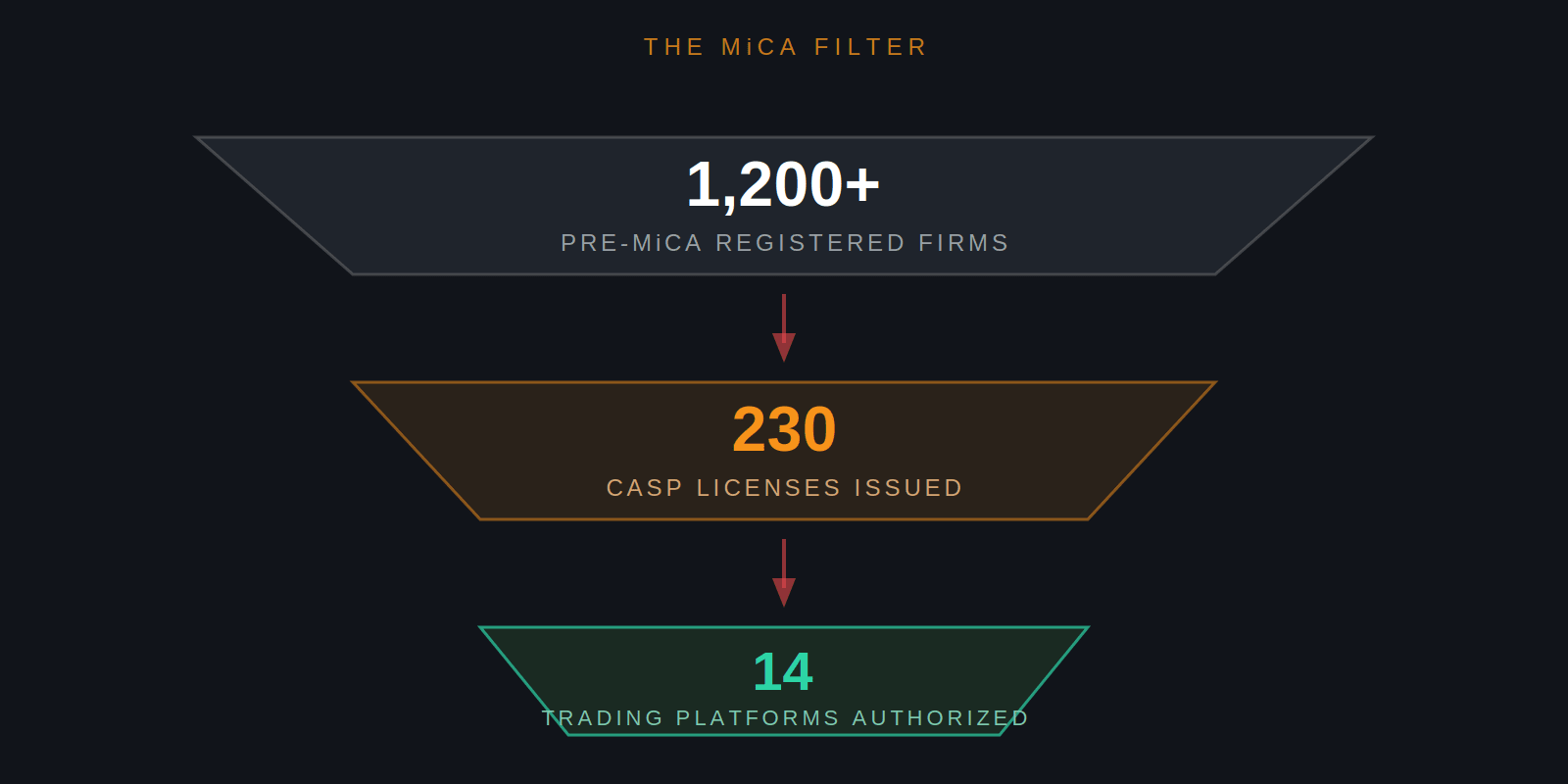
By BitBrainers Editorial Three days before the MiCA enforcement deadline, the largest crypto exchange in the world withdrew its license...

Money Got Binance in the Room. A Record Kept It at the Door.