By BitBrainers Editorial
The Numbers Behind The Deadline
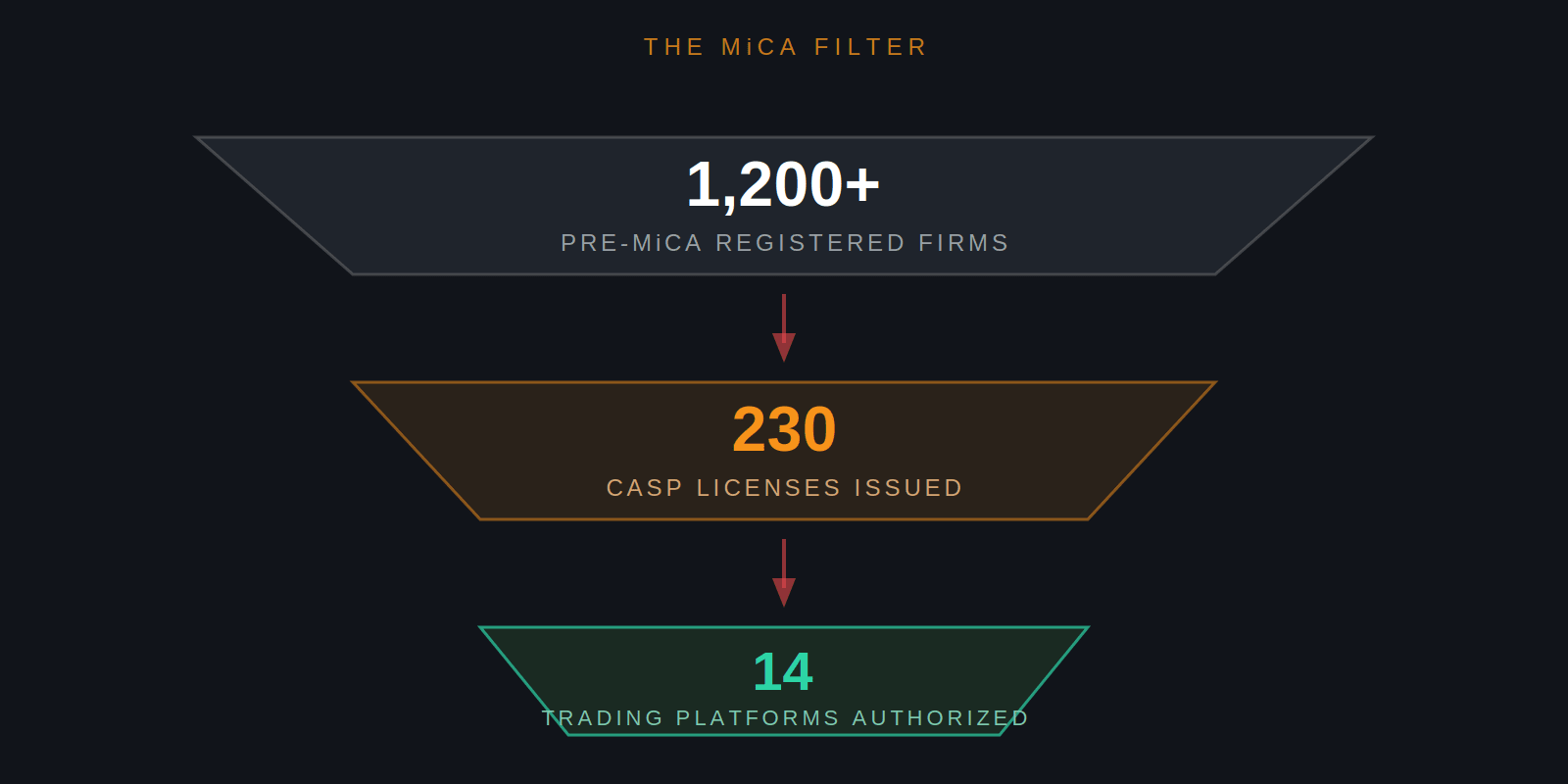
July 1, 2026 ends the 18-month transitional period under the EU's Markets in Crypto-Assets regulation. Around 230 firms now hold full CASP authorization across the bloc. Of those, only about 14 are cleared to run an actual trading platform. The pool they came out of was more than 1,200 firms registered under the old national rules.
That's a 19% conversion rate at the broad level, and roughly 1% at the trading-platform level. Ten EU member states haven't issued a single license. Estonia, which had 641 registered crypto firms in 2021, was down to about 40 by early 2025. France's regulator estimates that 40% of its registered providers never even submitted a MiCA application. Poland's national implementation law was vetoed for a third time in June, leaving Polish firms with no domestic path at all.
None of that is a story about firms running out of money. It's a story about firms running out of room.
What Money Couldn't Solve
The compliance cost of a MiCA authorization runs between €250,000 and €500,000 according to French regulators. For a small firm in Tallinn, that's existential. For Binance, it's a rounding error. So when Binance pulled its Greek application on June 24, the question wasn't budget. Reuters reported the Hellenic Capital Market Commission was preparing to reject the file. The reasons named in the reporting weren't capital or product gaps. They were past money-laundering penalties and corporate-structure issues, the kind of legacy concerns a fresh check can't paper over.
Binance has navigated this before. It holds a full MiCA passport through an EU entity it redomiciled and rebuilt in 2025, after rejections elsewhere on similar grounds. The Greek withdrawal isn't proof Binance can't get licensed; it already is, elsewhere. It's proof that even with the world's deepest war chest, you don't get a clean run at every jurisdiction. Some doors stay closed for reasons that pre-date the application.
That's the part of MiCA the headline numbers obscure. The framework didn't filter for size or balance sheet. It filtered for record. A clean compliance history, a manageable corporate structure, and the willingness to relocate to a jurisdiction that wants you became the actual currency.
This is the kind of read you get weekly.
No hype. No "this coin will 100x." Just honest macro on Bitcoin, gold, and the market.
The Map MiCA Drew
Look at where the licenses actually went, and a clear geography emerges. Germany leads with around 53 authorized entities. The Netherlands sits at 25 or 26. France, Malta, Cyprus, Ireland, and Luxembourg fill out most of the rest. Almost every major exchange that survived chose Ireland, Luxembourg, Malta, or the Netherlands as its EU base.
That's not random. Those are the jurisdictions that built a regulator willing to engage early, set realistic timelines, and process applications at scale. The countries that issued zero licenses weren't all small or hostile to crypto. Some were simply slow, understaffed, or politically conflicted about whether to compete for the business at all. Poland is the extreme case, but it's not the only one.
For users, that produces a strange map. After July 1, where you can legally trade crypto inside the EU depends less on where you live and more on where your exchange chose to redomicile. A Polish trader using a Polish-registered firm has a worse setup than a Polish trader using a firm passported in from Ireland, even though both users are sitting in the same country.
The Quiet Part Of The Stablecoin Story
The most visible casualty so far has been Tether. Tether didn't apply for MiCA authorization, and EU-licensed venues that continue listing non-authorized stablecoins risk losing their own CASP licenses. Coinbase began delisting USDT for EEA users in December 2024. Kraken followed in early 2025. Crypto.com delisted it alongside nine other tokens. Binance geofenced its EEA USDT pairs.
What gets less attention is what filled the gap. Circle's USDC and EURC are the only top-10 stablecoins fully MiCA-compliant, which puts them in a near-monopoly position for compliant euro and dollar exposure inside the EU. That's not a small consequence. It's the regulatory equivalent of being handed the only umbrella when it starts raining. Whether that's a feature or a flaw of MiCA's design depends on how comfortable you are with one issuer holding that much of the regulated market.
On The Radar
Watch how unlicensed firms communicate to EU users in the next 72 hours. France's AMF has explicitly warned that operating without authorization after the deadline exposes firms to criminal prosecution, so legal-quality wind-down notices should accelerate. Watch where Binance lands next on the MiCA application front, after Greece. And watch whether the European Commission's proposal to centralize CASP supervision inside ESMA itself gains ground after July 1, which would be a structural shift away from the current member-state model and is already being opposed publicly by Malta.
Sources:
Bitcoin.com News: MiCA Deadline Hits July 1 as Unlicensed Crypto Platforms Face EU Shutdown Risk
Yahoo Finance: July 1 MiCA Deadline Looms: More Than 80% of EU Crypto Firms Still Unlicensed
Kraken Blog: MiCA Enforcement Begins July 1: What It Means for Institutional Counterparties
This is market commentary, not financial advice. Nothing here is a recommendation to buy or sell any asset. Do your own research.