By BitBrainers Editorial
Where It Actually Stands
The Digital Asset Market Clarity Act passed the House on 17 July 2025 by 294 to 134. The Senate Banking Committee advanced its portion on 14 May 2026 by 15 to 9. Since then: no floor vote, no cloture filed, no scheduled date.
The bill has been sitting on the Senate Legislative Calendar since 1 June, at number 423. Eligible for floor action for two months, never scheduled.
Industry and congressional negotiators marked 7 August as the practical deadline. Majority Leader John Thune told reporters he did not think they would get it done, adding that he would like to at least get CLARITY started.
The arithmetic is the whole problem. Republicans hold 53 seats. Cloture needs 60. That means at least seven Democrats, and under Senate Rule XXII the bill needs two separate cloture sequences, each of which typically eats most of a legislative week. Floor time that might have covered it went to a Russia sanctions package and a backlog of nominations.
What Is Actually in It
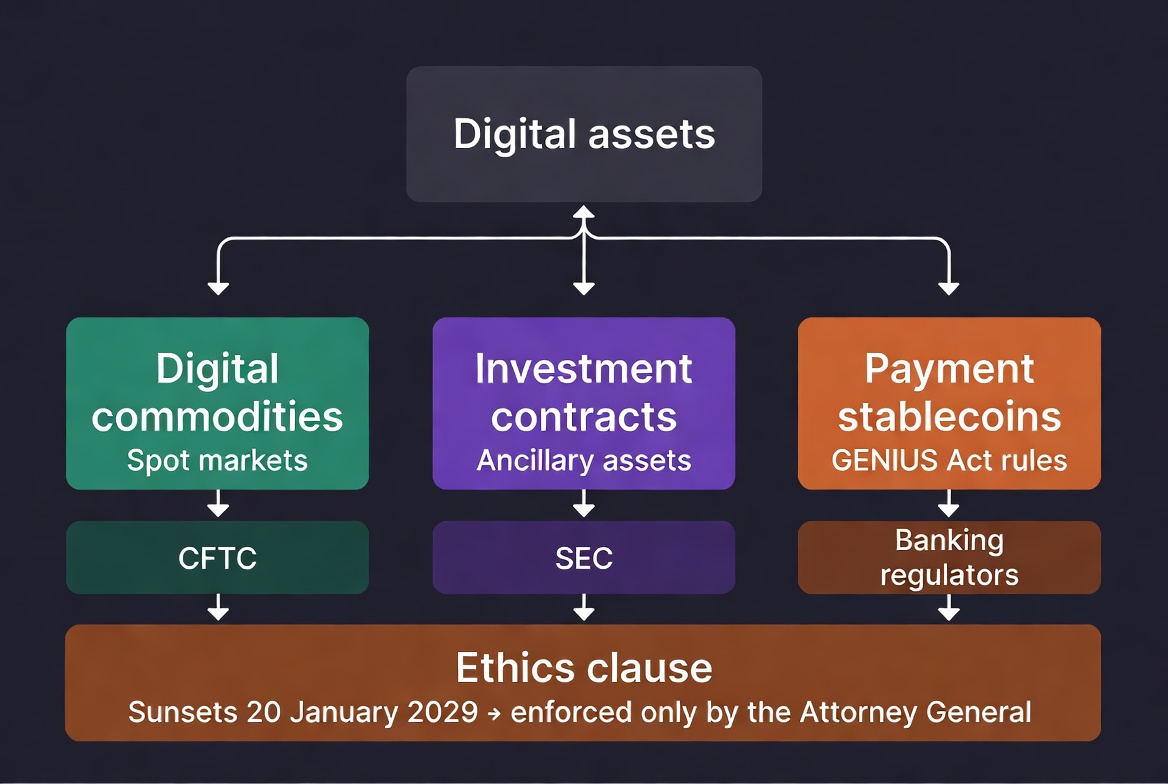
The merged text released on 22 July runs to roughly 616 pages. The core of it is a jurisdiction split. Spot markets in digital commodities go to the CFTC, investment contracts and ancillary assets stay with the SEC, and payment stablecoins fall under banking-style rules built on the already-enacted GENIUS Act. Exchanges, brokers and dealers would register with the CFTC.
Around that sit the provisions people actually argue about. A fundraising exemption lets projects raise up to $50 million a year and $200 million lifetime without full SEC registration. Intermediaries become financial institutions under the Bank Secrecy Act. Non-custodial developers get explicit protection from registration purely for writing code. Interest-like yields on idle stablecoin balances get banned while rewards tied to actual transaction activity survive. Most of it takes effect 360 days after enactment.
Worth noting what it is not. It does not touch tax treatment. Crypto remains property in the eyes of the IRS either way.
The Fight Is Not About Crypto
President Trump's 2025 financial disclosure showed roughly $1.4 billion in crypto-related income. About $636 million came from the $TRUMP meme coin and nearly $800 million from World Liberty Financial, the DeFi platform his family co-founded. A separate July disclosure tied more than $1 billion in income to his crypto ventures over the past year.
Democrats' position is structural rather than symbolic: they argue you cannot build a federal framework for an industry that produced the sitting President's single largest income stream without enforceable rules on his continued participation in it.
The White House agreed to ethics language that bars the President, Vice President, certain members of Congress, covered officials and their spouses from issuing or sponsoring a digital asset for consideration while in office, with a divestiture or blind trust requirement kicking in a year after enactment. Officials could still own crypto and would have to disclose sales.
Two details explain why that has not closed the deal. The ban sunsets on 20 January 2029, which is the end of the current presidential term, something we covered when the clause first appeared. And enforcement sits solely with the Attorney General, not state attorneys general and not private parties. So the restriction on the President expires when he leaves office and is enforceable in the meantime only by his own appointee.
Seven crypto-friendly Democrats rejected it. Angela Alsobrooks, Cory Booker, Catherine Cortez Masto, Ruben Gallego, John Hickenlooper, Mark Warner and Raphael Warnock said in a joint statement that the Republican text falls short, citing ethics alongside consumer protection, illicit finance, market integrity and DeFi regulation. Elizabeth Warren put it more directly, saying that whatever it is called, a provision that does not stop the President profiting from crypto is not an ethics provision.
Gallego, one of only two Democrats who backed the bill in committee, described the returned draft to Politico in language we will not reprint and said it was not a serious effort. He is now working on a counteroffer with Republican Thom Tillis.
Deadlines like this move fast.
We track what actually happens on the calendar, not what gets promised on it.
SubscribeThe Vote Might Happen Anyway, and Not to Pass
On 30 July, Treasury Secretary Scott Bessent publicly demanded an immediate floor vote, calling the bill floor-ready and accusing Senate Democrats of choosing politics over American leadership. Lummis amplified it, pointing to more than a hundred compromises already made and to the Fraternal Order of Police reversing its earlier opposition after the DeFi provisions were revised.
Thune has signalled he may bring the bill to the floor without the votes secured. That reads more as an election-year manoeuvre than a legislative one. Forcing senators to take a public position on crypto regulation months before November has value to Republicans whether or not the bill clears.
The risk is that it burns the negotiation. Cynthia Lummis, one of the Republican negotiators, posted that after nearly eleven months of giving almost everything asked of them, she does not know what else her Democratic colleagues need. Reporting on the talks suggests a forced vote on a text Democrats have already rejected could cause a rift that does not heal.
What the Market Thinks
Prediction markets have been brutal about this all year. Polymarket odds on CLARITY becoming law in 2026 peaked above 80 percent in February, hit a record low near 24 percent in mid-July, briefly recovered to around 45 percent when the updated text was expected, and have settled in the low-to-mid 30s as the ethics deadlock hardened. Galaxy Research cut its own estimate to 50 percent.
Worth noting what did not move those numbers. A direct public appeal from the President in mid-July produced no upward move at all, which tells you traders read the binding constraint as Democratic votes rather than presidential enthusiasm.
What Happens If It Slips
Failure before recess does not kill the bill. It pushes it into a September calendar with less momentum and then into an election year, where controversial votes get harder. Estimates of the delay range from 2027 to considerably longer. Lummis has warned that failure this year could push comprehensive federal rules out to 2030, after a Congress nobody has met yet is seated.
In the meantime the rules come from agencies rather than statute. The SEC and CFTC issued joint interpretive guidance on 17 March 2026 classifying sixteen digital assets under a five-category taxonomy, and the SEC has said it is prepared to write crypto rules if Congress does not. That is the part the industry actually fears, because interpretive guidance is not law. Any future administration can rescind it, and the whole framework reverts to enforcement discretion overnight.
Which is the real stake here, and it has little to do with this month. A statute is durable. Guidance lasts exactly as long as the people who issued it.
What to Watch This Week
One thing decides it: whether Thune files cloture on a motion to proceed before the chamber leaves. A filing typically sets up a vote two session days later, and without one there is no summer vote at all.
After that, watch whether the Gallego and Tillis counteroffer produces text the White House will accept, and whether any of the seven Democrats move publicly. If the window closes, the thing to track through autumn is whether leadership tries to attach CLARITY to must-pass year-end legislation. Lobbyists have floated that route in trade press. No senator has confirmed it.
Sen. Lummis (primary source) — Merged CLARITY Act text, released 22 July 2026
CoinDesk — Senators Ready to Send Stricter Ethics Rules on Trump's Crypto Ventures to White House
The Hill — Crypto Bill Faces Democratic Backlash Over New Ethics Rules
CoinDesk — US Senate Puts Off Crypto Clarity Act as It Focuses Limited Bandwidth Elsewhere
Bitcoin Magazine — Senate Democrats Reject Clarity Act Ethics Rewrite
Crypto News — CLARITY Act Senate Delay Drops 2026 Odds
Tools We Use
Kraken — Spot and futures on BTC, ETH, and 200+ assets.
Trezor — Cold storage. No internet connection required.
This is market commentary, not financial advice. Nothing here is a recommendation to buy or sell any asset. Do your own research.