By BitBrainers Editorial
Wednesday, June 24, 2026
Crypto Gets Regulated Into the Ground. Meta Builds a Betting App for 3.5 Billion People.
Tuesday, June 23, 2026
BofA Just Changed Its Fed Call. Bitcoin Should Care More Than It Does.
By BitBrainers Editorial
Bank of America spent most of this year telling clients the Fed would hold rates steady through 2026. On Monday it reversed that call. The bank now expects three separate rate hikes before the year ends, in September, October, and December, lifting the federal funds rate toward a range of 4.25 to 4.5 percent. The reason given is straightforward: core inflation is running hotter than expected, and the bank thinks policymakers are increasingly worried it is not temporary.
That is a real shift, not a rounding error. A bank moving from steady to three hikes in one note is the kind of call that changes how every other desk prices risk for the rest of the year. Bitcoin barely moved on the headline. That gap between the size of the news and the size of the reaction is the actual story.
Why This Is The Chain We Have Been Watching
A hawkish Fed call is not abstract for an asset like Bitcoin. It pays no yield. Every basis point the Fed adds to the safe rate raises the opportunity cost of holding something that pays nothing while it sits there. That is the entire mechanism, and it does not care how the asset is described in headlines. Gold faces the identical pressure for the identical reason, which is why a softening gold price often moves in the same direction as a softening Bitcoin price when this lever is the one being pulled.
BofA's note cited core personal consumption expenditures, the Fed's preferred inflation gauge, potentially reaching 3.5 percent, roughly 70 basis points above where it sat a year earlier. That is the number that actually matters here, more than any chart pattern. Inflation running hot is the input. Hawkish Fed commentary is the output. Higher real yields are the transmission. Pressure on non-yielding assets is the result. None of that chain runs through a ceasefire ticker or an exchange order book.
Read also: Bitcoin Weekly Brief: June 22 — The Ceasefire Is Cracking And Bitcoin Doesn't Care
This is the kind of read you get weekly.
No hype. No "this coin will 100x." Just honest macro on Bitcoin, gold, and the market.
The Part That Looks Like A Contradiction But Is Not
Strategy bought another 520 Bitcoin this week for roughly 35 million dollars, the same day this Fed news was landing. On its face that looks like conviction buying straight into a hawkish turn. Look closer and it is less dramatic. The purchase price was around 67,000 dollars. Strategy's average cost basis across its full holding is 75,651 dollars. The company bought below its own average, which is simply the dollar-cost-average strategy it has run for years, continuing on schedule. It is not a signal that someone with privileged information is shrugging off a more hawkish Fed. It is a company executing the same plan it always executes, regardless of what the macro backdrop is doing that week.
The two facts sitting next to each other, a bank turning more hawkish and a public company continuing to buy on its usual schedule, are not in tension. They are simply two different actors operating on two different time horizons. One is repricing risk for the next six months. The other is averaging in over years. Neither one tells you what happens next week.
What Actually Changed And What Did Not
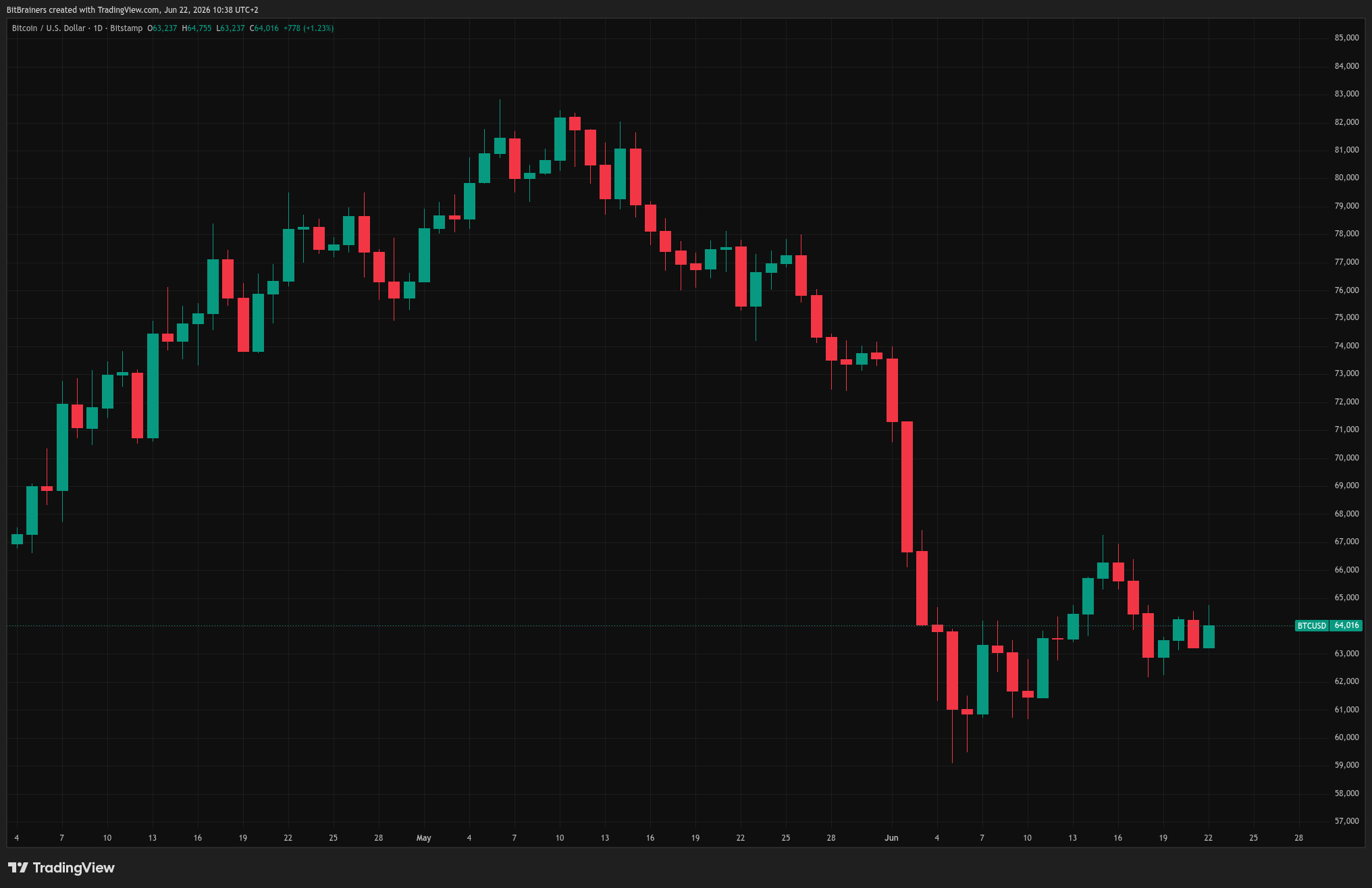
Bitcoin's range has not broken. Price is still sitting in the low to mid 60,000s, the same zone it has held through the ceasefire noise we covered last week. What changed is the macro backdrop underneath that range got less friendly, not more. A market that hopes for rate cuts to justify higher prices for risk assets just had one of its larger banks tell clients to expect the opposite. That does not guarantee a breakdown. It removes one of the arguments for a breakout higher.
The honest position here is the boring one. Watch the inflation prints between now and September. Watch whether other banks follow BofA's lead or push back on it. The Fed call that actually matters is the Fed's own, not a single desk's forecast of it. Until that lands, this is a backdrop that got tighter, not a verdict.
Sources
Yahoo Finance / CoinDesk, Bitcoin Is Stuck Near $64,000 As ETF Outflows Reach A Sixth Week
Yahoo Finance, Bitcoin News: Digital Dollar Blocked To 2030 While Staking Tax Bill Stalls In Congress
BitBrainers. We check the facts so you don't have to.
Disclosure: This post is market commentary, not financial advice. We hold Bitcoin. Nothing here is a recommendation to buy, sell, or use leverage.
Monday, June 22, 2026
Bitcoin Weekly Brief: June 22 — The Ceasefire Is Cracking And Bitcoin Doesn't Care.
By BitBrainers Editorial
Two ceasefires have failed this year, and Bitcoin gave back the entire rally both times. A third framework was signed on June 17. This week it started cracking, and the thing worth noticing is what Bitcoin did about it. Almost nothing.
BTC spent the week stuck in the low 60,000s, roughly 63,000 to 64,000, while the headlines screamed. That is the real story of this week. Not the war, not the deal, but the fact that price has stopped flinching at either one.
Nobody Sold The Bottom. They Were Sold.
By BitBrainers Editorial
Sunday, June 21, 2026
Bot Signal Watch #4: I Put My Own Bot on Trial. It Lost.
In the last Bot Signal Watch, the bot almost won and I refused to call it one. A long that came a few dollars short of its target, reported as still open, because "almost" is not a fill. A few people told me I was being too hard on it.
This one is harder than that. I stopped watching individual signals and put the whole strategy on trial. The verdict is in, and it's not the one I was hoping for.
The question I should have asked sooner
Every Bot Signal Watch so far has tracked what the bot did this week. Won here, lost there, sat on its hands. That's fine for a diary, but it never answered the real question: does the strategy actually have an edge, or have I been narrating a coin flip?
There is a proper way to answer that, and it isn't "look at this month's trades." It's a walk-forward test. You take years of price data, split it in two, let the strategy pick its best settings on the first half, then run those exact settings on the second half it has never seen. If the edge is real, it survives on the unseen data. If it was just fitted to the past, it falls apart. And you apply real fees and slippage to every trade, because a strategy that's profitable before costs and negative after costs is just a donation to the exchange.
Ten tests, one answer
I ran the bot's EMA cross logic this way across Bitcoin and Ethereum, on three timeframes. Then I tested the opposite idea, mean reversion, the same way. Ten tests in total. Here is the part that matters, the out-of-sample result, the half the strategy never got to practice on:
| Test | Out-of-sample return | Verdict |
|---|---|---|
| EMA cross, BTC 15m (the live bot) | -52% | Fails |
| EMA cross, BTC 4h | -2.6% | Fails |
| EMA cross, ETH 15m | -27% | Fails |
| Mean reversion, BTC (all timeframes) | -14% to -77% | Fails |
| Mean reversion, ETH 15m / 1h | -63% to -79% | Fails |
| One outlier (ETH 4h, both strategies) | positive | Too few trades to trust |
No version of the live bot's strategy survives. Not the 15-minute cross it actually runs, not a slower 4-hour version, not on Bitcoin, not on Ethereum. The single positive cell came from one corner of the data with so few trades that it tells you nothing, and I'll come back to why that one is a trap, not a discovery.
Why it loses, in plain terms
The cross strategy dies from a thousand small cuts. On 15 minutes, price chops back and forth across the moving averages constantly. The bot catches the occasional big move, those trades are real winners, but in between it gets whipsawed into dozens of tiny losses. The few wins can't outrun the steady bleed, and the fees finish the job.
Moving to a 4-hour chart fixes the chop, and for a moment it looked promising. But once the whipsaw was gone, what was left underneath was just a coin flip. Roughly equal wins and losses, and every flip costs you the spread. A coin flip that charges admission is not a strategy.
Mean reversion, betting that price snaps back to its average, was supposed to feed on exactly that chop. It didn't. It bleeds a different way: it wins small and often, then a real trend rips straight through the band and the stop-loss takes one brutal loss that erases a week of small wins. During the big moves of the last two years, price kept trending instead of reverting, and the strategy paid for it.
The trap I didn't fall into
One result came back glowing. Ethereum on the 4-hour chart showed a strong positive return and a high win rate, on both strategies. It would have been easy to point at that and say I'd found something.
It was built on fewer than forty trades. That is not enough to separate skill from luck. And here is the tell: it was the only positive cell across all ten tests, and it lit up for two completely different strategies in the same spot. When two opposite approaches both look good in the exact same corner of the data and nowhere else, that corner is a quirk of one period, not an edge. You need hundreds of trades before a number like that means anything. I have a few dozen. So I'm filing it as noise, which is what it is.
What I'm actually telling you
The bot does not have an edge. I tested it more honestly than most people ever test the systems they sell you, and the honest answer is no. That's the whole reason this series exists, to show the part nobody screenshots.
This isn't a sad ending. The point of running it as paper, in public, with nothing real on the line, was to find this out before it cost anything. It did its job. The infrastructure stays, the testing discipline stays, and the next thing I try will go through the exact same gauntlet before it earns a single dollar of risk.
If anyone ever shows you a bot with a perfect record and no losing weeks, ask them for the out-of-sample test with fees included. The silence that follows is the most honest data point you'll get.
Nothing here is financial advice. It's a record of testing a strategy and finding it wanting. Do your own research.
By BitBrainers Editorial
Weekly Brief: The Week FOMC Decides Everything
By BitBrainers Editorial Bitcoin hit $66,400 on Tuesday, its highest since June 17, on seven straight days of ETF inflows. By Friday it ...