₿ BTC Loading... via Binance

Tuesday, July 21, 2026

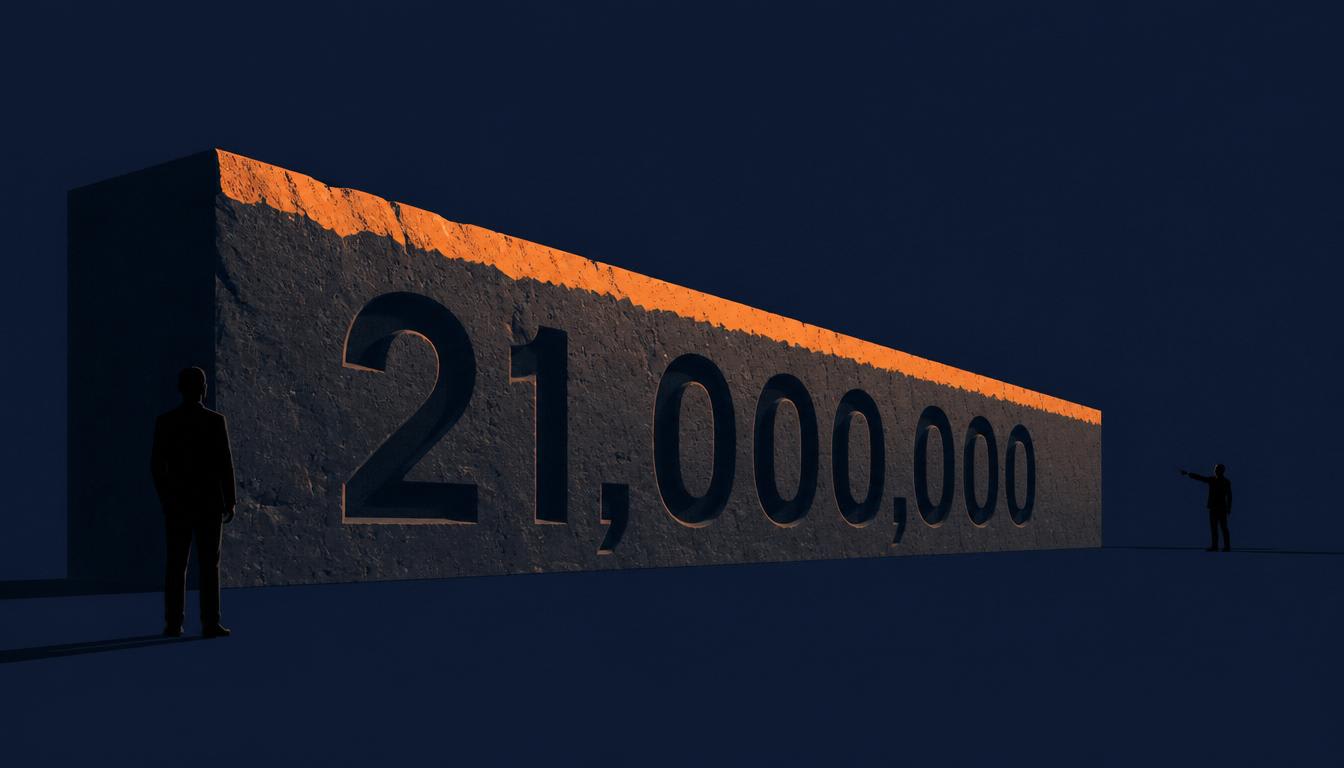
The 21M Debate Is Asking the Wrong Question.

BitBrainers - The 21M Debate Is Asking the Wrong Question

By BitBrainers Editorial

Every few years, someone with credentials proposes changing Bitcoin's supply cap. The community erupts. Nothing changes. But this time, something worth reading got buried underneath the noise.

Eli Ben-Sasson, co-inventor of Zcash and CEO of StarkWare, argued publicly earlier this month that the 21 million cap does not make sense and proposed 4% annual inflation instead. The reaction across Bitcoin communities was swift and largely dismissive.

Most of that reaction answered the wrong question. The 21 million cap is not under threat. What is under threat, eventually, is something the debate barely touched.


Two Arguments, One Got Ignored

Ben-Sasson made two separate points. The first was about lost keys: over time, private keys are lost. In the theoretical limit, all keys eventually disappear. A fixed supply therefore becomes a shrinking usable supply.

Most of the pushback focused here. The counter is clean. Satoshi addressed it directly: lost coins only make everyone else's coins worth slightly more. Think of it as a donation to everyone. Bitcoin divides to 100 million satoshis per coin, giving 21 quadrillion total units in circulation. Usability is not the constraint. Lost coins are a feature of a deflationary system, not a flaw.

His second point was flagged almost as an aside: "I'm not even talking about the security problem, looming large on the horizon." He was pointing at miner incentives after Bitcoin's block subsidy ends. The debate moved past it. That was the mistake.


On the Messenger

The credibility context matters before getting to the substance.

Zcash launched with a hard cap of 21 million coins, copied directly from Bitcoin. Ben-Sasson helped design that. His current project, Starknet, raised $287 million from venture capital. Its token is down roughly 99% from its 2024 all-time high.

This is directly relevant because his core argument is that inflation is necessary to keep an asset usable. The token he controls the monetary policy of is nearly worthless. That is evidence about his judgment on that specific claim, not a cheap shot.

Corporate Bitcoin holders have reached very different conclusions about what makes the asset worth holding long term. We covered what long-term institutional conviction actually looks like in practice here.

The debates that matter rarely trend.

Get the BitBrainers weekly breakdown in your inbox. Data-backed, no noise.

Subscribe

The Security Budget Problem Is Real

Today, roughly 95.5% of the 21 million supply has already been mined, around 20.05 million BTC. The current block subsidy is 3.125 BTC per block. The next halving arrives around April 2028, cutting that to 1.5625 BTC.

By 2140, the subsidy reaches zero. From that point, miners are paid exclusively through transaction fees. Bitcoin's design assumes a mature fee market will sustain enough hash rate to keep the network secure.

That assumption has not been tested. It will not be tested for over a century. Researchers and Bitcoin developers have been modeling the risks around fee variance and miner incentive stability in a pure fee regime for years. The honest answer is that nobody knows with certainty whether it holds.

This is the question worth having. Not whether the 21M cap should change. Whether transaction fees alone can sustain meaningful network security after the last halving cycle ends.


Why 4% Is Still the Wrong Answer

Accepting the security budget concern does not mean accepting Ben-Sasson's solution. Four percent annual inflation would destroy the hard money value proposition Bitcoin was built on.

For comparison, Monero runs a permanent tail emission producing roughly 0.85% annual inflation, trending toward zero over time. That is already considered aggressive by Bitcoin standards. Four percent compounds to something closer to mediocre fiat over long horizons.

Even among researchers who take the security budget question seriously, the ceiling for any theoretical tail emission sits well under 1%. Four percent is not a monetary policy. It is a number that sounds reasonable to people who have not thought hard about compounding.

And it would require a hard fork with near-unanimous consensus that does not exist and is not forming.


What to Actually Watch

Fee market trends across the next two halvings. Post-2024 data is the first real signal on whether block space demand is maturing structurally. Ordinals and Runes showed what high-fee blocks look like during demand spikes. Whether that becomes the baseline or reverts to thin fees is the open question.

Hash rate concentration. If the number of active mining pools continues shrinking after each halving, the security budget concern stops being theoretical and becomes measurable.

The CLARITY Act's path through the US Senate. Institutional adoption at scale means more high-value settlement on the base layer, which feeds directly into miner fee revenue. That bill is one of the cleaner links between regulatory progress and Bitcoin's long-term security economics.

The 21 million cap is not going anywhere. The question of what secures the network after the last block reward is mined is still open, and the time to think clearly about it is now.


Sources

X / EliBenSassonEli Ben-Sasson on Bitcoin's supply cap, July 7 2026

TracxnStarkWare fundraising data

CoinGeckoSTARK token price history

This is market commentary, not financial advice. BitBrainers holds Bitcoin and other digital assets. Nothing here is a recommendation to buy or sell any asset. Do your own research.
Monday, July 20, 2026

Bitcoin Is Sandwiched. Here Is What Breaks It Either Way.

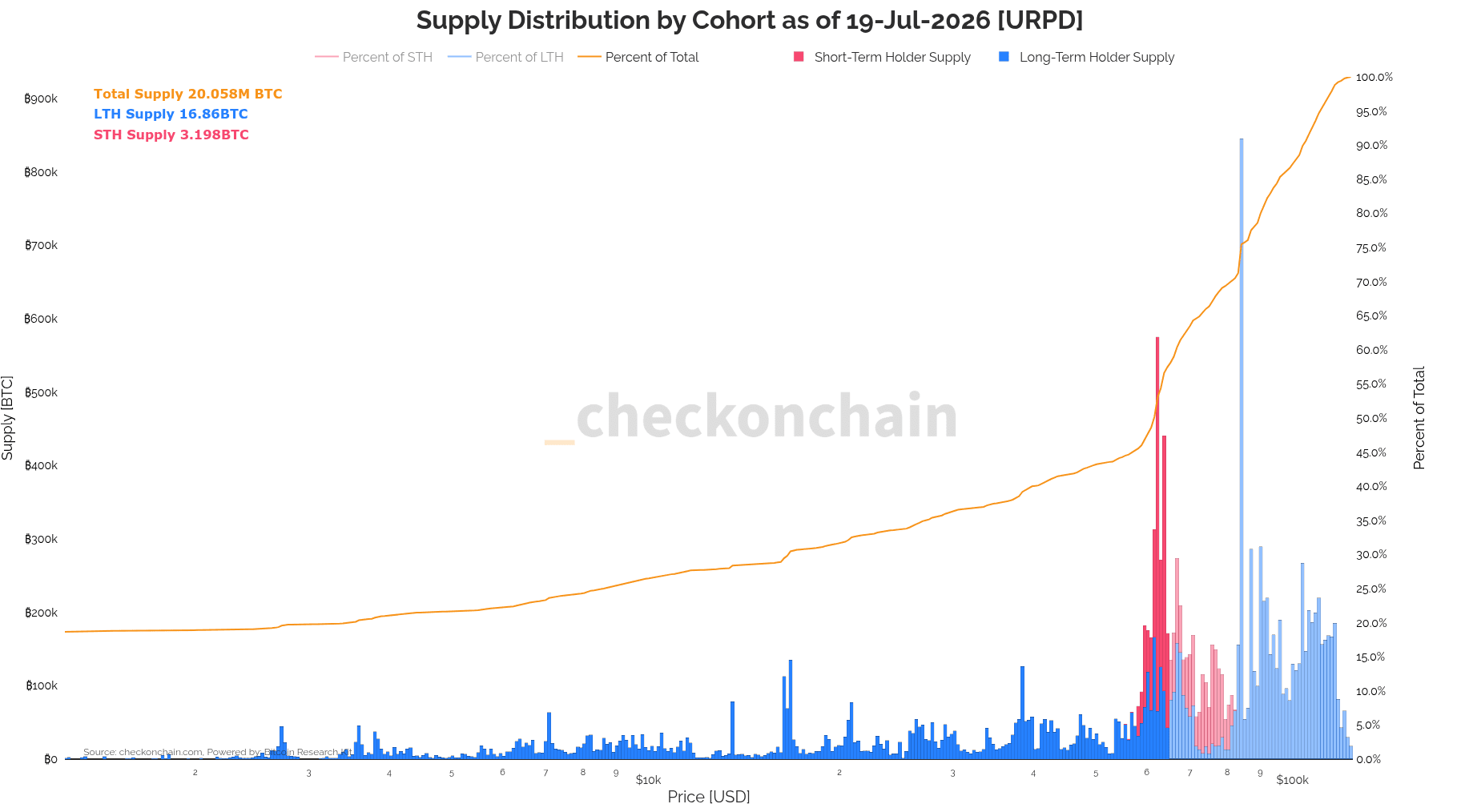
BitBrainers - Bitcoin Supply Distribution by Cohort July 2026

Source: Checkonchain

By BitBrainers Editorial

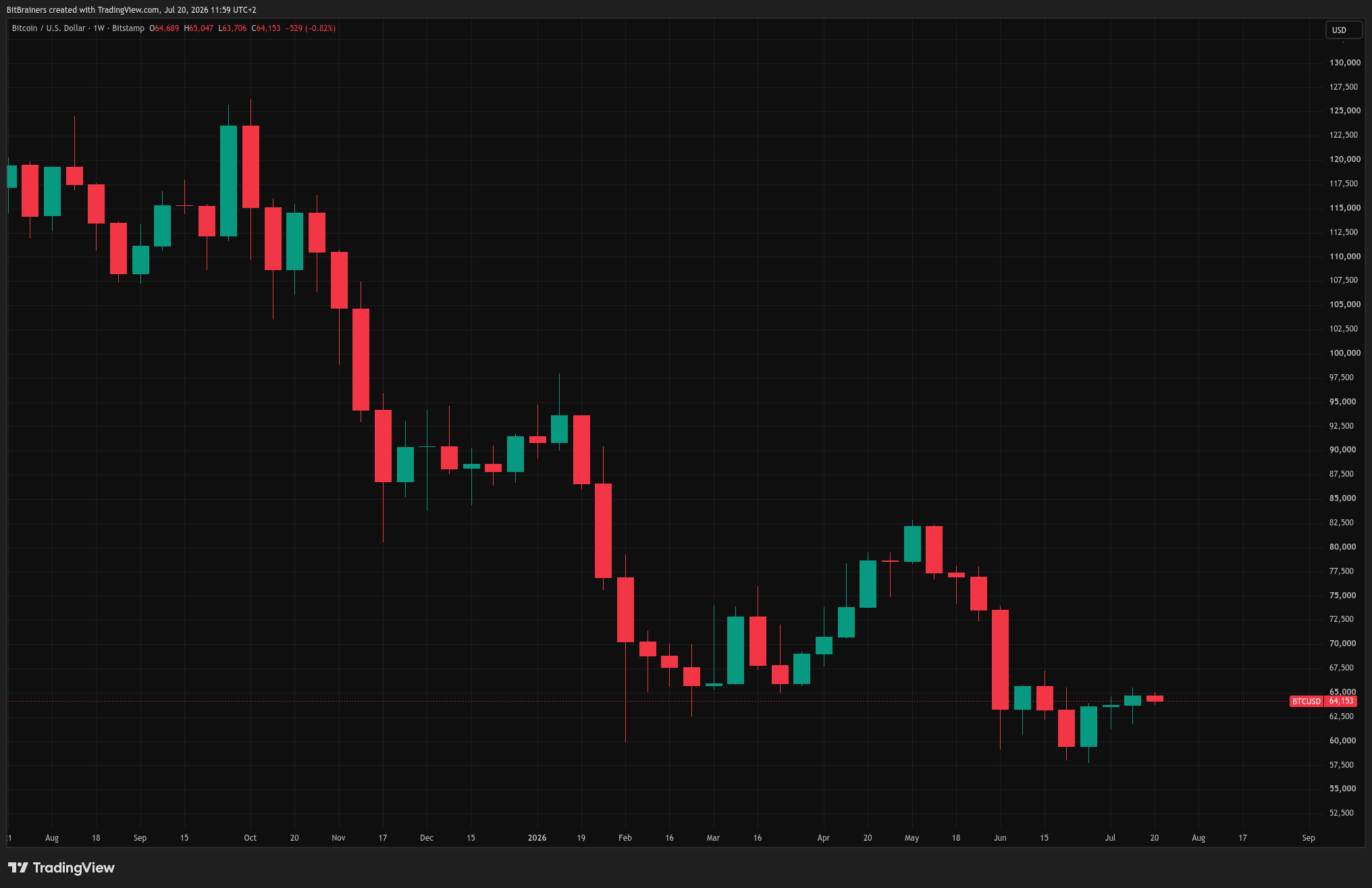
Bitcoin is trading at $64,094 on the weekly open, stuck between two EMA levels that have defined the entire 2026 range. The 21-week EMA sits at $70,928 above. The 55-week EMA is at $80,162 further out. Price has not reclaimed either since December 2025. This is what the chart says going into FOMC week.

The weekly structure is bearish. Every bounce since November's all-time high near $126,000 has failed to reclaim the declining 21-week EMA. The current candle opened below it, tested it once on the CPI print last week, and is already pulling back. The 55-week EMA at $80,162 is the level Merlijn The Trader calls the "reclaim" line, the level that started the +1,644% run in 2020 and the +710% run in 2022. It is currently $16,000 above spot price.

The daily picture is tighter. The 21-day EMA is at $63,583, sitting just below current price as support. The 55-day EMA is at $65,313, capping price from above. Bitcoin is sandwiched between both. No fresh signal from the EMA cross on the daily since the short triggered on June 3 near $71,800 and exited June 6. Since then, nothing. The bot is flat and waiting.

The On-Chain Picture

Long-term holder Binary CDD has dropped to 0. That means LTHs are not spending. They accumulated through the entire drawdown from $126,000 to $57,800 and have not distributed into the bounce. The SOPR ratio for LTHs and short-term holders combined sits at 0.89, edging slowly upward. The two previous times SOPR hit this level, April 2020 and September 2023, both resolved with significant rallies.

The $59,000 level is where slightly more than half of all traders hold their cost basis according to Checkonchain. The July 1 low of $57,800 tested just below it and bounced. That level held. It is now the floor that defines whether the structure is constructive or still distributing.

None of this confirms a bottom. The on-chain picture says the floor is under construction, not finished.

BitBrainers - BTC/USD Weekly Chart July 20 2026

Weekly levels. Real data. No hopium.

Get the breakdown every Monday before the market opens.

Subscribe

The ETF Picture

Spot Bitcoin ETFs recorded two consecutive weeks of net inflows after an eight-week, $8 billion outflow streak. Last week brought $75.7 million, the week before $197.4 million. The bleeding has stopped. Year-to-date net outflows still sit at $5.4 billion and the two-week recovery represents roughly 3% of what left in 2026.

The key caveat: last Monday saw $424.7 million drain out in a single session following renewed US-Iran military conflict. The net positive week only held because the rest of the week offset that single day. IBIT, BlackRock's fund, is still seeing inconsistent flows. A multi-week positive trend from IBIT specifically is the signal that institutional re-entry is structural rather than tactical.

ETF flows now explain roughly 45% of weekly Bitcoin price moves. The inflows are a tailwind. They are not yet a catalyst.

The Macro Overlay

The Fed enters its pre-FOMC blackout period today. No speeches, no interviews, no guidance until Chair Warsh speaks on July 29. The meeting itself is July 28-29. Markets price roughly 70% odds of a hold.

Brent crude is at $91, its highest level since June, driven by US-Iran strikes in the Strait of Hormuz and US crude inventories at a 42-year low of 726 million barrels, equivalent to 42 days of refinery demand. The June CPI relief that pushed Bitcoin to $65,471 last week was built on cheaper gasoline during a brief ceasefire window. That window closed. The July CPI will look different.

The CLARITY Act is also running down its last realistic window before the Senate leaves for recess. Regulatory clarity has been a positive sentiment driver. Its absence would remove one of the tailwinds the bounce has been leaning on. We covered the CLARITY hearing earlier this month here.

Levels to Watch

Resistance: $65,313 (55-day EMA), $65,631 (50-month EMA), $68,000 (200-week EMA). The 200-week EMA is the level that started every previous bull run. Price has not tested it since the decline began.

Support: $63,583 (21-day EMA), $59,000 (majority cost basis), $57,800 (July 1 low and structural floor).

The range is tight. A weekly close above $65,631 opens the path toward $68,000 and the Merlijn reclaim thesis. A weekly close below $63,583 puts $59,000 back in focus before FOMC.


What to Watch This Week

FOMC blackout runs through July 29. No macro guidance until then. Watch Brent crude for inflation expectations and ETF daily flows for institutional direction. The CLARITY Act Senate timeline resolves this week. Any fresh Hormuz escalation hits both oil and Bitcoin sentiment simultaneously. The setup is tight and the catalysts are live.

Sources
Bloomberg Bitcoin ETFs Attract Inflows for Second Week After Two-Month Outflows
CoinDesk BTC ETFs attract $273 million in two weeks. That's peanuts compared to recent exodus
KuCoin Bitcoin's $59K Level Could Be Key to Next Move as Long-Term Holders Stay
Crypto Times Crypto Week Ahead: CLARITY Act Deadline, Big Tech Earnings, the Pre-FOMC Calm

This is market commentary, not financial advice. BitBrainers holds Bitcoin and other digital assets. Nothing here is a recommendation to buy or sell any asset. Do your own research.

BitBrainers Editorial

Sunday, July 19, 2026

The CPI That Saved Bitcoin Was Built on Cheap Gas

BitBrainers - The CPI That Saved Bitcoin Was Built on Cheap Gas

By BitBrainers Editorial

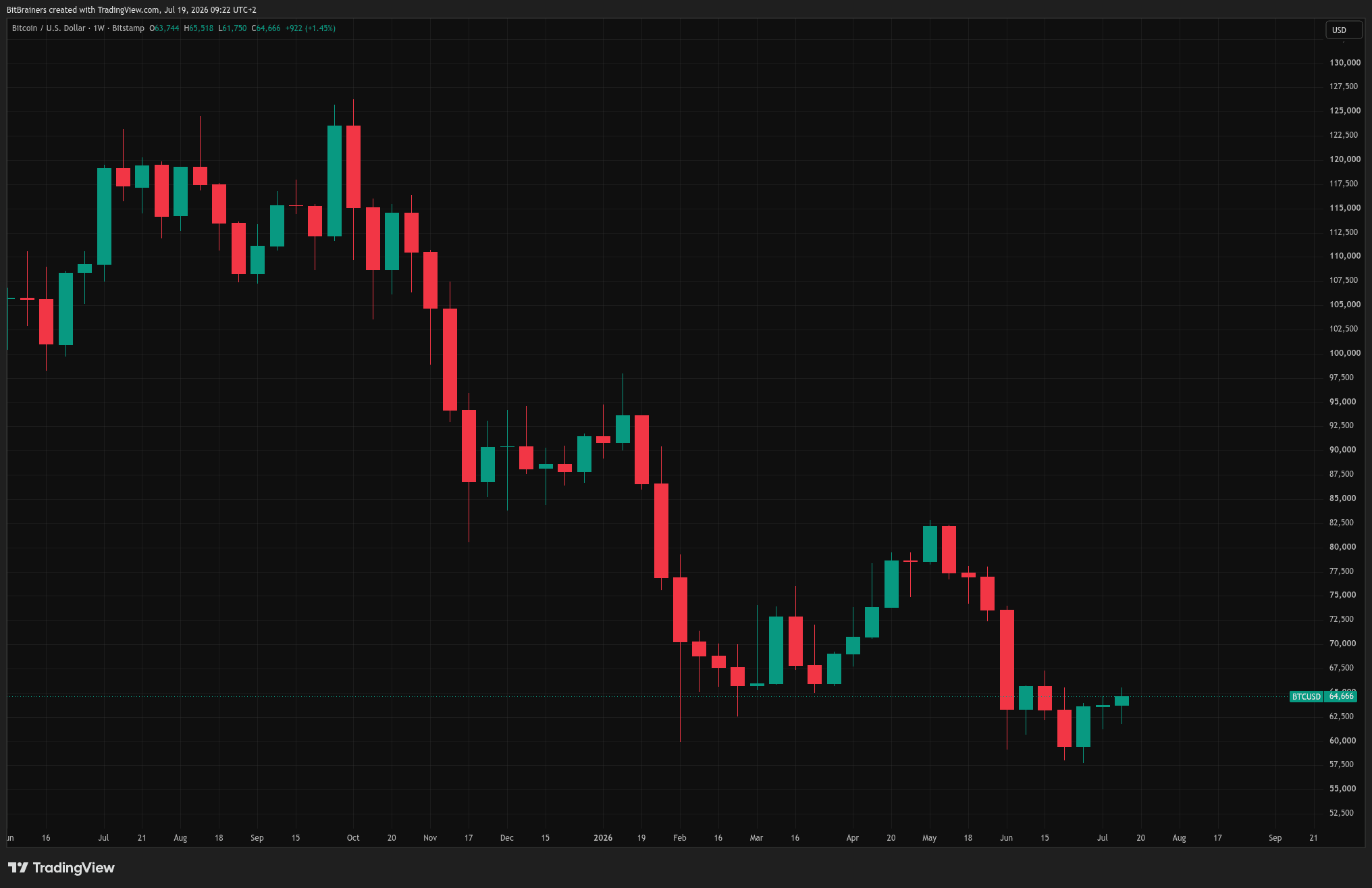
Bitcoin rallied nearly 5% on July 14 and broke $65,000 the following day. The catalyst was the June CPI print: headline inflation fell 0.4% month over month, the biggest monthly drop since April 2020. Core came in flat. Fed hike odds for July 29 collapsed from above 40% to around 13%. Risk assets breathed. Bitcoin followed.

What drove that inflation drop? Largely gasoline. Energy prices pulled the headline number lower after a brief period of relative calm in the Strait of Hormuz, where a fragile interim agreement between the US and Iran had allowed some shipping to resume after months of conflict.

That agreement fell apart the same week Bitcoin was celebrating.

US and Iranian forces exchanged strikes from July 13 onward. Brent crude, which had dipped toward the low $70s during the ceasefire window, surged back above $85 by July 14-15. The exact energy prices that made the CPI print look soft are now reversing in real time.

The Relief Was Already Priced on Old Data

CPI measures the previous month. June's print described a world where Hormuz tensions had briefly eased and gasoline got cheaper. The July print will describe a world where they hadn't.

Bitcoin rallied on a data point that was already stale when it landed.

The Fed's new chair Kevin Warsh acknowledged this directly. Minutes from the June meeting flagged AI-driven energy demand as a new inflation wildcard. Warsh is also scheduled to testify before Congress this week. Traders parsing his tone for September signals will be doing so against a backdrop of $85 oil and contested shipping lanes.


The macro picture changes fast.

Get the weekly brief every Monday before the market opens.

Subscribe

What the On-Chain Picture Actually Says

Beneath the CPI reaction, the structural picture is more interesting than the headline move. Whale addresses accumulated over 270,000 BTC near the $59,000 level in the two weeks before the bounce. Long-term holder supply is at record levels. Exchange reserves are at seven-year lows.

At the same time, the average spot ETF buyer entered around $83,800. With Bitcoin near $64,000, the typical ETF holder is sitting on an unrealized loss exceeding 23%. That gap explains why inflows have been sporadic. Buyers who are underwater tend to sell into strength rather than add.

This is not a normal distribution of holders. ETF products introduced a layer of institutional capital that tracks mandates and risk limits, not conviction. When real rates rise, those mandates force selling regardless of on-chain fundamentals. When real rates fall, the buying resumes. Bitcoin's price has become partially a function of interest rate expectations, not just adoption or scarcity.

Two forces pulling in opposite directions. Smart money accumulating on-chain. Institutional paper holders bleeding out through ETF redemptions. The feedback loop that defined 2024, where ETF inflows drove price and price attracted more inflows, is not functioning the same way in 2026.

Year-to-date net outflows from US spot Bitcoin ETFs stand at approximately $5.4 billion. June alone produced roughly $4.5 billion in outflows, the worst monthly reading since these products launched in January 2024.

The Bounce Has a Shelf Life

Bitcoin is a rate-sensitive risk asset in this cycle. The June CPI print did one specific thing: it removed the tail risk of a July hike. It did not open the door to cuts. Markets still assign roughly 70% odds to a hold on July 29, and prediction markets show around 76% odds of zero cuts across all of 2026.

The ceiling has not moved. The floor got confirmed.

Part of the move was also mechanical. A short squeeze wiped over $230 million in leveraged positions across two sessions following the CPI and PPI prints. That amplified the price action. It does not mean the underlying bid is as strong as the candle size suggests.

Whether Bitcoin can hold above $65,000 into the July 29 FOMC meeting now depends on three variables: whether oil stabilises or pushes higher from here, whether ETF flows turn sustainably positive, and whether Warsh signals anything new on the September path.

One of those three is already moving in the wrong direction. Read our July CPI breakdown for the full macro setup going into FOMC.

BitBrainers - BTC/USD Weekly Chart July 2026

On The Radar

Fed Chair Warsh testifies before Congress this week. July PPI landed July 15 below consensus, extending the inflation relief narrative for now. FOMC decision July 28-29 remains the next hard catalyst. Watch Brent crude. If it stays above $85 heading into August, the July CPI relief story starts to unwind before the Fed even meets.

Sources
Al Jazeera Oil prices hit 1-month high as US-Iran attacks dim Strait of Hormuz outlook
CNBC Oil prices today: Brent, WTI, Hormuz blockade
Phemex Bitcoin reclaims $64,000 after the softest CPI print of 2026
Memeburn Bitcoin price hits $64K as ETF outflows persist in July 2026
TechTimes Bitcoin breaks $65K on dual inflation miss

This is market commentary, not financial advice. BitBrainers holds Bitcoin and other digital assets. Nothing here is a recommendation to buy or sell any asset. Do your own research.
Friday, July 17, 2026

Weekly Brief: The Week the Market Celebrated Too Early

By BitBrainers Editorial

Bitcoin opened the week at $63,587, slid to a low of $61,481 on July 8 as Middle East tensions flared, then ripped to $65,000 on Tuesday when CPI came in soft. By Thursday July 17 it is back at $62,735. The week looked like a recovery. It ended where it started.

The CPI Print That Wasn't What It Looked Like

June headline CPI came in at 3.5% against a 3.8% forecast. Core landed at 2.6% versus 2.8% expected. Both missed below. Bitcoin jumped 3.8% to $64,434 and Ethereum rose 6.1% in the same session.

The problem is what drove the soft headline. Gasoline fell sharply in June after the US-Iran ceasefire took hold and oil pulled back. That ceasefire collapsed on July 8. WTI crude has since recovered toward $74 a barrel. The June data captured a world that no longer exists by the time markets traded on it.

Core CPI at 2.6% is a genuine improvement from May's 2.9% reading. But the Fed's actual target is core PCE, and nine of eighteen FOMC officials still project a rate hike before year-end. The July 28-29 meeting is live with no forward guidance, and the soft print shifts odds without changing the structure.


ETF Flows: One Day of Green in a Red Quarter

The CPI reaction produced one day of ETF inflows: roughly $197 million on July 14, ending a 10-day outflow streak. By some measures the single-day figure reached $265 million across all products. Either way, it was the strongest inflow session since May.

Context matters here. June saw $4.5 billion in ETF outflows, the worst monthly figure since the funds launched in early 2024. Year-to-date outflows remain deeply negative. One session recovered a few percent of the capital that left in June alone.

BlackRock's IBIT held approximately $60 billion in assets under management through the week, but BlackRock's broader digital assets AUM had fallen roughly 40% year over year to $49 billion. Citigroup had already cut its 12-month Bitcoin target from $112,000 to $82,000 and revised its 12-month ETF inflow assumption to zero.


The data before the crowd reads it.

Weekly macro and Bitcoin analysis. No price targets pulled from thin air.

Subscribe

Strategy Keeps Selling

Michael Saylor's company filed its weekly disclosure showing 3,588 BTC sold for $216 million during the week of June 30 to July 5, at an average of roughly $60,000 per coin. The company's cost basis across its entire stack sits at approximately $75,476 per coin. It is selling below cost.

The mechanism is straightforward: preferred stock dividends now exceed $1.5 billion annually and must be paid regardless of where Bitcoin trades. The first post-2022 sale was 32 coins in early June. The following disclosure was 3,588 coins. The pace is accelerating.

Strategy is the company whose founder told the world to never sell Bitcoin. The filings now show it sells every week. The two facts are not contradictory once you understand the capital structure. They are worth understanding before repeating either talking point.


CLARITY Act: The Hearing Happened, The Vote Has Not

The House Financial Services Committee held a field hearing in New York on July 17, exactly one year after the House passed the CLARITY Act 294-134. The hearing had no vote attached. Its purpose was to apply pressure on the Senate before the August recess closes the window.

The Senate math has not moved. The bill needs 60 votes for cloture. Republicans hold roughly 53 seats. Two Democrats, Ruben Gallego and Angela Alsobrooks, voted it out of the Banking Committee in May but both remain conditional. Five or more additional Democratic votes are needed and none are publicly committed.

Senator Lummis has said plainly that failure in 2026 likely pushes the next realistic window to 2030. Stifel's analyst Brian Gardner has written that the bill needs to clear the Senate before the August recess or prospects deteriorate materially. The GENIUS Act stablecoin rulemaking deadline of July 18 lands this week and may produce additional regulatory headlines.

For last week's full macro setup and what we were watching heading into this week: Bitcoin Weekly Brief: July 6


Key Levels This Week

Bitcoin at $62,735 on July 17. Weekly range: $61,481 low to $65,000 high. The Bollinger midband sits near $62,015 and the upper band near $65,652, with price compressing back toward the midline after the CPI spike. MACD histogram remains positive. RSI(6) at 62.5, RSI(24) at 49.1.

The $60,000 zone held twice this month. The $65,000 level rejected twice. Until one of those breaks on meaningful volume, the range is the structure.


On The Radar Next Week

July 28-29 FOMC. That is the main event. No forward guidance, no fresh dot plot until September, and the Fed walking in with one soft CPI print against a backdrop of recovering oil prices and an unresolved Hormuz situation. Watch the statement language for any shift in the hike-or-hold bias.

ETF flows daily. A second and third consecutive inflow day led by IBIT changes the picture. A reversal confirms the CPI session as a one-day relief bounce.

Strategy's weekly filing. If the pace continues accelerating from 32 coins to 3,588 coins in five weeks, the math on their dividend schedule suggests this is not a one-off.

CLARITY Act Senate calendar. Any announcement of a floor vote date before the recess, or the absence of one, is the binary that matters for the rest of July.


Sources

Caleb and Brown Weekly Rollup July 14, 2026

CoinStats Bitcoin Daily Market Analysis July 16, 2026

CryptoTicker Bitcoin's Green July Is Real, But One Vote Could Blow It All Up

Yahoo Finance What Happens to Bitcoin and Crypto If the CLARITY Act Misses Its Deadline

Motley Fool Crypto Market Today July 14: Ethereum Soars 6% on Cooler Inflation Data

This is market commentary, not financial advice. BitBrainers holds Bitcoin and other digital assets. Nothing here is a recommendation to buy or sell any asset. Do your own research.
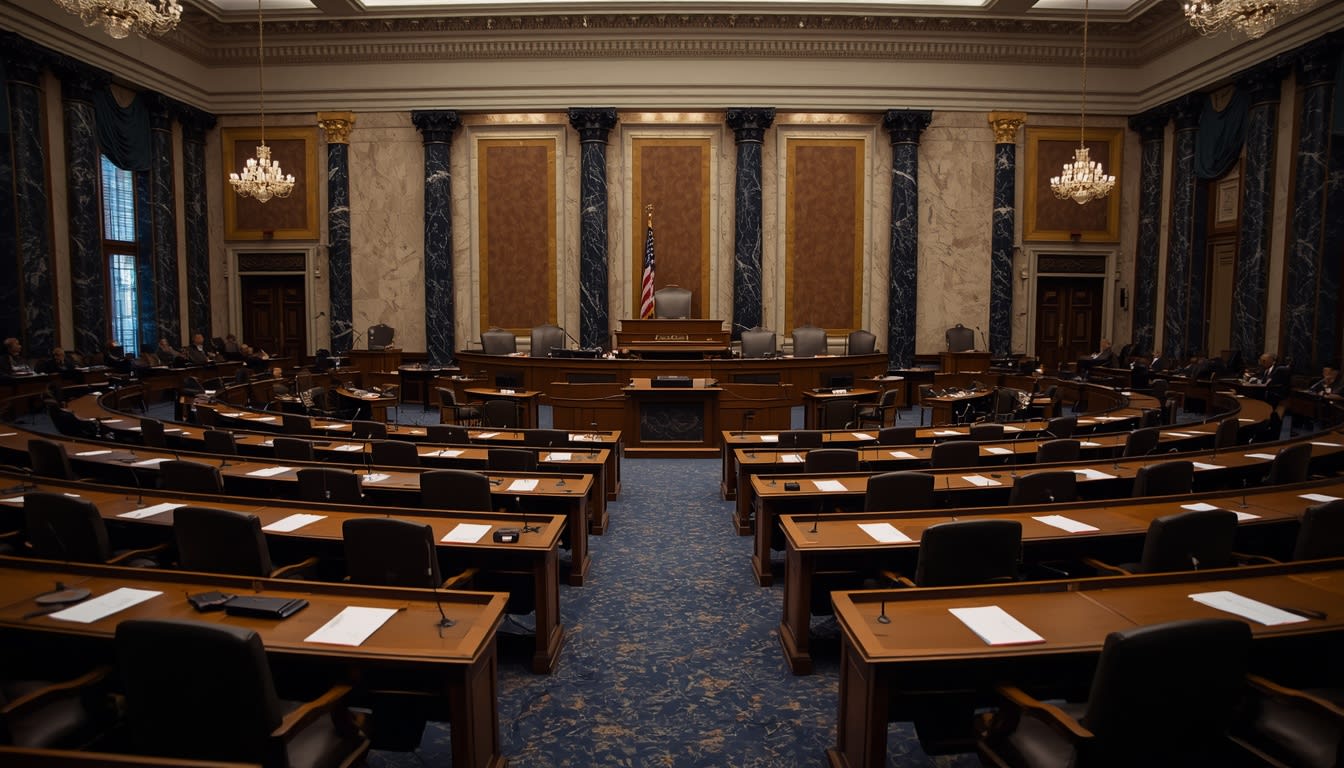
Thursday, July 16, 2026

CLARITY Act Hearing on July 17: Seven Democrats Decide Crypto Regulation in 2026

BitBrainers - CLARITY Act Hearing on July 17: Seven Democrats Decide Crypto Regulation in 2026

By BitBrainers Editorial

On Friday morning, the House Financial Services Committee convenes a field hearing in New York titled "Building the Future of Finance: How the CLARITY Act Unlocks Innovation." The House passed this bill a year ago, 294 to 134. The hearing has no vote attached and no legal power to move anything. So why does it matter? Because it lands in the exact week the Senate decides whether the United States gets crypto market rules in 2026 or waits until 2030.

A Hearing With No Vote and Plenty of Leverage

The CLARITY Act sits on the Senate Legislative Calendar with no floor vote scheduled. Prediction markets put the odds of passage this year at roughly 43%, down from the low seventies earlier this year.

Friday's session is pressure, applied publicly. Holding it in New York instead of a Capitol Hill committee room puts the exchanges, banks, and asset managers who would live under the framework in the room, arguing that the US either hosts the next generation of financial infrastructure or watches it leave.

The date is not an accident either. The House passed the original bill on July 17, 2025. The hearing lands exactly one year later, with the Senate's window closing.


The Math Is Seven Democrats

The Senate Banking Committee advanced the bill 15 to 9 on May 14. All thirteen Republicans voted yes, joined by two Democrats, Ruben Gallego and Angela Alsobrooks. Both conditioned their committee votes on further negotiation before committing to anything on the floor.

Cloture requires 60 votes. Republicans hold roughly 53 seats. That means at least seven Democrats, and only two are even conditionally on record.

The holdouts want three things. Stronger anti-money-laundering language, after Senator Warren branded the bill "a ticket to sanctions evasion." Resolution on Section 604, the developer protections that critics say could shield illicit actors. And an ethics provision covering government officials who hold crypto, a demand aimed squarely at the president's family businesses, from stablecoins to mining operations.

The holdouts are not just stalling. The Warren camp's core argument is that Section 604 could shield developers whose tools end up serving sanctions evasion, and the banking lobby argues that even activity-based stablecoin rewards compete with insured deposits while carrying none of the same obligations. Whether those arguments hold up or not, seven Democrats need political cover to vote yes, and cover comes from concessions, not hearings.


Washington moves markets more than charts do.

We track the policy, the flows, and the numbers behind the headlines. One email a week.

Subscribe

The Coinbase Reversal Tells You Where the Bodies Are Buried

In January, Brian Armstrong pulled Coinbase's support for the Senate draft an hour before a scheduled markup. The markup was cancelled. His stated objection covered several provisions, but the core of it was stablecoin yield: the Senate text restricted the rewards Coinbase pays users for holding USDC, a business that generated $355 million for the company in a single quarter.

The fix came in May. Senators Thom Tillis and Angela Alsobrooks brokered compromise language, now Section 404, that bans yield paid solely for holding a stablecoin while preserving rewards tied to actual activity: payments, transfers, staking, liquidity, loyalty programs.

Coinbase took the deal. This week its chief policy officer went on national television calling the bill the unlock for the company's "everything exchange" ambitions, tokenized stocks and stablecoin payments under one regulated roof. The company that killed the bill in winter is now its loudest advocate in summer. That reversal, more than any press release, tells you the industry believes this version can actually pass.


The Calendar Is the Real Opponent

Senator Lummis says the merged text combining the Banking and Agriculture Committee versions should land within days, with a possible floor vote the week of July 20. Galaxy Research projects a potential presidential signature the week of August 3 if everything holds, and puts passage odds at 60 to 75%, notably higher than the prediction markets.

The recess is the cliff. If the Senate leaves for August without a vote, the bill returns to a fall calendar that runs straight into midterm campaigning, where few Democrats will want to hand the administration a win on an asset class the president trades personally.

Lummis has said it plainly: failure in 2026 likely pushes the next realistic window to 2030.

Markets spent this week celebrating a soft inflation print instead. We covered why that rally rests on stale data: Bitcoin Pumped on Old News. Here Is What Actually Matters This Month.


What Friday Actually Signals

Watch three things in the hearing. Whether witnesses or members hint that the merged Senate text is genuinely close, whether Section 604 sounds like it is being negotiated or defended, and whether leadership talks about the bill as a July priority or an autumn project.

The market impact is asymmetric. Passage compresses the legal-risk premium priced into every US exchange, stablecoin issuer, and token network still caught between SEC and CFTC jurisdiction. Failure does not just maintain the status quo, it extends it for years, with the next Congress campaigning instead of legislating.

A hearing that cannot pass anything is still the clearest signal you will get this month about whether anything passes at all.


Sources

crypto.news CLARITY Act Senate Showdown: Why the July 17 Hearing Decides Crypto's 2026

CryptoSlate Crypto Finally Has a CLARITY Act Date, Delivery Now Depends on Seven Senate Democrats

Fortune Why Coinbase Split With a16z and the Crypto Sector on a Key Bill

The Crypto Times House Takes CLARITY Act to Wall Street With July 17 Innovation Hearing

The Crypto Times Coinbase Backs CLARITY Act to Unlock Its 'Everything Exchange'

This is market commentary, not financial advice. BitBrainers holds Bitcoin and other digital assets. Nothing here is a recommendation to buy or sell any asset. Do your own research.

He Called the AI Boom. Then He Got Margin Called Into It

By BitBrainers Editorial On July 24, Leopold Aschenbrenner wrote to his investors. The AI selloff, he said, was "one of the best...

He Called the AI Boom. Then He Got Margin Called Into It