
₿ BTC Loading... via Binance

Wednesday, July 22, 2026

Franklin Templeton Says Crypto Is the Rails for AI. They Left Out the Hard Part.

BitBrainers - Franklin Templeton Says Crypto Is the Rails for AI. They Left Out the Hard Part

By BitBrainers Editorial

Sandy Kaul, Franklin Templeton's head of digital assets and innovation at a $2 trillion asset manager, published a piece this week calling agentic AI the killer use case for blockchain and crypto. When a firm managing $2 trillion says something publicly, it is not speculating. It is positioning.

The thesis is clean. AI agents will transact with each other autonomously, at high frequency, for amounts too small for traditional payment rails to handle. An API call, a second of compute, access to a dataset. Fractions of a cent per transaction. Traditional networks charge $0.30 plus 2-3% and settle in one to three business days. That structure breaks for machine-to-machine commerce at scale.

AI agents cannot open bank accounts. KYC requirements built for humans do not map to software. Blockchains do not ask for a passport. That is structural, not incidental.

The numbers she cited are real. Aptos is recording up to 12,933 transactions per second. Solana 6,284. BNB Chain 3,252. Visa's network runs at roughly 1,700 TPS under normal load. The throughput gap is not marginal. If you want exposure to the chains pulling ahead in this race, Kraken lists SOL, ETH, and the major L2 tokens.


The Protocol Nobody Is Stress-Testing

x402 is the HTTP-native payment protocol developed by Coinbase that lets AI agents pay for APIs and services over standard HTTP, using stablecoins, without accounts or subscriptions. Visa, Mastercard and Stripe have all backed it. It has processed $15 million in adjusted volume across 109 million transactions since launch.

Franklin Templeton presents x402 as chain-agnostic. That is technically accurate. The spec is open. The Linux Foundation now maintains it.

The operational reality is different. Solana accounts for an estimated 50 to 80% of all x402 transactions. Base is the dominant EVM settlement layer. Coinbase developed x402. Coinbase runs Base. The protocol is chain-agnostic in its architecture and Coinbase-adjacent in its actual flow capture.

That is not a reason to dismiss the thesis. It is a reason to watch who controls the settlement layer when volumes scale.


Decentralization in Practice

The TPS numbers are peak figures recorded under specific conditions. They are real, but they describe ceiling performance, not operating reality under adversarial load or validator concentration pressure.

High-throughput chains tend toward validator concentration over time. The economics push that direction. Larger validator sets cost more to coordinate and often trade throughput for decentralization. The chains Kaul highlights are fast precisely because they made architectural trade-offs that centralize decision-making in fewer nodes.

Telegram's TON network is the clearest recent example. Non-custodial wallet, strong user numbers, genuine adoption. Telegram is also the network's dominant validator. Users hold keys. Telegram influences whether transactions clear. That is decentralization in architecture and a chokepoint in practice. We covered that dynamic in detail here.

Regulators do not need to attack a blockchain to disrupt it. They reach the domains, the app stores, the fiat on-ramps, and the banking relationships of the entities running the largest validator nodes. The attack surface for agentic payment rails is not the chain itself. It is everything around it. If self-custody matters to you while navigating this environment, Trezor is the standard starting point.

Institutions publish the bull case. We read the footnotes.

Bitcoin, macro, and AI infrastructure. Before the crowd finds it.

Subscribe

What Franklin Templeton Gets Right

Settlement finality is genuinely structural, not marketing. Machine-speed commerce cannot wait for T+1 or T+2. The moment agents are buying compute in real time, settlement delay is a functional failure, not an inconvenience.

The UX flywheel argument holds. If agent payments become invisible, one of crypto's largest adoption barriers disappears. People adopt applications, not infrastructure. Invisible rails are the only rails that scale.

If agentic commerce grows on-chain, demand for native gas tokens grows with it. That is a direct mechanism, not a speculative narrative.


The Question the Report Does Not Ask

Which chain actually wins? Franklin Templeton lists Aptos, Solana and BNB Chain as high-throughput candidates. It does not argue for one. That is appropriate restraint for an institutional report. It is also the question that determines where the value goes.

x402 adoption patterns suggest Solana and Base are pulling ahead in real transaction flow. Early integrations compound. A chain embedded into the first generation of agentic stacks is difficult to displace even if a superior alternative appears later.

The GENIUS Act and CLARITY Act are moving. Neither directly addresses autonomous software agents transacting on-chain. When regulators write those rules, the chains named in them gain structural advantages over those that are not.

We covered the first major attempt to put AI agents inside a brokerage account and what it got wrong: Robinhood Just Gave AI Agents a Brokerage Account.


On The Radar

Watch x402 facilitator concentration. If one entity controls the dominant settlement path through a chain-agnostic protocol, the protocol's neutrality is theoretical. Track which chains are getting embedded into enterprise AI agent stacks by default, not which chains have the highest peak TPS.

Watch for regulatory language that names AI agents specifically in the context of on-chain financial transactions. The first jurisdiction to write those rules sets the template. The chains and protocols they reference gain legitimacy by inclusion.


Sources
Franklin TempletonAgentic AI: The Killer Use Case for Blockchain and Crypto
CoinDeskForget Nvidia: The Next Big AI Trade Could Be Crypto and Blockchain
CointelegraphAgentic AI is Next Killer Use Case for Blockchain: Franklin Templeton
Chainstackx402 Protocol: Architecture and Payment Flow for AI Agents

This is market commentary, not financial advice. BitBrainers holds Bitcoin and other digital assets. Nothing here is a recommendation to buy or sell any asset. Do your own research.

Telegram Wants a Billion Crypto Wallets. One URL Already Proved Why That's Risky.

BitBrainers - Telegram Gram Wallet

By BitBrainers Editorial

On July 21, Pavel Durov announced what he called the largest rollout of a non-custodial crypto wallet in human history. Every Telegram app will get a native, built-in Gram wallet this summer, with zero-fee transfers for over one billion users. That is a real number. Telegram has more monthly active users than most countries have citizens.

The wallet runs on the MyTonWallet engine. Users generate a local 24-word seed phrase and hold their own private keys. Telegram never touches them. Lose the phrase, lose the funds. If you are new to self-custody and want to understand what holding your own keys actually means before the Gram wallet ships, Trezor is the standard starting point for hardware wallet education.

The crypto asset in question is Gram, which most people still know as Toncoin. It was renamed on June 15 after an 81% community governance vote. No swap, no migration. The blockchain is still called TON. The ticker is now GRAM.

What This Replaces (and What It Does Not)

Telegram already has a crypto wallet. The existing @wallet bot has over 150 million registered users. It is operated by The Open Platform, a third party affiliated with the TON Foundation, and it runs in custodial mode by default. Someone else holds your keys.

Durov's new wallet changes that. It is native, not a bot. It sits inside the app itself, not behind a third-party interface. Whether it replaces @wallet entirely or runs alongside it has not been confirmed.

The zero-fee claim applies to Telegram-to-Telegram transfers. Transactions on TON typically cost less than a cent and settle in under five seconds. In-app transfers that bypass the main network fee layer are already how the current wallet works. That part is not new. Baking it into every install of a billion-user app is.


This is the kind of story most newsletters miss.

BitBrainers connects the dots between regulatory moves, infrastructure risk, and what it means for your portfolio.

Subscribe

The Validator Problem the Announcement Skipped

There is a detail worth sitting with. The zero-fee promise works because Telegram became the largest validator on the TON network in 2026. As the dominant validator, Telegram can include zero-fee transactions in its own blocks without needing other validators to cooperate.

That means fee-free transfers depend entirely on Telegram's continued goodwill as a validator. If Telegram stops including your transaction, smaller validators have no economic reason to pick it up. No fee means no incentive.

This is not the same as trustless. It is cheaper, but it is not the same thing.

There is a sharper version of this problem. Telegram can credibly tell regulators it has no custody over user funds, because it genuinely does not hold private keys. But it controls whether those funds can move. If a government pressures Telegram to freeze a specific user, Telegram can stop including that user's transactions in its validator blocks. The funds sit in the wallet untouched. They just never move. Same outcome as a freeze. Clean hands on paper.

Whether Durov intends to use the architecture that way is a separate question. The design makes it possible regardless of intent. That is worth knowing before you decide how much of your stack lives inside a Telegram wallet. The trend of platforms positioning themselves as neutral infrastructure while controlling your access is not unique to Telegram. We looked at the same dynamic playing out at Robinhood last week.

One Week Earlier, a Ransomware Case Turned Off All of Telegram's Links

On July 13, the US Treasury's Office of Foreign Assets Control sanctioned a cybercriminal VPN service called 1VPNS. The service had supported ransomware groups including Avaddon, Qilin, and Sinobi. The FBI and European authorities had already seized its infrastructure in May 2026 in an operation called Operation Saffron.

The sanctions filing listed 1VPNS's Telegram channel as a contact address, in the format t.me/[channel]. That was enough to trigger what happened next.

The .me registry, DomainME, placed the entire t.me domain on serverHold. Every link starting with t.me stopped resolving worldwide. Channels, group invites, user profiles, bots, and crypto mini-apps. All dark. For 19 hours.

Durov found out on X. He posted asking the registry to look into it, which suggests Telegram received no advance notice. During the outage, the service switched links over to telegram.me and telegram.dog as fallbacks.

Once Telegram confirmed it had removed the 1VPNS channel, the registry lifted the hold. t.me came back online.

What Actually Happened at the Infrastructure Level

A serverHold is not a government-level block on Telegram. The app never went offline. But it is a registry-level action that sits above anything Telegram, its registrar GoDaddy, or its DNS provider Google Cloud can override. One entry on a sanctions list referenced a single Telegram channel URL, and the entire short-link domain for a billion-user platform went dark.

The .me registry is Montenegro's country-code domain, operated commercially by Identity Digital as backend provider. It also runs short-link domains for PayPal, WordPress, and Meta's apps. The same lever exists for all of them.

Durov's response was characteristically Durov. He bought t.you and posted: "I've just bought t.you (in addition to t.me) so it becomes a 'we' problem."

The Regulatory Risk Nobody Is Pricing In

Durov is promising non-custodial, self-sovereign crypto for a billion people. The pitch is that nobody can freeze it or block it. The same week he made that pitch, a single line in a US Treasury filing briefly removed his platform's entire link infrastructure from the global DNS.

The app itself was not taken down. The wallet would still function. But this is a preview of what escalated regulatory pressure actually looks like. The t.me incident was accidental collateral damage. A deliberate action would look different.

If regulators decide Gram at scale is a problem, the attack surface is not the wallet itself. It is the app stores, the validator status, the domain infrastructure, and the legal exposure Durov already carries from his August 2024 arrest in France, where he was questioned by investigators for a fourth time as recently as last week. Non-custodial keys do not protect you if the platform delivering them gets choked upstream.

GRAM is trading around $1.55 as of this writing, up roughly 7% on the wallet announcement. The all-time high is $8.25 from the 2024 tap-to-earn peak. If you want exposure to GRAM and prefer a regulated on-ramp, Kraken lists it. Size accordingly given the regulatory overhang.

On The Radar

The wallet ships "this summer" with no confirmed date. Watch the actual rollout across iOS, Android, and desktop. Watch whether @wallet gets deprecated or runs in parallel. Watch whether any app store flags the wallet functionality as it scales. And watch whether OFAC or another regulator takes direct interest in Gram once the user numbers become impossible to ignore.

The t.me outage resolved cleanly. The next time something similar happens, it may not be accidental.


Sources

DecryptPavel Durov Wants to Give a Billion Telegram Users a Crypto Wallet

TechCrunchTelegram's shortlink domain is back online after day-long suspension

TechRadarUS sanctions on rogue VPN accidentally break Telegram's short links worldwide

SpotedCryptoTelegram Gram Wallet 2026: 1 Billion Users Non-Custodial Launch

GlitchwireTelegram Announces Largest Non-Custodial Crypto Wallet Rollout in History

This is market commentary, not financial advice. BitBrainers holds Bitcoin and other digital assets. Nothing here is a recommendation to buy or sell any asset. Do your own research.
Tuesday, July 21, 2026

Robinhood Just Gave AI Agents a Brokerage Account.

BitBrainers - Robinhood Just Gave AI Agents a Brokerage Account

By BitBrainers Editorial

Robinhood announced yesterday that AI agents can now trade crypto on its platform. Real accounts, real money, no sandbox. You connect Claude, ChatGPT, Grok, or any MCP-compatible agent, fund a dedicated account, and let it run.

The reaction across finance feeds was enthusiastic. Automated trading, democratized. Hedge fund infrastructure for anyone with a phone.

We have been running a live trading bot for months. The enthusiasm is understandable. The product, as shipped, has some serious gaps.


What Robinhood Actually Built

Robinhood's Agentic Trading platform connects to its Trading MCP server at agent.robinhood.com/mcp/trading. You paste one URL into your agent's config, fund a dedicated account, and the agent can research tickers, build portfolios, and execute trades on a live schedule.

It launched for US equities on May 27. Crypto was added July 20. The timing matters: crypto trades 24/7, which is exactly the use case where an autonomous agent makes the most practical sense.

The platform supports Claude, ChatGPT, Codex, Cursor, and Grok out of the box. Push notifications fire on every trade. Real-time P&L is visible in the app. Users can disconnect the agent at any time.

On paper, that is a solid product. In practice, the most important feature is missing.


The Sandbox Problem

Every serious brokerage API ships a paper trading environment. Alpaca has one. Interactive Brokers has one. You wire the agent, blow up a fake account, learn what breaks, then flip the switch to live.

Robinhood's agentic MCP does not have one. You fund a real account. You place real orders. You lose real money. That is the integration test.

Their risk management documentation tells users to "set parameters carefully." That is not risk management. That is instructions.

Real bot risk management is a sandbox, a kill switch, position limits, and a dry run that cannot touch capital. You build all of that before the first live order goes anywhere near a market.

The broader question of what separates Bitcoin's infrastructure from the rest of crypto is worth understanding before connecting any agent to a live account. We covered that distinction here.

Trading bots, Bitcoin analysis, no noise.

Get the BitBrainers weekly breakdown in your inbox.

Subscribe

What the Agent Actually Does When Markets Move

LLMs are not deterministic. The same prompt, the same market data, and two different sessions can produce two different orders. That is fine in a chat window. It is a different problem when the output is an executed trade.

Robinhood's disclosure is honest about this: "AI agents can make errors, misinterpret instructions, act on incomplete or outdated information, and may behave in unexpected ways." They are right. The disclosure does not change the design.

Crypto moves fast enough that a misread instruction can cost real money before a push notification arrives. The 24/7 market is the whole pitch, and it is also the whole risk.

We built position limits, a kill switch, and logging into our bot before it touched a live account. Those are not optional features. They are the foundation.


Who This Actually Works For

None of this means the product is useless. For a retail user who wants an agent to rebalance a small portfolio, monitor a watchlist, or execute a simple conditional strategy, Robinhood's setup is genuinely accessible. The MCP integration is clean. The onboarding takes under a minute.

The issue is the gap between "accessible" and "safe for autonomous crypto trading." Those are not the same thing, and Robinhood's marketing does not clearly separate them.

Automated trading has historically lived at hedge funds and prop desks because those environments have engineering teams building the safety layer. Robinhood is packaging the capability without packaging the safety layer with it.

The retail user connecting Claude to a $500 crypto account is not a hedge fund. They should not have to build the infrastructure a hedge fund would build before their first trade goes live.


What to Watch

Robinhood is not the only platform moving here. The MCP standard is becoming the default integration layer across agent platforms in 2026. Where Robinhood goes, others follow.

The real question is whether paper trading environments arrive before or after the first wave of retail losses from agents behaving unexpectedly in a volatile market.

Crypto in July 2026 is not a forgiving environment for that experiment. FOMC meets July 28-29. Tariffs on 60 countries land this week. Bitcoin is pushing $67,000 resistance.

Connecting an AI agent to a live crypto account for the first time during that setup is not a test we would run.


Sources

RobinhoodRobinhood Is Now Open to Agents, May 27 2026

RobinhoodAgentic Trading Overview

Crypto BriefingRobinhood Introduces AI Agent Trading for Crypto Markets

Medium / Austin StarksI Just Tried Robinhood's Agentic Trading. I Am Not Impressed.

This is market commentary, not financial advice. BitBrainers holds Bitcoin and other digital assets. Nothing here is a recommendation to buy or sell any asset. Do your own research.
The 21M Debate Is Asking the Wrong Question.

BitBrainers - The 21M Debate Is Asking the Wrong Question

By BitBrainers Editorial

Every few years, someone with credentials proposes changing Bitcoin's supply cap. The community erupts. Nothing changes. But this time, something worth reading got buried underneath the noise.

Eli Ben-Sasson, co-inventor of Zcash and CEO of StarkWare, argued publicly earlier this month that the 21 million cap does not make sense and proposed 4% annual inflation instead. The reaction across Bitcoin communities was swift and largely dismissive.

Most of that reaction answered the wrong question. The 21 million cap is not under threat. What is under threat, eventually, is something the debate barely touched.


Two Arguments, One Got Ignored

Ben-Sasson made two separate points. The first was about lost keys: over time, private keys are lost. In the theoretical limit, all keys eventually disappear. A fixed supply therefore becomes a shrinking usable supply.

Most of the pushback focused here. The counter is clean. Satoshi addressed it directly: lost coins only make everyone else's coins worth slightly more. Think of it as a donation to everyone. Bitcoin divides to 100 million satoshis per coin, giving 21 quadrillion total units in circulation. Usability is not the constraint. Lost coins are a feature of a deflationary system, not a flaw.

His second point was flagged almost as an aside: "I'm not even talking about the security problem, looming large on the horizon." He was pointing at miner incentives after Bitcoin's block subsidy ends. The debate moved past it. That was the mistake.


On the Messenger

The credibility context matters before getting to the substance.

Zcash launched with a hard cap of 21 million coins, copied directly from Bitcoin. Ben-Sasson helped design that. His current project, Starknet, raised $287 million from venture capital. Its token is down roughly 99% from its 2024 all-time high.

This is directly relevant because his core argument is that inflation is necessary to keep an asset usable. The token he controls the monetary policy of is nearly worthless. That is evidence about his judgment on that specific claim, not a cheap shot.

Corporate Bitcoin holders have reached very different conclusions about what makes the asset worth holding long term. We covered what long-term institutional conviction actually looks like in practice here.

The debates that matter rarely trend.

Get the BitBrainers weekly breakdown in your inbox. Data-backed, no noise.

Subscribe

The Security Budget Problem Is Real

Today, roughly 95.5% of the 21 million supply has already been mined, around 20.05 million BTC. The current block subsidy is 3.125 BTC per block. The next halving arrives around April 2028, cutting that to 1.5625 BTC.

By 2140, the subsidy reaches zero. From that point, miners are paid exclusively through transaction fees. Bitcoin's design assumes a mature fee market will sustain enough hash rate to keep the network secure.

That assumption has not been tested. It will not be tested for over a century. Researchers and Bitcoin developers have been modeling the risks around fee variance and miner incentive stability in a pure fee regime for years. The honest answer is that nobody knows with certainty whether it holds.

This is the question worth having. Not whether the 21M cap should change. Whether transaction fees alone can sustain meaningful network security after the last halving cycle ends.


Why 4% Is Still the Wrong Answer

Accepting the security budget concern does not mean accepting Ben-Sasson's solution. Four percent annual inflation would destroy the hard money value proposition Bitcoin was built on.

For comparison, Monero runs a permanent tail emission producing roughly 0.85% annual inflation, trending toward zero over time. That is already considered aggressive by Bitcoin standards. Four percent compounds to something closer to mediocre fiat over long horizons.

Even among researchers who take the security budget question seriously, the ceiling for any theoretical tail emission sits well under 1%. Four percent is not a monetary policy. It is a number that sounds reasonable to people who have not thought hard about compounding.

And it would require a hard fork with near-unanimous consensus that does not exist and is not forming.


What to Actually Watch

Fee market trends across the next two halvings. Post-2024 data is the first real signal on whether block space demand is maturing structurally. Ordinals and Runes showed what high-fee blocks look like during demand spikes. Whether that becomes the baseline or reverts to thin fees is the open question.

Hash rate concentration. If the number of active mining pools continues shrinking after each halving, the security budget concern stops being theoretical and becomes measurable.

The CLARITY Act's path through the US Senate. Institutional adoption at scale means more high-value settlement on the base layer, which feeds directly into miner fee revenue. That bill is one of the cleaner links between regulatory progress and Bitcoin's long-term security economics.

The 21 million cap is not going anywhere. The question of what secures the network after the last block reward is mined is still open, and the time to think clearly about it is now.


Sources

X / EliBenSassonEli Ben-Sasson on Bitcoin's supply cap, July 7 2026

TracxnStarkWare fundraising data

CoinGeckoSTARK token price history

This is market commentary, not financial advice. BitBrainers holds Bitcoin and other digital assets. Nothing here is a recommendation to buy or sell any asset. Do your own research.
Monday, July 20, 2026

Bitcoin Is Sandwiched. Here Is What Breaks It Either Way.

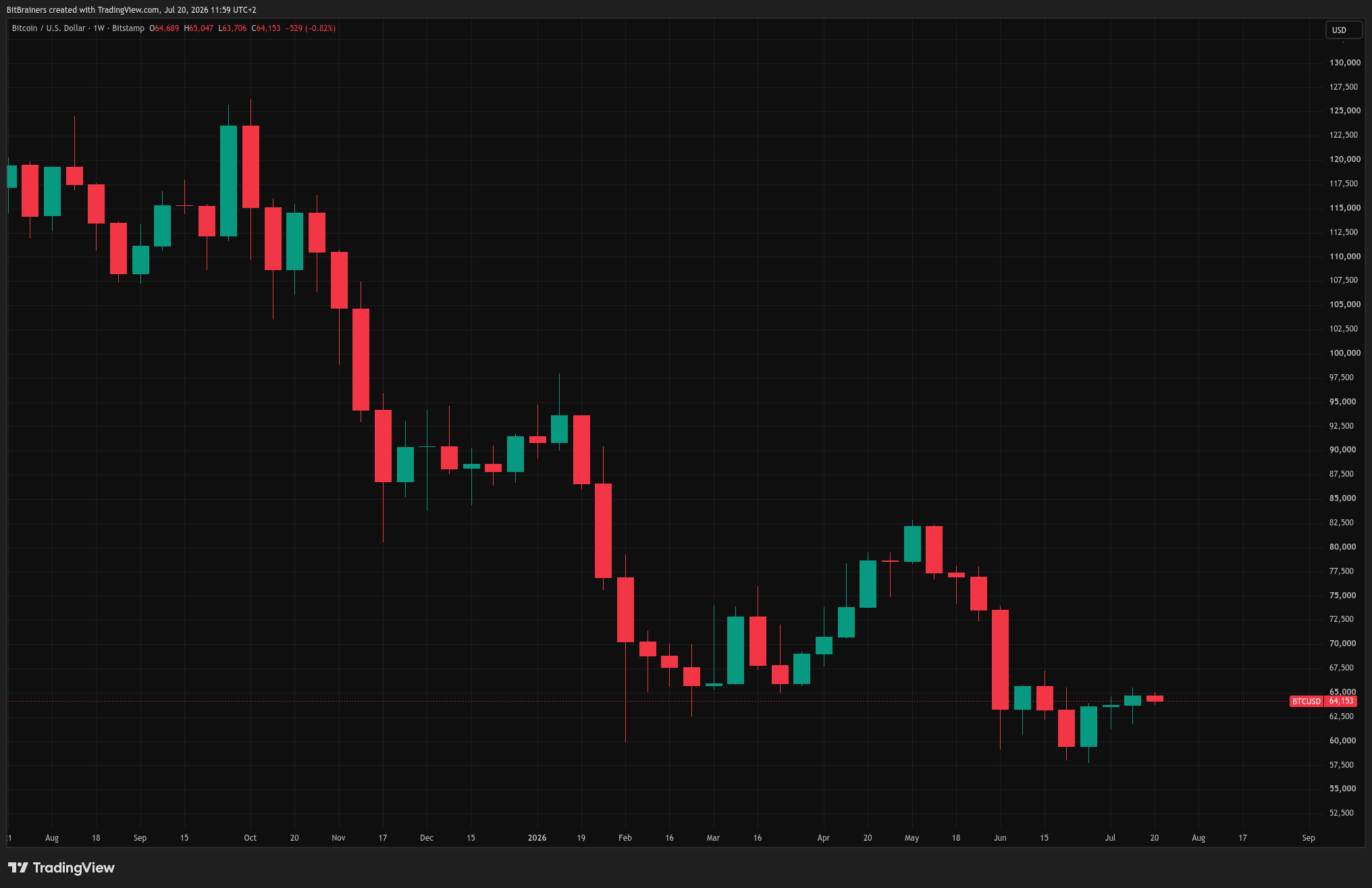
BitBrainers - Bitcoin Supply Distribution by Cohort July 2026

Source: Checkonchain

By BitBrainers Editorial

Bitcoin is trading at $64,094 on the weekly open, stuck between two EMA levels that have defined the entire 2026 range. The 21-week EMA sits at $70,928 above. The 55-week EMA is at $80,162 further out. Price has not reclaimed either since December 2025. This is what the chart says going into FOMC week.

The weekly structure is bearish. Every bounce since November's all-time high near $126,000 has failed to reclaim the declining 21-week EMA. The current candle opened below it, tested it once on the CPI print last week, and is already pulling back. The 55-week EMA at $80,162 is the level Merlijn The Trader calls the "reclaim" line, the level that started the +1,644% run in 2020 and the +710% run in 2022. It is currently $16,000 above spot price.

The daily picture is tighter. The 21-day EMA is at $63,583, sitting just below current price as support. The 55-day EMA is at $65,313, capping price from above. Bitcoin is sandwiched between both. No fresh signal from the EMA cross on the daily since the short triggered on June 3 near $71,800 and exited June 6. Since then, nothing. The bot is flat and waiting.

The On-Chain Picture

Long-term holder Binary CDD has dropped to 0. That means LTHs are not spending. They accumulated through the entire drawdown from $126,000 to $57,800 and have not distributed into the bounce. The SOPR ratio for LTHs and short-term holders combined sits at 0.89, edging slowly upward. The two previous times SOPR hit this level, April 2020 and September 2023, both resolved with significant rallies.

The $59,000 level is where slightly more than half of all traders hold their cost basis according to Checkonchain. The July 1 low of $57,800 tested just below it and bounced. That level held. It is now the floor that defines whether the structure is constructive or still distributing.

None of this confirms a bottom. The on-chain picture says the floor is under construction, not finished.

BitBrainers - BTC/USD Weekly Chart July 20 2026

Weekly levels. Real data. No hopium.

Get the breakdown every Monday before the market opens.

Subscribe

The ETF Picture

Spot Bitcoin ETFs recorded two consecutive weeks of net inflows after an eight-week, $8 billion outflow streak. Last week brought $75.7 million, the week before $197.4 million. The bleeding has stopped. Year-to-date net outflows still sit at $5.4 billion and the two-week recovery represents roughly 3% of what left in 2026.

The key caveat: last Monday saw $424.7 million drain out in a single session following renewed US-Iran military conflict. The net positive week only held because the rest of the week offset that single day. IBIT, BlackRock's fund, is still seeing inconsistent flows. A multi-week positive trend from IBIT specifically is the signal that institutional re-entry is structural rather than tactical.

ETF flows now explain roughly 45% of weekly Bitcoin price moves. The inflows are a tailwind. They are not yet a catalyst.

The Macro Overlay

The Fed enters its pre-FOMC blackout period today. No speeches, no interviews, no guidance until Chair Warsh speaks on July 29. The meeting itself is July 28-29. Markets price roughly 70% odds of a hold.

Brent crude is at $91, its highest level since June, driven by US-Iran strikes in the Strait of Hormuz and US crude inventories at a 42-year low of 726 million barrels, equivalent to 42 days of refinery demand. The June CPI relief that pushed Bitcoin to $65,471 last week was built on cheaper gasoline during a brief ceasefire window. That window closed. The July CPI will look different.

The CLARITY Act is also running down its last realistic window before the Senate leaves for recess. Regulatory clarity has been a positive sentiment driver. Its absence would remove one of the tailwinds the bounce has been leaning on. We covered the CLARITY hearing earlier this month here.

Levels to Watch

Resistance: $65,313 (55-day EMA), $65,631 (50-month EMA), $68,000 (200-week EMA). The 200-week EMA is the level that started every previous bull run. Price has not tested it since the decline began.

Support: $63,583 (21-day EMA), $59,000 (majority cost basis), $57,800 (July 1 low and structural floor).

The range is tight. A weekly close above $65,631 opens the path toward $68,000 and the Merlijn reclaim thesis. A weekly close below $63,583 puts $59,000 back in focus before FOMC.


What to Watch This Week

FOMC blackout runs through July 29. No macro guidance until then. Watch Brent crude for inflation expectations and ETF daily flows for institutional direction. The CLARITY Act Senate timeline resolves this week. Any fresh Hormuz escalation hits both oil and Bitcoin sentiment simultaneously. The setup is tight and the catalysts are live.

Sources
Bloomberg Bitcoin ETFs Attract Inflows for Second Week After Two-Month Outflows
CoinDesk BTC ETFs attract $273 million in two weeks. That's peanuts compared to recent exodus
KuCoin Bitcoin's $59K Level Could Be Key to Next Move as Long-Term Holders Stay
Crypto Times Crypto Week Ahead: CLARITY Act Deadline, Big Tech Earnings, the Pre-FOMC Calm

This is market commentary, not financial advice. BitBrainers holds Bitcoin and other digital assets. Nothing here is a recommendation to buy or sell any asset. Do your own research.

BitBrainers Editorial

Weekly Brief: The Week FOMC Decides Everything

By BitBrainers Editorial Bitcoin hit $66,400 on Tuesday, its highest since June 17, on seven straight days of ETF inflows. By Friday it ...