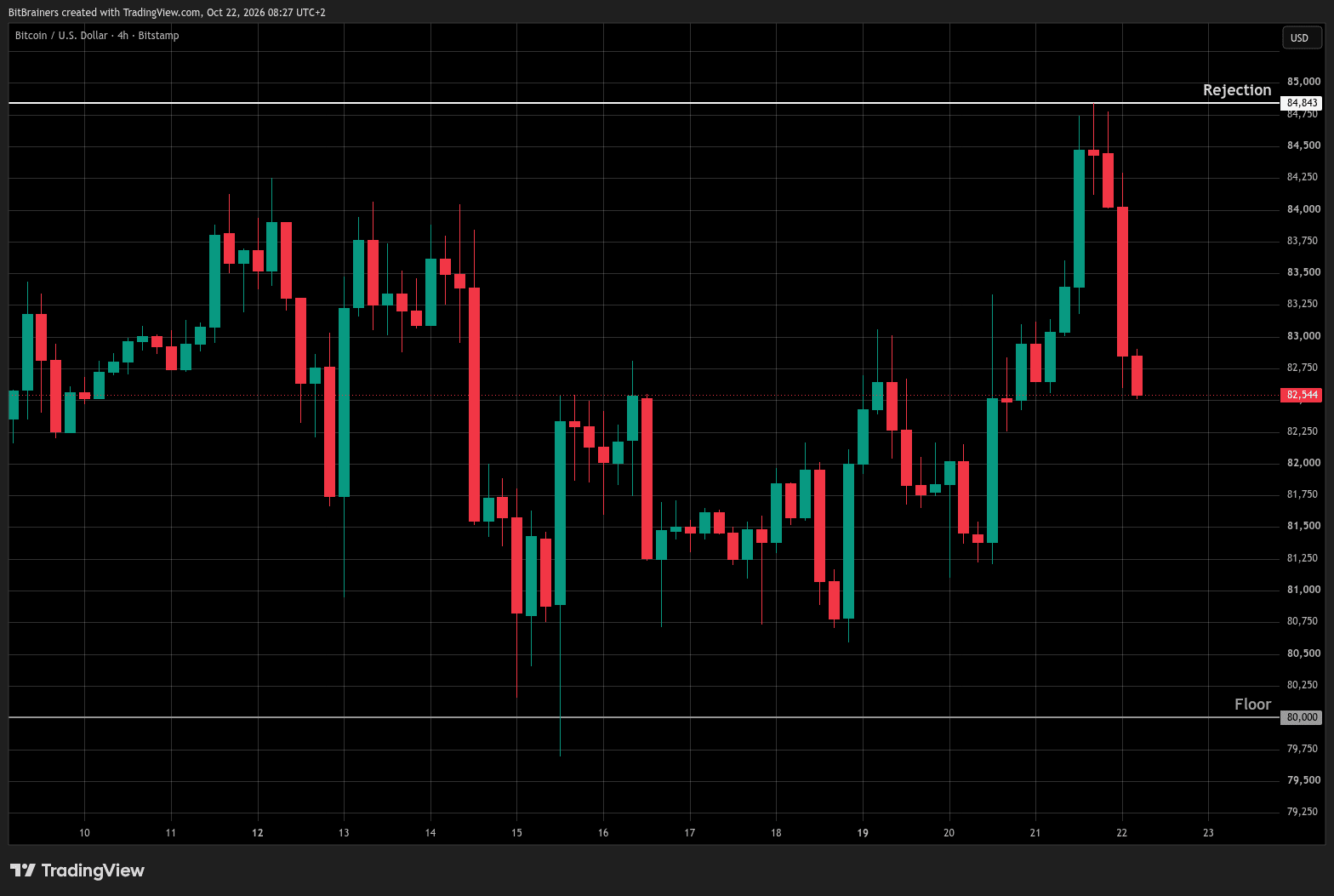
Bitcoin peaked at $126,080 on October 6, 2025. It is now down roughly 40% from that high, trading around $75,650. Most people are asking when it recovers. Benjamin Cowen is asking a different question: whether we have even seen the bottom yet.
Cowen, founder of Into The Cryptoverse and former NASA researcher, has been consistent since February. The base case is October 2026.
The Cycle Math
His reasoning is not sentiment-based. It is mathematical. The previous two cycles topped on day 1,059 and day 1,168 from their prior lows. This cycle topped on day 1,162. Almost identical timing. If the tops arrived on schedule, Cowen argues the bottoms will too, roughly a year after the peak, putting the floor at October 2026 and matching December 2018 and November 2022.
CryptoQuant's models independently support this window, flagging September through November as the highest probability zone. The post-halving math points to a bottom 912 to 922 days after the halving, which also lands in late September or early October 2026.
Fidelity has documented the same four-year pattern. Bear market bottoms formed in January 2015, December 2018, and November 2022, spaced approximately four years apart. If the cycle continues, the next low lands squarely in the second half of 2026.
What Happened in 2018 and 2022
To understand why Cowen's framework matters, it helps to look at what those previous cycles actually looked like from inside them.
In 2018, Bitcoin dropped 80% from its $20,000 peak to $3,200 in December. Along the way it produced sharp countertrend rallies that convinced traders the worst was over. It bottomed in February, rallied for months, then broke those lows in June before the final flush. Bear markets rarely move in straight lines. They grind participants down slowly, offering just enough hope to keep them positioned wrong.
The 2022 cycle was equally brutal. Bitcoin fell 78% from $69,000 to $15,476 in November 2022. Countertrend rallies of 20 to 30% appeared before the next leg down. Historically, bear markets take 19 to 25 weeks between major breakdowns. The current cycle has only been running about 14 weeks from its recent high, which means the timeline still fits prior bear market structures perfectly.
A simple but historically accurate indicator worth watching is the 50-week moving average crossing below the 100-week average. It called every bottom since 2015. In 2015, 2019, and 2022, the crossover marked the floor within the same range. As of now, that crossover has not triggered. The signal is still telling us something.
This Cycle Is Different in One Key Way
What makes this cycle unusual is not the timing. It is the mood at the top.
In 2017 and 2021, Bitcoin peaked amid retail frenzy. Social interest in crypto exploded. That euphoria triggered the usual altcoin rotation, with capital flooding from Bitcoin into smaller tokens after BTC topped.
This time, Bitcoin peaked on apathy. Social interest in crypto has been declining since 2021. The top came in quietly. As a result, the altcoin rotation never happened. Alts never ran. The cycle compressed into Bitcoin, and now it is unwinding the same way, without the noise, without the drama, and without the clear signal that a bottom is near.
Cowen's observation on this point is worth keeping: Bitcoin topped within one week of when it historically tops, despite all the narratives declaring the four-year cycle dead. ETFs, sovereign reserves, corporate treasuries. Every cycle had its version of this time is different. None of them broke the timing pattern.
The Recent Rally Is Not What It Looks Like
Bitcoin bounced from its lows to $82,800 recently. Bulls called it a recovery. Cowen called it a dead cat bounce, and his reasoning is technical. The bounce lasted 16 weeks and was rejected at the 200-day simple moving average. That is precisely what happened ahead of the final leg down in both 2018 and 2022. Rejection at the 200-day SMA is a classic bear market signal, not a recovery confirmation.
His floor estimate before any durable recovery: $60,000. Bitcoin's realized price, the average cost basis of all coins in circulation, sits near $54,000. That level has historically acted as support during prior bottoms. A flush toward that zone would not be unprecedented. In 2018 and 2022, the final capitulation brought price down to or through the realized price level before the real bottom was confirmed.
If October Is the Bottom, What Comes After
This is where the cycle framework becomes interesting rather than just painful.
Every Bitcoin bear market since 2015 has been followed by a significant recovery. From the 2015 bottom, Bitcoin rallied from $200 to nearly $20,000 by the end of 2017. From the 2018 bottom at $3,200, it eventually reached $69,000. From the 2022 bottom at $15,476, it ran to $126,080, a 716% gain.
The pattern is consistent: approximately one year of decline, then roughly two years of recovery and accumulation into the next bull market. A useful framework from cycle analysts describes it as one year of parabolic advance, one year of severe drawdown, and two years of recovery and reaccumulation. If October 2026 marks the low, the accumulation window opens immediately after.
Those who bought in late 2018 and late 2022 were not rewarded immediately. They were rewarded 18 to 24 months later, which is exactly how the cycle works. The entry point matters more than the entry price narrative that surrounds it.
There is also a monetary policy dimension that has aligned with each prior bottom. M2 liquidity bottomed in 2015 and 2018 just as Bitcoin hit lows. In 2022, M2 again hit a trough and aligned with the Bitcoin bear market floor. If global liquidity conditions begin expanding again into late 2026, the macro backdrop would match the historical pattern for the next accumulation phase.
What to Watch
Three indicators are worth monitoring over the coming months.
First, the 50-week and 100-week moving average crossover. It has called every bottom since 2015 and has not fired yet. When it does, the historical setup for accumulation begins.
Second, Polymarket and prediction market odds on macro events. In the current environment, US-Iran ceasefire odds and Federal Reserve policy signals are moving Bitcoin more than on-chain metrics. These markets move before the news does.
Third, ETF flow data. BlackRock's IBIT and the broader spot Bitcoin ETF complex are now the primary institutional price signal. Sustained inflow recovery after a period of outflows has historically marked the shift from distribution to accumulation in this cycle.
Cowen is not predicting permanent doom. He is predicting that the clock needs to finish running before the next phase begins. The four-year cycle topped on schedule. His argument is simply that bottoms arrive on schedule too.
The counterargument, ETFs, sovereign Bitcoin reserves, institutional adoption, is real. But every previous cycle had its own version of this time is different, and none of them broke the timing pattern.
The four-year cycle is not dead. It is just on schedule.
Sources: BeInCrypto — Bitcoin Four-Year Cycle Not Dead, Analysts Eye October 2026 as the Ultimate Bottom | BeInCrypto — Former NASA Researcher Shares Bitcoin Prediction for 2026 | Fidelity — Bitcoin Four-Year Cycles Explained | KuCoin — Cowen Predicts Bitcoin Bottom in Late 2026, Calls Recent Rally a Dead Cat Bounce