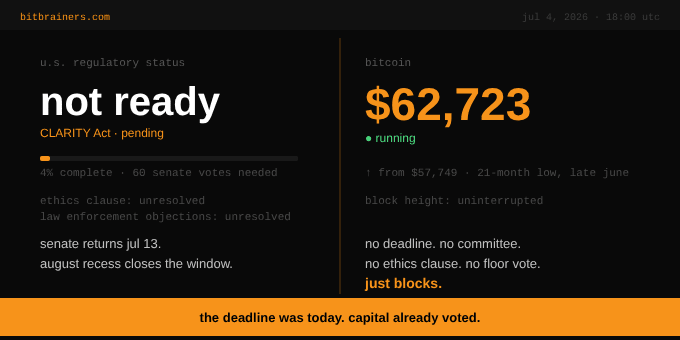
Today is July 4. There is no bill on the president's desk. There is no scheduled floor vote. The Senate is not even in session, and it does not return until July 13.
Bitcoin is trading around $62,700. That number and this missed deadline are more connected than they look.
What Actually Happened to the Deadline
The bill made real progress. The Senate Banking Committee passed it 15 to 9 on May 14, with two Democrats joining every Republican. On June 1 it was placed on the Senate Legislative Calendar, formally eligible for a floor vote.
Then the process hit the wall it was always going to hit. Bipartisan negotiations over ethics provisions broke down in June. The sticking point is a rule barring government officials from holding personal stakes in the crypto industry.
Senate Democrats treat that provision as non-negotiable. The White House has said it will accept rules that apply to everyone but will reject anything targeting one officeholder. Read between those two positions and the problem is obvious. The ethics clause is about the president's own crypto interests, and neither side can say so plainly and still cut a deal.
A second dispute over law enforcement objections to the bill's blockchain developer protections opened a parallel front. Two unresolved fights, one shrinking calendar.
What the CLARITY Act would actually deliver is straightforward. The CFTC gets clear jurisdiction over digital commodity spot markets, the SEC stays focused on securities and investment contracts, and for the first time there is a written framework for DeFi platforms and developer liability. That is the framework that removes the enforcement ambiguity keeping traditional finance cautious about sizing up crypto exposure.
The Math That Decides It
The bill needs 60 votes on the Senate floor. Republicans hold 53. That means at least seven Democrats have to cross over, and the two who voted yes in committee both said their floor votes are not guaranteed.
The calendar is the other constraint. The Senate returns July 13 and breaks for August recess a few weeks later. Policy analysts at Stifel put it bluntly: if the bill does not clear the Senate before that recess, its prospects deteriorate materially.
After August, every senator's attention shifts to the November midterms. The bill also still has to be reconciled with a separate Senate Agriculture Committee version and then merged with the House text that passed back in July 2025. None of that is fast.
Deadlines slip. Our Monday Brief doesn't.
One macro read every Monday, the levels that matter, zero hopium.
Subscribe FreeWhat the Vacuum Costs, in Numbers
This is where the missed deadline stops being a Washington story and becomes a price story.
Citi cut its 12-month Bitcoin target to $82,000 from $112,000, citing slow progress on US crypto legislation alongside ETF outflows and weak investor interest. That is a $30,000 haircut on a major bank's target, with regulatory delay written explicitly into the rationale.
The ETF picture makes the same point from the flow side. US spot Bitcoin ETFs posted roughly $4.5 billion in net outflows in June, their worst month on record. Institutions that were supposed to be the patient money spent six consecutive weeks heading for the exit.
Part of that is macro. The Fed held rates in June and dropped its easing language, and that repricing hit everything risky. We covered the flow mechanics in our breakdown of this week's bounce on weak jobs data and the first real ETF inflow.
But part of it is exactly what the CLARITY Act was supposed to fix. Institutional allocators do not size up positions in an asset class whose basic regulatory boundaries are still being negotiated. Every month the bill slips, that capital stays parked.
Where That Leaves the Chart
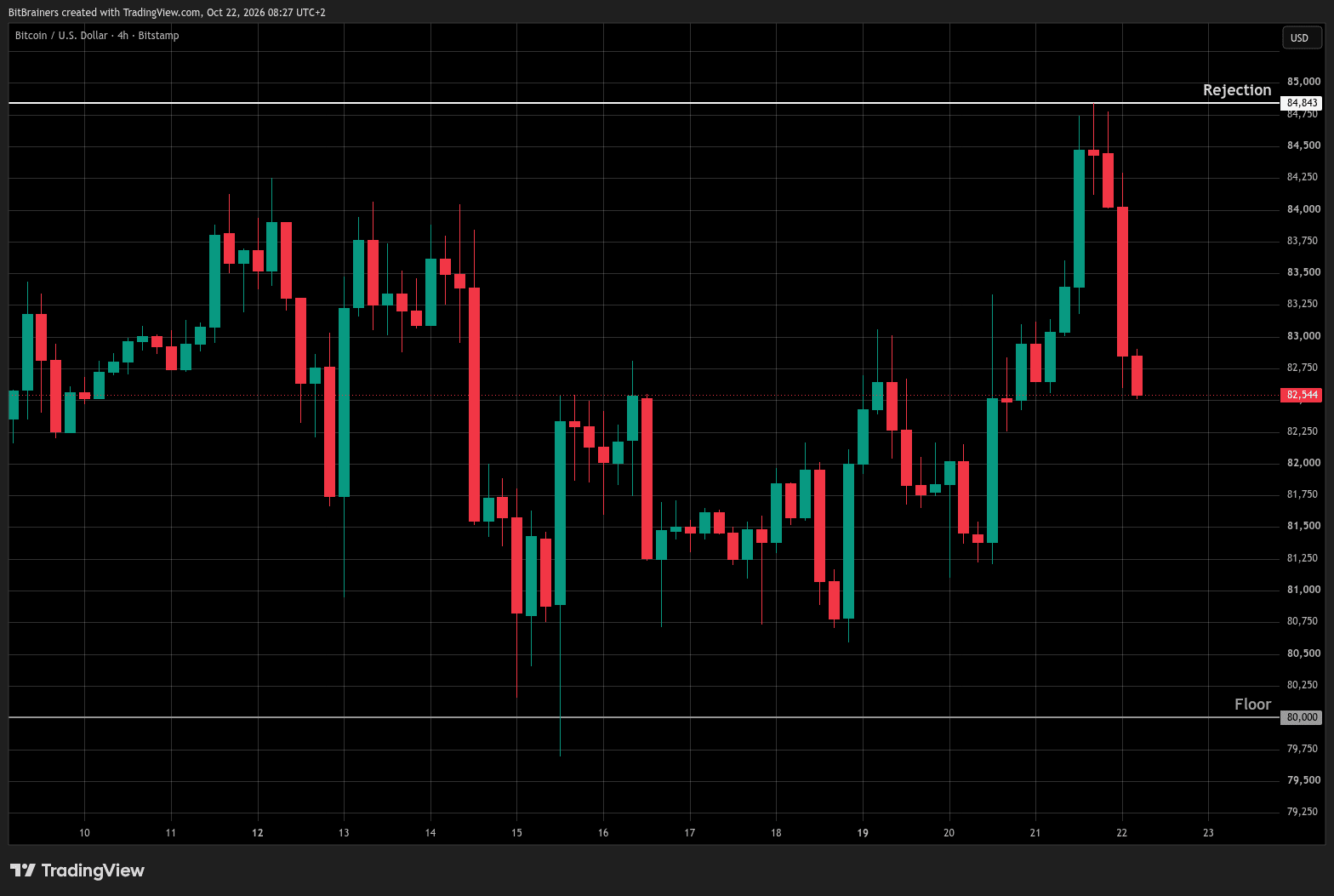
Bitcoin printed a 21-month low near $57,750 in late June and has since clawed back to the $62,000 to $63,000 area. The bounce is real but thin. It arrived on soft jobs data and one day of ETF inflows, not on any structural change.
The structural change was supposed to be today. It did not come.
That leaves two dates carrying the weight for July. The Senate's return on July 13, which starts the three-week window where the CLARITY Act either moves or effectively dies for the year. And the Fed meeting on July 28 and 29, where the market finds out whether the June hawkish turn was a one-off or the new baseline.
The Honest Read
The CLARITY Act is not dead. Senator Hagerty's base case still has a floor vote landing after July 13. A passage before the August recess would be a real catalyst, one the market is currently pricing at close to zero.
But we watch what capital does, not what politicians promise. A deadline the White House set publicly, with five months of runway, just passed with the Senate out of town. Citi did not wait to find out how the ethics fight resolves before cutting its target. The ETF money did not wait either.
If the bill slips past August, expect the analyst downgrades to continue and expect regulatory clarity to become a 2027 story. At $62,700 with no framework, that risk premium stays embedded in the price.
The next two to three weeks after July 13 will matter more than July 4 ever did. Capital is already voting with its feet.
Sources
CoinDesk: White House targets July 4 for Clarity Act passage, says crypto adviser Patrick Witt
CNBC: Crypto industry scores win as Clarity Act regulation bill clears Senate hurdle
The Crypto Times: Bitcoin Price Prediction July 2026: Will BTC Go Up or Crash?
CCN / Yahoo Finance: Senate's Last-Ditch CLARITY Act Talks Could Decide Crypto's Fate for the Rest of the Decade
24/7 Wall St.: Bitcoin Price Prediction for July 2026
Disclosure: This article is for informational purposes only and is not financial advice. We may earn commissions from affiliate links. Always do your own research before making investment decisions.