
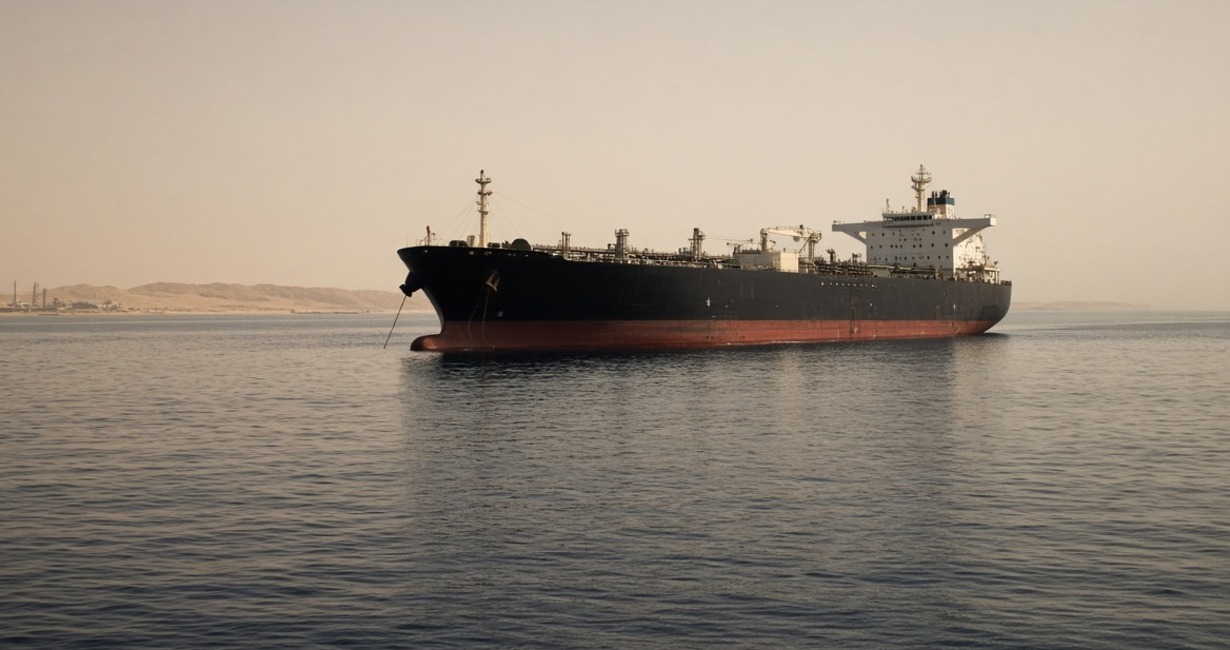
Illustration: a crude tanker on Gulf water. The strait Iran mined in February carries a fifth of the world's oil.
By BitBrainers Editorial
Iran mined the strait after the February 28 strikes. US forces cleared the lanes in late August, struck Larak Island days later, and spent September targeting Iranian oil tankers. After a quiet August, September restarted the shooting. On Saturday the Houthis launched missiles and drones at Riyadh, their first strike on the Saudi capital, claiming fires at Aramco facilities in Yanbu that remain unconfirmed. The Washington Post puts US troop deaths at 22 or 23, above the Pentagon's public number.
Iran's price for talks came the same day: frozen funds released, the war ended on all fronts including Lebanon, the naval blockade lifted, the drone strikes stopped. That is where the war sits. Iran cannot reopen Hormuz and cannot be made to stop firing. The United States controls the water and cannot end the launches. Both sides are pricing a longer war than anyone planned.
The Rate the War Feeds
Bitcoin ran to $87,363 on Monday and stopped. The 10-year cleared 5% and held. Through this campaign Bitcoin has traded as a risk asset against the rate move, not against the crude print.
The Hedge That Failed
Gold got the same test and failed it too. It spiked above $5,300 in the first days of the war, then fell roughly 13% in the first month, to around $4,400 by March 23. One of the sharpest drops on record. The safe-haven bid never stood a chance against the second-order effects: oil-driven inflation, a repriced Fed, and a stronger dollar. Gold had already run to records before the first strike, above $5,500 in January, so the war spike got sold into a crowded trade. The Dallas Fed puts the war's inflation add at 0.6 points on headline PCE and 0.2 on core. That is the number that mattered. Bitcoin traded as a risk asset against the rate move. Gold sold off for the same reason. The war is an inflation story, and inflation is a rate story.
Where It Goes
The forward map is pure inference. A ceasefire is not a guarantee of lower rates or a reopened Bitcoin chart. In June the lanes briefly reopened and Brent still traded back through $72, yet Bitcoin sold off hard when the 10-year cleared 5%. A truce would take oil off the boil, but the Fed has already found the inflation it needed to keep hiking. The current path holds $100-plus crude, 5%-plus rates, and a risk asset repricing around a Treasury yield that competes with the trade. If the war extends through year-end, that floor under rates only firms.
Frozen Funds
There is a custody story inside the war terms. Iran is bargaining for the release of frozen funds while its oil corridor sits blockaded: a state negotiating for seized reserves. The mechanism is the lesson this blog was built on. Money on someone else's ledger can be frozen, and a blockade can close the corridor around it. Self-custody is the answer to both.
Every player in this war has priced its own future. Iran wants its $100–$120B in frozen assets back, full sanctions relief, and a say in who administers the strait. The United States wants the blockade to do the negotiating. The Gulf states want the American umbrella plus one more partner, after Vision 2030 lost its safe-harbour assumption. China wants cheap barrels, and when Beijing starts restocking, the next oil shock begins. The $300B reconstruction plan comes with supervised banks, approved oil channels, and Big Four audits. Everyone's future routes through someone else's ledger. That is the lesson at country scale.
Three prices will tell you where this war goes before any communiqué does. Brent trades near $106, the 10-year is at 5.12%, and $87,363 got rejected on the Bitcoin chart. Bitstamp is $84,509, and the cap holds.
Sources
Reuters | U.S.-Iran phased Hormuz talksThe Washington Post via Reuters | U.S. troop death count
S&P Global | September flash PMI, input costs
Morningstar | Gold's post-war drop
Investing.com | Gold, real yields, and the January record
Congressional Research Service | MOU terms, Hormuz commodity impacts
Gibson Dunn | $300B reconstruction framework
World Bank | Global growth, reconstruction financing
Kpler via Reuters | Hormuz flows, China restocking outlook
TradingView / Bitstamp | Brent, 10Y, BTC/USD prints
This is market commentary, not financial advice. Nothing here is a recommendation to buy or sell any asset. Do your own research.

