

By BitBrainers Editorial
Employers added 29,000 jobs in September, and the estimates on desks that morning ran between 84,000 and 90,000. The miss against the consensus was wide. The Bureau of Labor Statistics took it with more caution, describing payroll employment as little changed, which is what the agency says when the move sits inside the noise.
The 10-year fell toward 5.16% when the number hit, and the session took it back. The close near 5.28% belongs to the catalysts already in the price: inflation, oil, and debt supply. A 29,000 print inside its own error band was a momentary bid. It was never a reason for the yield to stay down.
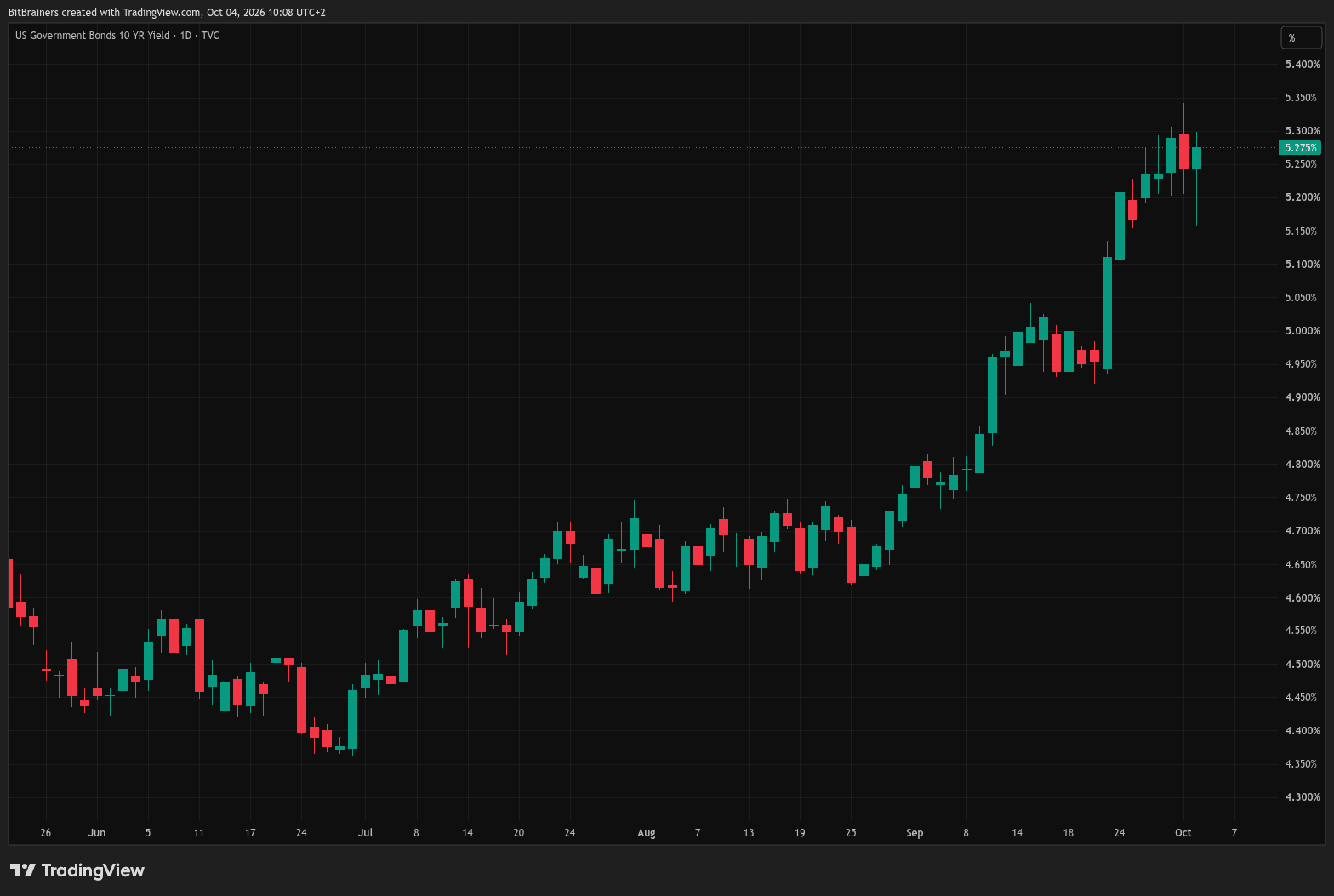
US 10-year Treasury yield, daily, July to October 2, 2026. The October 2 candle shows the dip toward 5.16% and the close near 5.28%. Source: TradingView (TVC).
Thursday's high was about 5.34%, the highest since 2002. CNBC had the 2-year up 5 basis points at 4.839% and the 30-year up 2 basis points at 5.629% late in the session.
That fits the conclusion of the October 1 yen test, which found that the carry-trade story covers only part of the selloff.
Revisions Took 60,000 Off the Last Two Months
The 29,000 headline is being set against August's original 162,000, as if one month collapsed into the other. BLS would not make that comparison. Its own 90% band on a monthly change is about ±122,000, wide enough that the two prints overlap, so the miss against the estimates is real while the collapse between the two months never survives the band.
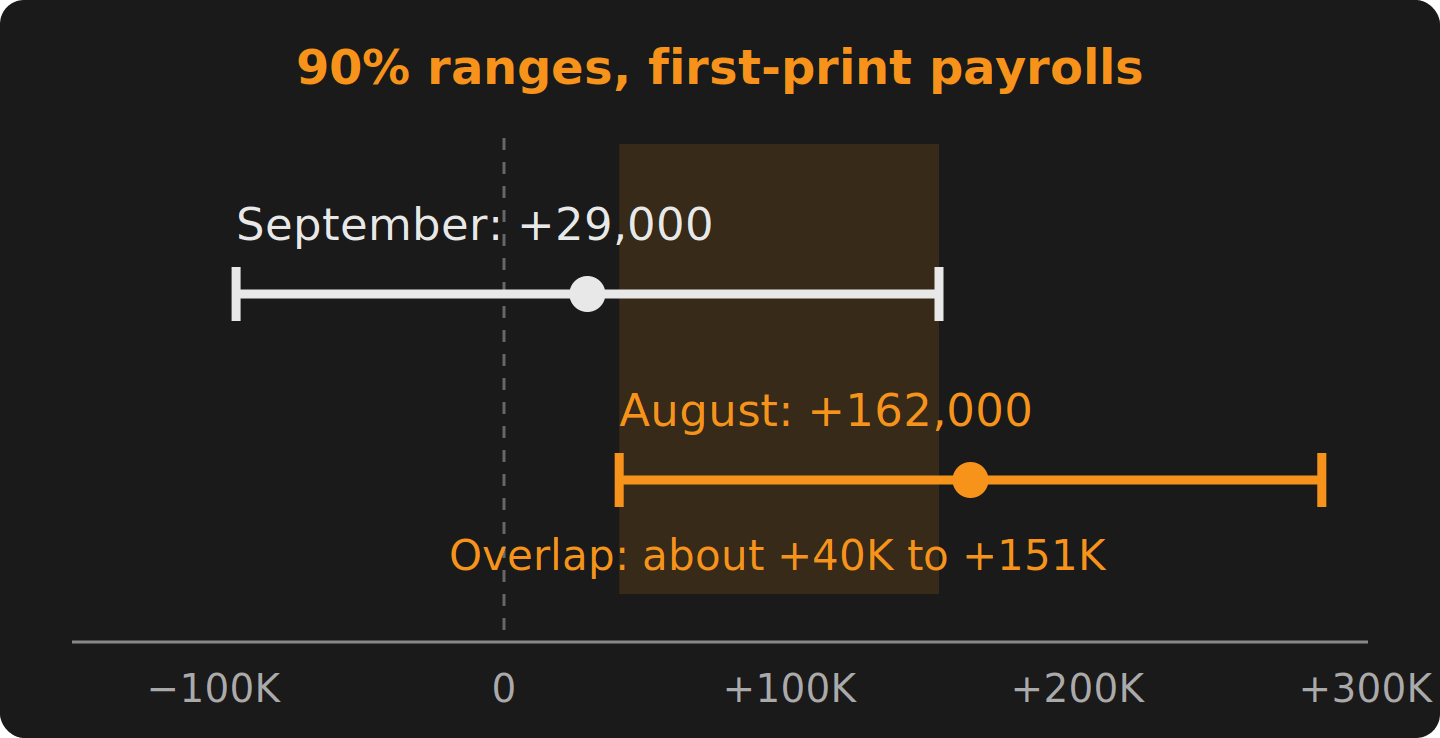
90% ranges around the first-print payroll changes for September (+29,000) and August (+162,000), using the approximate ±122,000 interval from the BLS technical note. The ranges overlap from about +40,000 to +151,000. Chart: BitBrainers.
July is the better warning. It has already been a loss of 23,000, a gain of 21,000, and now a loss of 10,000 again. It finished above where it started. This month's revisions took 60,000 off the previous estimates, and August came down with it, from 162,000 to 133,000.
August's bounce was mostly restaurants and schools. Food services added 59,200 and local education 41,900 on the first print, about 62% of the gain, and the two were still about 62% after the revision. Food services had been averaging 12,000 a month. Local education had dropped 57,500 in July, and BLS described the August gain as largely offsetting that drop. September gave it back: food services added 10,800, and local education slipped 1,800.
A Survey With Half the Reports In
September's first collection rate was 53.1%, the lowest of 2026 and the fourth lowest since 2016. Labor Day fell on September 7, inside the week that contains the 12th. The BLS technical note says an estimate is considered final only after two successive revisions, so the next look at September arrives with the October report.
ADP, which counts a different set of paychecks, reported 90,000 private jobs for September. BLS private payrolls rose 46,000, which is the 29,000 total plus a 17,000 drop in government. Same month, two serious surveys, and a gap of 44,000.
The trend underneath is slower and steadier. BLS puts the average monthly gain over the prior 12 months at 45,000, and the three-month average after this month's revisions works out to about 51,000. Average hourly earnings rose 3.0% over the past 12 months.
Monday's Weekly Briefing picks up where this leaves off
Key levels, positioning and the macro calendar for the week, delivered as a PDF. $9 a month.
Subscribe on GumroadWhere the Hiring Actually Is
Manufacturing is up 72,000 jobs since a low in December 2025, according to BLS, and construction has added an average of 10,000 a month over the prior 12 months.
The rest of the September report does not describe a tight market. Unemployment is 4.2%, inside the 4.1% to 4.3% range it has held since March, and hourly earnings rose 0.1% for the month and 3.0% over 12 months. Health care added 17,000 against a 33,000 monthly average, and BLS said employment in all major industries changed little.
Bitcoin at the Same Shelf
Bitcoin spiked to $87,219 in the hour of the release, a bet that the jobs miss would keep the 10-year down, and was back at $83,841 six hours later, once the close near 5.28% had said otherwise. The three daily highs at that zone now read $87,354 on September 21, $87,272 on September 23 and $87,219 on October 2, each one a little shorter than the last.
What Comes Next
The calendar is crowded before the next jobs number arrives. FOMC minutes land October 7, CPI on October 14, and the Treasury's TIC data on October 16, covering August and the first print that can show what Japan's holdings did through the intervention window. The Fed meets October 27 and 28, and the Bank of Japan October 29 and 30.
The October jobs report is scheduled for November 6 and carries the second estimate of September, built on more of the reports that were missing on October 2. Until then, the 12-month average of 45,000 is the number to hold any new print against.
Sources
Bureau of Labor Statistics | The Employment Situation, September 2026
Bureau of Labor Statistics | Employment Situation Technical Note
Bureau of Labor Statistics | Table B-1, employees on nonfarm payrolls by industry
Bureau of Labor Statistics | The Economics Daily, payroll employment rose 162,000 in August 2026
CNBC | U.S. Treasury yields rise despite September jobs report
CNBC | Jobs report, September 2026
Reuters via Virginia Business | US nonfarm payrolls surge 162,000 in August with steady 4.1% unemployment
FXStreet | The 29K jobs number isn't the real story
Cointelegraph | Bitcoin briefly hits $87K as weak US jobs data sends bond yields lower (cited for the Bitcoin price only)
ADP | National Employment Report, September 2026
This post is for information only and is not financial advice. Figures come from the sources listed above. Do your own research before making any decision.

