
The U.S. Treasury Department building on Pennsylvania Avenue in Washington, D.C.
By BitBrainers Editorial
The administration is split on the question. In a Time interview published October 1, Trump said growth would pay off the debt and that certain levels of inflation would also do it "very rapidly." Kevin Hassett, asked on Bloomberg's Open Interest whether the White House plans to inflate its way out of debt, answered "No, absolutely not," per 24/7 Wall St. The breakeven has not priced the inflation half of Trump's line.
| 10-year Treasury | Sep 14 | Oct 2 | Change |
|---|---|---|---|
| Nominal yield | 4.97% | 5.28% | +31 bp |
| Real yield (TIPS) | 2.60% | 2.92% | +32 bp |
| Breakeven inflation | 2.37% | 2.36% | -1 bp |
10-year Treasury par yields, nominal and real, with breakeven as the difference. Source: U.S. Treasury par yield curves via TIPS Yield (full history in its CSV download); FRED T10YIE.
The split
The real yield is what investors earn after inflation, and the breakeven is the regular yield minus the real yield, the compensation for expected inflation. The breakeven also carries a risk premium and a small liquidity discount, so a flat reading says only that the compensation did not rise.
Inflation is running hot today. Q2 current-dollar GDP grew 8.5% annualized against 2.2% real, so most of the nominal strength is price. The breakeven covers the next ten years.
The ten-year compensation did not move.
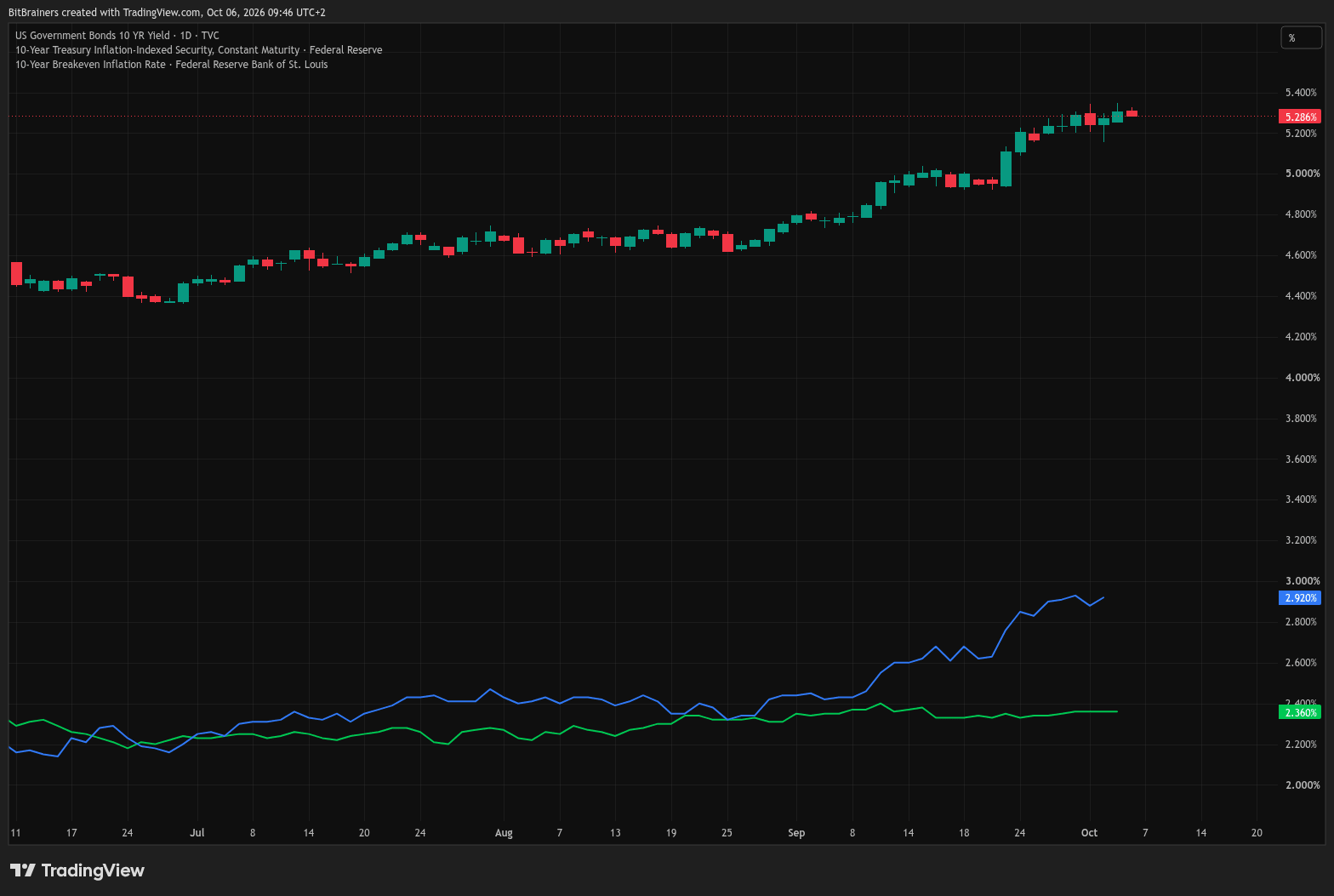
10-year nominal yield (candles), real yield (blue) and breakeven (green), mid-June to early October 2026. Sources: TradingView (nominal yield), FRED (real yield and breakeven).
Rates and supply
The real yield rises when the expected path of short-term rates rises, or when investors want more for holding long bonds, which is the term premium. The Fed raised rates on September 16 by a unanimous vote, the first increase since 2023, and markets have been repricing where rates go next.
I could match the two only for September 22 to 25. The 10-year yield rose 21 basis points in those sessions, from 4.96% to 5.17%, while the Federal Reserve Board's Kim-Wright 10-year term premium (FRED series THREEFYTP10) rose 9, from 0.93% to 1.02%, so the expected path of rates did more of the work. The New York Fed's ACM model gives a different level. I don't have a reading that places the increase between August and October.
Supply is the visible pressure. Treasury sized one buyback operation at up to $6 billion, three times the old maximum, and bought $5.19 billion. The 10-year yield rose that day, and September auctions drew adequate demand at higher yields.
The Bank of Japan raised its policy rate on September 18 to its highest level since 1995, and Britain's 30-year gilt yield briefly touched about 6% on October 1, the highest since 1998.
BMO put the one-month correlation between oil and the 10-year yield at 0.96 in mid-September. If oil works through expected rate hikes, real yields should rise and the breakeven should stay flat, which is what the table shows. The cross-country table is in the September 11 post, Bessent Tripled the Buyback. The 30-Year Still Went to 5.36%.
Stocks rose for months after the 10-year crossed 5% in 2007, and rallied after the October 2023 touch. The 2007 run ended in the credit collapse, and the 1994 hiking cycle cost stocks about 10% along the way. Yields near 5% have not ended a bull market on their own, and that does not make today's setup safe.
FactSet puts the S&P 500 at 19.0 times forward earnings, down from 22.1 in January, while analysts raised earnings estimates. The resulting earnings yield of about 5.26% sits about 2 basis points below the 10-year at 5.28%. Corporate borrowing for the AI build-out is bidding for the same buyers as the 10-year.
What would change this
A breakeven that moves above its recent range would say the market has started to price tolerated inflation.
The 10-year reopening on October 7 is the next supply test.
The high-yield spread went from 2.68% on September 18 to 3.10% on October 2, and a spread that stays above 3% would say credit is pricing the higher rates.
The Fed meets October 27 and 28, the UK Budget is October 28, and the Bank of Japan decides on October 30. Q3 earnings reports start in mid-October, and Q4 guidance is where a delayed reaction would show up.
As of October 5, the 10-year breakeven was 2.36%, with the 10-year yield at 5.31%.
SOURCES
TIME, 24/7 Wall St., FRED breakevens, TIPS Yield, FRED term premium, FRED credit spreads, The Vault Report, U.S. Treasury, Yahoo Finance on the buyback, CNBC on AI issuance, FactSet in January, FactSet, BEA, CNBC, Irish Times, 24/7 Wall St. on 2007, HB Wealth, Motley Fool.
This is market commentary, not financial advice. Nothing here is a recommendation to buy or sell any asset. Do your own research.


