₿ BTC Loading... via Binance

Tuesday, May 19, 2026

Autonomous Corporations: When a Smart Contract Runs a Business With No CEO

BitBrainers - Autonomous Corporations: When a Smart Contract Runs a Business With No CEO analysis and insights

A protocol called Uniswap processed billions in trading volume last year with zero employees making trade decisions. No CFO approved the liquidity pools. No board voted on fee structures. A set of smart contracts did it all, governed loosely by token holders who voted asynchronously from their wallets. That is not a startup experiment. That is a functioning economic entity that outcompeted licensed brokerages on trade execution speed.

Most people in crypto still frame DAOs as governance experiments or niche DeFi toys. They are wrong. The real story is structural. The autonomous corporation is not coming. It is already operating, and the next five years will determine whether legacy business structures adapt or get hollowed out from underneath.

The Traditional Corporation Has a Design Flaw That DAOs Were Built to Exploit

Every corporation runs on trust delegation. Shareholders trust a board, the board trusts executives, executives trust managers. Each layer adds friction, cost, and the possibility of misalignment. This structure made sense when coordination required physical proximity and legal enforcement. It makes far less sense when code can enforce rules without asking permission from anyone.

Bitcoin proved the concept first. The Bitcoin network has no HR department, no legal team, and no CEO. It has processed trillions in value since its launch using a consensus mechanism and open-source code. That is the original autonomous corporation, and it has never missed payroll because it has never had payroll.

The DAO model takes Bitcoin's coordination logic and applies it to commercial activity. Treasury management, revenue distribution, hiring decisions, and product direction all happen through on-chain votes or automated contract execution. The question is no longer whether this works. The question is how fast it scales.

MakerDAO Proves This Is Not Theoretical

MakerDAO governs DAI, a decentralized stablecoin that has maintained its peg through market crashes, regulatory pressure, and extreme volatility. MKR token holders vote on collateral types, stability fees, and risk parameters. There is no risk committee sitting in a Manhattan office. There is code and economic incentive.

In recent governance activity, MakerDAO's community has been actively restructuring itself into what it calls SubDAOs, smaller autonomous units that handle specific functions like lending and real-world asset integration. This is organizational theory happening in real time on a blockchain. They are not copying corporate structure. They are building something new with no historical template.

MakerDAO also holds US Treasury bonds as collateral through legal entities it controls. That bridge between on-chain governance and off-chain legal reality is where the most interesting development is happening right now.

Most People Do Not Know This About How DAO Treasuries Actually Work

Here is something most crypto blogs skip entirely. The largest DAOs are not just holding ETH or BTC in their treasuries. They are incorporating in jurisdictions like Wyoming, Marshall Islands, and Cayman Islands using DAO LLC structures. These legal wrappers give them the ability to sign contracts, own property, and hire contractors while keeping governance on-chain.

Wyoming passed its DAO LLC law in 2021. The Marshall Islands recognized DAOs as legal entities. These are not theoretical frameworks sitting in a whitepaper. They are functioning legal structures that let a smart contract control a bank account. When that bank account holds Bitcoin custody and the smart contract determines withdrawal conditions, you have an autonomous treasury with legal standing. Most retail investors have never heard of this layer and that is exactly where institutional money is now paying close attention.

Bitcoin Sits at the Center of This Architecture Whether It Wants To or Not

Bitcoin's role in the autonomous corporation model is not as a governance token. It is as reserve asset and neutral settlement layer. DAOs that want credible treasuries increasingly hold BTC alongside their native tokens. BTC at $77,071 today represents a globally liquid, politically neutral store of value that no single DAO governance vote can inflate or confiscate.

The practical implication is significant. As autonomous corporations grow, they need treasury diversification that does not introduce governance conflict. You cannot hold a competitor's governance token as your primary reserve. BTC solves that. It carries no voting rights, no team treasury, and no upgrade controversy that could manipulate its price through internal decisions.

Several DeFi protocols have already moved portions of their treasuries into BTC through on-chain wrapping mechanisms. This is not a coincidence. It reflects a maturing understanding of what sound treasury management looks like when humans are removed from the signing authority.

If you are building or participating in a DAO structure and holding significant BTC, custody becomes a serious operational concern. A hardware wallet like Trezor provides cold storage that keeps treasury assets offline and out of reach from smart contract exploits or front-end hacks. Self-custody is not optional at institutional scale. It is the baseline.

The Contrarian Take Nobody Wants to Hear About DAO Governance

Here is what almost every pro-DAO analysis gets wrong. Token-based governance does not eliminate power concentration. It relocates it. In practice, the top token holders in most major DAOs control voting outcomes by a wide margin. A16z, Paradigm, and a handful of whales effectively hold veto power over Uniswap governance proposals. That is not decentralization. That is shareholder capitalism with better UX.

The next wave of autonomous corporations will need to solve this more honestly. Conviction voting, quadratic voting, and time-locked delegation are being tested right now by protocols like Gitcoin and Optimism. These mechanisms try to give smaller participants proportional influence. Whether they succeed at scale is still an open question, but the experimentation is serious and technically grounded, not just theoretical.

The insight here is that the legal and governance shell of an autonomous corporation matters as much as the code. Bad governance design produces a DAO that behaves like a poorly run company. Good governance design produces something that genuinely outperforms centralized structures on speed, transparency, and alignment.

What Is Happening Right Now in This Space in the Past Week

Ethereum's development community has been pushing forward with discussions around account abstraction and smart contract wallets, specifically how they interface with on-chain governance systems. This directly affects how autonomous corporations execute decisions. When a governance vote passes, the execution needs to be trustless and fast. The infrastructure for that is being actively refined at the protocol level, not just the application layer.

This matters because autonomous corporations are only as reliable as the base layer they run on. Bitcoin provides the reserve layer. Ethereum and its L2 networks currently provide the execution layer for most DAO logic. That architecture is being hardened in real time.

For traders who want exposure to the infrastructure enabling this shift, Kraken offers access to both BTC and the ETH and governance tokens that sit within this ecosystem. Understanding which protocols are building real governance infrastructure versus speculative hype is the analytical edge most retail participants lack.

The Timeline Is Closer Than Traditional Business Analysis Admits

By 2028, expect the first autonomous corporation to pass $1 billion in annual revenue with no traditional executive team. The pieces are already assembled. Legal wrappers exist. Treasury management tools exist. On-chain payroll through protocols like Superfluid is already running. The bottleneck is not technology. It is regulatory clarity and talent willing to operate inside these structures full-time.

Regulatory pressure in the US has slowed DAO formation domestically, but it has simultaneously accelerated it in Dubai, Singapore, Switzerland, and the Marshall Islands. Capital and talent move to where the rules allow experimentation. The US is watching this happen while debating terminology.

The businesses that will be disrupted first are the ones with the highest coordination overhead and lowest product differentiation. That includes financial intermediaries, certain legal services, and content licensing platforms. Every business whose core function is gatekeeping access to a market is vulnerable to a smart contract that removes the gate entirely.

The Assumption You Walked In With Is Probably Wrong

Most readers assume the autonomous corporation is a crypto-native phenomenon that will remain marginal. The actual trajectory suggests otherwise. The same logic that made Bitcoin a viable monetary network without a central bank applies to any coordination problem where trust is the primary cost. That includes supply chains, insurance pools, creative royalty distribution, and venture capital allocation. Uniswap did not start as a threat to Nasdaq. It started as a weekend project. That pattern repeats.

The companies not taking DAO governance seriously right now are in the same position as banks that dismissed internet banking as a hobbyist experiment. The structure is already working at scale. The question is only which industries it reaches next and how fast.

What You Should Do Starting This Week

Start reading DAO governance forums, not just price charts. Uniswap, MakerDAO, and Arbitrum DAO publish all governance proposals publicly. Understanding how these decisions get made gives you a structural edge that most market participants do not have.

Hold BTC as your benchmark position and treat it as the reserve layer it actually functions as within this ecosystem. Keep that position in proper cold storage using Trezor so you control the keys regardless of what happens at the application layer above it. If you want to trade or accumulate through a regulated platform with deep liquidity, Kraken is the exchange worth using.

Learn what a DAO LLC actually is and how Wyoming and Marshall Islands structures work. This is not obscure. It is the legal foundation of the next generation of corporations. Understanding it now puts you five years ahead of the analysts who will be writing explainers about it in 2030.

Disclosure: This post contains affiliate links to Trezor and Kraken. BitBrainers may earn a commission at no extra cost to you. This is not financial advice.

BitBrainers. Because most crypto content is garbage.

Harvard Sold Bitcoin While Abu Dhabi Was Buying. One of Them Is Wrong.

Harvard Bitcoin ETF institutional divergence

Two of the world's most sophisticated institutional investors looked at the same Bitcoin ETF in the same quarter and made opposite decisions. Harvard Management Company, which oversees a $57 billion endowment, cut its BlackRock IBIT position by 43% and fully exited its $86.8 million Ethereum ETF stake. Abu Dhabi's Mubadala Investment Company raised its IBIT position by 16% to roughly $566 million. Both moves are in SEC 13F filings. Both are verifiable. They cannot both be right.

The divergence is the story. Not the price. Not the macro. The fact that two institutions with more analytical firepower than most sovereign governments looked at Bitcoin in Q1 2026 and drew opposite conclusions tells you something important about where this market actually is.

What Harvard Actually Did and Why It Matters

Harvard Management Company began buying IBIT shares in Q2 2025. At its peak in Q3 2025, Harvard held $442 million in Bitcoin ETF exposure, making IBIT its single largest disclosed public equity holding. Then it started selling. It cut 21% in Q4 2025. It cut another 43% in Q1 2026, reducing the position to 3,044,612 shares worth roughly $117 million as of March 31. It fully exited its $86.8 million Ethereum ETF position in the same quarter, one quarter after buying it.

IBIT no longer ranks among Harvard's top holdings. TSMC, Alphabet, Microsoft, and the SPDR Gold Trust now rank ahead of it. The shift signals a deliberate rotation away from crypto and toward traditional assets. That is not a neutral observation. Harvard's endowment does not make casual allocation decisions. Every move is deliberate and committee-approved.

The timing matters. Harvard was selling Bitcoin ETF shares while Bitcoin was declining from its $126,000 peak toward the $60,000 low hit in February 2026. That looks like reactive selling, not strategic repositioning. A $442 million position cut to $117 million during a drawdown is not a thesis change. It is a loss management decision.

What Mubadala Did Instead

Mubadala Investment Company is Abu Dhabi's sovereign wealth vehicle. It manages assets estimated at over $300 billion. In the same quarter that Harvard was selling, Mubadala raised its IBIT stake by 16% to approximately $566 million. That is not a small position. It is a commitment that dwarfs what Harvard held at its peak.

Mubadala did not stumble into Bitcoin. Sovereign wealth funds run multi-decade investment horizons. They are not managing quarterly performance reviews. A 16% increase in a $566 million Bitcoin ETF position during a drawdown quarter is a signal that the institution believes the current price is a buying opportunity, not a reason to reduce.

The contrast is stark. Harvard entered crypto aggressively, hit volatility, and retreated. Mubadala entered quietly and added during the same volatility. One of those approaches has historically worked better in Bitcoin markets.

Dartmouth, Goldman Sachs, and the Broader Institutional Split

Harvard and Mubadala are not the only institutions moving in opposite directions. Dartmouth College bought a Solana ETF position in Q1 2026, expanding its crypto exposure while Harvard was cutting. Goldman Sachs cut altcoin ETF exposure after its Q1 filing, signaling a similar defensive posture to Harvard's. Intesa Sanpaolo, Italy's largest bank, raised its crypto holdings to $235 million in Q1, adding Bitcoin, Ether, and XRP exposure while nearly exiting Solana entirely.

The institutional crypto market is not a monolith. It is fracturing along two distinct lines. On one side are institutions treating crypto as a tactical trade that gets cut when volatility spikes. On the other side are sovereign wealth funds and long-duration capital treating Bitcoin as a structural reserve asset that gets added during drawdowns. The second group has a longer time horizon and, historically, a better track record in this asset class.

The Detail Most Coverage Is Missing

Harvard's 13F filing shows public equity holdings only. Public equities are a small fraction of a $57 billion endowment. Harvard almost certainly has Bitcoin exposure through other vehicles, including direct holdings, private funds, or venture positions in crypto infrastructure companies, that do not appear in any 13F filing. Cutting the ETF position does not mean Harvard is exiting crypto. It means Harvard is reducing its most visible and easily tradeable crypto exposure during a period of market stress.

That is a meaningful distinction. An endowment manager who believes in Bitcoin long-term but needs to manage quarterly drawdown optics will cut the ETF first and keep the harder-to-value private positions. The 13F is a partial picture. Reading it as a full crypto exit is a mistake that most coverage is making.

Why Sovereign Wealth Funds Have a Structural Advantage Here

University endowments operate under specific constraints that sovereign wealth funds do not. Harvard's endowment must fund university operations annually, meaning it cannot hold illiquid or highly volatile positions without managing drawdown risk carefully. When Bitcoin fell from $126,000 to $76,000, that is a 40% drawdown on a position that was once $442 million. For a fund with annual spending obligations, that kind of volatility triggers mandatory de-risking regardless of the long-term thesis.

Mubadala has no such constraint. A sovereign wealth fund with a 20-year horizon can hold through a 40% drawdown without consequences. The ability to hold is the structural advantage. Bitcoin has rewarded holders and punished traders in every cycle since 2013. The institutions that treat it like a sovereign reserve asset are structurally positioned to outperform the ones treating it like a high-beta equity allocation.

What This Week's Price Action Confirms

Bitcoin is trading near $77,199 as of May 19, 2026, with the Fear and Greed Index at 25, deep in Extreme Fear territory. US spot Bitcoin ETFs posted $1 billion in net outflows for the week of May 11 through 15, snapping six consecutive weeks of net inflows. Monday alone saw $648.6 million in outflows. The retail and tactical institutional money is leaving. The long-duration sovereign capital is adding.

That divergence has a historical precedent. Every Bitcoin bear market has featured exactly this pattern. Short-duration capital exits during drawdowns. Long-duration capital accumulates. The cycle resolves when the short-duration sellers run out of supply to sell and the long-duration buyers absorb it. The only question is how long that process takes.

The Assumption Worth Reconsidering

Most readers arrived here thinking that Harvard selling Bitcoin is a bearish signal and Mubadala buying is a bullish one. The reality is more nuanced. Harvard selling is a liquidity management decision constrained by its operating model. Mubadala buying is a long-duration conviction trade unconstrained by quarterly reporting pressure. The bearish signal is not Harvard's exit. The bearish signal is that the market needed a $1 billion ETF outflow week to find a floor near $76,000. The bullish signal is that sovereign capital from Abu Dhabi is still adding at these prices. Both can be true simultaneously. The question is which signal has a longer shelf life. If you hold Bitcoin through a Trezor hardware wallet or trade it on Kraken, you are operating with the same time horizon as Mubadala, not Harvard. Whether that patience pays off depends entirely on which institution read this market correctly.


Sources: SEC EDGAR 13F filings Q1 2026, CoinDesk, Bitcoin.com

Disclosure: This post contains affiliate links to Trezor and Kraken. BitBrainers may earn a commission at no extra cost to you. This is not financial advice.

BitBrainers. We check the facts so you don't have to.

Monday, May 18, 2026

The Tax Man Has Been Watching Your Wallet Since 2016. Most Crypto Holders Still Don't Know

The Tax Man Has Been Watching Your Wallet Since 2016. Most Crypto Holders Still Don't Know

Most people who buy Bitcoin think about price. Very few think about what happens when they sell it, swap it, or spend it. Tax authorities in the US, UK, Australia, and the EU have been building crypto-tracking infrastructure for years. The assumption that crypto is anonymous and untaxed is one of the most expensive mistakes new holders make.

This post covers how crypto tax works in most major countries, what actually triggers a taxable event, and what most guides conveniently leave out.


Crypto Is Treated as Property, Not Currency, in Most Countries

The IRS in the United States classified Bitcoin as property in 2014. HMRC in the UK took a similar position. The Australian Taxation Office followed. What this classification means is that every time you dispose of crypto, including selling, trading, or spending it, you potentially trigger a capital gains event.

This is not the same as how your bank account works. When you spend dollars, you do not owe capital gains tax. When you spend Bitcoin, in most jurisdictions, you do.

The European Union has been tightening its framework under DAC8, a directive that requires crypto exchanges operating in the EU to report user data to tax authorities. The reporting net is getting wider, not smaller.


A Taxable Event Is Not Just Selling to Fiat

This is where most new holders get caught. Swapping Bitcoin for Ethereum on an exchange is a taxable event in the US, UK, and Australia. You are disposing of one asset and acquiring another, and the capital gain or loss is calculated at the moment of the swap.

If you bought 1 BTC at $30,000 and swapped it for ETH when BTC was worth $76,325, you have a realized gain on that BTC. It does not matter that you never touched fiat. The gain is still taxable.

Spending crypto on goods or services triggers the same mechanism. In the US, this has been the IRS position since at least 2019.


Short-Term vs Long-Term Gains: The Holding Period Matters

Most countries distinguish between assets held for a short period versus a longer period. In the US, assets held for less than 12 months are taxed at ordinary income rates. Assets held longer than 12 months qualify for preferential long-term capital gains treatment.

The UK uses a different system under Section 104 pooling rules, where HMRC calculates your average cost basis across all purchases of the same asset. Australia has a similar long-term discount structure for assets held over 12 months.

The specific rates vary by income bracket and country. What stays consistent across jurisdictions is that the holding period affects how much you owe.


Receiving Crypto as Income Is Taxed Differently

If someone pays you in Bitcoin for work, or you earn crypto through staking, mining, or yield farming, most tax authorities classify that as income, not capital gain. You pay income tax on the fair market value of the crypto at the time you receive it.

Then, when you later sell or swap that crypto, you also potentially owe capital gains tax on any appreciation from the original income value. This means a single unit of crypto can be taxed twice in two separate categories before you ever see fiat.

Staking rewards in particular are a grey area that different countries handle differently. The UK's HMRC has issued guidance treating most staking rewards as income on receipt.


Most People Do Not Know This: Sending Crypto Between Your Own Wallets Is Not a Taxable Event

Moving Bitcoin from one wallet you own to another wallet you own does not trigger a capital gains event in the US, UK, or Australia. The IRS, HMRC, and ATO are consistent on this point.

Where people trip up is failing to document that both wallets belong to them. If your records are messy and you cannot prove wallet ownership, an auditor may treat a transfer as a sale or gift. Keep a clear record of every wallet address you control and when you created it.

This matters especially as more Bitcoin holders move to self-custody using hardware wallets. The act of moving from an exchange to a hardware wallet is not a taxable event. The paperwork you keep proving that is what protects you.


The Cost Basis Problem Is Where Things Get Complicated

Cost basis is what you originally paid for your crypto. Your taxable gain is the difference between what you paid and what you received when you disposed of it. Sounds simple. In practice, it is a mess.

If you bought Bitcoin 40 times over three years at different prices, your cost basis is not straightforward. Different accounting methods, FIFO (first in, first out), LIFO (last in, first out), and specific identification, produce different tax outcomes. The US allows specific identification if you can document it properly. The UK mandates its own pool calculation method.

With BTC currently at $76,325, any long-term holder sitting on gains is also sitting on a tax liability they will realize the moment they sell. That number is not hypothetical, it is baked into every wallet that has appreciated.


Tax Authorities Already Have More Data Than You Think

This is the contrarian point most crypto blogs miss. Many holders still operate as if self-reporting is optional or unlikely to get checked. That assumption is outdated. Coinbase has been reporting user data to the IRS since at least 2016 under legal order. Exchanges operating in the EU are mandated to report under DAC8. The OECD's Crypto-Asset Reporting Framework is being adopted by over 50 countries to enable automatic cross-border data sharing.

The era of crypto being invisible to tax authorities is effectively over for anyone using a regulated exchange. The only people this does not apply to are those who have never touched a KYC (Know Your Customer) exchange, and that group is a fraction of total holders.

The practical implication is that inaction is not the same as safety. Tax authorities are building backward-looking cases using exchange data, blockchain analytics companies, and international cooperation agreements.


Losses Are Not the End of the Story: Tax Loss Harvesting Is Real

Selling crypto at a loss lets you offset capital gains elsewhere in most jurisdictions. This is called tax loss harvesting and it is a legitimate strategy used by accountants worldwide.

If you made gains on BTC but took losses on an altcoin position, you may be able to net those against each other. In the US, capital losses first offset capital gains of the same type, then can offset up to $3,000 of ordinary income per year, with excess losses carried forward.

With BTC trading at $76,325 in mid-May 2026, anyone who entered at higher prices during previous cycle peaks may actually be sitting on unrealized losses worth documenting. A qualified crypto tax accountant, not a general accountant who has never touched crypto, is worth the cost in this situation.


The Software Tools That Exist Are Useful But Not Infallible

Crypto tax software like Koinly, CoinTracker, and TaxBit imports exchange history and wallet transactions to calculate your liability automatically. These tools save enormous time. They also make errors when exchanges format data inconsistently, when DeFi transactions are complex, or when chain data is incomplete.

Never submit a tax report generated by software without reviewing it. One miscategorized transaction can throw off your entire cost basis calculation.

For anyone buying or selling regularly, keeping a clean paper trail from the moment you start is the difference between a two-hour tax filing and a nightmare audit.


The Assumption Worth Challenging Before You Leave

You probably came here thinking that crypto taxes are a problem for people who made a lot of money. That assumption is wrong in two directions. First, even small gains are reportable in most countries. Second, even people who lost money have obligations, including documenting and reporting those losses, because losses have tax value.

The tax system does not care whether you feel like you made meaningful money. It cares about what you disposed of and what it was worth at the time. If you traded, swapped, spent, or earned crypto in any tax year, you have a filing obligation in most major jurisdictions regardless of whether the net result was profitable.


Disclosure: This post contains affiliate links to Trezor and Kraken. BitBrainers may earn a commission at no extra cost to you. This is not financial advice.

The one thing to remember: Every disposal of crypto, not just selling to fiat, is a taxable event in most countries. Know your cost basis, track every transaction, and do not confuse inaction with invisibility.

BitBrainers. Follow the data, not the noise.

Hal Finney Wrote the Institutional Bitcoin Playbook in 2010. Nobody Read It.

Hal Finney Wrote the Institutional Bitcoin Playbook in 2010. Nobody Read It.

On December 30, 2010, a man named Hal Finney posted a message on the Bitcointalk forum. He was not a blogger or an influencer. He was a cryptographer who received the first Bitcoin transaction ever sent, directly from Satoshi Nakamoto. His post described in precise detail how Bitcoin would evolve over the next 15 years. Nobody paid attention.

The post has been sitting in plain sight ever since. What it describes is not a theory. It is a blueprint that is currently executing in real time.

The Post Nobody Read

Finney's argument was straightforward. Bitcoin itself cannot scale to handle every financial transaction on earth. The blockchain is too slow and too final for everyday commerce. What Bitcoin can do, he argued, is serve as the reserve asset for a new class of financial institutions. Those institutions would issue their own digital cash, redeemable for Bitcoin, and settle net transfers between themselves on-chain. Individual transactions between people would eventually become as rare as on-chain Bitcoin purchases were in 2010, which is to say, almost nonexistent.

He called this the "high-powered money" model. Central banks use the same concept today. Physical dollars in circulation are a fraction of total money supply. The base layer settles between institutions. Everything else runs on top.

Finney was describing the Lightning Network, Bitcoin ETFs, and corporate treasury accumulation in a single forum post, fourteen years before any of them existed.

The Institutions Arrived on Schedule

The SEC approved spot Bitcoin ETFs in January 2024. What followed was not gradual. BlackRock's IBIT fund attracted over $50 billion in assets under management in less than one year, making it the fastest-growing ETF launch in financial history. These are not retail investors buying Bitcoin on Coinbase. These are pension funds, sovereign wealth vehicles, and institutional allocators settling exposure through a regulated wrapper, exactly as Finney described.

Corporate treasury accumulation tells the same story with different numbers. Corporate treasuries have added roughly 62,000 BTC in Q1 2026 alone, with institutions buying at approximately 2.8 times the rate at which new coins enter circulation through mining. That ratio is the key data point. Demand from institutional settlement is structurally outpacing new supply.

Strategy holds an estimated 687,410 BTC by early 2026, representing more than 3% of the total 21 million Bitcoin that will ever exist. One company. More than 3% of total supply. That is not a trading position. That is a reserve.

The Number Most People Are Not Tracking

Here is the detail that gets missed in the price discussion. 35 publicly traded companies now hold at least 1,000 BTC each, up from 24 at the end of Q1 2025, according to Fidelity Digital Assets, with those holdings exceeding $116 billion. The distribution matters as much as the total. This is no longer a one-company phenomenon. The model that Strategy pioneered is being replicated across sectors, geographies, and firm sizes.

Over 170 to 190 publicly traded firms held Bitcoin as of late 2025, collectively controlling roughly 5% of the circulating supply. Add ETF holdings, government holdings, and private corporate treasuries and the institutional share of circulating Bitcoin is approaching levels that structurally limit the float available to retail markets.

Finney predicted this explicitly. He wrote that most Bitcoin transactions would occur between banks settling net transfers. Retail transactions on-chain would become rare. That is not a future state. It is the current trajectory.

What Finney Got Right That Saylor Gets Credit For

Michael Saylor is widely credited with inventing the corporate Bitcoin treasury concept. Strategy began accumulating in 2020. The financial press treats this as an original idea. It is not. Finney outlined the same logic in 2010, a decade before Saylor's first purchase. The insight that Bitcoin functions best as a reserve asset held by institutions, rather than a medium of exchange for daily transactions, predates the entire corporate treasury movement by ten years.

This is not a criticism of Saylor. Execution matters more than chronology. But the intellectual foundation was laid by Finney, and crediting the correct source changes how you think about where this is going. Finney was not making a price prediction. He was describing an institutional architecture. That architecture is being built right now, and it has a long way to go.

The Lightning Network Is the Secondary Layer Finney Described

Finney wrote that Bitcoin needed a secondary level of payment systems that is lighter weight and more efficient. He described institutions issuing their own digital cash redeemable for Bitcoin. The Lightning Network is the technical implementation of that secondary layer. Stablecoins backed by Bitcoin are the digital cash Finney described. The on-chain settlement layer processes institutional transfers. Everything else runs above it.

This architecture is not accidental. It is the only way a fixed-supply asset with slow finality can function as the base layer for a global financial system. Finney understood this constraint in 2010. The market is pricing it in today, slowly and incompletely.

The Week's Data Confirms the Direction

Bitcoin is trading at $77,000 this week with the Fear and Greed Index at 28. Spot ETFs recorded net outflows of over $1 billion for the week of May 11 through 15. The short-term traders are nervous. The institutional accumulators are not. Public companies collectively expanded their Bitcoin holdings throughout Q1 2026, adding tens of thousands of BTC and pushing total corporate treasuries to new record highs near 1.19 to 1.22 million BTC. The institutions are buying the same dip that retail is selling.

That divergence is Finney's model in practice. Institutional settlement layers accumulate through volatility. Retail activity creates the noise. The base layer absorbs it.

The Assumption Worth Reconsidering

Most people reading this post came in believing that institutional Bitcoin adoption is a new phenomenon driven by ETF approval and the Saylor playbook. That assumption is wrong in an important way. The model was described in full in 2010 by the person closest to Bitcoin's creation. What changed in 2024 was not the idea. What changed was regulatory permission and the maturation of custody infrastructure. The intellectual foundation has been public for 15 years.

If Finney was right about the institutional architecture, the second half of his prediction also deserves attention. He wrote that individual on-chain Bitcoin transactions would eventually become as rare as Bitcoin purchases were in 2010. In 2010, almost nobody transacted in Bitcoin. If that endpoint is the destination, the current institutional accumulation phase is still early. The institutions are building the reserves. The settlement layer is not finished yet. If you hold Bitcoin through a hardware wallet like Trezor, you are holding a reserve asset in the architecture Finney described. Whether you trade it on Kraken or hold it long term, understanding what layer you are operating on changes every decision you make.


Disclosure: This post contains affiliate links to Trezor and Kraken. BitBrainers may earn a commission at no extra cost to you. This is not financial advice.

BitBrainers. We check the facts so you don't have to.

Your Private Key Is the Last Thing Standing Between Bitcoin and Your Brain

Brain computer interface neural network

Neuralink's first human patient received a brain implant in January 2024, and within weeks of that news cycle, nobody in the Bitcoin space asked the obvious question. What happens to private key management when your authentication layer is your own neural signal?

That question is no longer hypothetical. It is an engineering problem with a countdown clock on it.

Neural Interfaces Are Already Processing Intentional Signals, Not Just Passive Data

The BCI field crossed a threshold that most people outside of neuroscience missed entirely. Neuralink's N1 chip, implanted in its first human participant Noland Arbaugh in January 2024, demonstrated real-time cursor control and text input through thought alone. Arbaugh, who has ALS, used neural signals to play chess, browse the web, and post on social media completely hands-free.

This is not the interesting part for crypto. The interesting part is signal specificity. The chip does not read "thoughts" in any mystical sense. It reads the firing patterns of motor neurons and maps them to intentional outputs. That is a structured data stream. Structured data streams are exactly what blockchain transaction protocols consume.

The gap between neural motor output and a signed Bitcoin transaction is smaller than most people realize. Both reduce to a chain of intentional, authenticated signals. The engineering challenge is not conceptual. It is about latency, security, and consent verification.

The Real Race Is Not About Speed, It Is About Signature Authority

Every Bitcoin transaction requires a private key signature. That signature is currently generated by a hardware or software wallet, triggered by a deliberate physical action. A button press. A PIN entry. A biometric scan.

BCIs introduce a fundamentally different model. The trigger becomes a neural intention pattern. You think "confirm," and the device interprets that pattern and initiates a signing process. Researchers at the BrainGate consortium have demonstrated that users can operate external software through thought-driven interfaces with measurable accuracy. BrainGate has been collecting neural data from human participants since the early 2000s, making it one of the longest-running BCI research programs outside of commercial ventures.

The wallet security model built around Bitcoin today assumes a physical separation between the human and the signing device. A Trezor hardware wallet keeps your private key air-gapped from internet-connected devices. That physical gap is a feature, not a limitation. BCI integration would require rethinking what that gap means when the human nervous system itself is part of the transaction initiation chain.

Most People Do Not Know That Neural Signal Spoofing Is Already a Research Topic

Here is the insider detail that almost nobody in crypto is tracking. Academic cybersecurity researchers have published work on adversarial BCI attacks. The core finding is that it is possible to inject signals into BCI-connected systems that mimic legitimate neural commands. The attack surface is not the brain itself. It is the electrode-to-software interface, the signal processing pipeline, and the firmware layer of the implanted device.

Apply that finding to a Bitcoin signing environment. If a BCI device can be spoofed into sending a false "confirm" signal, then every transaction you authorize through thought becomes vulnerable to a class of attack that no hardware wallet currently defends against. Consumer-grade EEG devices are already on sale today, and the research on input manipulation through such devices has been in academic literature for over a decade.

The crypto security industry has not started designing defenses for this vector. That gap will matter within the next 10 years as BCIs move from medical implants toward commercial consumer devices.

Bitcoin's Transaction Model Has a Design Advantage That No One Is Crediting

Here is the contrarian take that most crypto blogs will not give you. Bitcoin's relatively slow and deliberate transaction finality, which critics have called a weakness compared to faster chains, is actually an asset in a BCI world.

A thought-triggered transaction on a network with instant and irreversible finality is a catastrophic user protection problem. If your neural signal misfires, or if an adversarial input gets through, there is no recourse. Bitcoin's layered architecture, where on-chain settlement is treated as final but Lightning Network channels allow state updates without immediate broadcast, provides a natural buffer.

You can execute a Lightning payment in near-real-time through a BCI interface and still retain the ability to close a channel dispute on-chain. Ethereum and faster-finality chains are not designed around this kind of layered recourse. Bitcoin's architecture, often dismissed as legacy design, maps more cleanly onto the error tolerance requirements of neural interfaces than anyone in the BCI space has publicly acknowledged.

The Authentication Problem Will Define the First Decade of BCI Wallets

Right now, every serious Bitcoin holder separates custody into layers. Hot wallets for liquidity. Cold storage for long-term holdings. The signing authority for cold storage stays offline. That discipline exists because authentication is the weakest link in any custody chain.

BCIs do not solve the authentication problem. They move it. Instead of asking whether your password is secure, you start asking whether your neural signature is unique, stable, and unspoofable. Neural patterns do change over time. They shift with fatigue, medication, injury, and age. A private key derived from or unlocked by a neural pattern that degrades over time creates an entirely new category of key loss risk.

Researchers working on neural authentication have proposed multi-factor models that combine a neural signal with a secondary device confirmation. That is functionally similar to what Kraken and other exchanges already implement through hardware 2FA. The pattern of layered authentication will carry forward into the BCI era. The custody architecture will look familiar. The interfaces will not.

The Timeline Is Shorter Than the Crypto Industry Is Pricing In

Neuralink received FDA investigational device exemption in May 2023 and conducted its first confirmed human implant in January 2024. The FDA later awarded breakthrough device designation for Neuralink's speech restoration application in 2025. Meta has an active non-invasive BCI program through its 2019 acquisition of CTRL-labs, a deal reported by Bloomberg and CNBC at between $500 million and $1 billion. Synchron, a competitor to Neuralink, has already implanted its Stentrode device in human patients in both the United States and Australia, with published results in JAMA Neurology. These are not research curiosities. These are commercially motivated programs with regulatory pathways.

Within 5 years, non-invasive consumer BCI devices capable of detecting discrete intentional inputs will be on the market at accessible price points. Within 10 years, at least one major wallet interface or exchange will have a BCI integration layer in beta. That is a conservative read of the current development velocity, not an optimistic one.

The Bitcoin protocol itself does not need to change for this to happen. BCI integration operates at the interface layer, not the consensus layer. A BCI device triggers the same cryptographic signing process that a hardware button press triggers today. The base layer stays intact.

This Week Proves the Market Is Still Not Thinking Past Price

Bitcoin is trading at $76,996 as of May 18, 2026, and the dominant conversation in every major crypto news feed this week is price action, macro positioning, and ETF flow data. Zero mainstream crypto coverage this week has connected BCI development milestones to custody architecture evolution. That gap in analytical coverage is exactly where the next decade of crypto infrastructure risk is building.

The custody tools built today will be the legacy systems of the BCI era. Every design decision made now about key management, transaction confirmation UX, and authentication layers will either accommodate or resist the neural interface transition.

What the Reader Should Do Today

The practical moves are unglamorous but important. Start by understanding your current custody setup with the seriousness it deserves. If your Bitcoin is sitting on an exchange without a hardware wallet backup, the BCI threat vector is the least of your concerns. Get your key management right now using tools like a Trezor hardware wallet before the threat surface expands.

Follow BrainGate, Synchron, and CTRL-labs technical publications, not just their press releases. The research papers contain the signal. The press releases contain the noise. When adversarial BCI input papers start citing financial applications, that is the early warning indicator for the custody security industry.

Start trading and managing your portfolio through platforms built around layered security infrastructure. Kraken has consistently iterated on authentication and account security models. The platforms investing in security architecture today are the ones most likely to have defensible BCI integration layers when the time comes.

The assumption you probably brought into this post is that BCI and crypto is a futuristic thought experiment with no practical relevance today. That assumption is wrong. The authentication models being designed right now, the custody habits being built right now, and the security infrastructure being funded right now will either scale into the BCI era or break under it. You have a 5 to 10 year window to be on the right side of that transition. That window opened already.


Disclosure: This post contains affiliate links to Trezor and Kraken. BitBrainers may earn a commission at no extra cost to you. This is not financial advice.

BitBrainers. We check the facts so you don't have to.

Absorption or Exhaustion: What BTC's Slow Bleed to $58K Is Telling Traders.

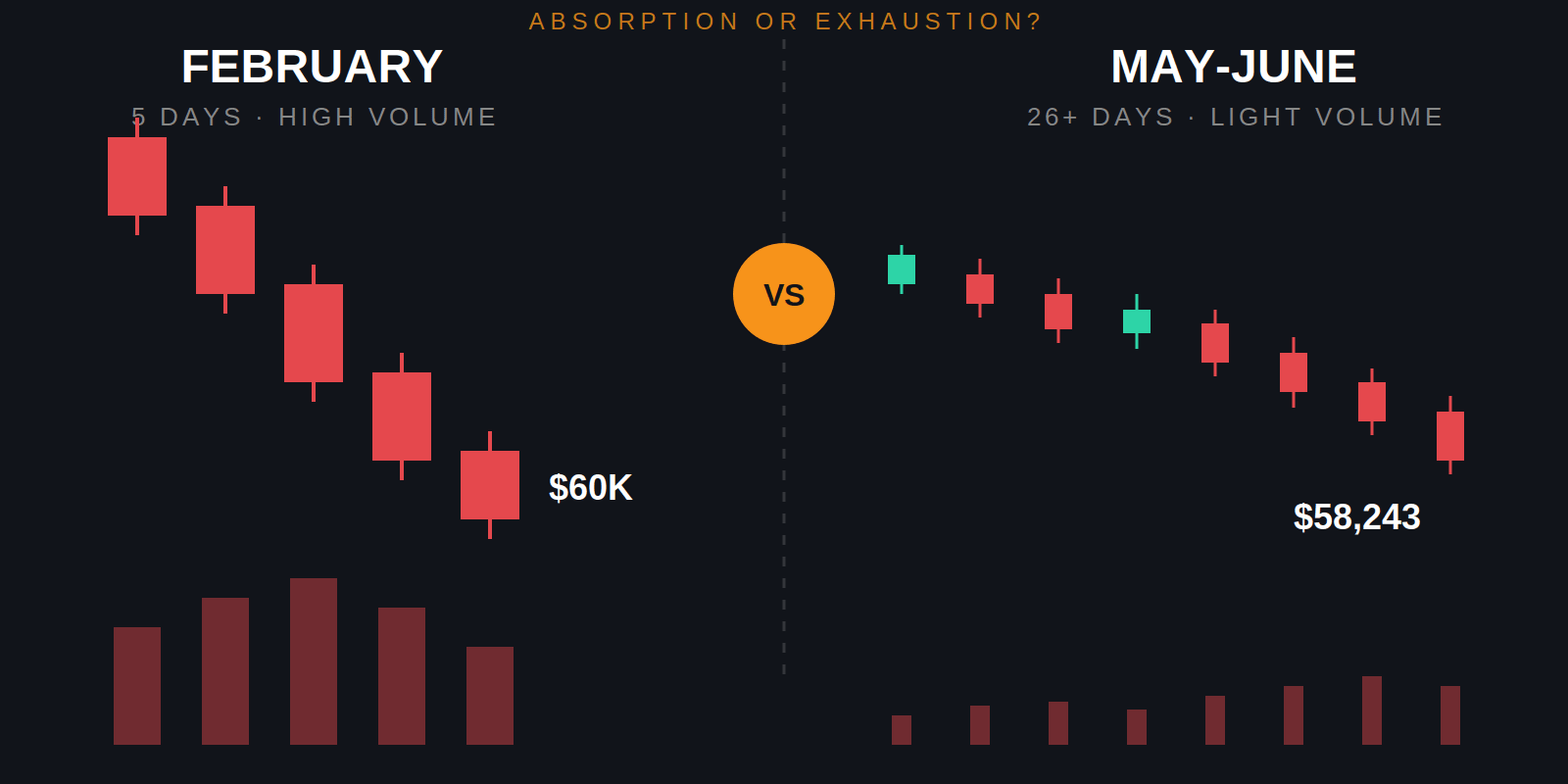
By BitBrainers Editorial Bitcoin has now made the trip down to the $60,000 zone twice this year, and the two trips don't look anyth...

Absorption or Exhaustion: What BTC's Slow Bleed to $58K Is Telling Traders.