Friday, July 31, 2026

Tether reserve buffer Q1 vs Q2 2026

BitBrainers - Tether reserve buffer Q1 vs Q2 2026

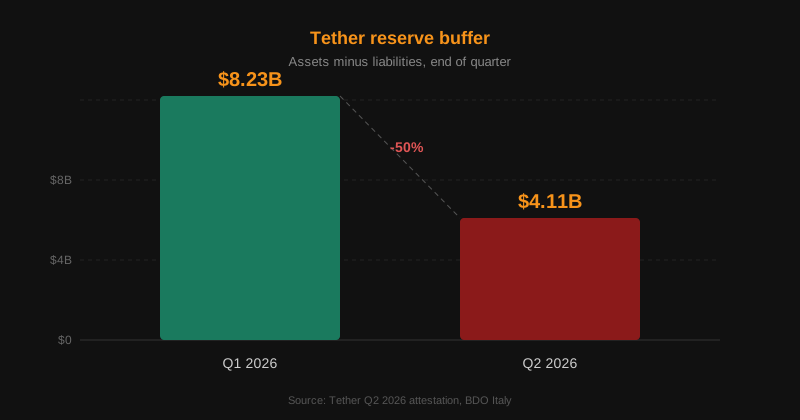
Tether reserve buffer — assets minus liabilities, Q1 vs Q2 2026. Source: Tether Q2 2026 attestation, BDO Italy.

By BitBrainers Editorial

Tether published its Q2 attestation on Friday. Net operating profit of $1.5 billion, up almost 50% from Q1. Fourteen more tons of gold. USDT circulation at $184.6 billion and over 60% of the stablecoin market. Every outlet led with those numbers. The one that needed explaining was the reserve buffer, which fell from $8.23 billion to $4.11 billion in three months.

What the Buffer Is and Why Halving Matters

The reserve buffer is the gap between what Tether owns and what it owes. As of June 30 the company reported $187.75 billion in assets against $183.64 billion in liabilities, leaving $4.11 billion of surplus.

Three months earlier that surplus was $8.23 billion. The liabilities barely moved, up roughly $110 million. The entire change came from the asset side, which fell about $4 billion.

That is the part worth sitting with. A company that earned $1.5 billion in the quarter still ended it with $4 billion fewer assets than it started with.


Where the Four Billion Went

Roughly $1.8 billion of it is explainable directly from the report. Tether marks its gold and Bitcoin holdings to market, and both fell in Q2.

Gold holdings went from $19.84 billion to $18.84 billion, a loss of $1 billion, and that is after buying 14 additional tons. The tonnage rose from 132.2 to 146.2 while the dollar value dropped, because the gold price fell around 15% during the quarter to just over $4,000 an ounce.

Bitcoin holdings went from $6.62 billion to $5.80 billion, a loss of $820 million. Same story: Tether added roughly 1,796 coins to reach 98,933 BTC, while the price used in the reports fell from $68,200 to $58,600.

So two of Tether's hard-asset positions grew in size and shrank in value at the same time. Add the $1.5 billion of profit that should have pushed assets up, and there is still a gap of several billion the attestation does not account for.

Capital movements out of the company are the obvious candidate. Tether's Q1 report disclosed $854 million in net capital movements alongside profit. The Q2 announcement gives no equivalent breakdown, and BDO's attestation confirms balances rather than explaining them.

Most coverage stopped at the headline number.

We read the attestation. Weekly, free, no filler.

Subscribe

The Case That This Is Fine

A fair reading says none of this is alarming. The buffer is still positive. Assets still exceed liabilities. The profit engine, interest income from short-duration Treasuries and repurchase agreements, is intact and producing more than it did last quarter.

Tether also cut secured lending by $2.38 billion, about 15%. Secured loans have been the least transparent line on that balance sheet for years, and shrinking them genuinely reduces risk. That is a decision in the right direction.

USDT grew by $446 million in circulation while the total stablecoin market contracted. Tether took share in a shrinking market and added more than 30 million users. A stablecoin losing float is a far harder problem than one gaining it, and Tether is not losing float.


The Case That It Is Worth Watching

A $4.11 billion buffer against $184.6 billion of liabilities is a cushion of about 2.2%. Three months ago it was 4.5%. Neither number is insolvency. The direction of travel is what changed.

The mechanism is also uncomfortable. Part of the buffer's decline came from gold and Bitcoin falling in price, which means the cushion partly depends on two volatile assets holding their value. Hard assets are a reasonable long-term bet. They are a strange choice for the layer that absorbs short-term shocks.

Then there is the audit. Tether reports through attestations from BDO Italy, which verify that reported balances match what BDO observed at a point in time. That is not the same as a full audit, and Tether has been describing a Big Four audit as in progress for several years without one appearing.


Why This Is Not Only Tether's Problem

USDT sits at over 60% of the stablecoin market. It is the base pair for a large share of crypto trading volume, a standard collateral asset across DeFi, and the settlement rail for cross-border flows in markets where dollar access is difficult.

That concentration means Tether's balance sheet is load-bearing for the whole asset class. A stablecoin at 60% market share does not have private problems.

None of which is a prediction. Tether is profitable, liquid, growing share, and holding an enormous pile of Treasuries, gold, and Bitcoin. The point is narrower: a buffer that halves in one quarter is the kind of number that deserves an explanation, and the report did not give one.


The Backdrop

Tether is among the largest private holders of U.S. government debt in the world. Its year-end 2025 report put direct and indirect Treasury exposure near $141 billion, and the Q2 profit came from exactly that exposure.

Meanwhile the U.S. national debt sat at $39.68 trillion on July 23 and has been rising roughly $41 billion a day, which puts the $40 trillion line right about now. Net interest costs are projected above $1 trillion for fiscal 2026.

Tether earns its money from that debt and converts part of the proceeds into physical gold in Switzerland. Whether you read that as a hedge or as an opinion about where this is going, the company has been doing it consistently for two years.

We looked at how to weigh conflicting signals in a soft market in Fear and Greed Says Buy. MVRV Says Not Yet. The Tether numbers belong in the same file: useful, incomplete, and worth revisiting next quarter.


What to Check in October

Three things in the Q3 attestation will say more than anything in this one. Whether the buffer recovers toward $8 billion or keeps sliding. Whether Tether discloses capital movements alongside the profit figure. And whether the Big Four audit moves from "in progress" to published.

If gold and Bitcoin recover in Q3, part of the buffer comes back on its own without Tether doing anything. That would tell you the halving was mostly mark to market. If the buffer keeps falling while those assets recover, that is a different story entirely.


Sources
CoinDesk: Tether posts $1.5 billion operating profit in Q2 as reserve buffer falls by half
Yahoo Finance: Tether reports $1.5B Q2 profit as USDT supply grows, gold holdings rise
Bloomingbit: Tether posts $1.5 billion in Q2 operating profit, gold holdings top 146 tons
IndexBox: U.S. national debt reaches $39.676 trillion, latest Treasury data shows record high

This is market commentary, not financial advice. Nothing here is a recommendation to buy or sell any asset. Do your own research.
1,082 Bitcoin Stolen from Coldcard Wallets in 41 Minutes. The Flaw Was Five Years Old.

BitBrainers - 1,082 Bitcoin Stolen from Coldcard Wallets in 41 Minutes. The Flaw Was Five Years Old.

By BitBrainers Editorial

Someone drained 1,082.65 BTC from over 1,190 Bitcoin wallets this morning. The sweep ran across nine blocks, in a 41-minute window between 01:10 and 01:51 UTC, with $70.2 million gone before Coinkite issued any public advisory. The flaw that made it possible was introduced in March 2021 and sat undetected for five years.

What Happened

The attack targeted single-signature wallets whose seeds were generated on Coldcard Mk3 hardware running firmware version 4.0.1 or later. That firmware, released in March 2021, contained a flaw in how the device generated randomness for seed creation. Instead of drawing from the hardware random number generator, affected devices fell back to software-based key generation seeded by predictable, non-secret chip data.

A seed generated from predictable inputs is not truly random. If someone can reconstruct the inputs, they can reconstruct the private key. Every wallet created on a compromised Mk3 since March 2021 was potentially sitting on a key an attacker could calculate without ever touching the device.

The attacker swept funds into four consolidation addresses, where they have not moved: 562.02 BTC, 398.48 BTC, 89.62 BTC, and 32.45 BTC. The sweep covered 1,196 addresses in a 41-minute window across nine blocks, with every transaction paying an identical hardcoded fee of 30 sat/vB — a significant overpay versus the 0.4–1.0 sat/vB median that week and leaving no change output. That pattern points to an automated tool spending keys it already held, not owners moving their own funds. All victims were single-signature wallets holding more than 0.15 BTC, many dormant for years.


Who Is Affected

Coinkite, the Canadian company behind Coldcard, issued a security advisory Thursday night warning Mk3 users that seeds generated on firmware 4.0.1 through 5.0.3 may be at risk. That covers the entire Mk3 firmware lifecycle from March 2021 through its final supported version.

The Mk4, Q, and Mk5 are in a different position. Coinkite's early analysis described them as unaffected, but independent analysis by Bitcoin Core developer Gregory Maxwell reached a different conclusion: the same class of entropy weakness is present on these devices, approximately 32 bits harder to exploit than on the Mk3. That is not the same as safe. If you hold significant funds on any Coldcard device and your seed was generated by the device without dice rolls or a strong BIP-39 passphrase, treat it as a risk and migrate. Do not wait for a definitive statement from Coinkite.

If you hold Bitcoin on a Coldcard Mk3 without a BIP-39 passphrase and your seed was generated after March 2021, treat that wallet as compromised. Move funds now, not after you finish reading.


The Lesson That Never Gets Old Enough

Hardware wallets fail. Not often, and not usually like this, but the history is long enough that "cold storage is safe" should always have a footnote. Ledger's 2020 customer data breach exposed 270,000 users to physical threats. Trezor disclosed a laser fault-injection vulnerability in 2026 affecting its TROPIC01 chip. Coldcard's randomness flaw went unnoticed for five years across hundreds of devices.

None of this means hardware wallets are not worth using. The alternative, leaving coins on an exchange, hands custody to a third party that can freeze withdrawals, go bankrupt, or get hacked on a scale that dwarfs any single hardware flaw. The point is that hardware wallets are the best available option, not a perfect one.

The specific flaw here, weak randomness in seed generation, is the kind of vulnerability that is invisible until it is not. The seed looks correct. The wallet functions normally. Coins arrive and leave without issue. The weakness is structural, baked in at the moment of creation, and impossible to detect by looking at the device or the wallet itself.

Self-custody is not set and forget.

We cover the security stories most feeds miss until they become headlines. Weekly, free.

Subscribe

What to Do Right Now

Before doing anything, confirm you are actually affected. You are at high risk only if all four of these are true: your seed was generated on a Coldcard Mk3 running firmware 4.0.1 or later, you did not use a strong BIP-39 passphrase, you did not use dice rolls for extra entropy, and it is a single-signature wallet. If you used a strong unique passphrase or dice rolls at seed generation, Coinkite and the majority of security researchers consider your risk minimal.

Step 1: Stay calm. Urgent but not reckless.

Every experienced voice in the security community is repeating the same thing. Panic transactions and rushed moves lose more coins than the exploit itself. Do not act under stress. Do not send everything in one big transaction. Do not respond to anyone in your DMs offering help.

Step 2: Never enter your existing seed anywhere.

Do not type your seed phrase into any website, app, phone, or tool claiming to check whether it is affected. Anyone asking for your seed is a scammer, not a helper. This applies to every tool, including ones that look official.

Step 3: Best solution. Get clean hardware and generate a new seed.

Get a hardware wallet from a different manufacturer entirely. Trezor, Jade, SeedSigner, and Keystone are the names security researchers are pointing to right now. Do not migrate to a Mk4, Q, or Mk5 as your solution. Coinkite confirmed on Friday that these devices carry a weaker version of the same flaw and issued a separate warning to their users.

Step 4: No clean hardware right now. Temporary fix only.

On the existing Mk3, create a strong and completely unique BIP-39 passphrase and move funds to the new passphrase-protected wallet derived from it. This is a short-term mitigation only. Migrate to a fresh seed on new hardware as soon as possible. Do not treat the passphrase step as a permanent solution.

If the amount is significant, consider multisig for the new setup.

If you feel overwhelmed, some providers including Swan are offering temporary custodial or assisted multisig options. Prefer multisig if you are moving a meaningful amount to a new setup. No single point of failure means one compromised device cannot drain everything.

One rule that overrides all of the above

Do not enter your existing seed phrase into any website, app, or tool claiming to check whether it is affected. Any tool asking for your seed phrase is the attack, not the solution.

We covered the basics of hardware wallet selection and the difference between hot and cold storage in Hot Wallet vs Cold Wallet: Which One Should You Actually Use. The Coldcard story is a reminder that "cold" is not a security guarantee on its own. The device, the firmware, the seed generation process, and the passphrase configuration all matter.


What We Still Do Not Know

Coinkite framed its advisory as issued "out of an abundance of caution" while the investigation continues. The timing and victim profile, single-signature wallets created on Mk3-era firmware, many dormant for years, is consistent with a weak entropy flaw. Independent researchers including AnchorWatch CEO Rob Hamilton, Wizardsardine CEO Kevin Loaec, and developer James O'Beirne all pointed to flawed seed generation as the likely cause. But the formal forensic review has not concluded and the causal link is not yet officially confirmed.

One risk that is not speculative: on-chain analysts have noted the attacker swept only addresses holding more than 0.15 BTC. The most likely explanation is that the target list was sorted by balance and truncated at a round number — 500 addresses in the first wave, now over 1,190 confirmed. The attacker almost certainly already holds the private keys to smaller balances. A second wave targeting sub-0.15 BTC addresses is a real possibility. If your address was generated on an affected device, the balance threshold is not protection.


Sources
CoinDesk: Major bitcoin wallet flaw drains 594 BTC in 25-minute sweep
Cointelegraph via TradingView: Coldcard issues Mk3 warning as experts examine $38M Bitcoin wallet drain
Crypto.news: Coldcard Mk3 warning follows $38M Bitcoin drain
Atlas21: 594 bitcoin drained in fifteen minutes: what we know so far
Cryptobriefing: Coinkite warns COLDCARD Mk3 users after $38M Bitcoin stolen from dormant wallets
Bitcoin Magazine: Coldcard Wallet Flaw Exposes Years of Bitcoin Seeds After $70M in BTC Stolen
CoinDesk: Coldcard's $38M+ Exploit Shakes Faith in Self-Custody

This is market commentary, not financial advice. Nothing here is a recommendation to buy or sell any asset. Do your own research.
Thursday, July 30, 2026

He Called the AI Boom. Then He Got Margin Called Into It

BitBrainers - He Called the AI Boom. Then He Got Margin Called Into It.

By BitBrainers Editorial

On July 24, Leopold Aschenbrenner wrote to his investors. The AI selloff, he said, was "one of the best buying opportunities since early 2025." He invited new capital starting August 1. Six days later, his fund's entire public equity book was gone. Ken Griffin's Citadel bought it.

Who Leopold Aschenbrenner Is

Aschenbrenner is in his mid-20s. He graduated Columbia as valedictorian at 19. He joined OpenAI's Superalignment team, got fired in 2024 for allegedly leaking documents, and immediately turned his widely-read essay series on AGI timelines into a hedge fund thesis.

The fund, Situational Awareness LP, raised money from the Stripe cofounders Patrick and John Collison, as well as Nat Friedman and Daniel Gross. It grew to $45 billion in assets under management by early July 2026 after delivering approximately 439 percent net returns since inception. That number is not a typo.

The thesis was simple: AGI is arriving faster than markets understand, the compute and chip infrastructure that supports it will be the trade of the decade, and anyone still treating AI as a speculative froth rather than a structural shift is going to get left behind. He was not wrong about any of that.


The Structure That Broke It

The fund ran leverage as high as 4x on concentrated bets across the AI infrastructure stack: Bloom Energy, CoreWeave, Nebius, SK Hynix, Lumentum, Coherent. It also ran short positions against software companies including Adobe, on the thesis that AI would eat their revenue.

Both sides of that book broke simultaneously. AI infrastructure names sold off hard in July. Software shorts moved against the fund instead of for it. When you are 4x levered and both your longs and your shorts go the wrong way at the same time, prime brokers do not wait for you to figure out a solution.

Goldman Sachs, JPMorgan Chase, and Bank of America started working with the fund to meet margin requirements. The positions were marketed for sale before Thursday's opening bell. Citadel was the primary buyer. Millennium and Jane Street also bid. Three of the largest hedge funds in the world were circling the liquidation.


The Letter Nobody Will Forget

The July 24 letter is the detail that makes this story more than a liquidation notice. While his prime brokers were already working to manage the margin situation, Aschenbrenner was writing to investors that this was a buying opportunity and inviting fresh capital. The letter mentioned a potential Anthropic IPO as a forward catalyst.

He was not lying. The thesis genuinely holds. The KOSPI's forward price-to-earnings ratio has fallen below 5 after the crash, meaning Samsung and SK Hynix are reporting strong chip earnings while trading at historically cheap valuations. The underlying businesses did not collapse. The margin structure collapsed around them.

That distinction matters. Being right on the thesis and getting wiped out on the leverage is not a contradiction. It is one of the oldest patterns in markets.

The thesis and the trade are not the same thing.

We cover the structural shifts underneath the headlines. Weekly, free, no AI hype.

Subscribe

This Happened the Same Week as Korea

The timing is not a coincidence. The same AI chip names that destroyed Aschenbrenner's fund were the same names that destroyed Korea's retail investors. SK Hynix appears in both stories. The KOSPI leveraged ETF holders and a $45 billion hedge fund ran the same directional bet on AI infrastructure with borrowed money. One was doing it with savings, the other with prime broker lines. The mechanism of destruction was identical.

We covered the Korean side of this in Korea AI Bubble Leveraged ETF Crash earlier today. What the Aschenbrenner liquidation adds is the confirmation that this was not a retail phenomenon. The most sophisticated AI investor in the world, backed by the Stripe founders, running a fund that had turned $225 million into an estimated $20 billion, got taken out by the same mechanism.


What Citadel Got and What It Means

Citadel Securities published its case for a Fed rate hike on Tuesday. Markets freaked out. The AI names that Aschenbrenner was long got hammered. His fund got margin called. Citadel the hedge fund then bought those same positions at distressed prices before Thursday's open.

Whether that sequence was deliberate coordination is not confirmed and probably not provable. What is confirmed is that Citadel Securities and Citadel the hedge fund are separate legal entities with information barriers between them. The timing is striking. The conspiracy theory is unverified.

What matters more is the structural observation: the person with the best thesis and the wrong leverage structure lost. The person who published the fear note and had the capital to catch the falling knife won. Markets do not reward being right. They reward being right without running out of margin first.


What Happens to the Fund

Situational Awareness LP survives as a private investment firm. It retains a roughly $5 billion stake in Anthropic, which it has not sold despite early reports suggesting otherwise. Aschenbrenner remains constructive on AI. His personal net worth is largely tied up in the fund's positions, meaning this is not an abstract professional setback.

His positions are already ripping today, after Citadel took them over. He sold at the bottom. That is the part that will sting longest.


Sources
CNBC: AI investor Leopold Aschenbrenner forced to unwind all public stock positions after steep losses
Bloomberg: Citadel Snaps Up AI Stocks From Situational Awareness Amid Rout
The Next Web: Aschenbrunner's Situational Awareness fund sells out to Citadel
Yahoo Finance: AI wizkid Leopold Aschenbrunner forced to sell entire portfolio after rout
MLQ News: Aschenbrenner's $20B AI Hedge Fund Reportedly Liquidates Public Equity Book After July Rout

This is market commentary, not financial advice. Nothing here is a recommendation to buy or sell any asset. Do your own research.
Korea AI Bubble Leveraged ETF Crash

BitBrainers - Korea AI Bubble Leveraged ETF Crash

By BitBrainers Editorial

Korea's stock market just handed an entire generation a lesson that a decade of zero interest rates had made easy to forget. When you borrow at 5 percent to hold a 2x leveraged ETF that drops 80 percent, the math does not care how good your thesis was.

The Setup

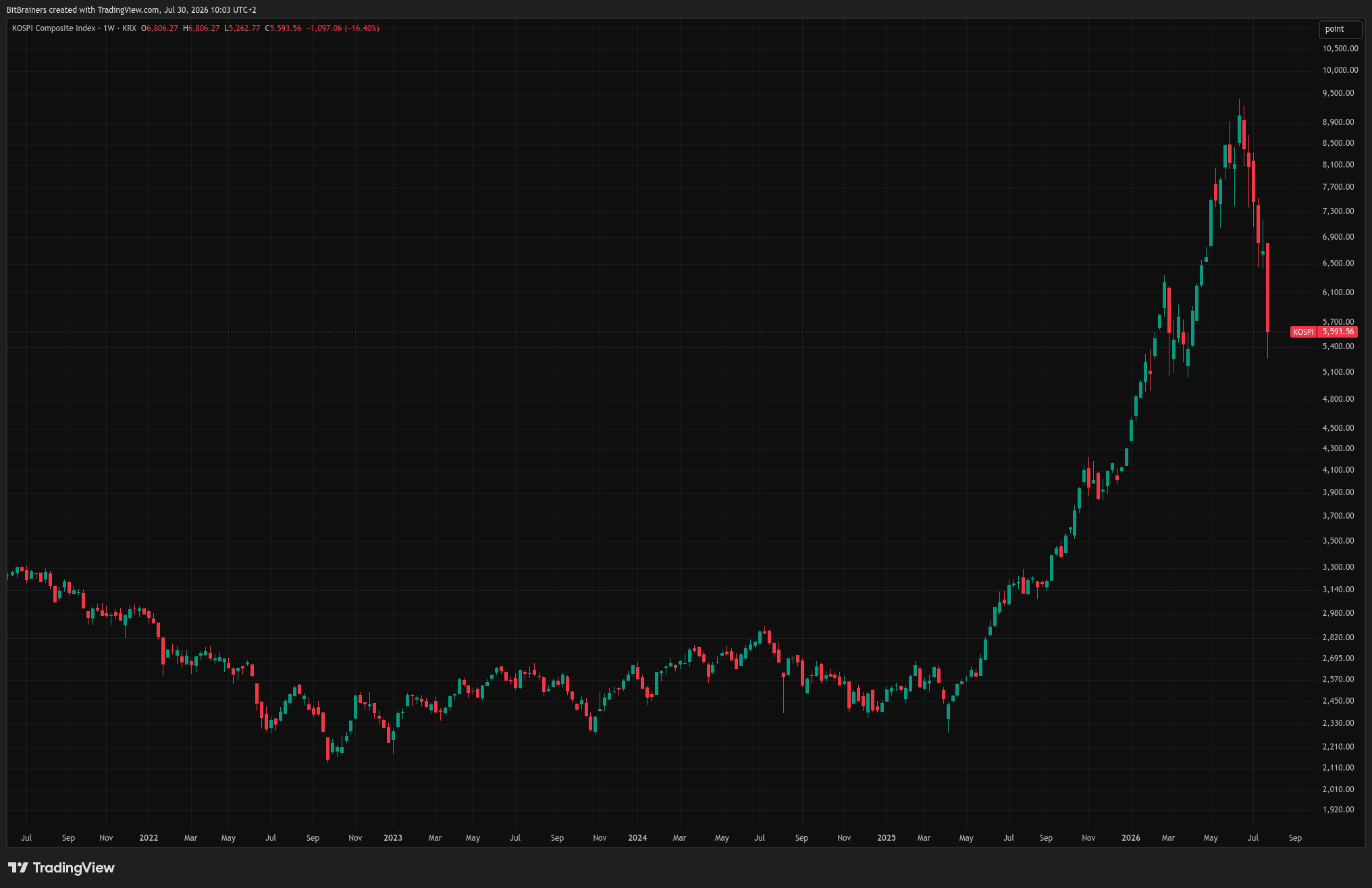
The KOSPI peaked in June 2026, riding an AI semiconductor boom that felt genuinely unstoppable. Samsung and SK Hynix had become national pride stocks. On May 27, regulators approved single-stock leveraged ETFs for the first time, letting retail traders take 2x daily exposure directly on both companies. The products sold out immediately. Margin loans hit a record 38.63 trillion won on June 24. Total investor debt topped 60 trillion won.

KOSPI Composite Index weekly chart 2022-2026

Source: TradingView. KOSPI Composite Index, weekly. Up 297% from 2022 lows to June 2026 peak. Now at 5,593.

Then the chip stocks rolled over. SK Hynix fell 15.37 percent in a single session on July 13, its worst day since listing. Samsung dropped 10.7 percent the same day. What followed was not a correction. It was a liquidation cascade.


The Numbers

This is not a market correction with a price tag. It is a demographic event with one. Mohamed Apabhai at Citi Global Markets estimated cumulative retail losses at $38.7 billion, or 56.3 trillion won. The hardest-hit chip ETFs are down more than 80 percent from their highs.

Goldman's Ioannis Blekos put the margin call count at 1.2 million accounts by July 13, with 320,000 to 360,000 fully liquidated, some leaving investors still owing money after the broker closed their positions. South Korea's working-age population is 35.7 million. That is one in every 30 adults with a blown account.

Investors aged 20 to 30 made up 62 percent of the liquidated accounts. These were not reckless gamblers. These were people who had rationally concluded that leveraged equities were their best shot at wealth in a country where housing had already priced them out. That context does not make the loss more forgivable. It makes it harder to look away from.


Why 5.2 Percent Is Not a Footnote

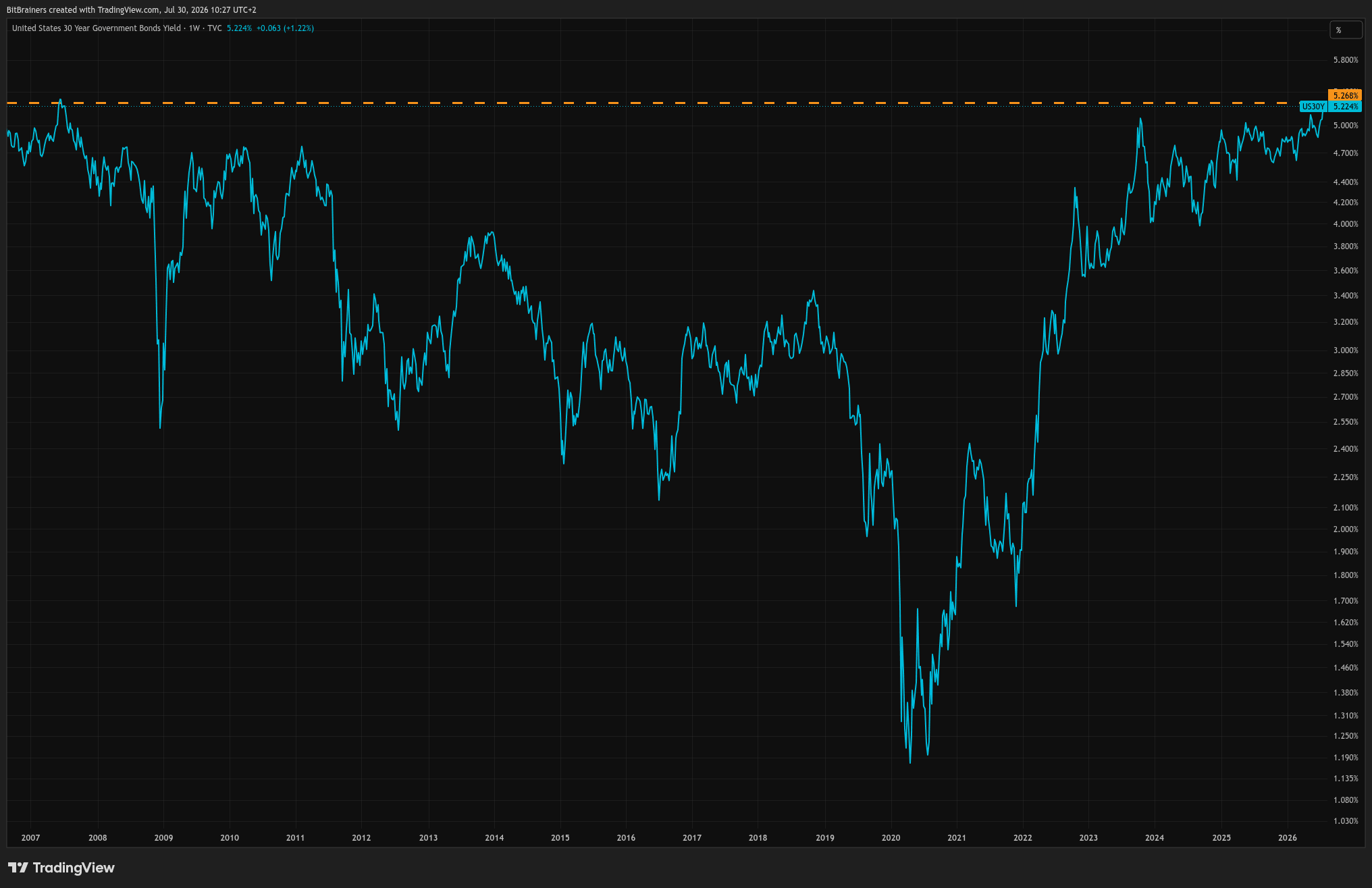
This did not happen in a vacuum. The US 30-year Treasury yield has closed in on 5.2 percent, its highest level since 2007, though it has not yet cleared that era's peak at 5.268 percent.

US 30-Year Treasury Yield approaching 2007 peak

Source: TradingView. US 30-year yield at 5.225%, approaching but not yet clearing the 2007 peak at 5.268% (orange line). Weekly chart.

A decade of near-zero rates trained an entire generation that borrowing to speculate was the rational move. Housing was unaffordable. Savings paid nothing. Leverage into growth assets was the only game in town, and for years the AI semiconductor boom made it look like genius. By the time Korean retail investors were going all-in on leveraged chip ETFs in spring 2026, they were paying 5 percent carry to hold those positions. When the stocks fell, the carry kept compounding regardless.

The last time the 30-year traded this close to its old highs, US households were leveraged into an asset class they did not fully understand, inside a regulatory environment that had just made it easier to do so. South Korea's finance minister has since issued a public apology. The 2007 parallel is not subtle.

The macro context your feed is missing

Bond yields, leveraged blow-ups, Bitcoin signals. One brief a week.

Subscribe

The Smart Money Saw It Too, and Still Got Caught

Leopold Aschenbrenner founded Situational Awareness in 2024 on the thesis that AGI is arriving faster than markets understood. The fund grew to $20 billion and delivered a 439 percent net return through June 2026. This week it is seeking new capital after significant losses in the AI selloff, with some investors being offered assets from the portfolio directly.

The irony is not subtle. One of the most credentialed AI bulls on Wall Street is now navigating the same forced-selling dynamics as the 25-year-old in Seoul who put his savings into a 2x SK Hynix ETF. The thesis was right in both cases. The leverage was the variable that made it painful.

Michael Burry has been warning about this since at least early 2026, with disclosed short positions on Nvidia and Palantir. He called the market overvalued in 2023 too, and it kept climbing. Being early to a structural call is not the same as being wrong. It is just expensive.


What Bitcoin Sees in All of This

Korean retail lost $38.7 billion on products issued by institutions, regulated by a government that then apologized. The regulatory approval came two months before the peak. Every step involved a counterparty making a decision about ordinary people's savings.

Bitcoin's supply does not change based on what a finance minister decides. There is no broker who can liquidate your position when a margin call hits, provided you hold it yourself. That sounds abstract until you watch 360,000 accounts get force-sold in two weeks. The same week Korea was unwinding, the Federal Reserve held rates while three of its own officials voted for a hike, the most dissents against the majority since 2016. We covered what that vote actually means in The Fed Held. The Vote Didn't.

This is not an argument that Bitcoin is a safe haven. It sold off hard in 2022 in far less dramatic circumstances. The point is structural: the counterparty risk that turned a bad trade into a life-altering event for hundreds of thousands of young Koreans does not exist in the same form when you hold your own keys. If you are holding Bitcoin on an exchange and have not yet thought about self-custody, this is a reasonable moment to reconsider. A Trezor hardware wallet keeps your keys off any platform that can make decisions about your account without your input.


What Comes Next

Citi warned that leveraged ETF market cap could fall below $8 billion before year-end, down from $52.5 billion in June. The deleveraging is not finished. Investors who survived the first wave are still holding positions, and margin balances have only partially unwound.

The Bank of Korea raised rates 25 basis points to 2.75 percent during the selloff, tightening liquidity exactly when markets needed it least. Regulators have halted new leveraged ETF listings and are weighing whether to restrict access to professional investors only.

The 30-year yield is not retreating. The macro environment that makes all leveraged retail exposure dangerous is not a Korea story. It is the frame around every trade right now.


Sources
Korea JoongAng Daily: Citi estimates retail investors have lost $38.7 billion on leveraged ETFs
Investing.com: Korea's Leveraged Chip Trade Hits the Margin Call Wall
CNBC: Minister apologizes as Korean leveraged ETF investors nurse heavy losses amid chip stock rout
Bloomberg: Aschenbrenner Hedge Fund Situational Awareness Seeks Capital After Loss, FT Says
Seoul Economic Daily: Reuters Calls Korea's Leverage ETF Launch a "Policy Failure"

This is market commentary, not financial advice. Nothing here is a recommendation to buy or sell any asset. Do your own research.
Wednesday, July 29, 2026

The Fed Held. The Vote Didn't.

BitBrainers - The Fed Held. The Vote Didn't.

By BitBrainers Editorial

Every headline today says the same thing: the Fed held. Technically true. Also the least interesting sentence anyone wrote about today's meeting. The real number is one paragraph down in every article, and almost nobody is leading with it.

The Fed Didn't Vote 12-0. It Voted 9-3.

Three sitting Fed officials looked at today's decision and said no. Cleveland's Beth Hammack, Minneapolis's Neel Kashkari, and Dallas's Lorie Logan all wanted a hike instead of a hold. That's the worst split against the majority's direction since September 2016.

A unanimous hold means the committee agrees. A 9-3 hold means a third of the room is on record saying the Fed is already behind. Those are not the same event wearing the same headline.

Warsh's own words gave it away before anyone had to dig: "I asked for a good family fight, and I got one." That's not a chair describing consensus. That's a chair describing a fight he didn't fully win.


Bitcoin Noticed the Headline. It Didn't Notice the Vote.

Price moved to $64,400 and stopped. That's not a reaction, that's a shrug. And it makes sense, because the rate itself told the market nothing it didn't already know.

What would have actually moved price is the thing most coverage skipped past: three officials on record wanting tighter policy, in the same meeting where inflation is still running hot from energy and supply shocks. That's not nothing. That's a preview.

Warsh Isn't Going to Warn You Next Time Either

He said it flat out. The committee wants to watch the market react "direct and unfiltered" instead of pre-committing to a path. Translation: don't expect a heads-up before the next surprise.

The next dot plot, the first real look at where this committee thinks rates are headed, doesn't land until September 16. Between now and then, the only signal anyone gets is whichever Fed official talks next, and how many more of them start agreeing with Hammack, Kashkari, and Logan.


The Number to Watch Isn't the Rate. It's the Dissent Count.

Three people just told you where they think this is going. If a fourth joins them before September, that's the surprise nobody has priced. If the number holds at three, the market spent today's whole news cycle reacting to a headline that changed nothing.

Either way, the rate wasn't the story today. It rarely is.


Sources
CNN Business: Fed holds interest rates steady for fifth-straight meeting, but inflation still clouds outlook
CNBC: Fed likely to keep rates on hold, but Warsh to face some strong dissension: Live updates
CoinDesk: Fed holds rates steady, extending pause as markets await Kevin Warsh's policy roadmap
Trading Economics: United States Fed Funds Interest Rate

This is market commentary, not financial advice. Nothing here is a recommendation to buy or sell any asset. Do your own research.

The War in the Price of Everything

Illustration: a crude tanker on Gulf water. The strait Iran mined in February carries a fifth of the world's oil.

The War in the Price of Everything