By BitBrainers Editorial
The Setup
The KOSPI peaked in June 2026, riding an AI semiconductor boom that felt genuinely unstoppable. Samsung and SK Hynix had become national pride stocks. On May 27, regulators approved single-stock leveraged ETFs for the first time, letting retail traders take 2x daily exposure directly on both companies. The products sold out immediately. Margin loans hit a record 38.63 trillion won on June 24. Total investor debt topped 60 trillion won.
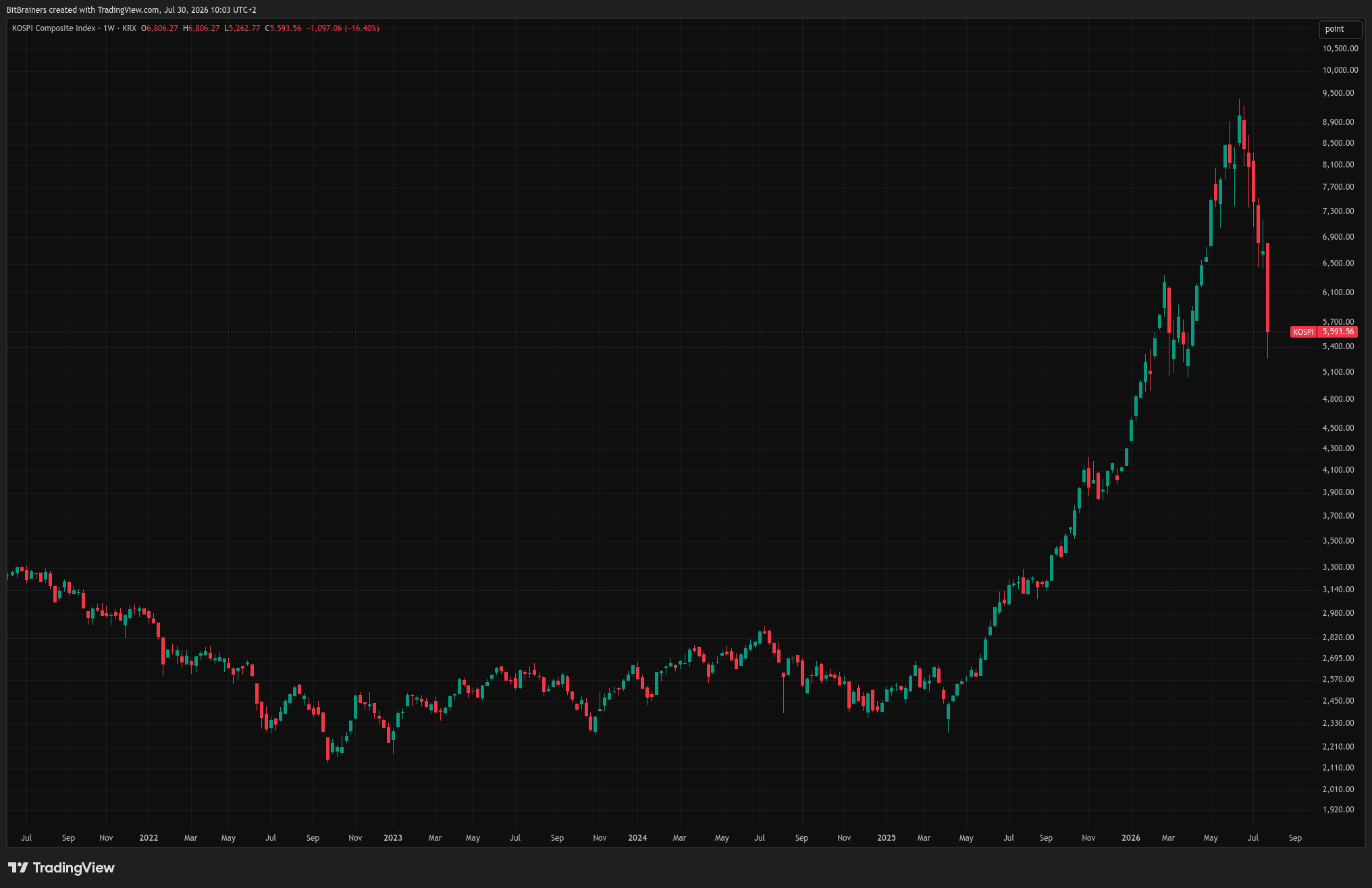
Source: TradingView. KOSPI Composite Index, weekly. Up 297% from 2022 lows to June 2026 peak. Now at 5,593.
Then the chip stocks rolled over. SK Hynix fell 15.37 percent in a single session on July 13, its worst day since listing. Samsung dropped 10.7 percent the same day. What followed was not a correction. It was a liquidation cascade.
The Numbers
This is not a market correction with a price tag. It is a demographic event with one. Mohamed Apabhai at Citi Global Markets estimated cumulative retail losses at $38.7 billion, or 56.3 trillion won. The hardest-hit chip ETFs are down more than 80 percent from their highs.
Goldman's Ioannis Blekos put the margin call count at 1.2 million accounts by July 13, with 320,000 to 360,000 fully liquidated, some leaving investors still owing money after the broker closed their positions. South Korea's working-age population is 35.7 million. That is one in every 30 adults with a blown account.
Investors aged 20 to 30 made up 62 percent of the liquidated accounts. These were not reckless gamblers. These were people who had rationally concluded that leveraged equities were their best shot at wealth in a country where housing had already priced them out. That context does not make the loss more forgivable. It makes it harder to look away from.
Why 5.2 Percent Is Not a Footnote
This did not happen in a vacuum. The US 30-year Treasury yield has closed in on 5.2 percent, its highest level since 2007, though it has not yet cleared that era's peak at 5.268 percent.
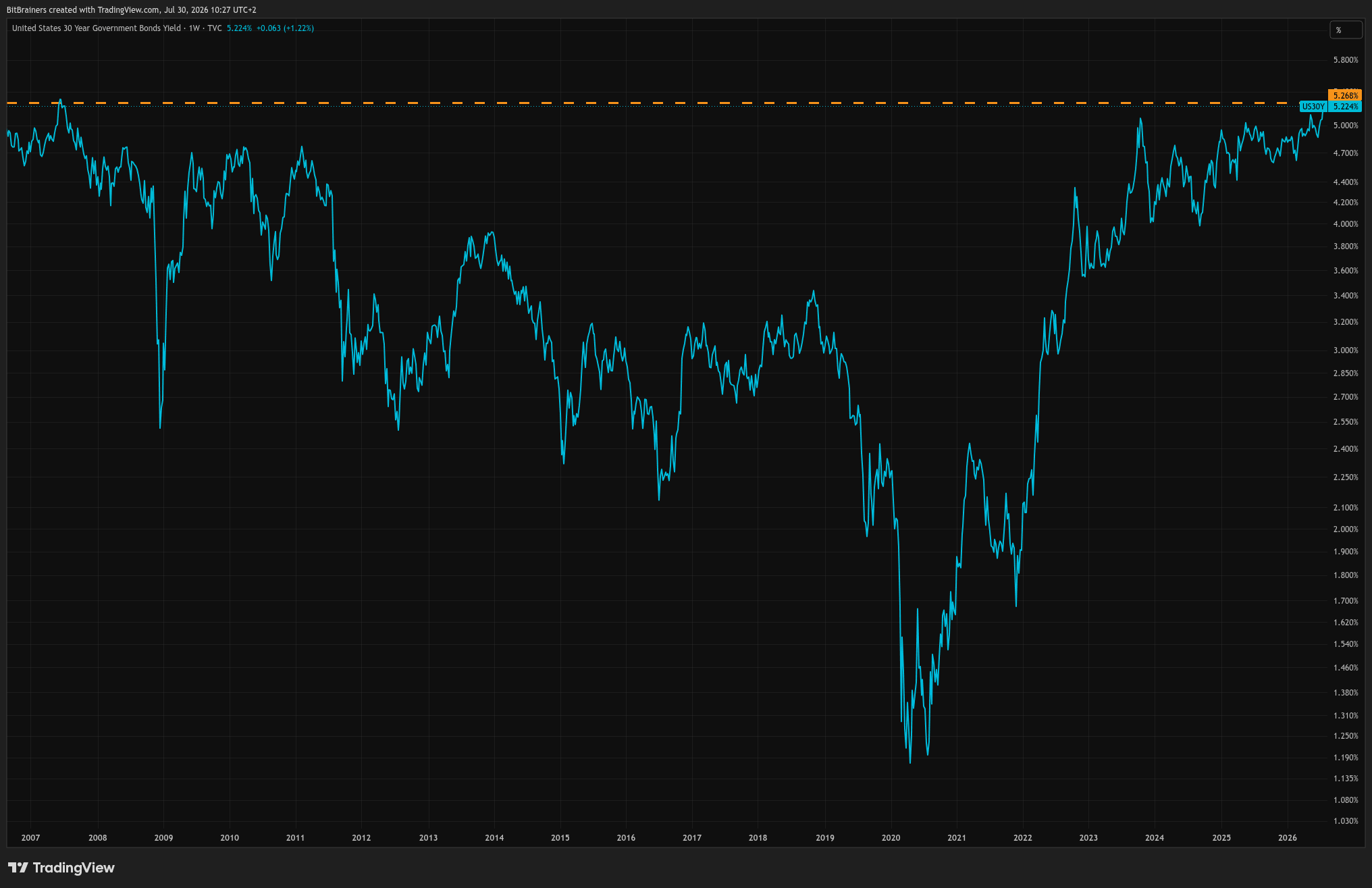
Source: TradingView. US 30-year yield at 5.225%, approaching but not yet clearing the 2007 peak at 5.268% (orange line). Weekly chart.
A decade of near-zero rates trained an entire generation that borrowing to speculate was the rational move. Housing was unaffordable. Savings paid nothing. Leverage into growth assets was the only game in town, and for years the AI semiconductor boom made it look like genius. By the time Korean retail investors were going all-in on leveraged chip ETFs in spring 2026, they were paying 5 percent carry to hold those positions. When the stocks fell, the carry kept compounding regardless.
The last time the 30-year traded this close to its old highs, US households were leveraged into an asset class they did not fully understand, inside a regulatory environment that had just made it easier to do so. South Korea's finance minister has since issued a public apology. The 2007 parallel is not subtle.
The macro context your feed is missing
Bond yields, leveraged blow-ups, Bitcoin signals. One brief a week.
SubscribeThe Smart Money Saw It Too, and Still Got Caught
Leopold Aschenbrenner founded Situational Awareness in 2024 on the thesis that AGI is arriving faster than markets understood. The fund grew to $20 billion and delivered a 439 percent net return through June 2026. This week it is seeking new capital after significant losses in the AI selloff, with some investors being offered assets from the portfolio directly.
The irony is not subtle. One of the most credentialed AI bulls on Wall Street is now navigating the same forced-selling dynamics as the 25-year-old in Seoul who put his savings into a 2x SK Hynix ETF. The thesis was right in both cases. The leverage was the variable that made it painful.
Michael Burry has been warning about this since at least early 2026, with disclosed short positions on Nvidia and Palantir. He called the market overvalued in 2023 too, and it kept climbing. Being early to a structural call is not the same as being wrong. It is just expensive.
What Bitcoin Sees in All of This
Korean retail lost $38.7 billion on products issued by institutions, regulated by a government that then apologized. The regulatory approval came two months before the peak. Every step involved a counterparty making a decision about ordinary people's savings.
Bitcoin's supply does not change based on what a finance minister decides. There is no broker who can liquidate your position when a margin call hits, provided you hold it yourself. That sounds abstract until you watch 360,000 accounts get force-sold in two weeks. The same week Korea was unwinding, the Federal Reserve held rates while three of its own officials voted for a hike, the most dissents against the majority since 2016. We covered what that vote actually means in The Fed Held. The Vote Didn't.
This is not an argument that Bitcoin is a safe haven. It sold off hard in 2022 in far less dramatic circumstances. The point is structural: the counterparty risk that turned a bad trade into a life-altering event for hundreds of thousands of young Koreans does not exist in the same form when you hold your own keys. If you are holding Bitcoin on an exchange and have not yet thought about self-custody, this is a reasonable moment to reconsider. A Trezor hardware wallet keeps your keys off any platform that can make decisions about your account without your input.
What Comes Next
Citi warned that leveraged ETF market cap could fall below $8 billion before year-end, down from $52.5 billion in June. The deleveraging is not finished. Investors who survived the first wave are still holding positions, and margin balances have only partially unwound.
The Bank of Korea raised rates 25 basis points to 2.75 percent during the selloff, tightening liquidity exactly when markets needed it least. Regulators have halted new leveraged ETF listings and are weighing whether to restrict access to professional investors only.
The 30-year yield is not retreating. The macro environment that makes all leveraged retail exposure dangerous is not a Korea story. It is the frame around every trade right now.
Sources
Korea JoongAng Daily: Citi estimates retail investors have lost $38.7 billion on leveraged ETFs
Investing.com: Korea's Leveraged Chip Trade Hits the Margin Call Wall
CNBC: Minister apologizes as Korean leveraged ETF investors nurse heavy losses amid chip stock rout
Bloomberg: Aschenbrenner Hedge Fund Situational Awareness Seeks Capital After Loss, FT Says
Seoul Economic Daily: Reuters Calls Korea's Leverage ETF Launch a "Policy Failure"
This is market commentary, not financial advice. Nothing here is a recommendation to buy or sell any asset. Do your own research.