Friday, August 7, 2026

$763.6 Million in Four Days, NFP Decides If the Streak Holds

BitBrainers - Bitcoin ETF Inflow Streak Faces NFP Test

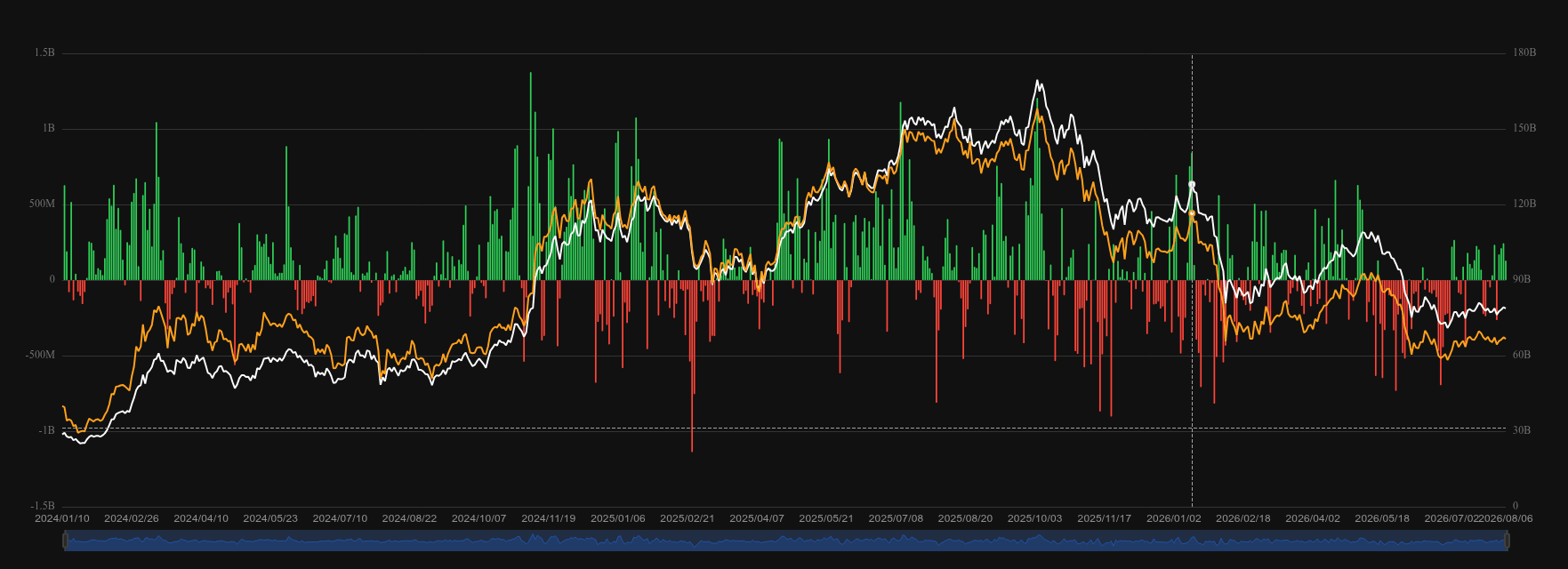
Spot Bitcoin ETF total net flows (green/red bars) and BTC price (orange line), January 2024 to August 2026. Source: SoSoValue.

By BitBrainers Editorial

Spot Bitcoin ETFs have recorded net inflows for four consecutive trading days in August 2026. The total stands at roughly $763.6 million. BlackRock's IBIT led every session. Franklin Templeton returned after 30 days of silence. The July nonfarm payrolls report lands at 8:30 AM ET. This is the first real test of whether the streak is conviction or reflex.

The numbers are straightforward. On August 3, the complex took in $170.1 million: IBIT led with $111.4 million, Fidelity's FBTC added $33.4 million, and Franklin Templeton's EZBC bought $9.2 million, its first purchase in more than 30 days. On August 4, IBIT added $170.3 million and the complex printed $211.5 million total.

On August 5, IBIT led again with $196.8 million and the daily total reached $244.4 million, the strongest single day of the run. On August 6, IBIT added $128.3 million and the complex printed $137.6 million total despite outflows from HODL and GBTC.

The cumulative August total is now roughly $763.6 million. Total net assets across the complex sit at approximately $79 billion. Cumulative net inflows since January 2024 are approximately $51.9 billion. The year-to-date deficit, which stood at $5.4 billion after June's carnage, has narrowed to roughly $4.5 billion.

The Context

June produced $4.5 billion in outflows, the worst month since the ETFs launched. July recovered only $172.4 million. August has already added roughly $763.6 million in four sessions. That is a reversal, not a recovery, and reversals in ETF flows have been short-lived in 2026.

The last sustained inflow streak ran seven sessions from July 14 to July 22, totaling roughly $981 million. It followed a ten-day outflow streak that pulled $2.73 billion from the complex. The streak before that, in April, brought $2.44 billion and nearly doubled March's $1.32 billion. Each streak has been followed by renewed selling. The question is whether August is different.

What makes this streak notable is the breadth. On August 3, every major fund printed green. IBIT, FBTC, BITB, ARKB, BTCO, and EZBC all bought. That level of coordinated participation has not happened since April. On August 5, even ARKB added $37.6 million, a fund that had been bleeding for most of July. The only red days in August came from HODL and GBTC, both legacy products with structural outflow trends.


What the Flows Actually Say

IBIT's flow profile tells the whole story. Over the past four trading days, IBIT has taken in roughly $607 million. Over one month, it has lost approximately $1.83 billion. Over three months, $3.91 billion has left. The four-day figure recovers roughly a third of one month's outflows. The streak matters, but it has real ground left to cover.

The year-to-date picture keeps the bulls honest. The complex would need roughly seven more weeks at the current pace simply to return to flat for 2026. One session in early 2026 recorded $753 million in a single day. The current streak averages roughly $189 million per day. The capacity for large creations exists. What has been absent is the sustained sequence that converts individual green days into a trend.

The structural improvement is durability. The complex has now been through an $8.2 billion drawdown, a $2.73 billion ten-day outflow streak, and a 21-month price low without any product closing, any issuer exiting, or any operational failure. The infrastructure held, which is not a price catalyst but the kind of datapoint institutional allocators underwrite before they size up.


The NFP Test

Consensus expects 83,000 to 100,000 jobs for July. The unemployment rate is expected to hold near 4.2%. The Fed held rates at 3.50% to 3.75% on July 29 with three dissenters voting for a hike. Chair Kevin Warsh said the Committee is positioned to wait for more data. That data arrives in hours.

A print below 100,000 with rising unemployment increases cut expectations. Risk assets typically sell first on recession fears before recovering on liquidity hopes. Bitcoin's $64,000 area, trading near $64,300 as of this morning, faces its first real test since February. If the ETF bid is conviction, it holds through the initial volatility. If it is reflex, the streak breaks today.

A print above 150,000 with steady unemployment validates the three dissenters. The dollar strengthens. The recent ETF inflows look premature. The streak breaks for a different reason.

The Goldilocks zone, 100,000 to 150,000, leaves the Fed holding in September and the market shrugging. The streak continues because the macro ambiguity that created it remains intact.


Get the Weekly Brief

One email. Monday morning. The macro events that move Bitcoin this week.

Subscribe

What to Watch

Watch the headline figure relative to 100,000. That is the threshold where recession pricing overtakes soft landing pricing.

Watch the unemployment rate. A tick to 4.3% or higher matches the highest level since late 2021.

Watch average hourly earnings. Sticky wages with weak jobs create the hardest outcome for the current policy framework.

And watch the ETF flow print for today. It will not be available until after the market close, around 4 PM ET. If the streak holds through an NFP miss, the institutional bid is real. If it breaks, the reflex trade is over.

For the full NFP preview and the Fed dissent context: yesterday's setup post


Sources

Farside Investors Bitcoin ETF Flow (US$m)

SoSoValue Bitcoin ETF Tracker

The Block Spot Bitcoin ETF Flows

Tools: Kraken for trading. Trezor for storage.

This is market commentary, not financial advice. Nothing here is a recommendation to buy or sell any asset. Do your own research.
Thursday, August 6, 2026

Tomorrow's NFP Is the Only Print That Matters Before Jackson Hole

BTC/USD daily with NFP line and $60K-$67K range

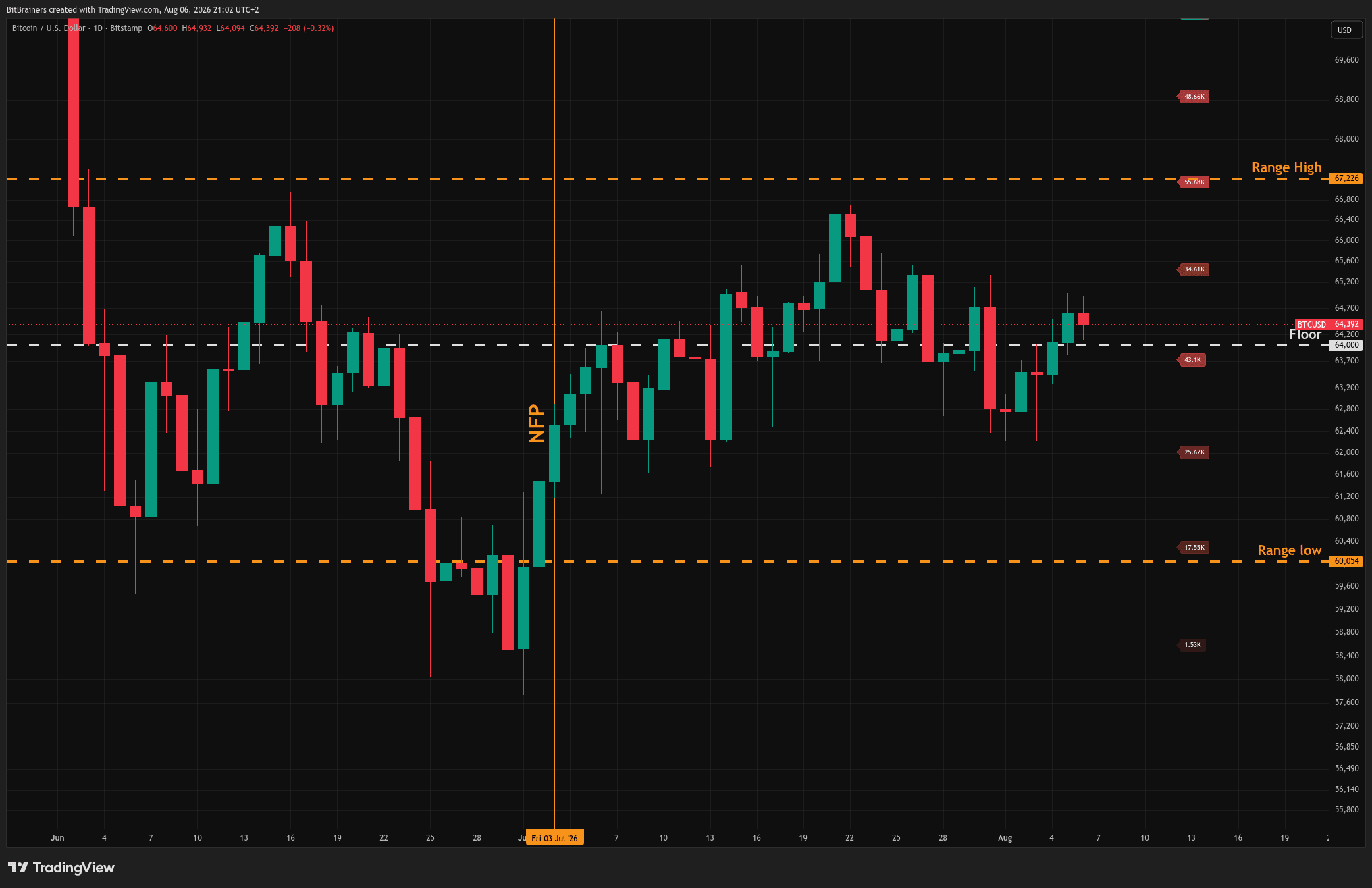
BTC/USD daily. Orange vertical line marks the July 3 NFP print. Dashed lines show the $60,000 to $67,000 range that has contained price since. Source: TradingView.

By BitBrainers Editorial

Bitcoin has traded between $60,000 and $67,000 for most of the third quarter. Spot Bitcoin ETFs took in $626 million over the first three sessions of August, with BlackRock's IBIT accounting for the bulk, after $4.5 billion in outflows during June. For readers trading these levels, Kraken offers spot and futures on BTC and ETH. The July nonfarm payrolls report lands tomorrow at 8:30 AM ET.

June's report set the current setup. Here is the last print and how Bitcoin reacted:

Month NFP Est. U Rate Part. AHE BTC Reaction
June 2026 +57,000 110,000 to 115,000 4.2% 61.5% 3.5% Dropped to $58K pre-print, then rose to $62K within 48h (+7%)

April and May were revised down by a combined 74,000 jobs. The three month average sits near 111,000.


What the Fed Did

On July 29 the FOMC held the federal funds target at 3.50% to 3.75% on a 9 to 3 vote. The three dissenters, Hammack, Kashkari, and Logan, preferred a 25 basis point hike. Chair Kevin Warsh said the Committee is positioned to wait for more data. That data is tomorrow.

Markets currently price about 55% odds of a September cut. The dissent complicates that pricing. One third of the voting committee believes policy is too loose. Warsh noted that tighter financial conditions already reflected in market rates gave the Fed room to hold, but he also said higher rates could well be part of the solution. The market heard that as a hawkish hold.


The Two Scenarios

A print below 100,000 with rising unemployment would increase cut expectations. Risk assets often sell first on recession fears before recovering on liquidity hopes. Bitcoin's $64,000 area faces its first real test since February. If the number collapses toward 80,000 or lower, the recession trade activates and the Fed faces pressure to cut 50 basis points, not 25.

A print above 150,000 with steady or falling unemployment would support the dissenters. The dollar would strengthen and the recent ETF inflows would look premature. $62,000 becomes the next level to watch. The market would reprice toward no cut in September, and the hawks would have the data they need to push again at the September meeting.


We read the filings so you can skip the timeline.

Weekly Bitcoin and macro analysis, built from primary sources.

Subscribe

What This Sets Up

Watch the headline figure relative to 100,000. That is the threshold where recession pricing overtakes soft landing pricing.

Watch the unemployment rate. A tick to 4.3% or higher would match the highest level since late 2021.

Watch average hourly earnings. Sticky wages with weak jobs create the hardest outcome for the current policy framework. The Fed cannot cut into accelerating wage inflation, and it cannot hold if the labor market is cracking.

And watch Bitcoin's reaction at $64,000. The level has held through three tests in the last month. If NFP misses and BTC drops through $62,000 on recession fear, the ETF bid will face its first real redemption test since June. If BTC holds or rallies on cut pricing, the institutional floor is real.

Jackson Hole runs August 27 to 29. This is the last major labor report before then. The ETF buyers are positioned for cuts. The three Fed dissenters are positioned for a hold or hike. Tomorrow's number settles it.

For the wider macro setup this week and the dates that matter: this week's Weekly Brief


Sources

Trading Economics United States Non Farm Payrolls

MUFG Research US Labor Update

U.S. Bank Federal Reserve Holds Rates at 3.50%-3.75% in July 2026

Texas Capital Bank No change in rates — Fed Meeting of July 29, 2026

The Wall Street Journal Fed Holds Rates Steady but Three Officials Vote for Increase

Kansas City Fed Jackson Hole Economic Policy Symposium

Tools We Use

Kraken — Spot and futures on BTC, ETH, and 200+ assets.

Trezor — Cold storage. No internet connection required.

This is market commentary, not financial advice. Nothing here is a recommendation to buy or sell any asset. Do your own research.

Wednesday, August 5, 2026

BlackRock Bought the Dip. Italy's Largest Bank Sold 94% of IBIT. Someone Is Wrong

Source: The Block. Dark blue bars are IBIT. The chart updates daily.

By BitBrainers Editorial

Intesa Sanpaolo cut its BlackRock IBIT position by 93.7% in the second quarter, dropping from roughly ~646,809 shares to 40,723 shares. The filing also disclosed a new put position against the same fund and a tripling of the bank's staked Ethereum ETF stake. This is not retail panic. This is Italy's largest bank, with €1.5 trillion in customer assets, deciding that a quarter of a billion dollars in Bitcoin ETF exposure was too much to keep.

In the same quarter, BlackRock's IBIT took in $869 million in a single week. The fund now holds 3.70% of every Bitcoin in existence and has absorbed $60.81 billion since launch. One institution is running for the exit. Another is still vacuuming up the floor. Both cannot be right about the same asset at the same price.


The Filing That Got Buried

Intesa Sanpaolo's Q2 13F landed without the fanfare of a MicroStrategy purchase or a Tesla headline, which is exactly why it matters. The bank had been one of the more visible European institutional adopters, more than doubling its crypto ETF holdings to $235 million in Q1 2026. Sixty days later, the Bitcoin allocation was effectively gone.

The details are more interesting than the headline. The bank did not just sell. It bought puts. That is a directional bet, not a rebalancing. And the same filing shows the bank tripled its position in a staked Ethereum ETF, suggesting the capital did not leave crypto entirely. It rotated. Whether that rotation is a vote against Bitcoin specifically, or against the ETF wrapper, or simply a mandate level decision to favour assets that generate yield over assets that produce none, the filing does not say. What it says is that one of Europe's most conservative systemically important banks no longer wants to own Bitcoin through BlackRock's product.


BlackRock's Vacuum

IBIT has now led daily inflows for so many consecutive sessions that the pattern is almost boring. The fund took in $319 million of a $499 million weekly total in late July, then added another $183 million in the final days of the month. When the broader complex was bleeding $4.5 billion in June, IBIT still found buyers. When Fidelity's FBTC, a fund with zero fees, was shedding $85 million in a week, IBIT was taking in $869 million.

The explanation is not price. It is plumbing. BlackRock's products sit on the platforms that pension managers, endowments, and financial advisers already use. Buying IBIT means clicking a button they have clicked a thousand times before. For most institutional allocators, IBIT is not a crypto bet. It is an asset allocation decision made inside infrastructure they trust. That distribution advantage explains why a fund charging 0.25% is beating a free competitor four to one.

But distribution is not conviction. It is convenience. And convenience flows reverse faster than conviction flows when the narrative turns.


The Divergence

Here is the tension. Intesa Sanpaolo sold 94% of its IBIT stake in a quarter when Bitcoin traded between roughly $60,000 and $67,000. BlackRock's own clients added billions through the same product in the same price range. Either Italy's largest bank is front running a correction that BlackRock's allocators do not see, or BlackRock's allocators are averaging into a range that Intesa decided was a ceiling.

The third option is that they are different animals entirely. Intesa's $235 million position was a trading book allocation, nimble enough to rotate into staked ETH in sixty days. BlackRock's inflows are coming from model portfolios and target maturity funds that rebalance quarterly, if that. One is a speedboat. The other is an oil tanker. They can move in opposite directions without either being wrong about the destination.

What breaks that symmetry is scale. IBIT now holds roughly $48.86 billion in net assets. If Intesa's rotation is the first of many European banks trimming Bitcoin ETF exposure ahead of regulatory uncertainty, the EU's MiCA deadlines, the stalled CLARITY Act, the ethics deadlock in Washington, then BlackRock's inflows are absorbing exits that have not yet shown up in the daily flow data. The daily prints show BlackRock winning. The quarterly filings show someone large leaving. Both are true. One is just slower.


What the Flows Actually Say

Zoom out and the picture is less bullish than the IBIT headlines suggest. U.S. spot Bitcoin ETFs recorded $5.4 billion in net outflows in the first half of 2026, their first negative half year since launching in January 2024. June alone produced $4.5 billion in outflows, the largest single month exit on record. July's recovery covered roughly 15% of that damage before the final week flipped back to red.

The cumulative net inflow total since launch, roughly $53.94 billion, is still below the October 2025 peak. The funds have not made back what they lost between November 2025 and February 2026, a four month stretch that saw $6.38 billion leave alongside Bitcoin's slide from over $100,000 to nearly $60,000.

IBIT's dominance is real, but it is also a concentration risk. When a single fund is the only buyer in a market of sellers, the fund becomes the market. Large inflow days now have follow on effects on spot price that did not exist eighteen months ago. That feedback loop cuts both ways. If BlackRock's allocators ever stop buying, a bad quarter, a risk averse macro shock, a regulatory headline, there is no second buyer large enough to absorb the flow.


We read the filings so you can skip the timeline.

Weekly Bitcoin and macro analysis, built from primary sources.

Subscribe

What This Sets Up

Watch the next wave of 13F filings. Intesa was not the only European bank in these products. If Deutsche Bank, BNP Paribas, or Santander show similar reductions in Q3, the institutional adoption narrative needs a rewrite. One bank rotating is a trade. Three banks rotating is a trend.

Watch Ethereum ETF flows. Intesa did not leave crypto. It left Bitcoin for staked ETH. If that rotation repeats across other institutional filings, the Bitcoin is the only institutional crypto thesis takes a hit. Ethereum's ETF complex is smaller and younger, but it is yield bearing in a way Bitcoin's is not, and that matters for bank treasury desks.

Watch IBIT's daily prints for deceleration. The fund has led inflows for so long that the streak itself has become the story. The day that streak breaks, not because of a single red day, but because the weekly total turns negative while Bitcoin is still above $60,000, is the day the oil tanker starts turning.

And watch Friday's NFP. A print below 100,000 prices in a September cut and gives risk assets a macro tailwind. Above 150,000 and the Fed's three dissents start looking like a majority. Intesa and BlackRock are arguing about Bitcoin's institutional future. The jobs number might decide who is right.

For the wider macro setup this week and the dates that matter: this week's Weekly Brief


Sources

CryptoTimes Intesa Sanpaolo Slashes IBIT Holdings 94%, Boosts ETH Stake 3x in Q2

Yahoo Finance BlackRock's IBIT Leads Nearly $1B Bitcoin ETF Recovery as Inflows Hit 7 Straight Days

CryptoBriefing BTC ETF Flows Turn Negative for Over Half of 2026

CoinDesk The Bitcoin ETF Recovery in Flows Is Real. It Is Just Not Complete Yet

Investing.com BlackRock IBIT Sees $214M Outflow as Redemption Streak Hits $4.4B

Tools We Use

Kraken — Spot and futures on BTC, ETH, and 200+ assets.

Trezor — Cold storage. No internet connection required.

This is market commentary, not financial advice. Nothing here is a recommendation to buy or sell any asset. Do your own research.

Monday, August 3, 2026

The Market Priced Everything This Week Except the $110 Million Theft

BitBrainers - Coldcard drained vs Bitcoin price

By BitBrainers Editorial

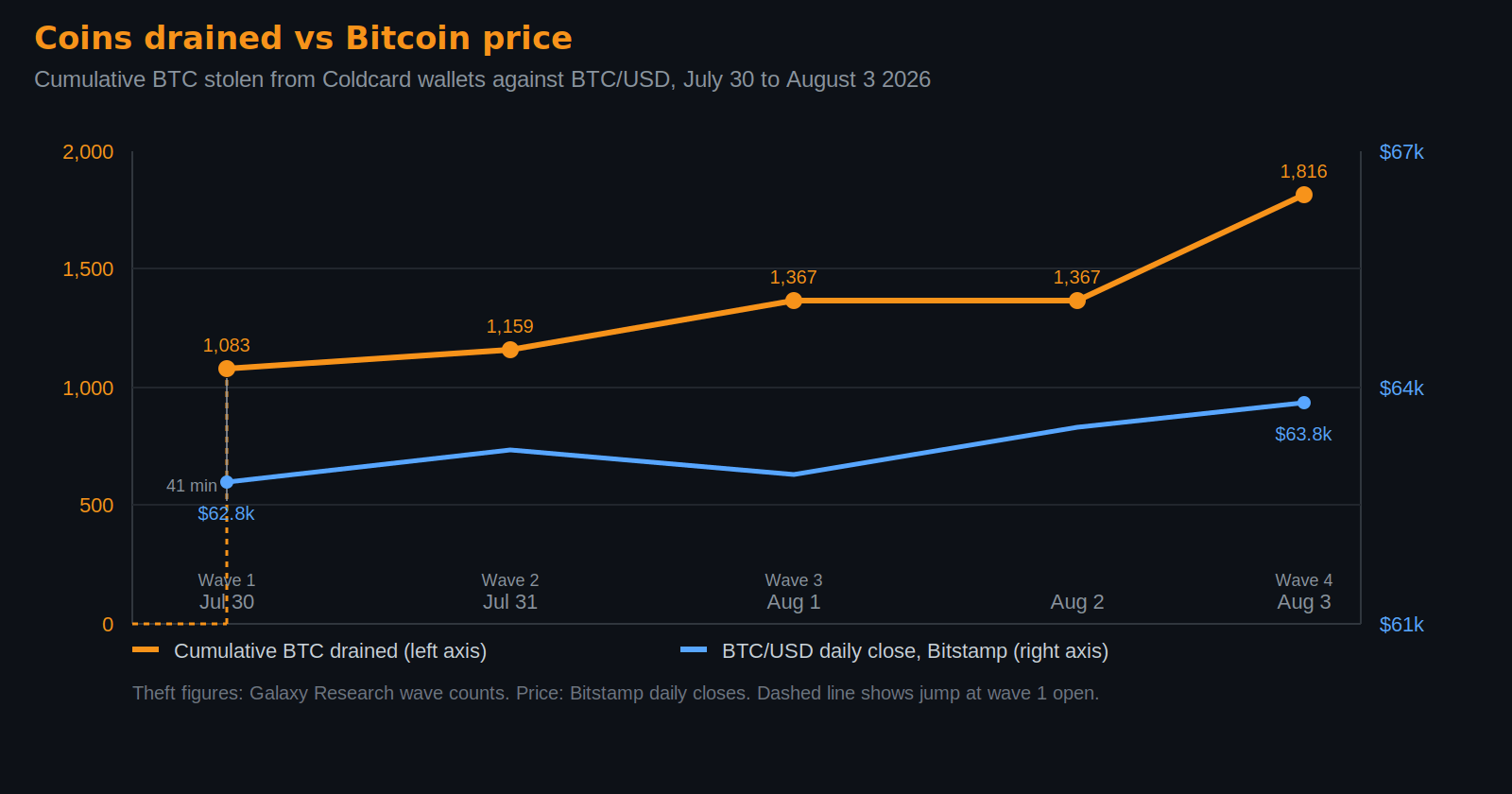
On July 30 an attacker emptied 1,196 Bitcoin addresses in 41 minutes. Four waves later the running total stands at 1,815.75 BTC across 5,294 addresses, with a fourth wave actively running on August 3. The devices holding those coins were Coldcards, the hardware wallet the most security-conscious corner of Bitcoin has recommended for a decade. Bitcoin closed July 30 around $62,800, down less than 1% from the prior session, and was back at $63,781 by August 3. A theft at that scale bought a brief dip inside an existing range.

Forty Bits Instead of One Hundred Twenty Eight

A hardware wallet generates a seed phrase from a dedicated chip built to produce true randomness. The target is 128 bits of entropy, a number large enough that guessing it is computationally impossible for anything humans can build.

A single code change on March 1, 2021 caused Coldcard firmware to silently fall back to a software pseudorandom generator instead of the STM32 hardware chip. On Mk3 devices the effective search space collapsed to roughly 40 bits. Coinkite has confirmed that figure. Every coin taken came from a wallet created after that March 2021 firmware release, which is the strongest on-chain evidence linking the thefts to the bug.

The gap between 128 bits and 40 bits is not a matter of degree. An attacker who could constrain the device UID, timer state and prior RNG-call history could reproduce candidate seeds offline, derive their addresses, and check them against public blockchain data. No physical access to any device was required at any point.

Coinkite CEO Rodolfo Novak apologised publicly and took full accountability, saying the company's review process had failed to catch it. Emergency firmware shipped on July 31. That firmware does not repair an existing seed. A seed created with weak entropy stays weak permanently, on any device, in any wallet software. Coinkite has since halted shipments and destroyed all remaining vulnerable inventory, an acknowledgment that the problem cannot be patched on existing hardware, only replaced.


The Coins Have Not Moved

Here is the detail that explains the muted reaction. Galaxy Research reported that the first three waves of stolen Bitcoin remain unspent in attacker-controlled addresses. Not mixed, not bridged, not sent to an exchange. A fourth wave is moving coins right now as this post publishes.

Galaxy called that unusual for a theft of this size and offered two readings: the operator is waiting for scrutiny to fade, or has no viable path to launder a sum this visible on a public ledger. A decade ago $75 million in stolen Bitcoin would have been through a mixer within hours. Today, with exchange compliance tightened and firms like Galaxy and Chainalysis watching in real time, moving it is the hard part.

What happened here was a change of ownership rather than supply hitting the market, and for price purposes those are entirely different events. Only one of them registers as flow.

That covers the mechanics. It does not explain why the drift since has been sideways rather than sharply lower, which is where the rest of the week comes in.


We read the filings so you can skip the timeline.

Weekly Bitcoin and macro analysis, built from primary sources.

Subscribe

What Was Actually Setting Price

The $116 million was competing for attention with a calendar that had far more direct claims on flows.

The FOMC voted 9-3 to hold rates at 3.50% to 3.75% on July 29, with three officials dissenting toward a hike. Fed Chair Kevin Warsh again declined to give forward guidance. The PCE print on July 31 showed continued cooling, which softened hike expectations at the margin without changing the committee's split.

Spot Bitcoin ETFs posted net outflows of $61.53 million for the week ending July 31, breaking a three-week inflow streak worth roughly $306 million. Fidelity's FBTC led redemptions at $85.19 million. BlackRock's IBIT ran the other way with $869.02 million in weekly inflows.

Senate Majority Leader John Thune confirmed the CLARITY Act would not get a floor vote before the August recess. Polymarket odds on 2026 passage sit near 28%, down from 82% in February.

Three catalysts with direct, measurable links to institutional flows. Against those, a firmware bug affecting a device with a niche installed base competes for headlines, not for order books.

Strategy's Michael Saylor flagged that Bitcoin is sitting almost exactly on its 200-week moving average, a level it has traded above 92% of the time by Strategy's own calculation. That is the company's number rather than an independent study, but the level is real and the market is respecting it.


The Part Nobody Is Pricing

Price gave this one candle. Bitcoin's security assumptions deserve considerably more than that.

The bug lived in open-source code for five years. Public review is supposed to be the defence, and the code was public the entire time. Coinkite says it suspects an attacker used an automated tool to comb old code versions, something Coinkite itself had attempted weeks earlier without finding it.

That is the uncomfortable part. Machine-assisted auditing found a five-year-old flaw before the vendor running the same class of tool did. Every open-source wallet firmware repository is now sitting in the same searchable pile, and the search cost has collapsed.

Victims are organising class-action claims over losses now exceeding $116 million. Legal opinion is split on whether a hardware manufacturer carries product liability for a firmware defect of this kind. Whatever the outcome, it sets the first real precedent for the category.

None of that is in the price. Some of it will be, eventually, in the form of slower self-custody adoption or a repricing of what a hardware wallet warranty is actually worth.


The Argument Happening Underneath

The louder claim circulating is that this marks a turning point for self custody, an assault on the be-your-own-bank position that has anchored Bitcoin culture since the beginning.

The counterargument is more persuasive. People who already cared about self custody will now care more and tighten their setup. People who never cared are still leaving coins on exchanges and were never going to be moved by a firmware advisory. The net behavioural change is probably close to zero, which is a duller conclusion than a revolution but fits how the last several custody scares actually played out.

The concrete prediction worth holding onto is narrower. Passphrases move from optional to standard practice, because a BIP-39 passphrase is the specific thing that protected people here. Dice-roll entropy sits in the same category. Both were treated as advanced-user extras for years, and both just became the difference between a working wallet and an empty one.

A paid hardware device is a convenience layer that a lot of holders quietly reclassified as a security guarantee. The device did the job it was sold to do, right up until one line of firmware meant it had never been doing it at all. Convenience and guarantee are not the same product, and the price difference between them is not what the market has been paying.


What This Sets Up

Watch whether the first three waves move. A transfer toward an exchange or mixer turns a custody story into a supply story, and that is the version that would show up on a chart. An OP_RETURN message has already appeared in one attacker address advertising laundering services and KYC bypass for a 10% fee. That is not the attacker moving coins. It is the wider illicit economy signalling it is ready when they are.

Watch the class-action filings. A ruling on manufacturer liability for a firmware defect would reprice risk across every hardware wallet vendor, not just Coinkite.

Watch the audit wave. If machine-assisted review of old firmware is now cheap enough for an attacker to run at scale, the next disclosure of this type is a question of scheduling, not probability. The vendors with the shortest patch-to-disclosure gap will be the ones that survive the next one with their reputations intact.

For the wider macro setup this week and the dates that matter: this week's Weekly Brief


Sources

Bloomberg Coldcard Bitcoin Wallets Compromised as Hackers Exploit Software Flaw

Fortune Bitcoin Owners Rocked by $116 Million Hack: What We Know About the Coldcard Exploit

The Hacker News Coldcard Hardware Wallet Flaw Linked to $70 Million Bitcoin Theft in 41 Minutes

TheStreet Crypto Coldcard Hack Just Grew to $89M

CryptoTimes Coldcard Hack Enters Wave 4: 449 BTC Swept Live

Blockhead A Five-Year-Old Coldcard Bug Let Hackers Guess Bitcoin Wallet Keys

Bitcoin Magazine Coinkite Releases Fixed Firmware After Coldcard Bug

Bitcoin.com News Coinkite Faces Class Action Threat as Bitcoin Wallet Bug Costs Users Over 1,300 BTC

CaptainAltcoin Bitcoin Spot ETFs End Inflow Streak

Tools We Use

Kraken — Spot and futures on BTC, ETH, and 200+ assets.

Trezor — Cold storage. No internet connection required.

This is market commentary, not financial advice. Nothing here is a recommendation to buy or sell any asset. Do your own research.

Weekly Brief: July Closed Green. August Has a Record to Defend

By BitBrainers Editorial

Bitcoin closed July at roughly $63,000, up about 7% for the month. That makes three consecutive green Julys, a streak no other month can match. August arrives with the worst seasonal record on the board, a CLARITY Act that just lost its Senate floor window, and an ETF flow picture that flipped back to red in the final week of the month. The range from early July is still intact. Whether it holds is the only question that matters this week.

July Ended Green. August Has Never Been Kind.

Bitcoin held the $60,965 floor through July and closed near $63,000. The month printed green for the third consecutive year, which is genuinely rare. Seasonal data going back to 2013 shows August closing red more often than any other month, with a median loss around 8%.

That context does not make a down August inevitable. It does put the burden of proof on the bulls. A three-day close above $66,885 invalidates the bearish seasonal framing and opens a path toward $76,000. Losing $60,965 on a three-day close starts a different conversation, with the $54,000 zone as the next technical reference.

The range has held since early July with no break in either direction on real volume. Until that changes, the range is the trade.


ETF Flows: Three Weeks Up, Then a Friday Flush

Spot Bitcoin ETFs ran three consecutive weeks of net inflows through late July, roughly $306 million across the streak. That reversed June's $4.5 billion outflow month, the worst since the funds launched in early 2024.

The final week broke it. Net outflows hit $61.53 million for the week ending July 31, driven by a sharp move on the last trading day. Fidelity's FBTC led redemptions at $85.19 million. Grayscale's GBTC shed another $52.63 million.

BlackRock's IBIT was the outlier, posting $869.02 million in weekly inflows against the broader red tape. IBIT keeps functioning as the institutional anchor, but even that inflow could not offset redemptions across the rest of the product set.

Three weeks of inflows followed by one red week is not a trend reversal. It is a data point worth watching as August opens.


Flows over noise, every week.

The macro and Bitcoin read that skips the hopium and shows the data.

Subscribe

CLARITY Act: The Window Closed Without a Vote

Senate Majority Leader John Thune confirmed last week that the CLARITY Act will not get a floor vote before the recess. The bill is not dead, but the calendar now works against it in ways it did not in February.

The updated merged text dropped on July 22 at 616 pages, combining the Senate Banking and Agriculture drafts and adding ethics provisions barring covered federal officials from issuing or sponsoring digital assets while in office. Democrats had demanded those provisions for months. The compromise arrived too late for a floor calendar already consumed by a Russia sanctions package and a backlog of nominations.

Polymarket odds on the CLARITY Act becoming law in 2026 have fallen to roughly 28%, down from 82% in February. The bill passed the House in July 2025 with 294 votes and cleared the Senate Banking Committee in May. It has not received a full Senate floor vote. Missing August does not kill it, but it pushes the next realistic window into a fall calendar crowded by election-year politics and must-pass appropriations.

The market impact runs through what stays in place without it. The SEC and CFTC's March 17 joint guidance, classifying 16 digital assets under a five-category taxonomy, remains the operating framework. That guidance can be rescinded by any future administration without a congressional vote. A statute cannot. The longer the bill waits, the longer that reversibility sits under every institutional allocation decision.


The Fed Held. Jackson Hole Is the Next Real Signal.

The FOMC voted 9-3 to hold rates at 3.50% to 3.75% on July 29. Three officials dissented in favor of a hike. Fed Chair Kevin Warsh again withheld forward guidance in the post-meeting statement, consistent with his strategic-ambiguity approach.

The PCE price index released July 31 showed continued cooling, which softened rate-hike expectations at the margin. But three dissents on a hold is not a committee drifting toward cuts. The next FOMC is September 15 to 16. Warsh speaks at Jackson Hole on August 27 to 29, and that speech is the next real read on direction.

Bitcoin barely reacted to the hold. That tracks with how the market has treated Fed decisions all year. The live sensitivity sits in ETF flows and the legislative calendar, not the rate line itself.


Key Levels This Week

Bitcoin near $63,000 entering August 3. Support at $61,400 and $59,070. Resistance at $64,567, with $67,172 as the next target if reclaimed on volume. The $60,965 weekly floor is the structural line.

Price sits below the 20-day moving average inside a descending channel. ETH trades near $1,865 with supports at $1,807 and $1,717. XRP at $1.06, near its own channel support around $1.05.

None of the three have confirmed a breakout. All three are watching the same variables: the jobs print, ETF flows, and whatever the Senate does before it leaves town.


The Week Ahead: Dates That Matter

This is a calendar-heavy week where the macro prints and the Senate clock overlap. The dates below are the ones capable of moving price.

Date Event Why It Matters
Mon Aug 3 Senate floor opens Published schedule lists only a spending-bill vote. No CLARITY Act action.
Wed Aug 5 Cloture filing deadline Last day to file ordinary cloture for a Friday procedural vote on CLARITY.
Fri Aug 7 July NFP, 8:30am ET Consensus around 87,500 vs June's 57,000. Below 100K prices in a September cut. Above 150K pushes yields up.
Fri Aug 7 CLARITY recess cutoff Practical last chance for a 2026 Senate vote before the break.
Mon Aug 10 Senate recess begins State work period starts. Legislative window for crypto closes until fall.
Wed Aug 12 July CPI First inflation read after the July hold. Feeds directly into September rate positioning.
This week Palantir, AMD earnings Read as AI-demand signals. Palantir consensus is $1.81B revenue, up 81% YoY.

Beyond this week, Warsh speaks at Jackson Hole on August 27 to 29, and the next FOMC lands September 15 to 16. Both sit outside the immediate window but frame the back half of the quarter.

For last week's setup and what we were watching heading in: Weekly Brief: The Week the Market Celebrated Too Early


Sources

CaptainAltcoin Bitcoin Spot ETFs End Inflow Streak, Week of July 27-31

US Bureau of Labor Statistics Employment Situation Release Schedule, July 2026

CryptoNews CLARITY Act Senate Delay Drops 2026 Odds to 35%

CryptoSlate CLARITY Act Vanishes From Monday's Senate Schedule

CryptoRank Bitcoin, Ethereum and XRP Price Prediction for August 2026

CNBC Stock Market Next Week: Outlook for Aug. 3-7, 2026

BeInCrypto Bitcoin Price Prediction for August 2026: Whales Bet Against a 4-Year Losing Streak

Tools We Use

Kraken — Spot and futures on BTC, ETH, and 200+ assets.

Trezor — Cold storage. No internet connection required.

This is market commentary, not financial advice. Nothing here is a recommendation to buy or sell any asset. Do your own research.

The War in the Price of Everything

Illustration: a crude tanker on Gulf water. The strait Iran mined in February carries a fifth of the world's oil.

The War in the Price of Everything