By BitBrainers Editorial
That timing is not random. Here is the connection.
Japan's Bond Market Just Hit a 29-Year High
Japan's 10-year government bond yield climbed to 2.84% today, its highest level since the late 1990s, a 30-year high. That number matters well beyond Tokyo.
Japan is the largest foreign holder of US Treasuries, holding approximately $1.2 trillion. For three decades, near-zero domestic rates meant Japanese investors had every incentive to park savings abroad in higher-yielding assets like US bonds, equities, and risk assets. That flow quietly helped keep global yields lower than they would otherwise be.
As domestic Japanese yields rise, that logic reverses. Japanese institutions earn 2.82% at home now. The incentive to hold US Treasuries or take on risk abroad weakens. Data already reflects the shift: Japanese investors have been net sellers of foreign securities to the tune of approximately $25 billion since the start of 2026.
The Carry Trade and What Unwinds When It Breaks
The mechanism is straightforward. You borrow yen at near-zero rates. You convert to dollars and buy higher-yielding assets globally. US bonds, equities, Bitcoin. You pocket the difference.
When Japanese yields rise, that trade stops working. Borrowing in yen gets more expensive. The yen strengthens as capital flows back home. Anyone who borrowed yen to fund positions faces higher repayment costs and a currency moving against them. They sell assets to repay the yen debt.
Not because anyone is bearish on Bitcoin. Because the funding leg is broken.
Estimates on total yen carry exposure vary. Figures of $20 trillion in connected positions have been cited across institutional research, including from the Bank for International Settlements. Not all of that is in Bitcoin. But when liquidity tightens globally, risk assets move together, and Bitcoin has historically been one of the first to reprice.
Why This Complicates the Bullish Setup
Earlier today we published the case for why the US bond market was already pricing in rate cuts — inflation breakevens below 2%, weak jobs data, oil normalizing. That case is real. You can read the full breakdown in our inflation and FOMC preview from this morning.
The Japan story does not invalidate that case. It adds a risk layer the US data cannot resolve on its own.
The Federal Reserve sets short-term US rates. It does not control what Japanese investors do with their $1.2 trillion in Treasury holdings. If Japanese repatriation continues and reduces demand for US Treasuries, long-term US yields can rise independently of whatever Warsh says on July 28. That is precisely what CNBC's deVere Group pointed out earlier this year: "Markets still appear to be behaving as if Japanese volatility is a temporary disturbance rather than a regime shift. We believe that is a mistake."
The macro layer most posts skip.
Every Monday we cover what actually moves Bitcoin. Key levels, no noise, free.
Subscribe FreeWhat the Failed Breakout and Japan Tell You Together
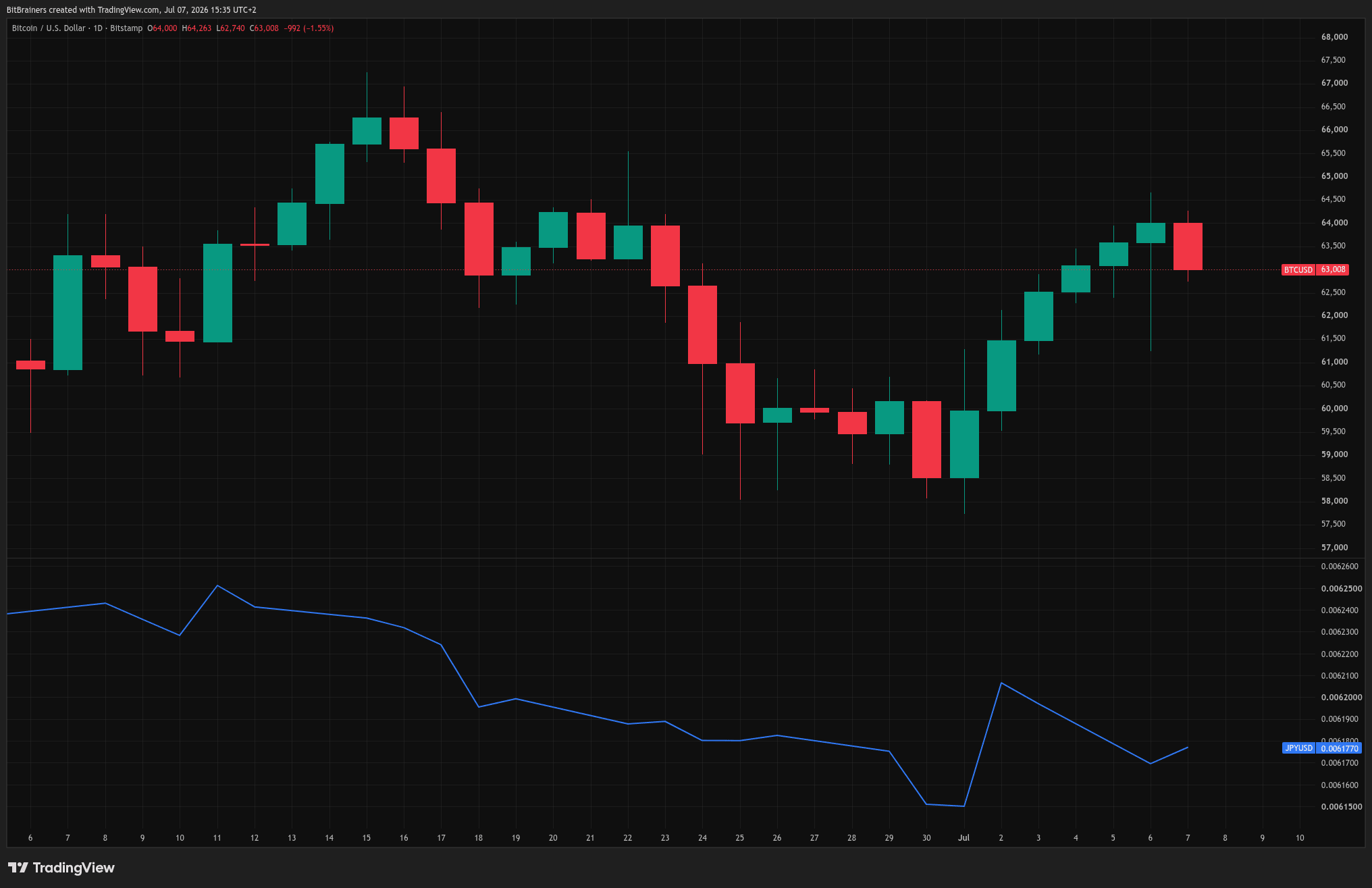
Bitcoin touching $64,033 and immediately pulling back below $63,800 on the same day Japan's yield hit a 30-year high is a data point. One session does not confirm anything. But it illustrates the tension cleanly.
The US macro setup of weak jobs, falling inflation breakevens, and soft oil created the conditions for the push toward $64K. The Japan carry risk is the structural headwind that makes holding above $63,800 harder than the US data alone would suggest.
Short liquidations dominated at $86.6 million versus $54 million longs, per Coinglass, confirming genuine short covering drove the move. Open interest at $47.71 billion with moderate funding rates shows fresh leverage without euphoria. The technical push was real. The pullback is equally real.
What Decides It
Is Japan the real reason Bitcoin couldn't hold $64K today? Possibly. One session is not confirmation. But the timing of the pullback and the yield move is a data point worth holding.
Wednesday's FOMC minutes at 2pm ET remain the nearest catalyst. A dovish read confirms the US macro tailwind and gives Bitcoin room to extend toward $66,000 to $67,600, the next resistance zone above the flip line.
A hawkish read, combined with continued Japanese yield pressure, makes the $63,800 flip line a false breakout and reopens the range below it.
The Japan story is not resolved by Wednesday. It is a slower-moving structural risk that will follow Bitcoin into the second half of July regardless of what the minutes say.
Watch USDJPY as much as the FOMC minutes this week. If the yen strengthens while US yields hold, the carry unwind is the story. If USDJPY holds steady, the Japan risk stays contained and the US macro tailwind takes over.
Sources
CoinDesk: BTC's recent macro relief faces a challenge from Japanese interest rates
Trading Economics: Japan 10-year government bond yield — 2.82%, highest since May 1997
TD Economics: What Happens in Japan May Not Stay in Japan
CNBC: Japanese bond yield rise could shake up borrowing costs in the U.S.
StoneX: Japan Yield Curve Pressure Threatens Global Carry Trades
Disclosure: This article is for informational purposes only and is not financial advice. We may earn commissions from affiliate links. Always do your own research before making investment decisions.