By BitBrainers Editorial
The Numbers, Side by Side
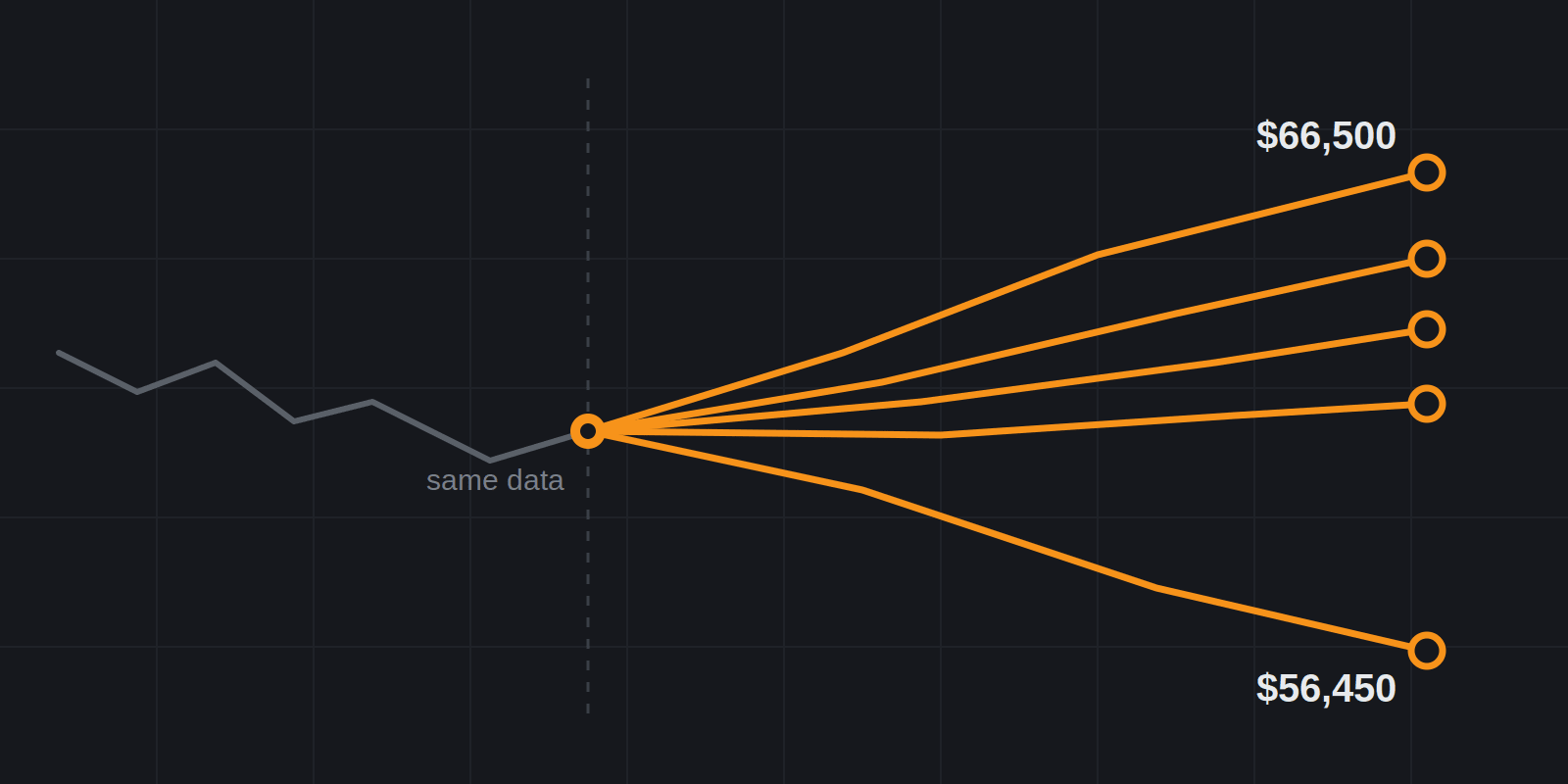
Finbold ran the test with Bitcoin trading around $61,200. Anthropic's Claude came in most bullish, projecting an 8.67 percent climb to $66,500 by month end. OpenAI's ChatGPT-5.2 called a 5.4 percent rally to $64,500. Grok 4.1 landed at $63,501, a 3.77 percent gain. DeepSeek saw an essentially flat month, up 1.31 percent to $62,000. And Gemini 3 Flash broke from the pack entirely, forecasting a 7.76 percent drop to $56,450.
Same price data. Same technical indicators. Same date. One model says Bitcoin gains eight and a half percent, another says it loses nearly eight.
To be fair about the baseline: human analysts produce at least this much dispersion on Bitcoin targets, often more. Citi just cut its 12-month target to $82,000 in the same week other desks are defending six figures. Dispersion is not the AI-specific failure here. The difference is in the delivery. A human strategist wraps the number in scenarios, probabilities, and an implicit admission that this is an educated guess. The models deliver theirs with uniform, unhedged confidence, because sounding authoritative is what they are optimized for. The spread is normal. The false certainty attached to every point in it is the new problem.
A separate and larger experiment last week makes the point harder to dismiss. Bitcoin.com News put the same stripped-down question to 14 AI chatbots, deliberately removing the supporting context so each model had to produce an unbiased forecast across 30-day, 90-day, and year-end horizons. The answers came back as ranges wide enough to be unfalsifiable. One flagship model offered a year-end window of $50,000 to $75,000. Another gave $55,000 to $75,000. A forecast that spans a 50 percent move in either direction is not a forecast. It is a refusal to be wrong dressed up as analysis.
When They Agree, It Gets Worse
The counterintuitive part: model agreement is not more trustworthy than model disagreement. In June, ChatGPT and Claude were separately asked where Bitcoin bottoms by Q4 2026, and their answers landed within $2,500 of each other, $54,500 and $52,000 respectively. That looks like signal. Two independent systems converging on the same zone.
Except they are not independent. Both models were trained on overlapping snapshots of the same internet, both were fed the same public market data, and both leaned on the same widely published frameworks, realized price for one, miner production cost for the other, both of which have been standard crypto-analyst furniture for years. Even the outlet reporting the convergence flagged the open question of whether it reflects genuine signal or simply shared training data and identical inputs. When two students copy from the same textbook, matching answers tell you about the textbook, not about the exam.
Numbers checked. Narratives questioned.
The Macro brief that reads the data before the hype.
Subscribe FreeWe Ran Our Own Version of This Test
Back in June we tested this mechanism directly rather than taking anyone's word for it. We asked several leading models for a Bitcoin allocation recommendation and got the same answer from all of them: a cautious 2 to 15 percent position, dollar-cost averaged in, medium risk. That uniformity is not five systems independently reasoning their way to the same conclusion. It is the answer a compliance-minded advisor is trained to give, the one that never gets anyone sued, reproduced across every model because they were all trained on the same body of careful, liability-aware financial writing.
Then we corrected one model's stale price data and watched its recommended allocation triple, from a 1 to 5 percent range up to 5 to 15 percent, off a single number changing in its context. Nobody managing real money triples position size over one price correction. Whatever produced that jump, it was not conviction. The model latched onto whatever drawdown figure it believed it was looking at and rebuilt its entire answer around it, with full confidence both times.
That is the mechanism under this week's ten thousand dollar spread. These systems do not hold a thesis about Bitcoin that survives from one question to the next. Each answer is generated fresh, shaped by whatever is loudest in the prompt, and delivered with the same fluent certainty whether the underlying reasoning is sturdy or nonexistent. Fluency and correctness are not connected, and price forecasting is where that disconnect is most expensive to ignore.
The Spread Is the Information
None of this means the models are useless. It means the test itself measures the worst way to use them. Short-term crypto moves are driven by things a single chart rarely captures: macro liquidity, ETF flows, whale wallet movements, regulatory headlines, leverage cascades, corporate treasury actions. Pure visual technical analysis is a weak signal in the best of times, so handing a model a chart and asking for a price is asking it to be confident about insufficient input. It will oblige, because a system trained to sound authoritative papers over the gap rather than admitting it.
The stronger configurations exist and almost nobody publishing these forecast pieces uses them: feed the model on-chain data, filings, and news flow together instead of a chart in isolation, give it code execution to build custom indicators rather than eyeballing MACD, or run multiple models against each other in structured debate and study where they break ranks. Used that way, a model is a research multiplier. Used as a chart oracle, it is a random number generator with excellent grammar.
Read properly, this week's forecasts do carry one honest piece of information: the spread itself. Five frontier systems given identical data disagree by more than 16 percent of Bitcoin's price. That is a direct measurement of how little predictive structure exists in the chart right now, published accidentally by the companies most motivated to hide it. The disagreement is the finding.
Meanwhile the thing that actually moved markets this week was not in any model's forecast. It was a mechanical trigger, Strategy's valuation crossing below the value of its own Bitcoin, that had been sitting in an SEC filing since last August. We covered it here: The Premium Died First. The Framework Was Already Written. No chatbot flagged it in advance. It was findable the whole time by anyone reading filings instead of asking for price targets.
How to Read the Next Forecast
Practical rules for the next time an AI price prediction crosses your feed.
- Check the spread before the number. If the same test produced targets ten thousand dollars apart, any single model's target is noise wearing a suit
- Treat convergence with the same suspicion as divergence. Models trained on the same data agreeing is expected, not informative
- Watch what happens when inputs change. An answer that swings hard on one corrected number was never analysis
- Judge the input before the output. A forecast built on a chart alone was starved of the things that actually move price. Rich input, filings plus flows plus on-chain data, deserves more attention than any chart-only oracle
- Use the models for what they are built for: reading filings, compressing data, arguing against your position. The July 31 forecasts will be graded in four weeks, and we will check the scores
Sources: Finbold AI predicts Bitcoin price for July 31, 2026, Bitcoin.com News 14 AI Models Including Claude, ChatGPT and Grok Predict Bitcoin's Price Outlook, CCN via Yahoo Finance Can AI Call the Bitcoin Bottom?
Disclosure: This is analysis, not financial advice. We hold BTC. Do your own research before making investment decisions.