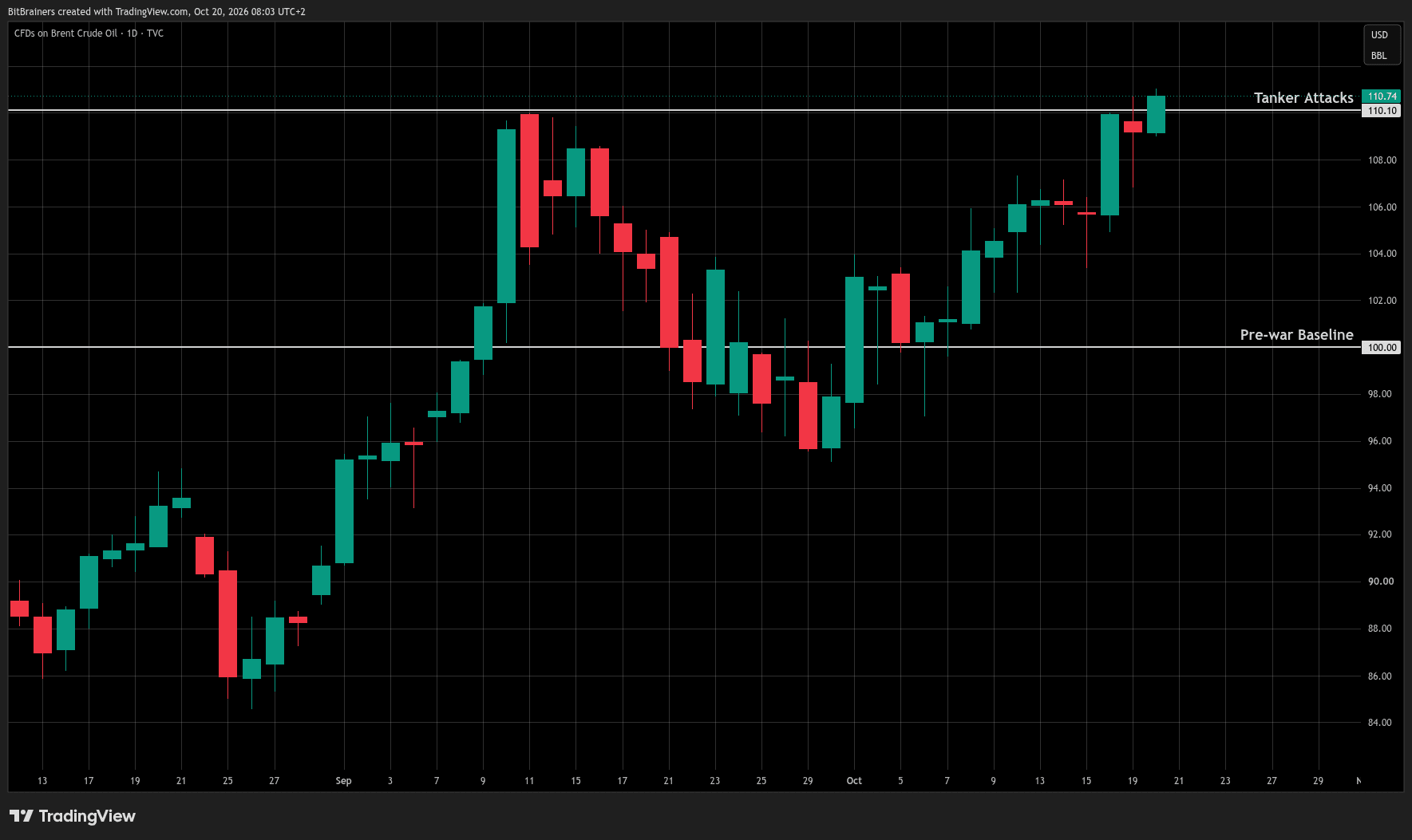
Brent Crude Oil chart, October 2026. Source: TradingView (TVC). Chart: BitBrainers.
By BitBrainers Editorial
On Monday Brent fell about 2% to $107.45 after President Trump waived sanctions on Russian oil. The market priced the promise of additional supply and sold the headline.
The physical constraint did not change. Flows through the Strait of Hormuz were running near 11.6 million barrels a day in the week to October 13, against a pre-war baseline of roughly 17.15 million. That is still about 5.5 million barrels a day missing from the global system. On Friday, after another week of tanker attacks, Brent futures briefly touched $110, its highest since May.
We have already seen what happens when the strait actually reopens. In June a deal that restored Hormuz flows took Brent to $72 by early July. The price climbed back above $100 as the disruption returned. Oil has followed the barrels moving through the strait, not the paperwork signed in Washington.
The Russia waiver removes the threat of tariffs on buyers of Russian oil. A separate diesel deal promises 300,000 tonnes immediately, then larger volumes later. At roughly 7.45 barrels a tonne the first tranche is about 2.2 million barrels, less than half of one day of the shortfall still missing from Hormuz. It adds promised barrels to the tape while the physical shortage remains intact.
This is why the Fed is stuck. The physical shortage in Hormuz keeps oil above $100. Expensive oil keeps inflation hot. If inflation stays hot, the Fed cannot cut rates. They already raised in September, and a December hike is still on the table. As long as Brent stays above $100, yields stay high, and the Fed has no room to move. The market is pricing the waiver as a solution, but the physical shortage remains untouched.
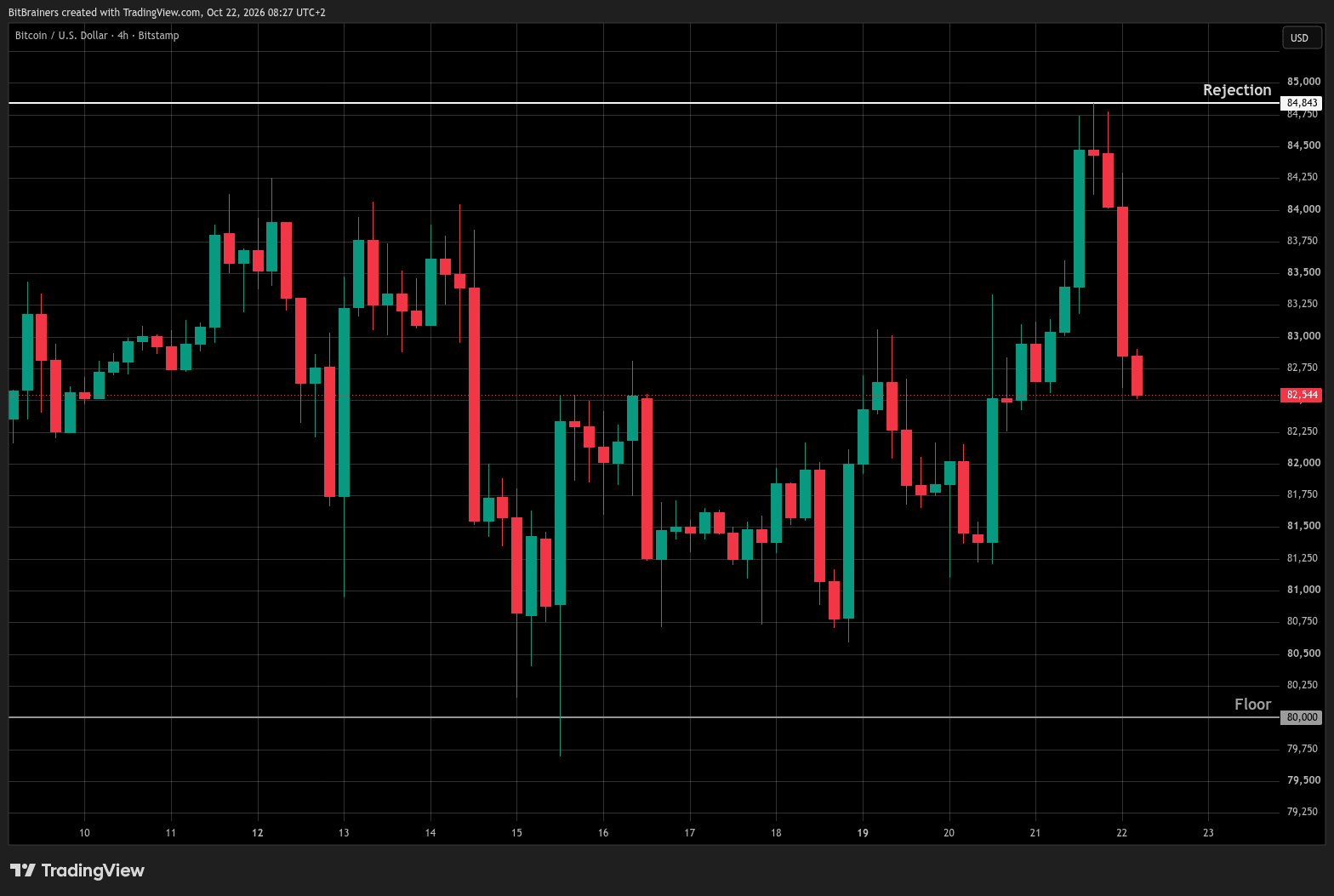
For Bitcoin, this means the upside remains capped. When oil falls on headlines, yields ease and Bitcoin gets room, as it did Monday. But if Brent stays above $100 because the strait is still blocked, the 10-year yield stays high, and Bitcoin will keep getting rejected at $83,000.
Relief for risk assets requires either weekly Hormuz flows climbing back toward the 17 million barrel range, or Brent sustainably breaking below $100. Until one of those happens, the waiver is a headline, and Bitcoin remains stuck under the ceiling.
This is market commentary, not financial advice. Nothing here is a recommendation to buy or sell any asset. Do your own research.
SOURCES
Reuters — Brent crude pricing and Russia sanctions waiver.
Kalkine — Strait of Hormuz flow data (11.62 million bpd).
TradingView — Brent Crude chart.
Bureau of Labor Statistics — CPI and PPI data.
Federal Reserve — FOMC calendar.