₿ BTC Loading... via Binance

Saturday, June 27, 2026

Money Got Binance in the Room. A Record Kept It at the Door.

BitBrainers - The MiCA Filter

By BitBrainers Editorial

Three days before the MiCA enforcement deadline, the largest crypto exchange in the world withdrew its license application in Greece. Binance didn't fail because the application was too expensive, or because it lacked lawyers, or because it didn't understand the rules. It failed because of the part of compliance you can't pay your way out of: a record.

The Numbers Behind The Deadline

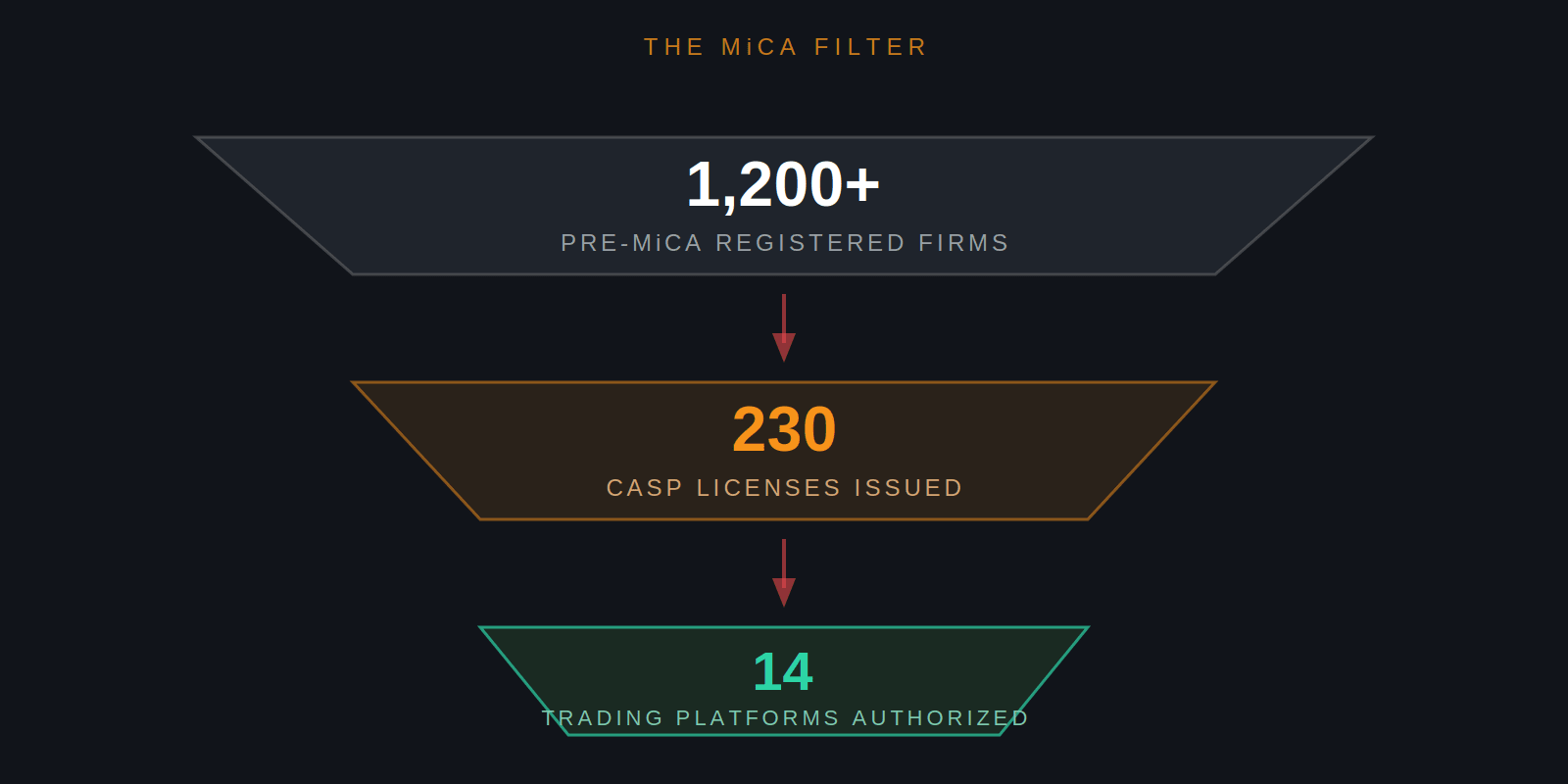
July 1, 2026 ends the 18-month transitional period under the EU's Markets in Crypto-Assets regulation. Around 230 firms now hold full CASP authorization across the bloc. Of those, only about 14 are cleared to run an actual trading platform. The pool they came out of was more than 1,200 firms registered under the old national rules.

That's a 19% conversion rate at the broad level, and roughly 1% at the trading-platform level. Ten EU member states haven't issued a single license. Estonia, which had 641 registered crypto firms in 2021, was down to about 40 by early 2025. France's regulator estimates that 40% of its registered providers never even submitted a MiCA application. Poland's national implementation law was vetoed for a third time in June, leaving Polish firms with no domestic path at all.

None of that is a story about firms running out of money. It's a story about firms running out of room.


What Money Couldn't Solve

The compliance cost of a MiCA authorization runs between €250,000 and €500,000 according to French regulators. For a small firm in Tallinn, that's existential. For Binance, it's a rounding error. So when Binance pulled its Greek application on June 24, the question wasn't budget. Reuters reported the Hellenic Capital Market Commission was preparing to reject the file. The reasons named in the reporting weren't capital or product gaps. They were past money-laundering penalties and corporate-structure issues, the kind of legacy concerns a fresh check can't paper over.

Binance has navigated this before. It holds a full MiCA passport through an EU entity it redomiciled and rebuilt in 2025, after rejections elsewhere on similar grounds. The Greek withdrawal isn't proof Binance can't get licensed; it already is, elsewhere. It's proof that even with the world's deepest war chest, you don't get a clean run at every jurisdiction. Some doors stay closed for reasons that pre-date the application.

That's the part of MiCA the headline numbers obscure. The framework didn't filter for size or balance sheet. It filtered for record. A clean compliance history, a manageable corporate structure, and the willingness to relocate to a jurisdiction that wants you became the actual currency.

This is the kind of read you get weekly.

No hype. No "this coin will 100x." Just honest macro on Bitcoin, gold, and the market.

The Map MiCA Drew

Look at where the licenses actually went, and a clear geography emerges. Germany leads with around 53 authorized entities. The Netherlands sits at 25 or 26. France, Malta, Cyprus, Ireland, and Luxembourg fill out most of the rest. Almost every major exchange that survived chose Ireland, Luxembourg, Malta, or the Netherlands as its EU base.

That's not random. Those are the jurisdictions that built a regulator willing to engage early, set realistic timelines, and process applications at scale. The countries that issued zero licenses weren't all small or hostile to crypto. Some were simply slow, understaffed, or politically conflicted about whether to compete for the business at all. Poland is the extreme case, but it's not the only one.

For users, that produces a strange map. After July 1, where you can legally trade crypto inside the EU depends less on where you live and more on where your exchange chose to redomicile. A Polish trader using a Polish-registered firm has a worse setup than a Polish trader using a firm passported in from Ireland, even though both users are sitting in the same country.


The Quiet Part Of The Stablecoin Story

The most visible casualty so far has been Tether. Tether didn't apply for MiCA authorization, and EU-licensed venues that continue listing non-authorized stablecoins risk losing their own CASP licenses. Coinbase began delisting USDT for EEA users in December 2024. Kraken followed in early 2025. Crypto.com delisted it alongside nine other tokens. Binance geofenced its EEA USDT pairs.

What gets less attention is what filled the gap. Circle's USDC and EURC are the only top-10 stablecoins fully MiCA-compliant, which puts them in a near-monopoly position for compliant euro and dollar exposure inside the EU. That's not a small consequence. It's the regulatory equivalent of being handed the only umbrella when it starts raining. Whether that's a feature or a flaw of MiCA's design depends on how comfortable you are with one issuer holding that much of the regulated market.

On The Radar

Watch how unlicensed firms communicate to EU users in the next 72 hours. France's AMF has explicitly warned that operating without authorization after the deadline exposes firms to criminal prosecution, so legal-quality wind-down notices should accelerate. Watch where Binance lands next on the MiCA application front, after Greece. And watch whether the European Commission's proposal to centralize CASP supervision inside ESMA itself gains ground after July 1, which would be a structural shift away from the current member-state model and is already being opposed publicly by Malta.


Sources:
Bitcoin.com News: MiCA Deadline Hits July 1 as Unlicensed Crypto Platforms Face EU Shutdown Risk
Yahoo Finance: July 1 MiCA Deadline Looms: More Than 80% of EU Crypto Firms Still Unlicensed
Kraken Blog: MiCA Enforcement Begins July 1: What It Means for Institutional Counterparties

Disclosure: This is not financial advice. We hold positions in BTC and discuss our own trades publicly, wins and losses.

Absorption or Exhaustion: What BTC's Slow Bleed to $58K Is Telling Traders.

BitBrainers - Absorption or Exhaustion

By BitBrainers Editorial

Bitcoin has now made the trip down to the $60,000 zone twice this year, and the two trips don't look anything alike. The first one was fast and ugly. This one has been slow, quiet, and is still going. That difference matters more than the price action itself.

Same Floor, Different Speed

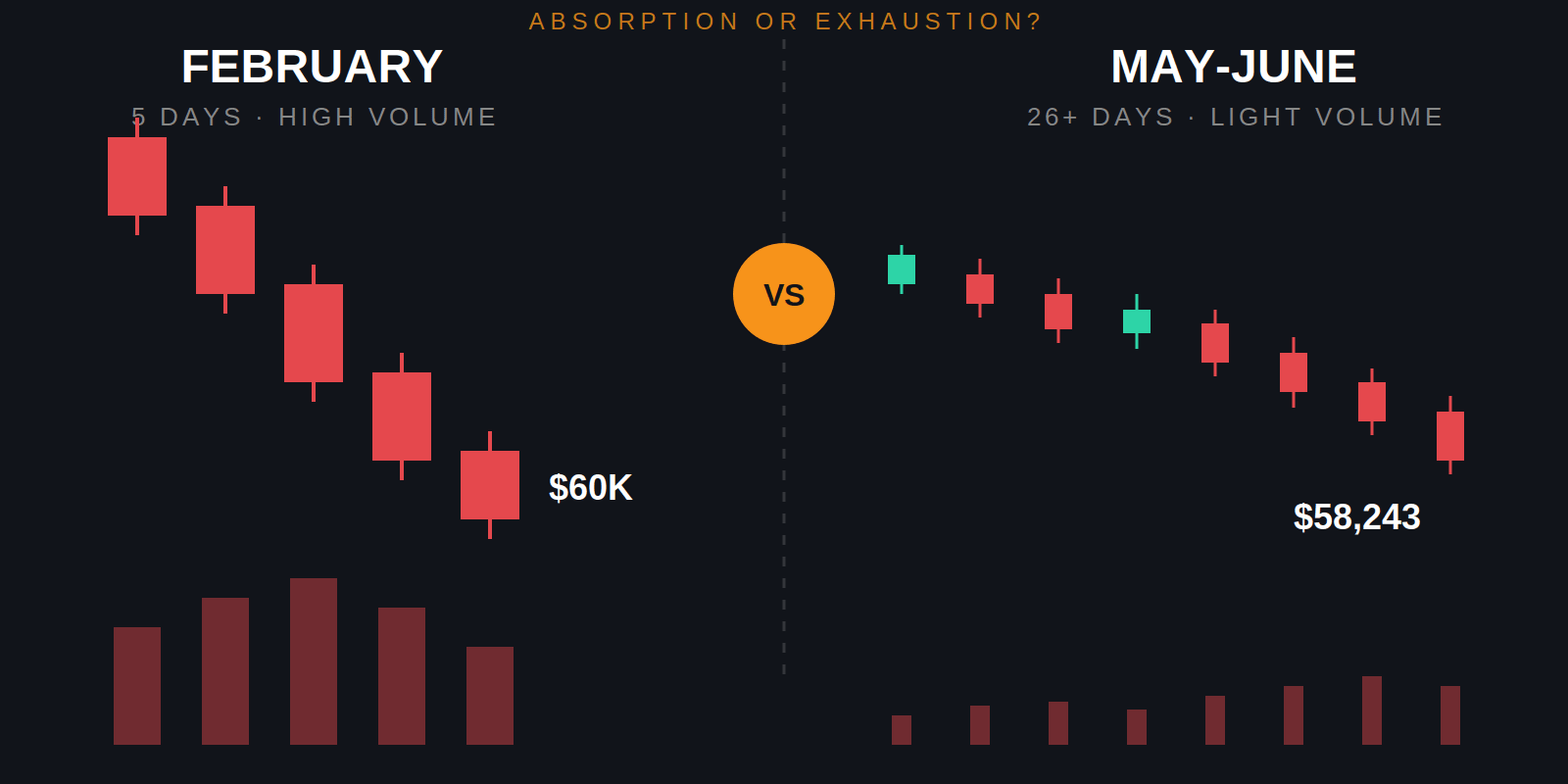
In February, Bitcoin dropped from the low $80,000s into the $60,000 zone in about five trading days. Big red candles, heavy volume, the kind of move that liquidates leveraged longs in bulk rather than asking nicely. That was a flush.

Bitcoin then recovered, climbed back into the $73,000-$77,000 zone by May, and rolled over again. This time the same trip, roughly the same distance, took around 26 days instead of five. And the volume behind it was a fraction of February's. Then came a bounce toward $67,000 that failed to hold, followed by an 11-day grind lower into a $58,243 low this week, again on volume lighter than the leg before it.

Same destination, three different speeds, each one slower and quieter than the last.


What Slower Usually Means

In Wyckoff-style market reading, this pattern has a name: absorption. The idea is straightforward. February's flush forced out the most leveraged, most panic-prone holders in one violent move. If most of that supply already left the market then, there's simply less forced selling left to do the same job a second time, which would explain why this leg needed five times longer to cover the same ground.

That's the optimistic read. It is not the only one. Light volume on a slow decline is just as consistent with the opposite story, buyers who have no urgency to step in, letting price drift lower because nothing is forcing them to defend a level. Both stories produce the exact same chart. The volume tells you effort is dropping. It doesn't tell you whose effort.

This is the kind of read you get weekly.

No hype. No "this coin will 100x." Just honest macro on Bitcoin, gold, and the market.

What Actually Moved This Week

The trigger behind this latest leg wasn't crypto-native. It was the May PCE inflation print, the Fed's preferred inflation gauge, coming in at 4.1% year-over-year, the hottest reading since 2023 and more than double the Fed's 2% target. Markets immediately repriced the odds of a December rate hike to around 77%, with Bank of America now modeling three hikes in 2026 and Deutsche Bank expecting two starting as early as September.

That kind of shift is bad news for anything priced on the assumption that money stays cheap. The inflation surprise triggered roughly $1.48 billion in crypto-wide liquidations within 24 hours, with Bitcoin alone accounting for about $665 million of that. It's also landing on top of six weeks of spot Bitcoin ETF outflows, nearly $6 billion over the past 30 days, the largest monthly exodus of the year.

None of that is a Bitcoin story. It's a rates story that Bitcoin happens to be sitting inside of. There's a second force working in the same direction: speculative capital that would normally chase crypto on a good week has been rotating into AI infrastructure stocks instead. The Nasdaq 100 erased an intraday rally on the same inflation news that hit Bitcoin, and the two markets have tracked each other closely all year. When the trade everyone wants exposure to is chips and data centers, Bitcoin doesn't need a crypto-specific reason to get starved of fresh demand. It just needs to not be the thing winning that week.


What Would Actually Settle This

A chart can't prove which read is right. Only a reaction can. If $67,000 gets reclaimed and held on real volume, the absorption case gets stronger. If price keeps bleeding lower and the next leg down comes on rising volume instead of fading volume, that's the distribution case confirming itself instead.

The specific thing to watch for is what traders call a spring: price briefly punches below a level everyone's watching, then snaps back above it fast, on rising volume, trapping the people who shorted the breakdown. A bounce that reclaims a level but fades back into the range on light volume isn't that. It has to hold, with volume expanding behind it, not just touch the level and retreat.

Right now neither has happened. Bitcoin is sitting at the lows, the bounce attempts have been weak, and demand hasn't shown up in any way that forces a real reaction. That's not a bottom call. It's a "the chart got interesting, prove it" situation, and so far nobody's proven anything.

On The Radar

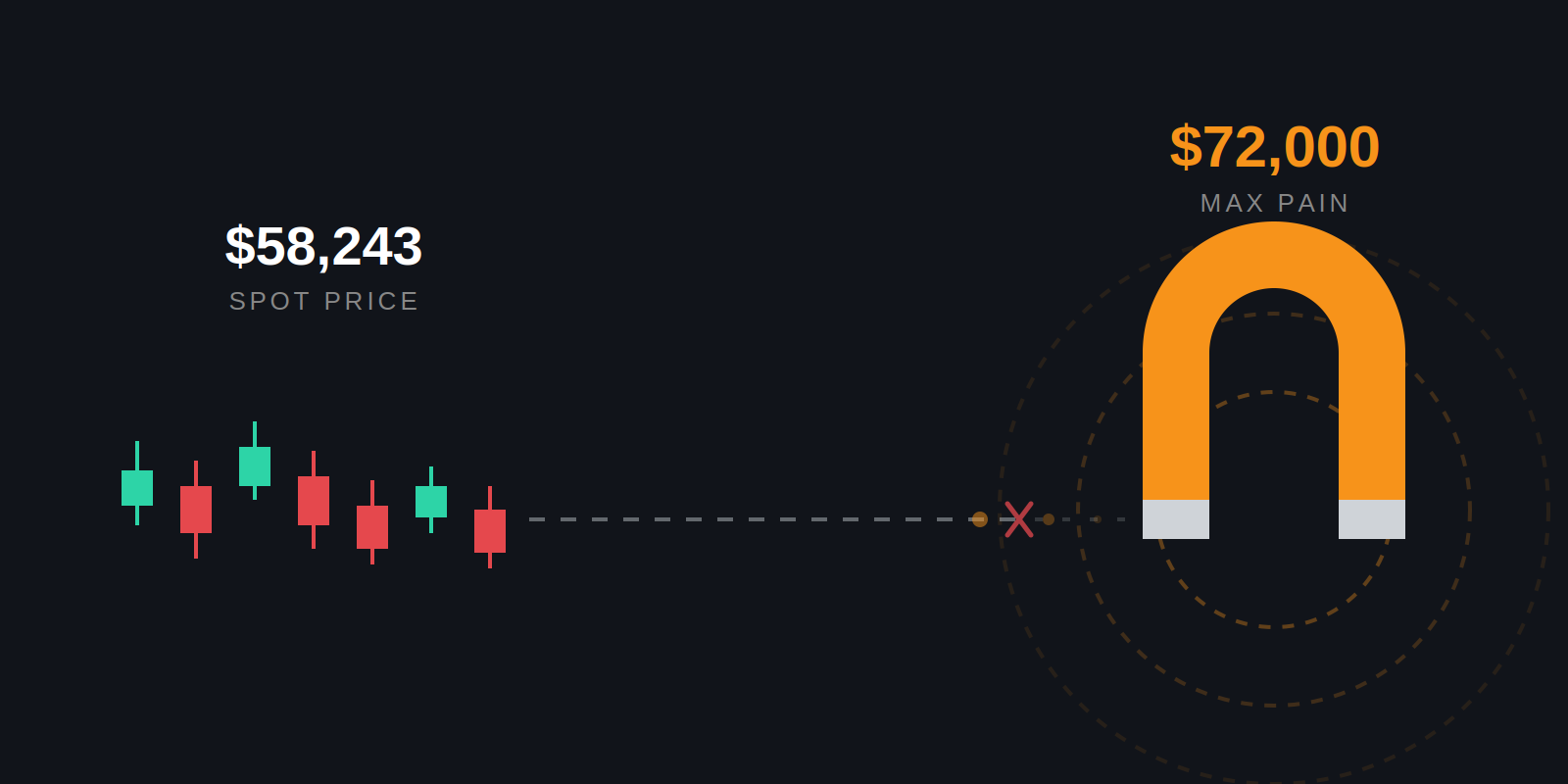
Watch $67,000 on the next bounce attempt, and watch whether volume rises or keeps fading on the next leg in either direction. Friday's $10 billion Deribit options expiry also resets a chunk of the positioning that's been shaping this range, and that kind of reset doesn't always settle in a single day. Pinning or volatility effects from it can keep showing up for several days after expiry, not just on the day itself. More on the expiry mechanics in our max pain breakdown.


Sources:
CryptoTickerCrypto Prices Today: Why Bitcoin Slipped Below $60,000 Again
CoinStats AIBitcoin (BTC) Daily Market Analysis

Disclosure: This is not financial advice. We hold positions in BTC and discuss our own trades publicly, wins and losses.

You Might Also Like: The Fed Chair Who Loved Bitcoin

Friday, June 26, 2026

Strategy Says Its Bitcoin Covers The Dividend For 32 Years. The Real Number Is Different.

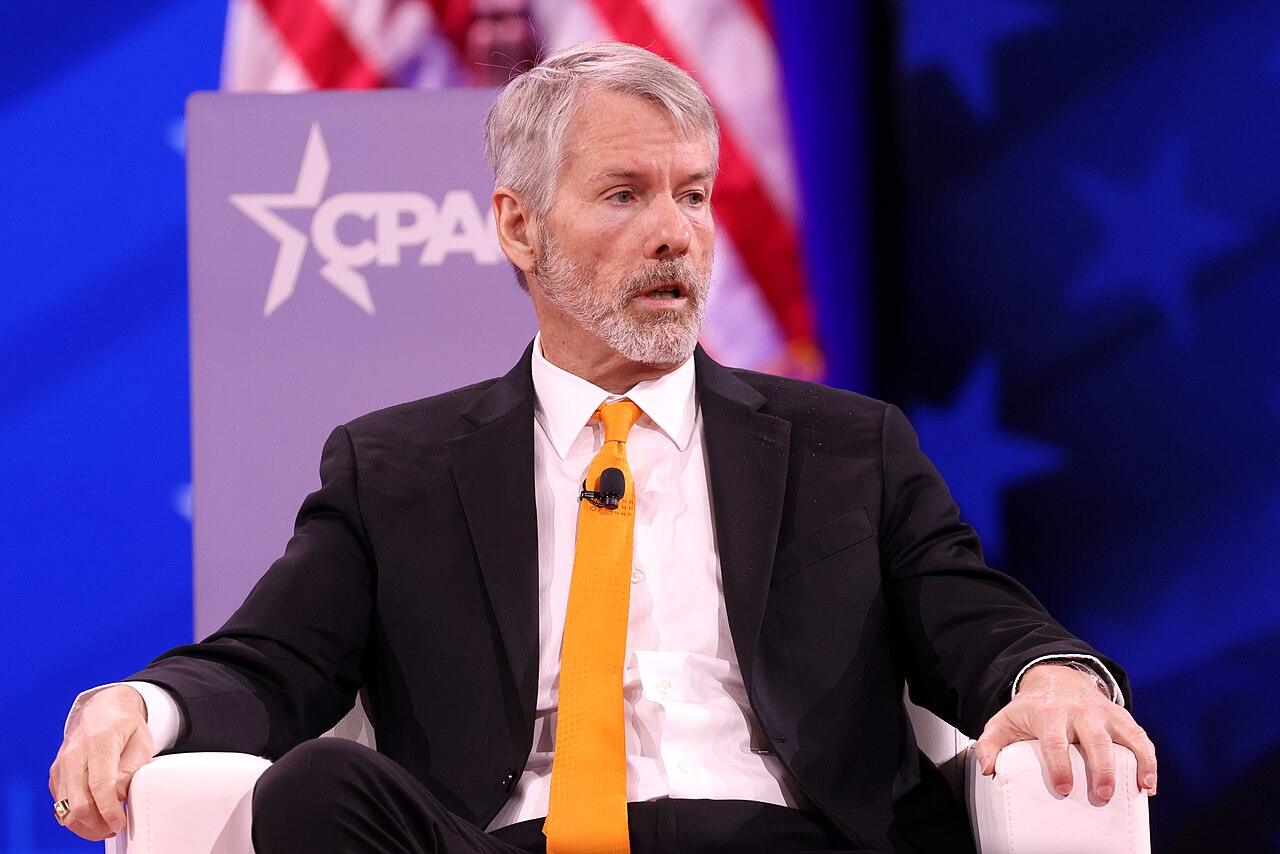
Michael Saylor speaking at CPAC 2025, photo by Gage Skidmore

Photo: Gage Skidmore, CC BY-SA 2.0

By BitBrainers Editorial

Strategy says its Bitcoin reserve covers STRC's dividend for 32 years. CryptoQuant says the real number is 14 months. Both claims came from real math. Only one of them survived contact with this week's price action.

Thursday, June 25, 2026

What Is Max Pain in Bitcoin Options and Why It's Not Working This Time.

BitBrainers - Max Pain Theory Bitcoin Options

By BitBrainers Editorial

Every quarter, somewhere on crypto Twitter, someone explains that Bitcoin's price is about to get pulled toward a number called "max pain." It sounds like inside knowledge. Most of the time it's a theory doing a lot of work it can't actually back up, and this week is a clean example of it failing in real time.

The Fed Chair Who Loved Bitcoin

BitBrainers - The Fed Chair Who Loved Bitcoin

By BitBrainers Editorial

Kevin Warsh personally owned stakes in more than thirty crypto assets before he became the most powerful man at the Federal Reserve. He once called Bitcoin "the newest, coolest software" and compared it to gold for investors under forty. Then he chaired his first policy meeting as Fed Chair, and Bitcoin had one of its roughest stretches in months.

The CLARITY Act Got Its Ethics Clause. It Expires With Trump's Term.

By BitBrainers Editorial Senate Democrats spent months refusing to move the CLARITY Act without an ethics provision. They got one. It ...

The CLARITY Act Got Its Ethics Clause. It Expires With Trump's Term.