By BitBrainers Editorial
What Max Pain Actually Is
Every options contract has two sides. A call gives the buyer the right to buy Bitcoin at a set price. A put gives the buyer the right to sell at a set price. When the contract expires, one side gets paid and the other side's bet expires worthless.
Max pain is just a calculation: the one price, out of every strike price traded, where the total payout to option buyers is the smallest. Flip it around, and it's the price where the sellers of those options, usually the bigger, better capitalized side of the trade, keep the most money. The theory built on top of that fact claims something stronger: that as expiry nears, the market actually gets pulled toward that price, because the people who sold the options have an incentive to push it there.
This is the kind of read you get weekly.
No hype. No "this coin will 100x." Just honest macro on Bitcoin, gold, and the market.
This Week's Numbers, As The Live Example
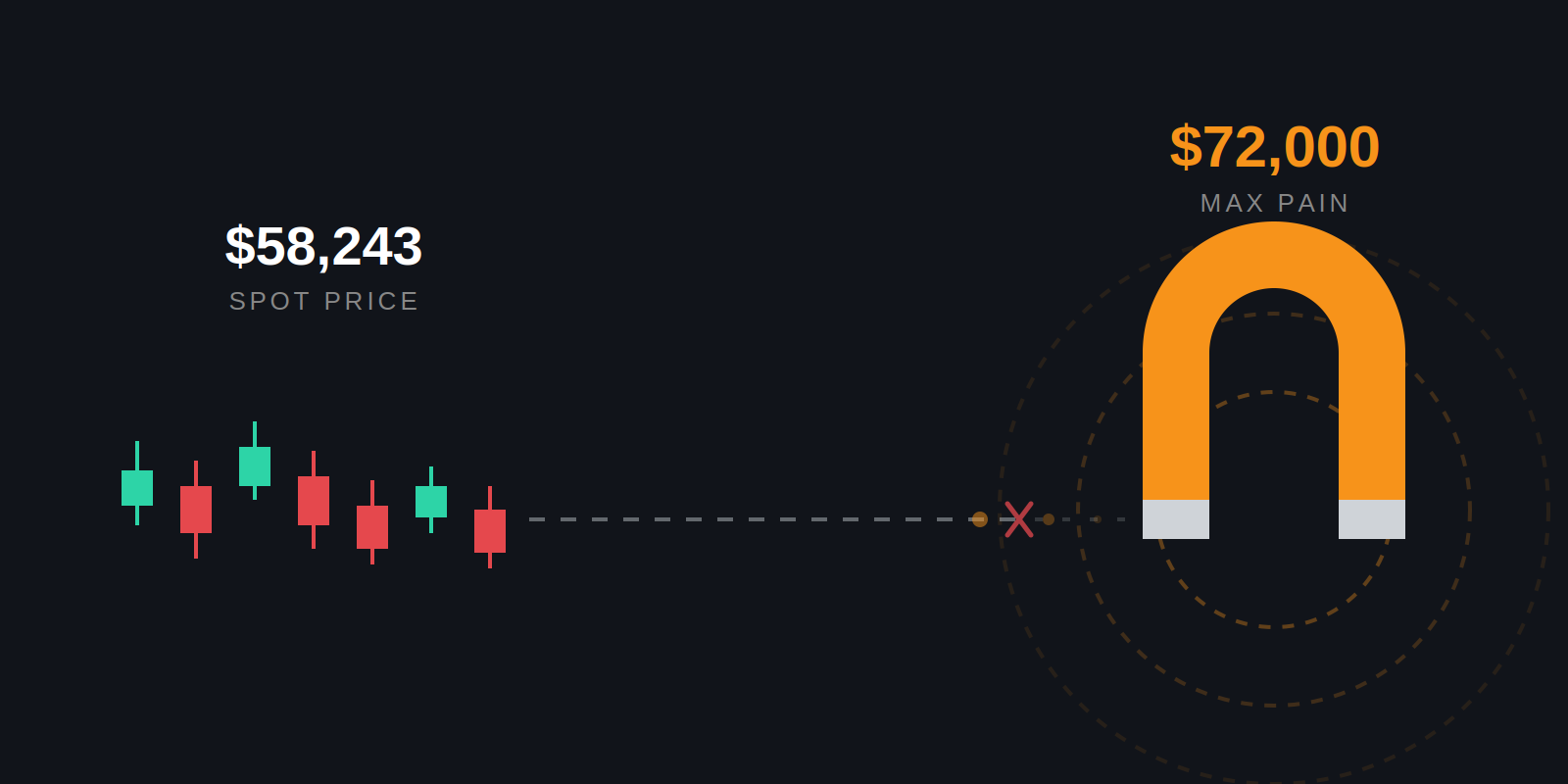
Friday, June 26, around $10 billion in Bitcoin options expire on Deribit, the largest exchange for crypto derivatives. It's the biggest quarterly settlement of the year so far. The max pain level for that expiry sits near $72,000. Bitcoin, as of this week, is trading closer to $58,243, roughly 19% below it.
By the textbook version of the theory, that gap should be closing right now, with price drifting up toward $72,000 as sellers defend their position. The opposite happened. Bitcoin fell from around $67,000 toward $58,243 in the days heading straight into the expiry, moving further from max pain, not closer to it.
Why It's Not Pulling This Time
Options traders who actually price this for a living have been saying for years that the simple version of the theory is mostly wrong. Pelion Capital's Tony Stewart has long argued max pain carries limited real weight in crypto markets. Bitfinex's research desk put it more precisely this week: the pull toward max pain only exists when the sellers of those options are in a specific hedging position, what traders call being long gamma, and choose to actively hedge toward that price. Right now Bitcoin is positioned below that condition entirely. There's no mechanical reason for the $72,000 level to act as a magnet, because the players who would need to push it there have no incentive to.
That's the part the theory's popular version always leaves out. Max pain describes where option buyers lose the most money. It does not describe where the market is actually going to trade. Those only line up when very specific positioning conditions are met, and most of the time on social media, nobody checks whether they are.
When It Has Worked, And Why That's Misleading
The theory isn't pure fiction, which is exactly why it spreads. Back in November 2025, Bitcoin was trading around $91,700 heading into a quarterly expiry with max pain calculated near $91,500, and price did drift subtly toward that level in the days before settlement. A few months before that, in September, BTC sat near $92,300 against a max pain of $91,800, and again there was a small pre-expiry move closer to it. Moments like that get screenshotted and passed around as proof the theory works.
What usually goes unmentioned is how close those gaps were to begin with, a few hundred dollars on a six-figure asset, well within normal daily noise. A market drifting toward a price it was already near isn't the same as a market getting pulled fifteen percent uphill, which is what the theory would need to do right now to mean anything. The mechanical explanation is the gamma condition described above. When dealers are positioned long gamma near the max pain strike, their ordinary hedging activity happens to nudge price toward that level as a side effect, not because anyone is deliberately steering it there. When that condition isn't met, as it isn't this week, there's no mechanism left to do the pulling, gap or no gap.
What Actually Happens On Expiry Day
What expiry day does reliably do is reset the board. Every option that's out of the money expires worthless, and the hedging structure built around it disappears with it. That includes support levels and resistance levels that traders had been pointing to all month, built entirely on options positioning rather than anything fundamental. Once those contracts roll off, the floor or ceiling they were creating can simply vanish, and a new set of positions for the next month or quarter starts forming around wherever price actually is.
That's a real source of volatility. It's just not the kind the max pain crowd is usually describing. The honest takeaway is closer to: expect the range to shift after a big expiry, not that price is being steered to a specific number beforehand.
You Might Also Like
He Called Bitcoin "The New Gold." His First Fed Decision Said Otherwise.
Sources:
CoinDesk: Forget Max Pain Theory. Bitcoin Is Well Below the $72,000 Magnet Going Into $10 Billion Options Expiry
Bitfinex Alpha: Options Expiries To Trigger Potential BTC Volatility
Disclosure: This article is for informational purposes only and is not financial advice. BitBrainers may earn a commission from affiliate links elsewhere on this site.