₿ BTC Loading... via Binance

Friday, July 3, 2026

Five AIs, One Bitcoin Chart, Ten Thousand Dollars of Disagreement

BitBrainers - Five AIs, One Bitcoin Chart, Ten Thousand Dollars of Disagreement

By BitBrainers Editorial

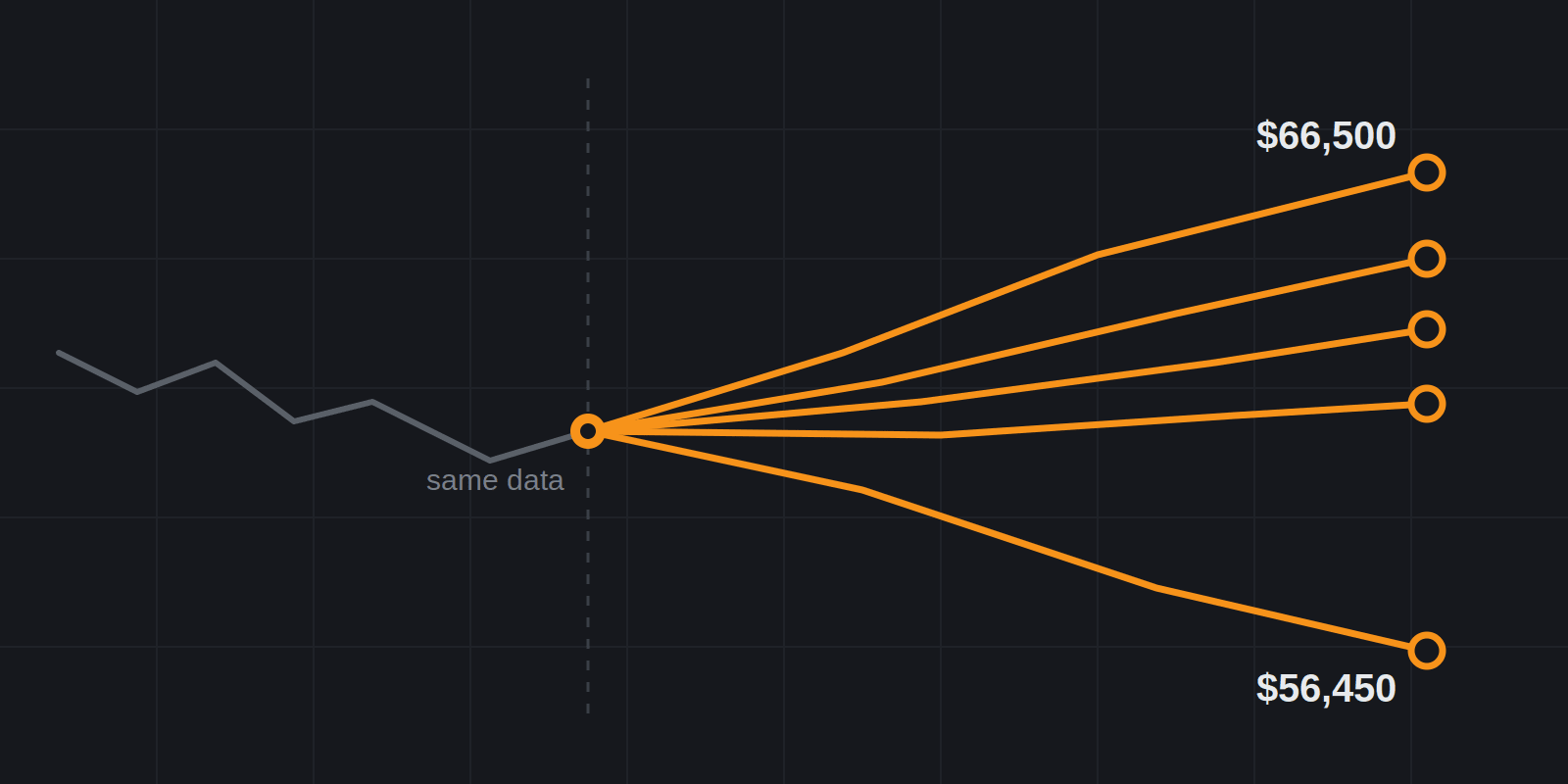
Five of the most advanced AI models on the planet were handed the same Bitcoin chart this week and asked where the price lands on July 31. Their answers span more than ten thousand dollars. Before you screenshot whichever forecast agrees with your position, it is worth understanding what that spread actually measures, because it is not Bitcoin.

The Numbers, Side by Side

Finbold ran the test with Bitcoin trading around $61,200. Anthropic's Claude came in most bullish, projecting an 8.67 percent climb to $66,500 by month end. OpenAI's ChatGPT-5.2 called a 5.4 percent rally to $64,500. Grok 4.1 landed at $63,501, a 3.77 percent gain. DeepSeek saw an essentially flat month, up 1.31 percent to $62,000. And Gemini 3 Flash broke from the pack entirely, forecasting a 7.76 percent drop to $56,450.

Same price data. Same technical indicators. Same date. One model says Bitcoin gains eight and a half percent, another says it loses nearly eight.

To be fair about the baseline: human analysts produce at least this much dispersion on Bitcoin targets, often more. Citi just cut its 12-month target to $82,000 in the same week other desks are defending six figures. Dispersion is not the AI-specific failure here. The difference is in the delivery. A human strategist wraps the number in scenarios, probabilities, and an implicit admission that this is an educated guess. The models deliver theirs with uniform, unhedged confidence, because sounding authoritative is what they are optimized for. The spread is normal. The false certainty attached to every point in it is the new problem.

A separate and larger experiment last week makes the point harder to dismiss. Bitcoin.com News put the same stripped-down question to 14 AI chatbots, deliberately removing the supporting context so each model had to produce an unbiased forecast across 30-day, 90-day, and year-end horizons. The answers came back as ranges wide enough to be unfalsifiable. One flagship model offered a year-end window of $50,000 to $75,000. Another gave $55,000 to $75,000. A forecast that spans a 50 percent move in either direction is not a forecast. It is a refusal to be wrong dressed up as analysis.


When They Agree, It Gets Worse

The counterintuitive part: model agreement is not more trustworthy than model disagreement. In June, ChatGPT and Claude were separately asked where Bitcoin bottoms by Q4 2026, and their answers landed within $2,500 of each other, $54,500 and $52,000 respectively. That looks like signal. Two independent systems converging on the same zone.

Except they are not independent. Both models were trained on overlapping snapshots of the same internet, both were fed the same public market data, and both leaned on the same widely published frameworks, realized price for one, miner production cost for the other, both of which have been standard crypto-analyst furniture for years. Even the outlet reporting the convergence flagged the open question of whether it reflects genuine signal or simply shared training data and identical inputs. When two students copy from the same textbook, matching answers tell you about the textbook, not about the exam.

Numbers checked. Narratives questioned.

The Macro brief that reads the data before the hype.

Subscribe Free

We Ran Our Own Version of This Test

Back in June we tested this mechanism directly rather than taking anyone's word for it. We asked several leading models for a Bitcoin allocation recommendation and got the same answer from all of them: a cautious 2 to 15 percent position, dollar-cost averaged in, medium risk. That uniformity is not five systems independently reasoning their way to the same conclusion. It is the answer a compliance-minded advisor is trained to give, the one that never gets anyone sued, reproduced across every model because they were all trained on the same body of careful, liability-aware financial writing.

Then we corrected one model's stale price data and watched its recommended allocation triple, from a 1 to 5 percent range up to 5 to 15 percent, off a single number changing in its context. Nobody managing real money triples position size over one price correction. Whatever produced that jump, it was not conviction. The model latched onto whatever drawdown figure it believed it was looking at and rebuilt its entire answer around it, with full confidence both times.

That is the mechanism under this week's ten thousand dollar spread. These systems do not hold a thesis about Bitcoin that survives from one question to the next. Each answer is generated fresh, shaped by whatever is loudest in the prompt, and delivered with the same fluent certainty whether the underlying reasoning is sturdy or nonexistent. Fluency and correctness are not connected, and price forecasting is where that disconnect is most expensive to ignore.

The Spread Is the Information

None of this means the models are useless. It means the test itself measures the worst way to use them. Short-term crypto moves are driven by things a single chart rarely captures: macro liquidity, ETF flows, whale wallet movements, regulatory headlines, leverage cascades, corporate treasury actions. Pure visual technical analysis is a weak signal in the best of times, so handing a model a chart and asking for a price is asking it to be confident about insufficient input. It will oblige, because a system trained to sound authoritative papers over the gap rather than admitting it.

The stronger configurations exist and almost nobody publishing these forecast pieces uses them: feed the model on-chain data, filings, and news flow together instead of a chart in isolation, give it code execution to build custom indicators rather than eyeballing MACD, or run multiple models against each other in structured debate and study where they break ranks. Used that way, a model is a research multiplier. Used as a chart oracle, it is a random number generator with excellent grammar.

Read properly, this week's forecasts do carry one honest piece of information: the spread itself. Five frontier systems given identical data disagree by more than 16 percent of Bitcoin's price. That is a direct measurement of how little predictive structure exists in the chart right now, published accidentally by the companies most motivated to hide it. The disagreement is the finding.

Meanwhile the thing that actually moved markets this week was not in any model's forecast. It was a mechanical trigger, Strategy's valuation crossing below the value of its own Bitcoin, that had been sitting in an SEC filing since last August. We covered it here: The Premium Died First. The Framework Was Already Written. No chatbot flagged it in advance. It was findable the whole time by anyone reading filings instead of asking for price targets.

How to Read the Next Forecast

Practical rules for the next time an AI price prediction crosses your feed.

  • Check the spread before the number. If the same test produced targets ten thousand dollars apart, any single model's target is noise wearing a suit
  • Treat convergence with the same suspicion as divergence. Models trained on the same data agreeing is expected, not informative
  • Watch what happens when inputs change. An answer that swings hard on one corrected number was never analysis
  • Judge the input before the output. A forecast built on a chart alone was starved of the things that actually move price. Rich input, filings plus flows plus on-chain data, deserves more attention than any chart-only oracle
  • Use the models for what they are built for: reading filings, compressing data, arguing against your position. The July 31 forecasts will be graded in four weeks, and we will check the scores

Sources: Finbold AI predicts Bitcoin price for July 31, 2026, Bitcoin.com News 14 AI Models Including Claude, ChatGPT and Grok Predict Bitcoin's Price Outlook, CCN via Yahoo Finance Can AI Call the Bitcoin Bottom?

Disclosure: This is analysis, not financial advice. We hold BTC. Do your own research before making investment decisions.

The Premium Died First. The Framework Was Already Written.

BitBrainers - The Premium Died First. The Framework Was Already Written.

By BitBrainers Editorial

On June 27, a number on Strategy's own website crossed a line it had never crossed before, and two days later the company that spent four years promising never to sell Bitcoin published a board-approved plan to sell up to $1.25 billion of it. The stock went up on the news, JPMorgan published a warning three days after that, and almost nobody in the coverage connected the two dates, even though Strategy itself filed the script for this exact moment with the SEC back in August 2025.

The Number That Forced It

The metric is enterprise mNAV. It compares Strategy's total enterprise value, meaning market cap plus debt plus preferred stock, against the market value of the 847,363 BTC on its balance sheet. For years that ratio was the whole bull case. At the November 2024 peak it hit 4x, meaning investors paid four dollars for every dollar of Bitcoin the company held, because MSTR was the leveraged BTC vehicle everyone wanted. The premium powered a flywheel: issue stock above the value of the Bitcoin backing it, use the proceeds to buy more Bitcoin, and let the growing stack justify the next issuance.

On June 27, 2026, that ratio closed below 1 for the first time. The market briefly valued the entire company, the software business, the brand, the financial engineering, at less than the coins in the vault. The ratio has since recovered above parity as MSTR rebounded roughly 20 percent after the framework announcement, but the crossing itself did its damage, because below 1 the funding model stops working. Issuing shares below NAV to buy Bitcoin dilutes existing shareholders instead of enriching them, so the accumulation engine that bought $13.7 billion of BTC this year alone could no longer fund itself the old way. Meanwhile the obligations stacked on top of that engine kept running regardless. The company owes roughly $1.7 billion a year in preferred dividends and interest, anchored by its STRC preferred stock, whose rate just went up to 12 percent.


A Script Filed Last August

Here is the part the coverage keeps missing: Strategy told everyone this would happen. An 8-K exhibit filed with the SEC in August 2025 laid out a public playbook tied to mNAV levels. Above 4x, issue stock aggressively to buy Bitcoin. Between 2.5x and 4x, issue opportunistically. Below 1x, consider issuing credit to repurchase MSTR instead. CEO Phong Le went further late last year, saying the company might consider selling Bitcoin if the ratio dropped below 1. And the first crack in the never-sell brand had already appeared in May, when Strategy quietly sold 32 BTC for about $2.5 million to cover dividend obligations, its first sale since 2022.

So when the ratio crossed on a Friday and the framework arrived the following Monday, it was less a reversal than a pre-announced contingency going live.

The June 29 filing, branded the Digital Credit Capital Framework, has five parts: a $2.55 billion dollar reserve dedicated to dividends and interest, a hard floor of 12 months of coverage, the STRC dividend increase to 12 percent, two separate $1 billion buyback authorizations for preferred securities and common stock, and the piece that made headlines, a Bitcoin Monetization Program authorizing sales of up to $1.25 billion. Worth being precise here: this is an authorization, not a sale. The ceiling represents under 2.5 percent of the stack, and as of the filing date no additional Bitcoin had been sold under it.

MSTR jumped 6 to 7 percent in pre-market trading on the news, which sounds backwards until you look at the alternative. With the treasury underwater by roughly $14 billion at the time of the filing against a $75,651 average cost, and a $1.7 billion annual dividend bill, a formal funded mechanism for meeting those obligations beats improvised distress selling from every angle an investor cares about. The rally was relief that the company had a plan, not enthusiasm for the selling.

The market moves fast. We keep the receipts.

One macro brief every Monday. No hopium, no noise.

Subscribe Free

Then JPMorgan Picked Its Target

Three days after the framework, on July 2, JPMorgan analysts led by Nikolaos Panigirtzoglou published a report warning that Strategy's sell authorization introduces avoidable two-way flow risk into the Bitcoin market. Their argument: Strategy bought roughly 70 percent of all net digital asset inflows this year and holds around 4 percent of total BTC supply, so a buyer that size gaining formal authority to sell adds a new source of uncertainty. Their prescription: hold 24 to 36 months of dividend coverage instead of the current 17.4, even if it means issuing equity at a discount.

The concentration point has real substance. A holder of 4 percent of supply gaining sell authority genuinely changes market signaling, whoever the holder is. But the aim is selective, and the numbers show it.

In June, US spot Bitcoin ETFs posted their worst month ever, $4.06 billion in net outflows. BlackRock's IBIT alone accounted for roughly $3.3 billion of it, and the ETF complex mechanically sold an estimated 51,726 BTC over 30 days to meet redemptions. That is realized selling, more than two and a half times Strategy's entire authorized ceiling, executed in a single month. JPMorgan wrote no report about two-way flow risk from the ETF wrapper. The warning went to the Bitcoin-native company with the loud founder rather than to the asset manager whose product did the actual selling.

Context on the messenger matters too. Jamie Dimon called Bitcoin a fraud in 2017, a pet rock in 2024, and told a Senate hearing in 2023 that if he were the government he would close it down. None of that makes his analysts wrong about Strategy's balance sheet, and the balance sheet criticism deserves engagement on its merits. It does mean the framing deserves the same scrutiny the balance sheet gets.


Where We Actually Land

We have watched enough leverage from the desk side to separate two things the coverage keeps merging. The accumulation was never the problem. Building an 847,363 BTC position, 4 percent of everything that will ever exist, is the boldest corporate conviction bet on record, and if you believe Bitcoin survives the decade, that stack is the whole point of the company. We still back that idea, including this week.

The machinery bolted on top is a different animal. Twelve percent perpetual dividends, layered preferred securities, and a funding model that only works while the equity trades at a premium amount to a structure that borrowed against the premium as if it were permanent, and premiums are cyclical by nature. The framework is not Saylor abandoning the thesis. It is the balance sheet adapting to a bear market that refused to honor the financing terms, with enough reserve and flexibility built in that distress is a scenario, not a schedule.

The honest read: the conviction survives, the engineering is on probation, and the largest realized Bitcoin seller last month was the ETF wrapper Wall Street built, not the company Wall Street warned about.

Read also: Bitcoin Doesn't Have a Crypto Problem. It Has an AI Problem.

What Happens Next

The open questions this framework does not answer yet.

  • Does mNAV hold above 1, or was the rebound a bounce? Every week below parity is a week the accumulation engine stays mathematically stalled, no matter what Saylor tweets
  • Does Strategy actually sell, or does the $1.25 billion authorization sit untouched as a confidence prop? The first real sale under the program, whatever its size, will move the market more than the announcement did
  • STRC trades near $87.50 against $100 par. Until it recovers par, Strategy cannot issue new preferred at a profit to fund purchases, which leaves the reserve and the sell authorization as the main funding tools
  • July ETF flows. IBIT redeemed roughly $3.3 billion in June. If that pace holds, the ETF wrapper stays a bigger BTC seller than Strategy is even authorized to become
  • The FOMC meets July 28 and 29. A hawkish Warsh keeps pressure on everything above, a softer tone changes the whole equation
  • The CLARITY Act clock in the Senate, which JPMorgan itself names as the other condition for a stronger second half

Sources: SEC / Strategy Inc. Form 8-K, June 29, 2026, CoinDesk Strategy's valuation has fallen below the value of its bitcoin holdings, CoinDesk JPMorgan says Strategy's bitcoin sales policy adds two-way risk, Bloomberg JPMorgan Says Saylor's Strategy Adds New Risk to Bitcoin Market, The Block Strategy loses its bitcoin premium as enterprise mNAV dips below 1

Disclosure: This is analysis, not financial advice. We hold BTC. Do your own research before making investment decisions.

Thursday, July 2, 2026

The Fed Just Lost Its Reason to Hike

BitBrainers - The Fed Just Lost Its Reason to Hike

By BitBrainers Editorial

The US economy added 57,000 jobs in June. The forecast was 114,000. That is not a soft print, that is half of one, and it landed on a market that spent the last two weeks pricing in the opposite problem. On top of the miss, May's figure was revised down by 43,000 to 129,000, ending a three-month streak of payrolls beating expectations. Within hours, Bitcoin went from drifting below $60,000 to briefly trading above $62,000. The move was fast, but the repricing underneath it is the actual story.

One Report, Two Repricings

Remember where the market stood on Wednesday. The June FOMC dots projected at least one more rate hike before year end, several officials penciled in more than one, and Polymarket had the odds of another 2026 hike at 54 percent. The debate was not hikes versus cuts. It was hikes versus holding.

One jobs report moved both dials. Polymarket's hike probability dropped from 54 to 47 percent in a day. CME FedWatch now shows roughly 80 percent odds the Fed leaves rates unchanged at the July 28-29 meeting, up from about 72 percent before the print. Traders also priced out a September move entirely, pushing residual hike risk into October.

The setup helped. A day earlier at the ECB Forum, Fed Chair Kevin Warsh said inflation risks were easing. He gave no path, he never does, but paired with a payrolls number at half the forecast, the market did the math for him. Hiking into a labor market that just printed 57,000 is a hard sell, even for a Chair who spent his first meeting sounding hawkish. We covered that first meeting and what it did to Bitcoin in The Fed Chair Who Loved Bitcoin. Today was the first data point that pushed back.

The macro read, once a week, no hopium

Join the BitBrainers Weekly Brief. The week's real signal in one email.

Subscribe Free

The Bounce Comes With an Asterisk

Bitcoin rallied about 4 percent on the release and briefly reclaimed $62,000 before settling near $61,700. After the worst month since June 2022 and a roughly 30 percent decline across the first half of the year, any green candle gets attention. This one deserves some, and also deserves its asterisk.

The level that matters is $62,500. That is the halfway retracement of the recent leg down, and desks are treating it as the line between a relief rally and an actual recovery. Below it, today's move is short covering plus a macro sigh of relief. Above it, with follow-through, the conversation changes.

The heavier problem has not moved. US spot Bitcoin ETFs bled roughly 4 billion dollars in June, the largest monthly redemption since launch. A jobs report can reprice the Fed in an afternoon. It cannot reverse institutional flows. Until those stabilize, rallies in this tape are guilty until proven innocent.


The Part Nobody Wants to Price

Here is the uncomfortable read. The US economy needs roughly 100,000 new jobs a month just to keep the unemployment rate steady. June printed 57,000, and May was revised lower. One month below breakeven is noise. Two starts a trend, and a trend below breakeven stops being a Fed story and starts being a growth story.

Weak labor data helps risk assets exactly as long as it reads as "the Fed can relax" and not "the economy is stalling." That line is invisible until it is crossed, and markets historically cross it in one session. In 2019 and again in 2024, jobs misses were bought right up until a print landed that made cuts look like a rescue instead of a gift.

So the honest framing of today: Bitcoin got a real macro tailwind, the first one this summer. The hike case took genuine damage and the July meeting is now close to a formality. But 47 percent is still nearly a coin flip on the year, the ETF door is still swinging outward, and the same data that killed the hike will kill the rally if it repeats in August. Enjoy the bounce. Respect the asterisk.


On The Radar This Week

The FOMC meets July 28-29, and the market has effectively pre-decided a hold. The more interesting release is the next CPI print, because an inflation surprise is now the only thing that could put the hike back on the table. On the chart, $62,500 is the confirmation level above and $57,900 is the late-June low that has to hold below. And the quiet third dial is ETF flows: this bounce only becomes a trend if the redemption streak breaks. Watch for the first string of consecutive net inflow days since May. Until then, between those numbers, everything is noise.

Sources

US Bureau of Labor Statistics: The Employment Situation, June 2026
crypto.news: Bitcoin surges past $62K as U.S. payroll miss dents Fed rate hike odds
Investing.com: Bitcoin jumps to $62,000 as weak US jobs data eases rate-hike fears

Disclosure: This content is for informational purposes only and does not constitute financial advice. We may earn a commission through affiliate links at no extra cost to you. Always do your own research.

The FBI Director Bought Bitcoin Stock. He Just Forgot to Mention It for Six Months.

Kash Patel speaking with attendees at FreedomFest 2024

Photo: Gage Skidmore, CC BY-SA 2.0

By BitBrainers Editorial

The FBI director bought six figures of Bitcoin-adjacent stock, sat on the disclosure for six months, and the Justice Department's own ethics office says there's nothing to see here. The company he bought into does millions of dollars in business with his own agency. This is the kind of story that gets buried in a Wednesday news cycle, and it deserves better than that.

What Actually Happened

FBI Director Kash Patel purchased between $100,001 and $250,000 in Strategy stock, the company formerly known as MicroStrategy, on November 21. Strategy is the largest publicly listed corporate holder of Bitcoin in the world, built around aggressively accumulating BTC as its primary treasury asset. Patel did not disclose the trade to federal regulators until May 26, six months after the purchase and well past the 45-day window required under the STOCK Act.

His explanation, delivered in a letter to the Office of Government Ethics that same day, was that the trade had been "inadvertently omitted" from an earlier disclosure. Two days later, a Deputy Assistant Attorney General wrote to the same office stating the omission was caused by an unspecified "miscommunication." An FBI official told reporters the late filing was "not realized and unintentional."


Why The Company Matters As Much As The Delay

A late disclosure alone is a paperwork problem. What makes this one worth reading past the headline is who Patel bought stock in. Strategy has done millions of dollars in business with the Department of Justice over the past decade, and the FBI is part of the Department of Justice. Patel now personally holds a six-figure position in a company his own agency writes checks to.

The Deputy Assistant Attorney General who reviewed the case concluded there was no conflict of interest. Government watchdogs disagree with the framing entirely. Dylan Hedtler-Gaudette of the Project on Government Oversight put it in blunt terms: "That's violating the law, no other way to put it." He's referring specifically to the disclosure timeline, not the ethics question, but the two are hard to fully separate here. Late disclosure and financial entanglement with an agency contractor are not the same problem, but they compound each other.

Worth being fair about the baseline here. Senior officials holding stock in companies their agency interacts with is not automatically a scandal, Pentagon officials often hold defense contractor stock, HHS officials hold pharma stock. Passive investment in a publicly traded company isn't prohibited on its own, that's exactly why ethics offices exist to make case-by-case calls rather than ban the practice outright. No evidence has surfaced that Patel steered any DOJ contract toward Strategy, traded on non-public information, or received anything in return for the purchase. The documented complaint is narrower than "corruption": a six-figure trade, a company with agency ties, and a disclosure filed roughly 186 days late. That's still a real problem. It's just a specific one, not a vague one.

This also isn't Patel's first time drawing scrutiny for personal stock trades in office. He purchased shares in Krispy Kreme and ON Semiconductor in 2025, trades that already prompted questions from members of Congress before this latest disclosure issue surfaced. A pattern of individual stock trading while running a federal law enforcement agency is its own separate conversation from any single trade's merits.


The Rules Everyone Ignores

The STOCK Act exists for exactly this reason: to make sure senior officials disclose trades fast enough that the public can see potential conflicts before they compound. The threshold is low, any trade over $1,000, and the window is short, 45 days. Patel's trade sat undisclosed for roughly six times that window.

He is not alone. NOTUS, the outlet that first reported this story, has identified more than 30 members of Congress who filed STOCK Act disclosures late over the past year. The customary penalty for a first violation is a $200 fine, a number small enough that it functions less as a deterrent and more as a rounding error against a quarter-million-dollar trade. Patel has not been fined as of this writing, and multiple watchdog groups doubt he will be.

This is the kind of read you get weekly.

No hype. No "this coin will 100x." Just honest macro on Bitcoin, gold, and the market.

What This Says About Bitcoin's Position In Washington

Set aside the ethics question for a moment and look at what this story confirms about where things actually stand. A sitting FBI director felt comfortable putting a six-figure personal position into a Bitcoin treasury company, one connected to his own agency's contractor relationships, and the mistake that got him in trouble wasn't the trade itself, it was the paperwork. Nobody in this story is arguing Patel shouldn't have bought Strategy stock. The argument is entirely about timing.

That's a meaningful signal on its own. Bitcoin exposure has moved deep enough into Washington's bloodstream that a law enforcement official's personal stake in the largest corporate BTC holder barely registers as controversial, only the six-month delay in reporting it does. A few years ago this trade wouldn't have happened at all, or would have drawn scrutiny on the merits, not just the calendar.


Worth Watching Right Now

Strategy's stock itself remains under separate pressure. Canaccord cut its price target on the company this week even while maintaining a broadly bullish thesis on Bitcoin, part of a wider reassessment of Strategy's capital structure following its recently disclosed unrealized paper losses and new buyback authorization. Meanwhile Trump's own 2025 financial disclosure, released the same week, showed over $1.4 billion in crypto-related income, a separate and much larger story about the overlap between federal power and Bitcoin exposure that deserves its own treatment.

Sources

NOTUS. Kash Patel's Late Stock Disclosure Raises STOCK Act Questions

CoinDesk. FBI Director Kash Patel Caught Sleeping on Required Disclosure of Six-Figure MSTR Investment

Raw Story. Kash Patel Accused of 'Violating the Law' With Massive Undisclosed Stake in DOJ Contractor

BitBrainers. We check the facts so you don't have to.

Disclosure: This is market and policy commentary, not financial or legal advice. We hold Bitcoin. Always do your own research.

Wednesday, July 1, 2026

Why Your Exchange Wants You to Stay (And What Actually Fixes It)

BitBrainers - fractured Bitcoin coin with capital flowing toward AI infrastructure

By BitBrainers Editorial

Every exchange interface is built around one goal: keep your coins on their platform. Not because they're malicious by design, but because your balance sitting on their books is the entire business model. The friction to withdraw isn't an accident. It's revenue protection.

The Balance Sheet You Never See

When you deposit Bitcoin on an exchange, you don't hold Bitcoin anymore. You hold an IOU. The exchange holds the actual private keys, and your balance is just a number in their database. That number can be lent out, used as collateral, or in the worst case, gone before you ever try to withdraw it.

FTX proved this isn't theoretical. Sworn testimony and court filings later confirmed that Alameda Research, the trading firm founded by the same person who ran FTX, had been drawing on customer deposits for years before the collapse, using them as an open line of credit that reportedly ran into the tens of billions. The exchange marketed itself as the safest place to hold crypto while quietly reinvesting customer funds behind the scenes. When withdrawals spiked in November 2022, the gap between what customers thought they owned and what the exchange actually had on hand became impossible to hide. A U.S. court later ordered $12.7 billion in restitution and disgorgement, one of the largest judgments in the history of financial fraud enforcement. None of that money would have been at risk if it had never left customer wallets in the first place.

Three Ways They Profit While You Wait

Trading fees are the obvious one, but they're rarely the biggest. Spread markup on market orders quietly costs more than the stated fee on most retail trades. Interest on idle deposits is another: your uninvested cash or stablecoins often earn the exchange yield in the background while you earn nothing. And withdrawal friction, minimum amounts, network fee markups, occasional "verification delays," all nudge you toward leaving funds parked rather than moving them out.

None of this requires bad intent. It's just what happens when the platform's incentives and your incentives point in different directions. I watched this exact dynamic from the inside on a CFD brokerage desk. The house doesn't need you to lose. It just needs you to stay active and stay parked.

Worth saying plainly: not every exchange is FTX. Platforms like Kraken that publish proof-of-reserves and submit to third-party audits are a meaningfully different risk than one that hides its balance sheet entirely. Some withdrawal friction is also just regulation doing its job, KYC and AML checks exist to catch fraud and stolen funds, not only to slow you down. The incentive misalignment is still real. It's just not the whole story on every platform.

This is the kind of read you get weekly.

No hype. No "this coin will 100x." Just honest macro on Bitcoin, gold, and the market.

What Self-Custody Actually Fixes

Self-custody removes the middleman from the equation entirely. Your keys, your coins, no balance sheet risk, no lending desk, no "temporary" withdrawal freeze during a bank run. It doesn't eliminate risk, you take on the responsibility of not losing your own keys, but it converts counterparty risk into a risk you fully control.

A hardware wallet like a Trezor keeps your private keys offline, away from any exchange's balance sheet. Setup takes minutes. The habit of moving funds off-exchange after every trade takes longer to build, but it's the difference between owning Bitcoin and owning a promise.

Be honest with yourself about the tradeoff. More people lose crypto to their own mistakes, a lost seed phrase, a phishing link, a backup that was never written down, than to an exchange collapse. Self-custody removes one risk and hands you a different one. It's still the better trade for anything you're not actively using, but only if you take the seed phrase part seriously.

The Middle Ground

You don't need to self-custody every dollar you trade with. Keep active trading capital on the exchange, move everything else off. Treat the exchange like a checking account, not a savings account. That single mental shift changes how much risk you're actually carrying at any given time.

The Test That Actually Tells You Something

Forget reading the terms of service. There's a faster way to gauge how an exchange treats withdrawals: try one. Move a small, real amount off the platform and time it. A clean process, clear fees, and funds landing in your wallet within the stated window is a good sign. Repeated "verification required" prompts, minimums that conveniently sit above what you're trying to move, or support tickets that go nowhere are the same pattern that preceded past exchange failures, just earlier in the timeline. This costs you a few dollars in network fees. It's a cheap way to find out what a five-figure or six-figure withdrawal would actually look like before you need it to work.

Worth Watching Right Now

The EU's MiCA transitional licensing period expired today, July 1. Roughly 92 percent of the exchanges and crypto businesses that previously operated under older national licenses across Europe still lack full MiCA authorization, leaving them to either secure a license, wind down, or transfer clients to an already-licensed platform. Separately, Strategy authorized a new $2 billion buyback program alongside a mechanism that would let it sell bitcoin for liquidity if needed, a notable shift from its prior all-in accumulation stance. Bitcoin extended its slide below $58,500 this week, with roughly $320 million in leveraged positions liquidated in a single day.

Sources

CFTC, consent order and $12.7 billion judgment against FTX and Alameda Research, August 2024. Forbes, coverage of the FTX/Alameda restitution ruling, August 2024. Axios, FTX trial testimony on Alameda's use of customer funds, October 2023.

BitBrainers. We check the facts so you don't have to.

Disclosure: This post contains affiliate links. We may earn a commission at no extra cost to you.

The Fed Meets Tomorrow. Bitcoin Is Watching the Wrong Number.

By BitBrainers Editorial Tomorrow at 2pm ET, the Federal Reserve announces whether the fed funds rate holds at 3.50 to 3.75 percent o...

The Fed Meets Tomorrow. Bitcoin Is Watching the Wrong Number.