
₿ BTC Loading... via Binance

Tuesday, July 7, 2026

Bitcoin Touched $64K and Pulled Back. Japan's Bond Yields Just Hit a 30-Year High. Those Two Facts Are Connected.

BitBrainers - Bitcoin Japan bond yields risk July 2026

By BitBrainers Editorial

Bitcoin touched $64,033 today then pulled back to $63,500. That is the $63,800 flip line we flagged in Monday's Weekly Brief — the level that was supposed to end the downtrend structure. Price visited it and retreated. On the same day, Japan's 10-year bond yield hit its highest level since 1996.

That timing is not random. Here is the connection.

Japan's Bond Market Just Hit a 29-Year High

Japan's 10-year government bond yield climbed to 2.84% today, its highest level since the late 1990s, a 30-year high. That number matters well beyond Tokyo.

Japan is the largest foreign holder of US Treasuries, holding approximately $1.2 trillion. For three decades, near-zero domestic rates meant Japanese investors had every incentive to park savings abroad in higher-yielding assets like US bonds, equities, and risk assets. That flow quietly helped keep global yields lower than they would otherwise be.

As domestic Japanese yields rise, that logic reverses. Japanese institutions earn 2.82% at home now. The incentive to hold US Treasuries or take on risk abroad weakens. Data already reflects the shift: Japanese investors have been net sellers of foreign securities to the tune of approximately $25 billion since the start of 2026.

The Carry Trade and What Unwinds When It Breaks

The mechanism is straightforward. You borrow yen at near-zero rates. You convert to dollars and buy higher-yielding assets globally. US bonds, equities, Bitcoin. You pocket the difference.

When Japanese yields rise, that trade stops working. Borrowing in yen gets more expensive. The yen strengthens as capital flows back home. Anyone who borrowed yen to fund positions faces higher repayment costs and a currency moving against them. They sell assets to repay the yen debt.

Not because anyone is bearish on Bitcoin. Because the funding leg is broken.

Estimates on total yen carry exposure vary. Figures of $20 trillion in connected positions have been cited across institutional research, including from the Bank for International Settlements. Not all of that is in Bitcoin. But when liquidity tightens globally, risk assets move together, and Bitcoin has historically been one of the first to reprice.
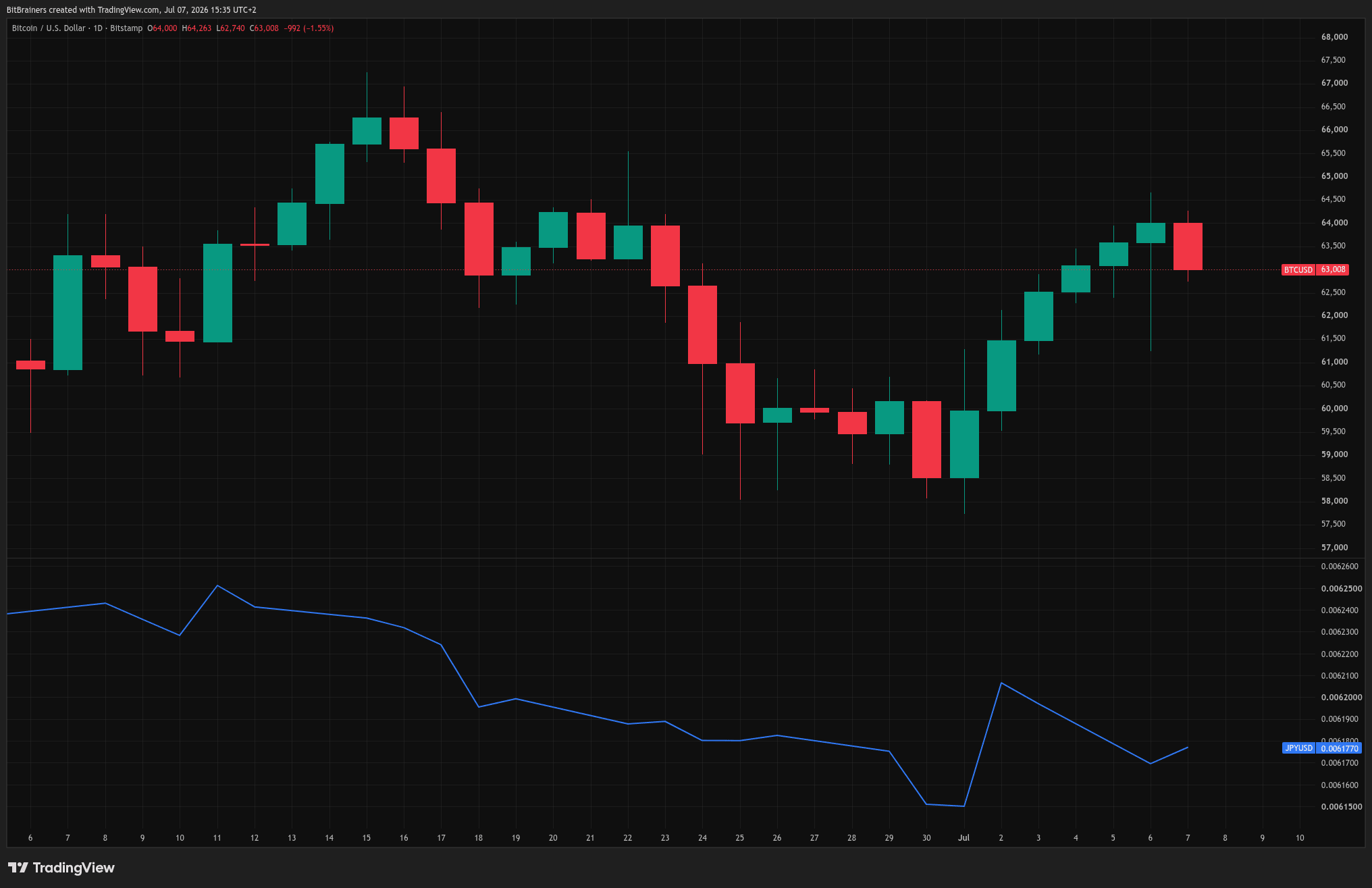
BitBrainers - BTCUSD vs JPYUSD correlation July 2026

Why This Complicates the Bullish Setup

Earlier today we published the case for why the US bond market was already pricing in rate cuts — inflation breakevens below 2%, weak jobs data, oil normalizing. That case is real. You can read the full breakdown in our inflation and FOMC preview from this morning.

The Japan story does not invalidate that case. It adds a risk layer the US data cannot resolve on its own.

The Federal Reserve sets short-term US rates. It does not control what Japanese investors do with their $1.2 trillion in Treasury holdings. If Japanese repatriation continues and reduces demand for US Treasuries, long-term US yields can rise independently of whatever Warsh says on July 28. That is precisely what CNBC's deVere Group pointed out earlier this year: "Markets still appear to be behaving as if Japanese volatility is a temporary disturbance rather than a regime shift. We believe that is a mistake."

The macro layer most posts skip.

Every Monday we cover what actually moves Bitcoin. Key levels, no noise, free.

Subscribe Free

What the Failed Breakout and Japan Tell You Together

Bitcoin touching $64,033 and immediately pulling back below $63,800 on the same day Japan's yield hit a 30-year high is a data point. One session does not confirm anything. But it illustrates the tension cleanly.

The US macro setup of weak jobs, falling inflation breakevens, and soft oil created the conditions for the push toward $64K. The Japan carry risk is the structural headwind that makes holding above $63,800 harder than the US data alone would suggest.

Short liquidations dominated at $86.6 million versus $54 million longs, per Coinglass, confirming genuine short covering drove the move. Open interest at $47.71 billion with moderate funding rates shows fresh leverage without euphoria. The technical push was real. The pullback is equally real.

What Decides It

Is Japan the real reason Bitcoin couldn't hold $64K today? Possibly. One session is not confirmation. But the timing of the pullback and the yield move is a data point worth holding.

Wednesday's FOMC minutes at 2pm ET remain the nearest catalyst. A dovish read confirms the US macro tailwind and gives Bitcoin room to extend toward $66,000 to $67,600, the next resistance zone above the flip line.

A hawkish read, combined with continued Japanese yield pressure, makes the $63,800 flip line a false breakout and reopens the range below it.

The Japan story is not resolved by Wednesday. It is a slower-moving structural risk that will follow Bitcoin into the second half of July regardless of what the minutes say.

Watch USDJPY as much as the FOMC minutes this week. If the yen strengthens while US yields hold, the carry unwind is the story. If USDJPY holds steady, the Japan risk stays contained and the US macro tailwind takes over.


Sources

CoinDesk: BTC's recent macro relief faces a challenge from Japanese interest rates
Trading Economics: Japan 10-year government bond yield — 2.82%, highest since May 1997
TD Economics: What Happens in Japan May Not Stay in Japan
CNBC: Japanese bond yield rise could shake up borrowing costs in the U.S.
StoneX: Japan Yield Curve Pressure Threatens Global Carry Trades

Disclosure: This article is for informational purposes only and is not financial advice. We may earn commissions from affiliate links. Always do your own research before making investment decisions.

The Bond Market Is Already Pricing in Rate Cuts. The Fed Hasn't Said So Yet.

BitBrainers - inflation breakeven FOMC minutes Bitcoin July 2026

By BitBrainers Editorial

Bitcoin is trading near $62,877 this morning. The macro picture underneath it shifted last week in a way that most of the daily coverage missed. The bond market is now saying something different from the Federal Reserve, and Wednesday is when we find out who is right.

The signal is in the inflation breakevens. Understanding what they are and what they just did is the whole story.

What the Bond Market Is Actually Saying

The two-year breakeven inflation rate measures what the bond market expects inflation to average over the next two years. It is calculated by comparing regular government bonds with inflation-protected ones. When investors buy more inflation protection, the breakeven rises. When they sell it, the breakeven falls.

Last week the two-year breakeven dropped below 2% for the first time since 2024. That is the Fed's inflation target. The market is saying it expects inflation to run at or below target over the next two years.

For Bitcoin, the transmission is direct. Softer rate-hike odds reduce the opportunity cost of holding a non-yielding asset. When the bond market stops pricing in tightening, money that was sitting in yield-bearing instruments looks for better returns elsewhere. Bitcoin is one of those elsewheres.

This is not a minor data point. It is the bond market's aggregate judgment about where the economy is heading, backed by real money. And it directly contradicts the June FOMC dot plot, which had nine of eighteen officials projecting a rate hike before year-end.

Why the Divergence Matters for Bitcoin

The June FOMC meeting hit Bitcoin hard. Warsh's hawkish debut dropped the easing bias from the statement, shifted the dot plot toward hikes, and sent Bitcoin and gold lower the same day. Markets priced in a 40% chance of a hike by December.

Since then, three things have moved in the other direction. The June jobs report came in at 57,000 payrolls, well below the 185,000 consensus. Oil has fallen back to pre-Iran war levels after the Strait of Hormuz reopened faster than expected. And the inflation breakeven just crossed below 2%.

Each of these independently softens the case for a rate hike. Together they represent a material shift in the macro backdrop since Warsh spoke on June 17.

Bitcoin's best week since March happened during the same period these signals were accumulating. That is not a coincidence. Softer rate expectations directly reduce the opportunity cost of holding a non-yielding asset like Bitcoin.

Wednesday's FOMC Minutes Are the Test

The June 16-17 meeting minutes release at 2pm ET on Wednesday July 8. This is Warsh's first FOMC as chair, and it was his hawkish debut that sent markets lower.

What the minutes will show is how unified the committee actually was. The published statement was unanimous on the rate hold. The dot plot had nine officials projecting a hike. Those two things can coexist. You can hold rates and still signal future tightening.

The caveat worth naming: headline inflation printed 4.2% in May, energy-driven but still elevated. That is the number Warsh cited in his press conference, and it is the one nine officials pointed to when projecting a hike. The softening breakeven signal reflects where markets think inflation is going. The dot plot reflects where officials think it still is. That gap is exactly what the minutes will clarify.

What nobody knows yet is whether the hawkish tone reflected genuine consensus or a narrow majority. Minutes reveal the internal debate. Dissenting views, staff economic projections, and the language around the inflation assessment all live in the minutes but not in the press release.

If the minutes show a divided committee with a strong dovish minority pushing back against the hike projections, the breakeven signal gets confirmed and Bitcoin's near-term setup improves. A clean dovish surprise could quickly take price toward the $63,800 flip line and the $64,000 to $66,000 resistance zone above it. If the minutes show near-uniform hawkish conviction, the 40% December hike probability stays live and the macro headwind is not yet resolved.

We read the minutes so you don't have to.

Every Monday, the macro read that moves Bitcoin. Key levels, no noise, free.

Subscribe Free

One More Variable: Strategy Closed the Loop

Last week's brief noted that Strategy had quietly sold Bitcoin for the first time since 2022. The full picture is now confirmed via SEC filing: 3,588 BTC sold for $216 million at an average price of roughly $60,000 per coin, to replenish dollar reserves for preferred stock dividends. They still hold 843,775 BTC with an average acquisition cost of $75,476.

The announcement hit the price on Monday morning. Bitcoin dropped from $62,900 to $61,900 within the hour. It has since recovered but the dynamic is worth noting: Strategy is now a company that sells Bitcoin when its capital structure requires it, at whatever price the market offers. That is a different entity than the permanent structural buyer the market was pricing in.

The Setup Into Wednesday

Bitcoin options expiring July 8, the same day the minutes drop, have turned call-heavy. Call volume of 6,065 outpaces 3,465 puts on Deribit. Max pain sits at $63,000, just above current spot.

The bond market, the options market, and the on-chain picture from last week all lean the same way. Inflation expectations are soft. Defensive positioning in options is easing. Long-term holders are at record accumulation. The ingredients for a move higher are in place.

Wednesday's minutes are the variable that either confirms this picture or contradicts it. A dovish read and Bitcoin tests $63,800, the technical flip line where the downtrend structure breaks. A hawkish read and the macro headwind reasserts itself.

We covered the full on-chain picture, LTH accumulation, and the $53,000 realized price floor in our indicators breakdown from last week. The macro backdrop covered today and the on-chain backdrop covered there are pointing in the same direction. Wednesday is when we find out if the market agrees.


Sources

CoinDesk: U.S. inflation outlook underpins Bitcoin bulls after best week since March
CoinPedia: Fed Minutes July 8: Will the FOMC signal a rate cut or another hike?
CoinDesk: FOMC minutes, SpaceX joins Nasdaq 100: Crypto Week Ahead
BeInCrypto: Bitcoin options turn call-heavy before July 8 FOMC minutes
CoinDesk: Strategy dramatically ups pace of Bitcoin sales, raising $216 million

Disclosure: This article is for informational purposes only and is not financial advice. We may earn commissions from affiliate links. Always do your own research before making investment decisions.
Monday, July 6, 2026

Bitcoin Has a 21 Million Cap. The Claims Against It Don't.

BitBrainers - Bitcoin paper claims explainer

By BitBrainers Editorial

Bitcoin has a hard cap of 21 million coins. That number is enforced by consensus, secured by energy and cryptography, and cannot be changed without the agreement of the entire network. Satoshi built this constraint into the protocol in 2009 and it has held ever since.

What Satoshi did not build is a constraint on the number of claims that can be created against those 21 million coins. That problem belongs to the financial system, not the protocol. And the financial system is already working on it.

What FTX Actually Proved

In November 2022, FTX collapsed and roughly one million users discovered that the Bitcoin in their accounts did not exist. FTX had lent customer funds to its sister trading firm Alameda Research, which had lost them. The accounts showed balances. The coins were gone.

The popular read was "crypto is risky." The more precise read was: an exchange created claims against Bitcoin it did not hold, nobody audited those claims in real time, and users had no way to know the difference between an IOU and an actual coin.

That is the paper Bitcoin problem in its most extreme form. FTX was not an anomaly. It was a demonstration of what happens when the mechanism is left unchecked.

Every Exchange Balance Is an IOU

When you buy Bitcoin on an exchange and leave it in your account, you do not own Bitcoin. You own a contractual claim against the exchange for Bitcoin. The distinction matters enormously.

If the exchange is solvent and honest, the claim is worth exactly one Bitcoin. If the exchange is insolvent, over-leveraged, hacked, or operating fraudulently, the claim is worth whatever a bankruptcy court decides. That is not the same as holding a private key.

Most exchanges hold actual Bitcoin in reserve to back their customer balances. Most is not all. And reserve levels are not publicly verified on a real-time basis for most platforms. You are trusting an audit that may be months old, conducted by a firm with limited access.

ETFs Are Closer to Bitcoin. They Are Still Not Bitcoin.

The spot Bitcoin ETFs that launched in January 2024 are a genuine improvement over exchange IOUs. For several of the largest US funds, the custodian is Coinbase Custody, holding actual Bitcoin on-chain segregated from other assets.

But the custody chain introduces counterparty risk that does not exist with self-custody. The ETF share is a financial instrument, not a coin. The fund can be lent to authorized participants during the creation and redemption process. The holder has no ability to convert shares into actual Bitcoin or verify that the underlying coins are intact without trusting the custodian and the auditor.

For most institutional investors that tradeoff is acceptable. It is worth knowing it exists.

The protocol is sound. The system around it is not automatically.

We cover what the headlines skip. Every Monday, free.

Subscribe Free

Rehypothecation: The Same Bitcoin in Two Places

Bitcoin-backed lending is growing. Institutions borrow against Bitcoin collateral, just as they borrow against securities or real estate. The problem is rehypothecation: using the same collateral to secure multiple obligations simultaneously.

In traditional finance, securities rehypothecation is legal and common. A stock pledged as collateral at a prime broker can be lent out to a short seller, who delivers it to a buyer, who pledges it somewhere else. The original owner still "has" their shares. So does everyone in the chain. More claims than assets.

Bitcoin rehypothecation is less transparent than traditional finance because it is not subject to the same reporting requirements. There is no central registry of which Bitcoin has been pledged where. The protocol itself is sound, as we covered in our white paper breakdown, but that soundness does not prevent financial layer opacity.

Derivatives: Bitcoin Price Exposure With No Bitcoin

CME Bitcoin futures are cash-settled. When a contract expires, the counterparties exchange dollars based on the settlement price. No Bitcoin changes hands. The price is influenced by instruments that have zero connection to actual coin supply.

This is not unique to Bitcoin. Oil futures, gold futures, and stock index futures are all traded in volumes that dwarf the underlying physical market. But it means a significant portion of Bitcoin "demand" expressed in price discovery is demand for financial exposure, not demand for actual coins.

As derivatives markets deepen, this gap widens. Price can be set by participants who hold no Bitcoin and have no intention of ever holding any.

How Big Is Paper Bitcoin? Nobody Knows.

This is the honest answer. There is no public aggregate figure for total Bitcoin claims versus actual circulating coins. Glassnode estimates roughly 3 to 4 million BTC are permanently lost to forgotten keys. Circulating supply is approximately 19.8 million. Claims through exchanges, ETFs, lending desks, and derivatives are not audited in aggregate anywhere.

What we do know: exchange reserves have been falling for years and now sit at a seven-year low of 2.21 million BTC. That means less Bitcoin is sitting on exchanges than at any point since 2017. Whether that reflects genuine self-custody adoption or simply migration to different custodial structures is not clear from on-chain data alone.

What This Means in Practice

Bitcoin's protocol is not broken. The 21 million cap is real and mathematically enforced. Saylor is right on this. But the financial system building around Bitcoin is creating leverage, opacity, and periodic credit risk that the protocol was never designed to prevent.

Gold went through the same process. Banks created paper gold through fractional reserve systems for centuries before the gold standard was formally abandoned. The underlying commodity remained scarce. The claims against it did not.

Saylor's own view is more optimistic than this reads. He sees the financial layers forming around Bitcoin as ultimately strengthening it, the same way gold became more useful when banks and credit markets developed around it. The risk section of his manifesto is a warning about how those layers can go wrong, not an argument against them existing. This post is that warning in plain language.

The practical implication is straightforward. The closer your Bitcoin is to the base layer, meaning a private key you control with coins verified on-chain, the more actual Bitcoin exposure you have. The further you get from that, the more you are holding a financial instrument whose value depends on counterparty solvency, not protocol integrity.

Not every holder needs to self-custody. But every holder should understand what they actually own.


Sources

Michael Saylor / Strategy: Bitcoin Evolves by Not Changing — on paper Bitcoin risk
CoinDesk: FTX bankruptcy filing and customer fund misuse — November 2022
Glassnode: Exchange reserve data and on-chain supply metrics
CME Group: Bitcoin futures contract specifications — cash settlement

Disclosure: This article is for informational purposes only and is not financial advice. We may earn commissions from affiliate links. Always do your own research before making investment decisions.
Bitcoin Weekly Brief: July 6 — The President Made $1.2 Billion From Crypto. The Senate Noticed.

By BitBrainers Editorial

Good Monday morning. Bitcoin is trading near $63,252, up about 1.5% on the day, with the Fear and Greed Index at 22. The Senate is still on recess, the Fed does not meet for another three weeks, and the biggest crypto story of the week came from a 927-page ethics filing rather than a chart.

That filing is going to follow the market into July. Here is why.

Where Bitcoin Sits This Morning

Bitcoin spent last week clawing back from a 21-month low under $58,000 and is now pressing the low $63,000s. The bounce came on two things: a weak June jobs report that showed just 57,000 new payrolls, and the first green ETF day in two weeks.

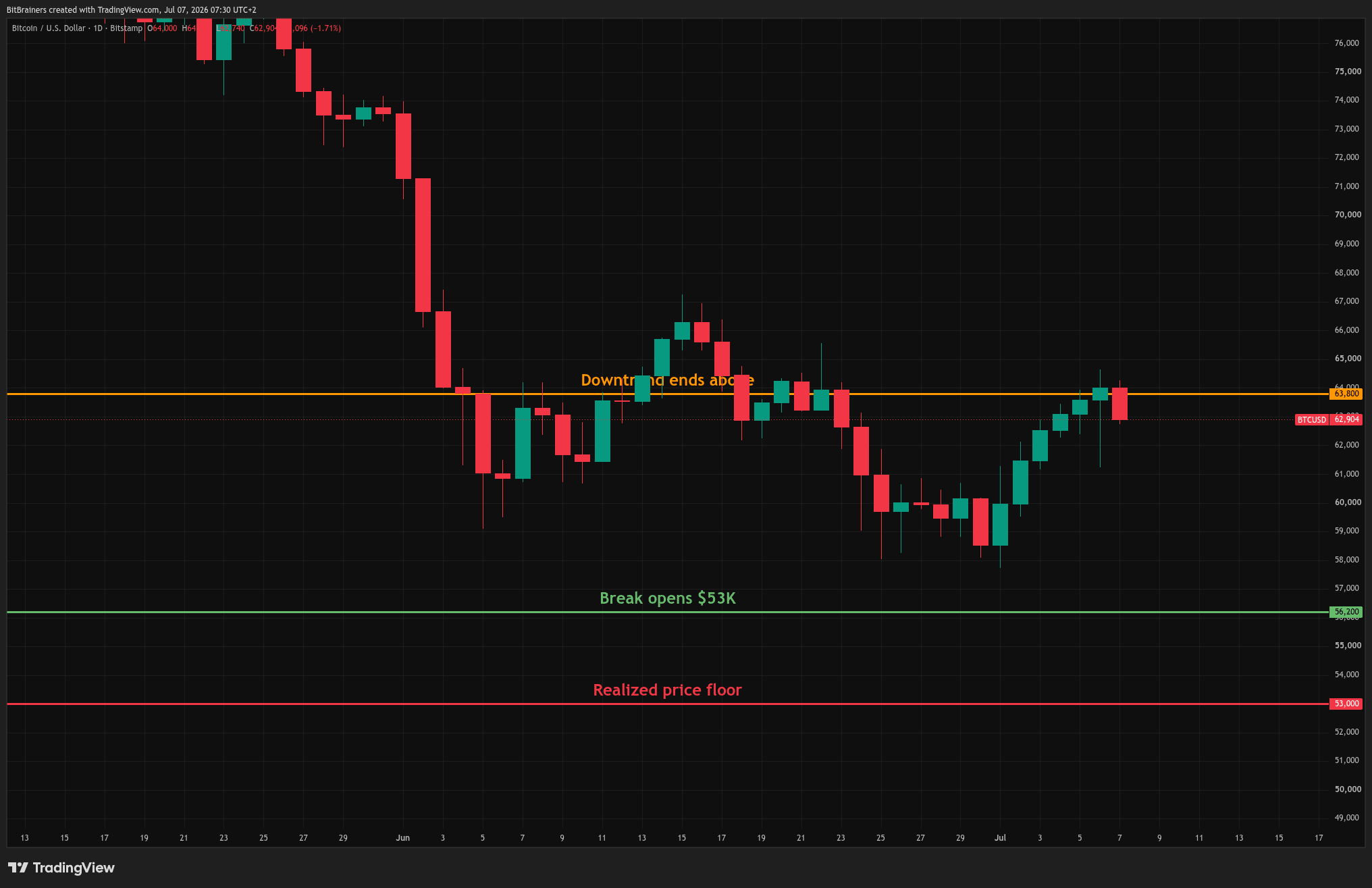
The level that matters is still $63,800. Multiple analysts have flagged it as the point where the downtrend structure breaks — specifically, where Bitcoin clears the lower high from the June decline and changes the technical picture from a series of lower highs to something more constructive. Price is roughly $550 below it as of this morning, close enough that one decent catalyst closes the gap.

Context matters here. Late June gave us the first weekly close below the 200-week moving average since 2023, a line Bitcoin has only lived under during the worst stretches of past bear markets. A recovery from that kind of technical damage needs follow-through, not one good week.

The 927 Pages Hanging Over the CLARITY Act

On Tuesday the Office of Government Ethics released President Trump's annual financial disclosure. It runs 927 pages, one of the longest ever filed by a sitting US president, and it reports more than $1.2 billion in crypto-related income for 2025.

The breakdown: $635 million in royalties from a group called "Celebration Coins" tied to his memecoin business, and over $526 million from sales of cryptocurrency tokens tied to World Liberty Financial, the crypto firm co-founded by members of his family. The White House says there are no conflicts of interest. Senate Democrats spent Wednesday saying otherwise, loudly.

Why this matters for price: the CLARITY Act, the market structure bill the entire US crypto industry has been waiting on, is stuck in the Senate on exactly one unresolved dispute. The ethics provision covering government officials holding personal crypto. The president just filed a public document showing he earned more from crypto last year than most exchanges did.

The Senate returns from recess on July 13 with roughly three working weeks before the August break. The disclosure hands Democrats fresh ammunition for the ethics fight at the worst possible moment for the bill's timeline. If CLARITY does not advance before recess, it slides toward 2027, and the market knows it.

The Flow Test: One Green Day Is Not a Trend

Thursday's session brought $221.7 million into US spot Bitcoin ETFs, the largest daily inflow in two months. It ended a ten-day streak that drained $2.73 billion from the complex and capped the worst ETF month on record, with June outflows north of $4 billion.

Look inside the number before celebrating. Fidelity's FBTC took in $166 million and ARKB added $92 million, but BlackRock's IBIT, the largest fund in the group, still bled $40 million on its eleventh straight red day. When the biggest holder base keeps de-risking while smaller funds turn green, that is reallocation, not fresh conviction.

Year-to-date net outflows still sit at $5.4 billion. Research this year estimates ETF flows now explain close to half of weekly Bitcoin price moves, so this ledger is not a sentiment indicator. It is a structural input. The test this week is simple: does Thursday get a second and third green day, and does IBIT stop bleeding.

The disclosure everyone skimmed. The flows everyone missed.

We read the boring documents so your Monday starts sharp. Free, every week.

Subscribe Free

Key Levels This Week

$63,800 Flip line. Clearing this breaks the lower high structure from the June decline. Next resistance sits at $66,600 to $67,600.
~$63,252 Current price. Roughly $550 below the flip line. The 20-day moving average near $62,500 needs to hold as support.
$56,200 Support. A break here opens the $50,000 to $53,000 zone.
$53,000 Realized price floor. Aggregate cost basis of all circulating supply. A sustained break puts the average holder underwater and removes the structural argument for the bull case.

The Calendar From Here

July 13, Senate returns. The CLARITY window reopens with the ethics clause now radioactive after the disclosure. Three working weeks to the August recess. Watch whether Republican leadership even schedules floor time.

July 14, June CPI. This is the number that sets the FOMC table. The weak jobs print already cooled rate-hike talk. A soft CPI reading reinforces that and gives Warsh room to soften language. A hot one swings hike odds back up and likely reverses last week's ETF momentum on the spot.

July 28 and 29, FOMC. The Fed decides into a market where positioning is stretched and every basis point of expectation is already traded. Whichever way CPI leans two weeks earlier, this meeting is where it gets priced for real.

This week itself is quieter. No Senate, no Fed, no major data until CPI. That leaves the daily ETF flow prints as the single most direct signal for whether last week's bounce has real sponsorship behind it. We covered the full on-chain backdrop, LTH accumulation, funding rates, and the $53,000 floor in detail in our indicators breakdown from last week.

Our Read Going Into the Week

We are in the setup phase, not the move. The base case is continued chop between $56,000 and $63,800 until the Senate returns and CPI lands.

The on-chain picture has not changed: long-term holders back in accumulation, exchange reserves at multi-year lows, leverage washed out. The fuel is there.

What has changed is the politics. A market structure bill blocked on an ethics clause just collided with the largest presidential crypto disclosure in history. The disclosure does not move price today. But it moves the odds on the biggest regulatory catalyst of the year, and those odds moved in the wrong direction over the weekend. If CLARITY slips past August recess, the market loses its most credible near-term fundamental catalyst and the macro headwinds carry more weight.

Watch the flows Monday through Wednesday. That is the short-term answer. The Senate and the CPI are the medium-term one. Everything else is waiting.


Sources

CNBC: Trump says outside funds run his money after disclosure shows billions in 2025 revenue
CNN: Trump made more than a billion dollars from cryptocurrency ventures in first year back in office
NBC News: Trump's financial disclosure lists $1.4 billion in crypto earnings, powered largely by meme coins
CoinDesk: Bitcoin ETFs see $221 million inflow, ending 10-day outflow streak
24/7 Wall St.: Bitcoin price prediction for July 2026

Disclosure: This article is for informational purposes only and is not financial advice. We may earn commissions from affiliate links. Always do your own research before making investment decisions.

Sunday, July 5, 2026

Most People Have Read the Bitcoin White Paper. Almost Nobody Understood Section 11.

BitBrainers - Bitcoin white paper Section 11 math explained

By BitBrainers Editorial

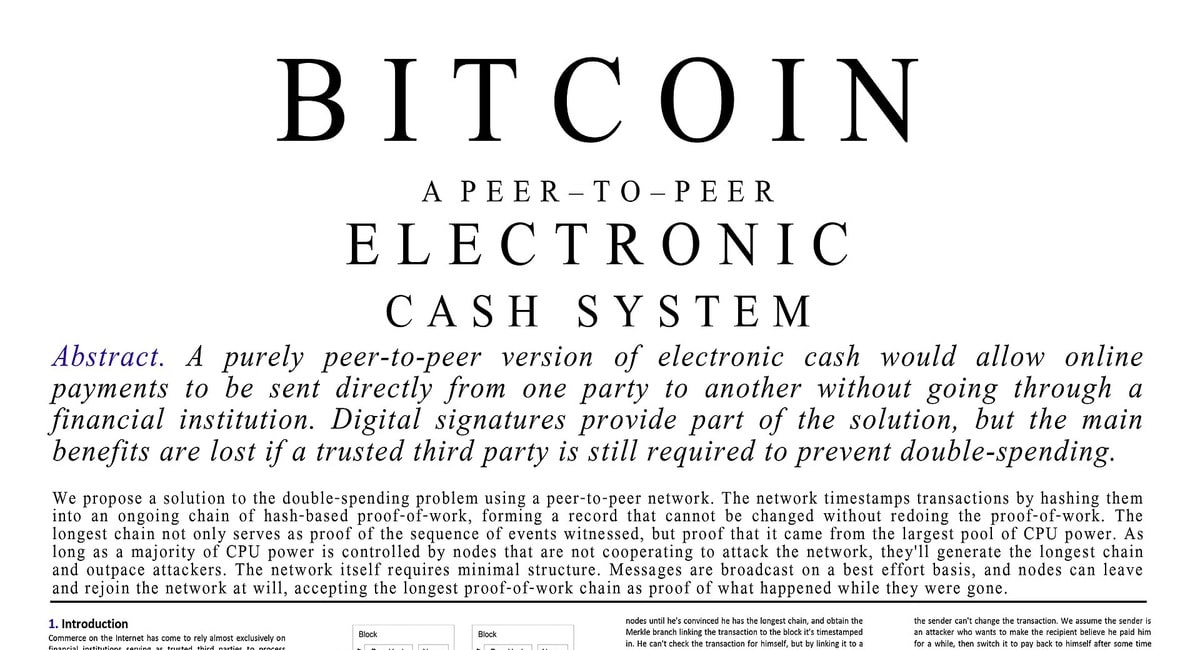
The Bitcoin white paper is nine pages. Most people who claim to have read it understood eight of them. Section 11 is where Nakamoto stops arguing and starts proving. It is also where most readers quietly stopped following the math and decided to trust the conclusion instead.

This is an honest walkthrough of what Section 11 actually says, what problem it solves, and why the answer to that problem is the reason you wait for six confirmations before treating a Bitcoin transaction as final.

What the First Ten Sections Actually Do

Sections one through ten build the argument. Nakamoto describes the problem with double-spending, introduces the concept of a chain of proof-of-work, explains how nodes reach consensus without a central authority, and walks through the incentive structure that keeps miners honest.

It is a compelling design document. Every piece fits logically. But by Section 10, Nakamoto has only argued that the system should work. Section 11 is where he proves it cannot be broken, mathematically, given a specific assumption about the attacker's share of hash power.

The Problem Section 11 Is Solving

Imagine you receive a Bitcoin payment. The sender broadcasts the transaction, it gets included in a block, and the block gets added to the chain. You ship the goods. Then the sender quietly mines an alternative version of the chain that does not include your transaction, catches up to the honest chain, and broadcasts it. Your payment disappears. The sender has their Bitcoin back.

This is the double-spend attack. It is the fundamental threat Nakamoto needed to make practically impossible for the system to work.

The question Section 11 answers is precise: if an attacker controls q percent of the network's total hash power and the honest chain is already z blocks ahead, what is the probability the attacker ever catches up?

The Gambler's Ruin Problem

Nakamoto frames this as a version of the gambler's ruin problem. A gambler with finite resources plays against a casino with infinite resources. Even if the gambler has a near-even chance of winning each hand, the casino will eventually bankrupt them because the casino can absorb losses and the gambler cannot.

In Bitcoin, the honest chain is the casino. It has more hash power than the attacker by assumption, so it mines blocks faster on average. The attacker is the gambler, trying to close the gap against a chain that keeps moving forward.

Nakamoto models the number of blocks the attacker mines using a Poisson distribution. The Poisson distribution is the right tool here because it models the number of times a random event occurs in a fixed interval when that event has a known average rate. Mining a block is exactly that kind of event.

The attacker mines blocks at rate q. The honest chain mines blocks at rate p, where p plus q equals 1 and p is greater than q. For each block the honest chain adds, Nakamoto calculates the probability the attacker closes the gap entirely and overtakes the chain.

What the Formula Produces

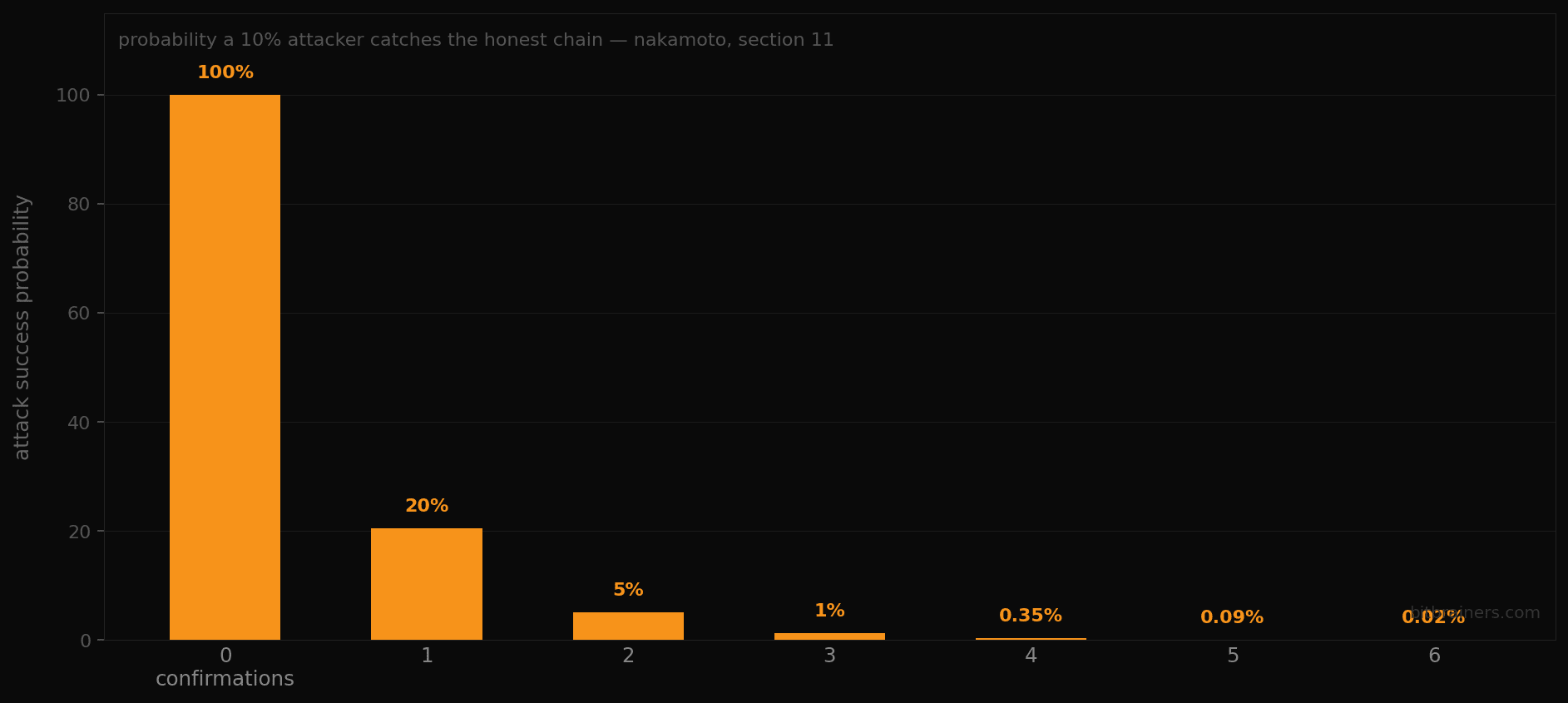
BitBrainers - Nakamoto Section 11 attack probability by confirmation

The result is this: the probability the attacker ever catches up from z blocks behind drops exponentially as z increases. Not linearly. Exponentially. Each additional confirmation multiplies the difficulty of a successful attack.

Nakamoto runs the numbers in Section 11 for a specific scenario. If the attacker controls 10 percent of hash power and the recipient waits for 0 confirmations, the attacker succeeds roughly 45 percent of the time. Wait for 1 confirmation and that drops to around 20 percent. At 6 confirmations with a 10 percent attacker, the probability of a successful double-spend is approximately 0.024 percent — two hundredths of one percent.

At 30 percent attacker hash power, the same 6 confirmations holds the probability in the low double digits, around 10 to 12 percent. It is only when the attacker approaches or exceeds 50 percent that the math breaks down fundamentally, because at that point the expected value of the attack becomes positive.

Six confirmations is not an arbitrary convention. It is the point at which the attack probability becomes economically irrational for any attacker controlling a realistic share of hash power.

This also explains why different participants use different thresholds. A merchant accepting a small payment might accept one or two confirmations — the potential loss is too low to justify waiting. An exchange receiving a large transfer might wait for 20 or 30. Six became the industry default because it represents the rational threshold for a realistic attacker, not because Nakamoto mandated it.

Bitcoin basics without the hand-waving.

Every Monday we break down what actually matters in markets and on-chain. No hopium, no noise.

Subscribe Free

Why This Was a Genuine Intellectual Achievement

Nakamoto did not invent the Poisson distribution or the gambler's ruin problem. Both are classical probability theory. What he did was recognize that these tools mapped precisely onto the double-spend problem and apply them correctly in nine pages.

The insight is that you do not need to prevent attacks from being attempted. You only need to make them unprofitable. The math in Section 11 proves that with honest majority hash power, the cost of a successful double-spend attack grows faster than the potential gain as confirmations increase.

That is the security model. Not cryptography alone. Not decentralization alone. A probability calculation that makes cheating economically self-defeating.

What It Means Today

The model holds as long as no single entity controls more than 50 percent of hash power. That assumption has been under pressure as mining has concentrated in large pools. Two or three major pools coordinating would theoretically cross the threshold.

In practice, the economics still work in Bitcoin's favor. A successful 51 percent attack would destroy the value of the asset the attacker spent resources to mine. The incentive to attack is undermined by the attack's own success. Nakamoto noted this too, in Section 6.

But the honest read is that the security guarantee in Section 11 is a probabilistic one, not an absolute one. Six confirmations makes attack economically irrational under normal conditions. It does not make attack physically impossible.

That distinction is what most white paper summaries quietly omit. Nakamoto did not omit it. He put the exact numbers in a table and let the math speak.

The One Line Worth Remembering

Section 11 closes with this: "We can see that the probability drops off exponentially with z."

That sentence is the entire security argument in eleven words. Every six-confirmation standard, every exchange policy, every custody procedure in the industry is downstream of that one observation. Most people who have "read" the white paper read around it.

Now you have not.


Sources

Satoshi Nakamoto: Bitcoin: A Peer-to-Peer Electronic Cash System (2008)
Bitcoin Wiki: Confirmation — security model and confirmation thresholds
Bitcoin Wiki: Double-spending — attack mechanics and historical context

Disclosure: This article is for informational purposes only and is not financial advice. We may earn commissions from affiliate links. Always do your own research before making investment decisions.

Weekly Brief: The Week FOMC Decides Everything

By BitBrainers Editorial Bitcoin hit $66,400 on Tuesday, its highest since June 17, on seven straight days of ETF inflows. By Friday it ...