
₿ BTC Loading... via Binance

Sunday, July 19, 2026

The CPI That Saved Bitcoin Was Built on Cheap Gas

BitBrainers - The CPI That Saved Bitcoin Was Built on Cheap Gas

By BitBrainers Editorial

Bitcoin rallied nearly 5% on July 14 and broke $65,000 the following day. The catalyst was the June CPI print: headline inflation fell 0.4% month over month, the biggest monthly drop since April 2020. Core came in flat. Fed hike odds for July 29 collapsed from above 40% to around 13%. Risk assets breathed. Bitcoin followed.

What drove that inflation drop? Largely gasoline. Energy prices pulled the headline number lower after a brief period of relative calm in the Strait of Hormuz, where a fragile interim agreement between the US and Iran had allowed some shipping to resume after months of conflict.

That agreement fell apart the same week Bitcoin was celebrating.

US and Iranian forces exchanged strikes from July 13 onward. Brent crude, which had dipped toward the low $70s during the ceasefire window, surged back above $85 by July 14-15. The exact energy prices that made the CPI print look soft are now reversing in real time.

The Relief Was Already Priced on Old Data

CPI measures the previous month. June's print described a world where Hormuz tensions had briefly eased and gasoline got cheaper. The July print will describe a world where they hadn't.

Bitcoin rallied on a data point that was already stale when it landed.

The Fed's new chair Kevin Warsh acknowledged this directly. Minutes from the June meeting flagged AI-driven energy demand as a new inflation wildcard. Warsh is also scheduled to testify before Congress this week. Traders parsing his tone for September signals will be doing so against a backdrop of $85 oil and contested shipping lanes.


The macro picture changes fast.

Get the weekly brief every Monday before the market opens.

Subscribe

What the On-Chain Picture Actually Says

Beneath the CPI reaction, the structural picture is more interesting than the headline move. Whale addresses accumulated over 270,000 BTC near the $59,000 level in the two weeks before the bounce. Long-term holder supply is at record levels. Exchange reserves are at seven-year lows.

At the same time, the average spot ETF buyer entered around $83,800. With Bitcoin near $64,000, the typical ETF holder is sitting on an unrealized loss exceeding 23%. That gap explains why inflows have been sporadic. Buyers who are underwater tend to sell into strength rather than add.

This is not a normal distribution of holders. ETF products introduced a layer of institutional capital that tracks mandates and risk limits, not conviction. When real rates rise, those mandates force selling regardless of on-chain fundamentals. When real rates fall, the buying resumes. Bitcoin's price has become partially a function of interest rate expectations, not just adoption or scarcity.

Two forces pulling in opposite directions. Smart money accumulating on-chain. Institutional paper holders bleeding out through ETF redemptions. The feedback loop that defined 2024, where ETF inflows drove price and price attracted more inflows, is not functioning the same way in 2026.

Year-to-date net outflows from US spot Bitcoin ETFs stand at approximately $5.4 billion. June alone produced roughly $4.5 billion in outflows, the worst monthly reading since these products launched in January 2024.

The Bounce Has a Shelf Life

Bitcoin is a rate-sensitive risk asset in this cycle. The June CPI print did one specific thing: it removed the tail risk of a July hike. It did not open the door to cuts. Markets still assign roughly 70% odds to a hold on July 29, and prediction markets show around 76% odds of zero cuts across all of 2026.

The ceiling has not moved. The floor got confirmed.

Part of the move was also mechanical. A short squeeze wiped over $230 million in leveraged positions across two sessions following the CPI and PPI prints. That amplified the price action. It does not mean the underlying bid is as strong as the candle size suggests.

Whether Bitcoin can hold above $65,000 into the July 29 FOMC meeting now depends on three variables: whether oil stabilises or pushes higher from here, whether ETF flows turn sustainably positive, and whether Warsh signals anything new on the September path.

One of those three is already moving in the wrong direction. Read our July CPI breakdown for the full macro setup going into FOMC.
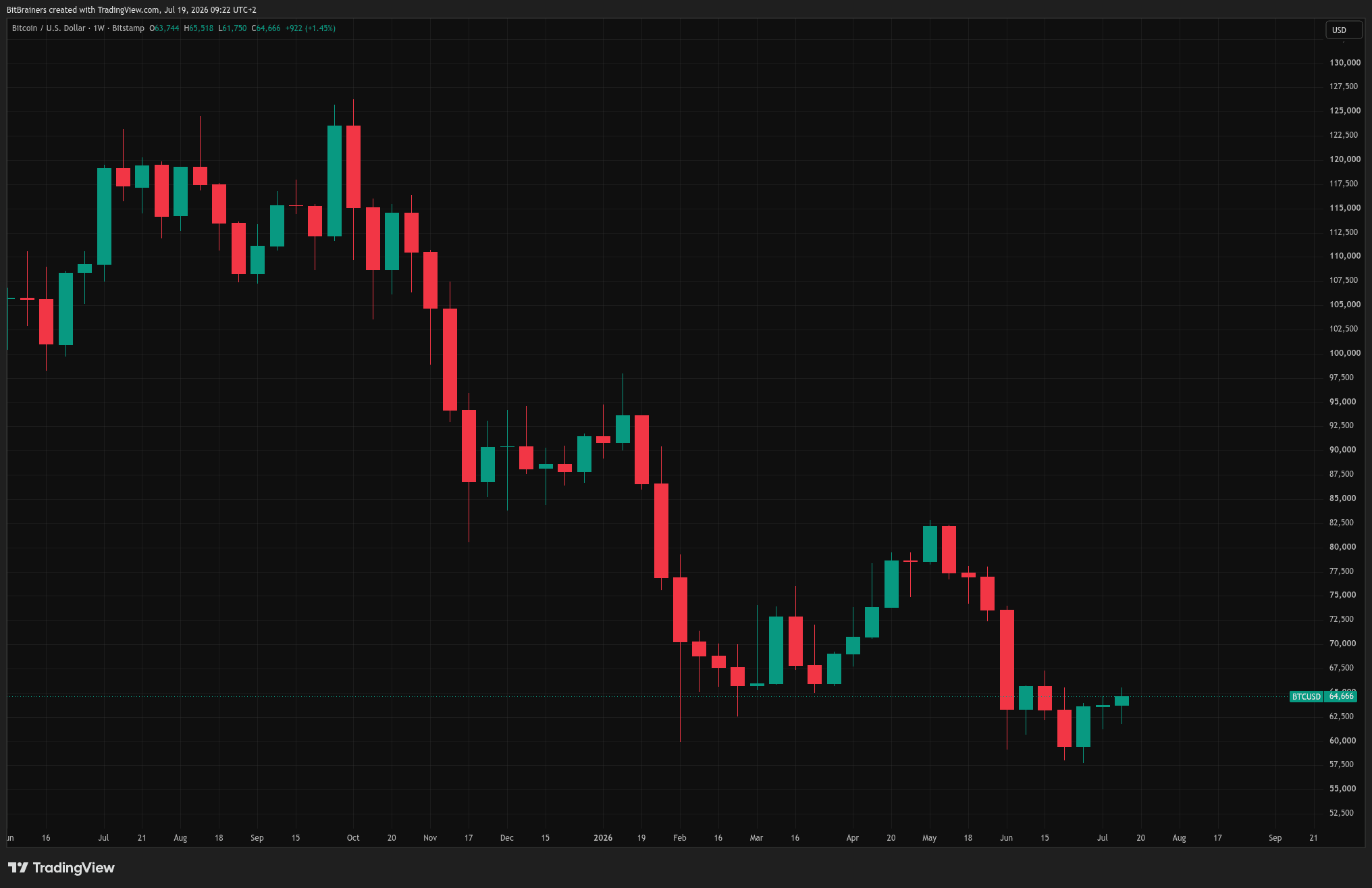
BitBrainers - BTC/USD Weekly Chart July 2026

On The Radar

Fed Chair Warsh testifies before Congress this week. July PPI landed July 15 below consensus, extending the inflation relief narrative for now. FOMC decision July 28-29 remains the next hard catalyst. Watch Brent crude. If it stays above $85 heading into August, the July CPI relief story starts to unwind before the Fed even meets.

Sources
Al Jazeera Oil prices hit 1-month high as US-Iran attacks dim Strait of Hormuz outlook
CNBC Oil prices today: Brent, WTI, Hormuz blockade
Phemex Bitcoin reclaims $64,000 after the softest CPI print of 2026
Memeburn Bitcoin price hits $64K as ETF outflows persist in July 2026
TechTimes Bitcoin breaks $65K on dual inflation miss

This is market commentary, not financial advice. BitBrainers holds Bitcoin and other digital assets. Nothing here is a recommendation to buy or sell any asset. Do your own research.
Friday, July 17, 2026

Weekly Brief: The Week the Market Celebrated Too Early

By BitBrainers Editorial

Bitcoin opened the week at $63,587, slid to a low of $61,481 on July 8 as Middle East tensions flared, then ripped to $65,000 on Tuesday when CPI came in soft. By Thursday July 17 it is back at $62,735. The week looked like a recovery. It ended where it started.

The CPI Print That Wasn't What It Looked Like

June headline CPI came in at 3.5% against a 3.8% forecast. Core landed at 2.6% versus 2.8% expected. Both missed below. Bitcoin jumped 3.8% to $64,434 and Ethereum rose 6.1% in the same session.

The problem is what drove the soft headline. Gasoline fell sharply in June after the US-Iran ceasefire took hold and oil pulled back. That ceasefire collapsed on July 8. WTI crude has since recovered toward $74 a barrel. The June data captured a world that no longer exists by the time markets traded on it.

Core CPI at 2.6% is a genuine improvement from May's 2.9% reading. But the Fed's actual target is core PCE, and nine of eighteen FOMC officials still project a rate hike before year-end. The July 28-29 meeting is live with no forward guidance, and the soft print shifts odds without changing the structure.


ETF Flows: One Day of Green in a Red Quarter

The CPI reaction produced one day of ETF inflows: roughly $197 million on July 14, ending a 10-day outflow streak. By some measures the single-day figure reached $265 million across all products. Either way, it was the strongest inflow session since May.

Context matters here. June saw $4.5 billion in ETF outflows, the worst monthly figure since the funds launched in early 2024. Year-to-date outflows remain deeply negative. One session recovered a few percent of the capital that left in June alone.

BlackRock's IBIT held approximately $60 billion in assets under management through the week, but BlackRock's broader digital assets AUM had fallen roughly 40% year over year to $49 billion. Citigroup had already cut its 12-month Bitcoin target from $112,000 to $82,000 and revised its 12-month ETF inflow assumption to zero.


The data before the crowd reads it.

Weekly macro and Bitcoin analysis. No price targets pulled from thin air.

Subscribe

Strategy Keeps Selling

Michael Saylor's company filed its weekly disclosure showing 3,588 BTC sold for $216 million during the week of June 30 to July 5, at an average of roughly $60,000 per coin. The company's cost basis across its entire stack sits at approximately $75,476 per coin. It is selling below cost.

The mechanism is straightforward: preferred stock dividends now exceed $1.5 billion annually and must be paid regardless of where Bitcoin trades. The first post-2022 sale was 32 coins in early June. The following disclosure was 3,588 coins. The pace is accelerating.

Strategy is the company whose founder told the world to never sell Bitcoin. The filings now show it sells every week. The two facts are not contradictory once you understand the capital structure. They are worth understanding before repeating either talking point.


CLARITY Act: The Hearing Happened, The Vote Has Not

The House Financial Services Committee held a field hearing in New York on July 17, exactly one year after the House passed the CLARITY Act 294-134. The hearing had no vote attached. Its purpose was to apply pressure on the Senate before the August recess closes the window.

The Senate math has not moved. The bill needs 60 votes for cloture. Republicans hold roughly 53 seats. Two Democrats, Ruben Gallego and Angela Alsobrooks, voted it out of the Banking Committee in May but both remain conditional. Five or more additional Democratic votes are needed and none are publicly committed.

Senator Lummis has said plainly that failure in 2026 likely pushes the next realistic window to 2030. Stifel's analyst Brian Gardner has written that the bill needs to clear the Senate before the August recess or prospects deteriorate materially. The GENIUS Act stablecoin rulemaking deadline of July 18 lands this week and may produce additional regulatory headlines.

For last week's full macro setup and what we were watching heading into this week: Bitcoin Weekly Brief: July 6


Key Levels This Week

Bitcoin at $62,735 on July 17. Weekly range: $61,481 low to $65,000 high. The Bollinger midband sits near $62,015 and the upper band near $65,652, with price compressing back toward the midline after the CPI spike. MACD histogram remains positive. RSI(6) at 62.5, RSI(24) at 49.1.

The $60,000 zone held twice this month. The $65,000 level rejected twice. Until one of those breaks on meaningful volume, the range is the structure.


On The Radar Next Week

July 28-29 FOMC. That is the main event. No forward guidance, no fresh dot plot until September, and the Fed walking in with one soft CPI print against a backdrop of recovering oil prices and an unresolved Hormuz situation. Watch the statement language for any shift in the hike-or-hold bias.

ETF flows daily. A second and third consecutive inflow day led by IBIT changes the picture. A reversal confirms the CPI session as a one-day relief bounce.

Strategy's weekly filing. If the pace continues accelerating from 32 coins to 3,588 coins in five weeks, the math on their dividend schedule suggests this is not a one-off.

CLARITY Act Senate calendar. Any announcement of a floor vote date before the recess, or the absence of one, is the binary that matters for the rest of July.


Sources

Caleb and Brown Weekly Rollup July 14, 2026

CoinStats Bitcoin Daily Market Analysis July 16, 2026

CryptoTicker Bitcoin's Green July Is Real, But One Vote Could Blow It All Up

Yahoo Finance What Happens to Bitcoin and Crypto If the CLARITY Act Misses Its Deadline

Motley Fool Crypto Market Today July 14: Ethereum Soars 6% on Cooler Inflation Data

This is market commentary, not financial advice. BitBrainers holds Bitcoin and other digital assets. Nothing here is a recommendation to buy or sell any asset. Do your own research.

Thursday, July 16, 2026

CLARITY Act Hearing on July 17: Seven Democrats Decide Crypto Regulation in 2026

BitBrainers - CLARITY Act Hearing on July 17: Seven Democrats Decide Crypto Regulation in 2026

By BitBrainers Editorial

On Friday morning, the House Financial Services Committee convenes a field hearing in New York titled "Building the Future of Finance: How the CLARITY Act Unlocks Innovation." The House passed this bill a year ago, 294 to 134. The hearing has no vote attached and no legal power to move anything. So why does it matter? Because it lands in the exact week the Senate decides whether the United States gets crypto market rules in 2026 or waits until 2030.

A Hearing With No Vote and Plenty of Leverage

The CLARITY Act sits on the Senate Legislative Calendar with no floor vote scheduled. Prediction markets put the odds of passage this year at roughly 43%, down from the low seventies earlier this year.

Friday's session is pressure, applied publicly. Holding it in New York instead of a Capitol Hill committee room puts the exchanges, banks, and asset managers who would live under the framework in the room, arguing that the US either hosts the next generation of financial infrastructure or watches it leave.

The date is not an accident either. The House passed the original bill on July 17, 2025. The hearing lands exactly one year later, with the Senate's window closing.


The Math Is Seven Democrats

The Senate Banking Committee advanced the bill 15 to 9 on May 14. All thirteen Republicans voted yes, joined by two Democrats, Ruben Gallego and Angela Alsobrooks. Both conditioned their committee votes on further negotiation before committing to anything on the floor.

Cloture requires 60 votes. Republicans hold roughly 53 seats. That means at least seven Democrats, and only two are even conditionally on record.

The holdouts want three things. Stronger anti-money-laundering language, after Senator Warren branded the bill "a ticket to sanctions evasion." Resolution on Section 604, the developer protections that critics say could shield illicit actors. And an ethics provision covering government officials who hold crypto, a demand aimed squarely at the president's family businesses, from stablecoins to mining operations.

The holdouts are not just stalling. The Warren camp's core argument is that Section 604 could shield developers whose tools end up serving sanctions evasion, and the banking lobby argues that even activity-based stablecoin rewards compete with insured deposits while carrying none of the same obligations. Whether those arguments hold up or not, seven Democrats need political cover to vote yes, and cover comes from concessions, not hearings.


Washington moves markets more than charts do.

We track the policy, the flows, and the numbers behind the headlines. One email a week.

Subscribe

The Coinbase Reversal Tells You Where the Bodies Are Buried

In January, Brian Armstrong pulled Coinbase's support for the Senate draft an hour before a scheduled markup. The markup was cancelled. His stated objection covered several provisions, but the core of it was stablecoin yield: the Senate text restricted the rewards Coinbase pays users for holding USDC, a business that generated $355 million for the company in a single quarter.

The fix came in May. Senators Thom Tillis and Angela Alsobrooks brokered compromise language, now Section 404, that bans yield paid solely for holding a stablecoin while preserving rewards tied to actual activity: payments, transfers, staking, liquidity, loyalty programs.

Coinbase took the deal. This week its chief policy officer went on national television calling the bill the unlock for the company's "everything exchange" ambitions, tokenized stocks and stablecoin payments under one regulated roof. The company that killed the bill in winter is now its loudest advocate in summer. That reversal, more than any press release, tells you the industry believes this version can actually pass.


The Calendar Is the Real Opponent

Senator Lummis says the merged text combining the Banking and Agriculture Committee versions should land within days, with a possible floor vote the week of July 20. Galaxy Research projects a potential presidential signature the week of August 3 if everything holds, and puts passage odds at 60 to 75%, notably higher than the prediction markets.

The recess is the cliff. If the Senate leaves for August without a vote, the bill returns to a fall calendar that runs straight into midterm campaigning, where few Democrats will want to hand the administration a win on an asset class the president trades personally.

Lummis has said it plainly: failure in 2026 likely pushes the next realistic window to 2030.

Markets spent this week celebrating a soft inflation print instead. We covered why that rally rests on stale data: Bitcoin Pumped on Old News. Here Is What Actually Matters This Month.


What Friday Actually Signals

Watch three things in the hearing. Whether witnesses or members hint that the merged Senate text is genuinely close, whether Section 604 sounds like it is being negotiated or defended, and whether leadership talks about the bill as a July priority or an autumn project.

The market impact is asymmetric. Passage compresses the legal-risk premium priced into every US exchange, stablecoin issuer, and token network still caught between SEC and CFTC jurisdiction. Failure does not just maintain the status quo, it extends it for years, with the next Congress campaigning instead of legislating.

A hearing that cannot pass anything is still the clearest signal you will get this month about whether anything passes at all.


Sources

crypto.news CLARITY Act Senate Showdown: Why the July 17 Hearing Decides Crypto's 2026

CryptoSlate Crypto Finally Has a CLARITY Act Date, Delivery Now Depends on Seven Senate Democrats

Fortune Why Coinbase Split With a16z and the Crypto Sector on a Key Bill

The Crypto Times House Takes CLARITY Act to Wall Street With July 17 Innovation Hearing

The Crypto Times Coinbase Backs CLARITY Act to Unlock Its 'Everything Exchange'

This is market commentary, not financial advice. BitBrainers holds Bitcoin and other digital assets. Nothing here is a recommendation to buy or sell any asset. Do your own research.
Wednesday, July 15, 2026

Bitcoin Pumped on Old News. Here Is What Actually Matters This Month.

BitBrainers - Bitcoin Pumped on Old News. Here Is What Actually Matters This Month.

By BitBrainers Editorial

Bitcoin pumped 4% on Tuesday after the June CPI print came in below expectations. Headline inflation landed at 3.5%, core at 2.6%. The crowd cheered. Price hit $65,000. ETF inflows showed up for the first day in two weeks. Nobody mentioned that the data was nine days old.

The Number That Moved the Market

June CPI measures prices collected through the end of June. The soft headline was driven by gasoline, which fell roughly 10% during the month after the US-Iran ceasefire took hold and oil pulled back sharply.

That ceasefire collapsed on July 8. US and Iranian forces exchanged fresh airstrikes, Trump declared the ceasefire over, and WTI crude surged toward $74 a barrel. The energy deflation that made Tuesday's print look friendly is already gone.

Core CPI, which the Fed actually targets through its PCE proxy, came in at 2.6%. That is cooler than the 2.9% May reading, which is genuinely good. But it does not change where the Fed sits today.


What the Fed Actually Sees

At the June meeting, Kevin Warsh held rates at 3.50 to 3.75%. Nine of eighteen FOMC officials project at least one rate hike before year-end. The cutting bias was removed from the statement entirely.

Warsh also scrapped forward guidance. There will be no fresh dot plot until September. The July 28-29 meeting is live, with no signals in either direction, and markets walking in blind.

One soft CPI print shifts the odds. It does not change the structure. The Fed's own 2026 inflation forecast is 3.6% headline. Tuesday's 3.5% barely clears that bar.


The data before the crowd reads it.

Weekly macro and Bitcoin analysis. No hype, no price targets pulled from thin air.

Subscribe

The Story Nobody Led With

While the market was celebrating the CPI print, Strategy filed its weekly Bitcoin disclosure. The company sold 3,588 BTC for $216 million during the week of June 30 to July 5, at an average price of roughly $60,000 per coin.

Strategy's average cost basis across its holdings is approximately $75,476 per coin. The company is underwater. It is selling Bitcoin to fund preferred stock dividends, which now exceed $1.5 billion annually.

This is the same company that built its identity on never selling. The first sale since 2022 happened six weeks ago: 32 coins, $2.5 million. Last week it was 3,588 coins and $216 million. The pace is accelerating.


ETF Flows: One Day Does Not Fix a Broken Quarter

Tuesday's CPI reaction brought one day of ETF inflows: $221 million, the largest single session in two months. Analysts at HashKey and LVRG Research both described it as cautious re-entry, not a trend reversal.

Year-to-date ETF outflows still stand at $5.4 billion. June alone saw $4.5 billion exit, the worst month since the funds launched in early 2024. One session recovered roughly 4% of the 2026 capital that has left.

Citigroup cut its 12-month Bitcoin target from $112,000 to $82,000 in June. The more important part of that note was not the price target. It was Citi's rationale: they reduced their 12-month net ETF inflow assumption to zero, citing outflows, stalled crypto legislation, and capital rotating into AI-related equities.

For the ETF inflow story to become structural, analysts need to see IBIT reverse, multiple issuers participating, and price holding higher lows across several sessions. None of that happened Tuesday.

For context on how this year's five previous CPI prints moved Bitcoin, see our earlier breakdown: Five CPI Prints, Five Bitcoin Reactions, and Why the Sixth Comes With a Catch.


What to Watch Now

July 28-29 is the date that matters. That is when Warsh's Fed meets again, with no pre-signaling, no fresh projections until September, and a market that just handed them one piece of softer inflation data against a backdrop of geopolitical oil risk.

Between now and then, watch ETF flows daily. A second and third consecutive inflow session, led by IBIT, would shift the picture. A single-day reversal back to outflows would confirm Tuesday as the relief bounce it looks like.

Watch Strategy's weekly filings. If the pace of selling continues to accelerate from 32 coins to 3,588 coins in six weeks, the math on their dividend obligations suggests this is not a one-off.

The market celebrated old news on Tuesday. The new news lands July 28.


Sources

CoinDesk Strategy Dramatically Ups Pace of Bitcoin Sales, Raising $216 Million

Brave New Coin Bitcoin ETF Flows Face CPI Test as Fed Rate-Hike Risk Returns

TechTimes Bitcoin ETF Outflow Streak Ends at $2.7B as June Jobs Data Cools Rate Risk

24/7 Wall St. Bitcoin Price Prediction for July 2026

Hex Trust Market Pulse: Macro Ceiling, On-Chain Floor

This is market commentary, not financial advice. BitBrainers holds Bitcoin and other digital assets. Nothing here is a recommendation to buy or sell any asset. Do your own research.

Tuesday, July 14, 2026

Today's Inflation Number Describes a World That Ended Six Days Ago.

BitBrainers - CPI Day and Bitcoin

By BitBrainers Editorial

Five times in 2026, the Bureau of Labor Statistics released a CPI number at 8:30am Eastern. Five times, Bitcoin moved more than it had any business moving on a single data point. Today is the sixth.

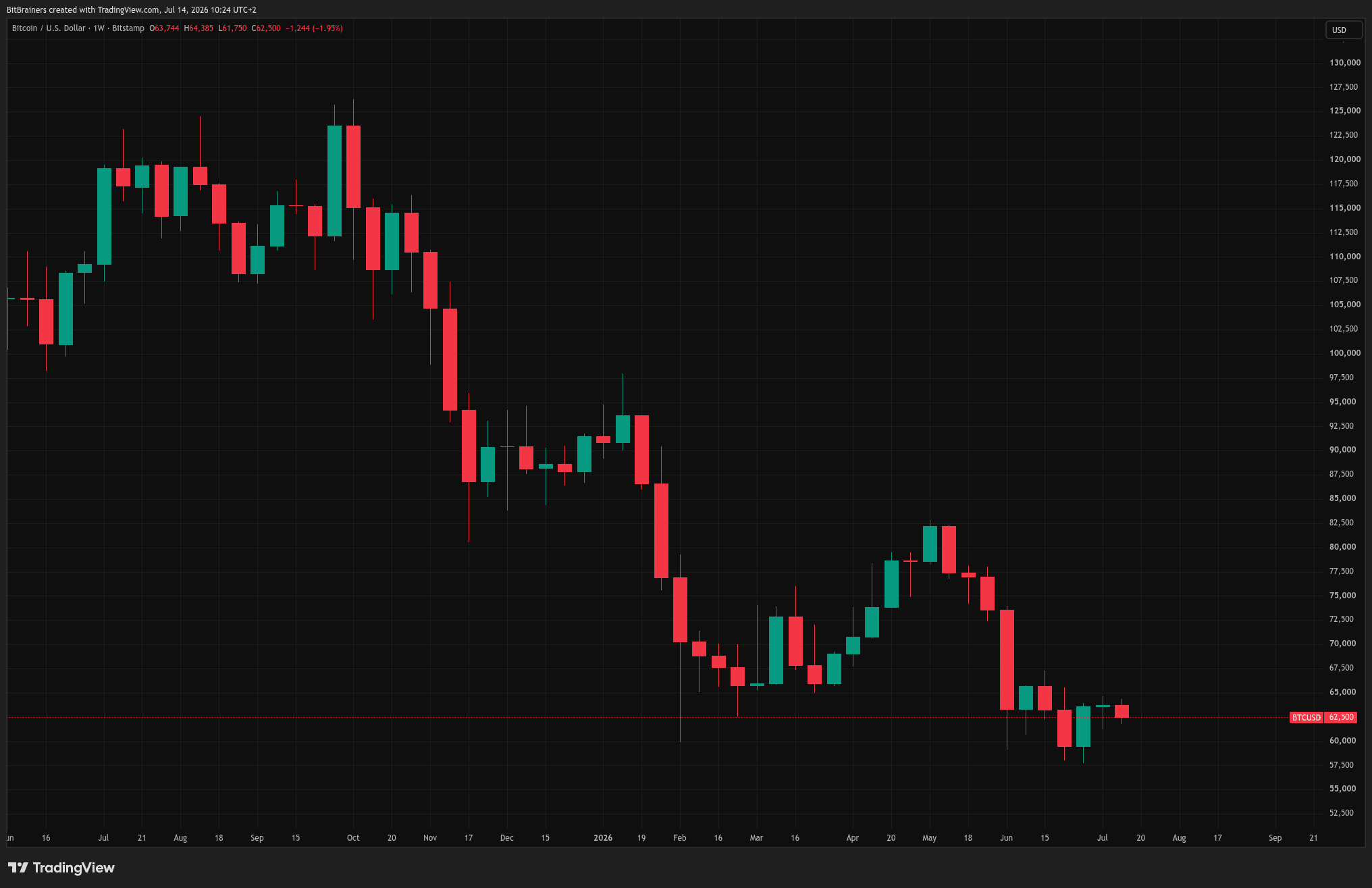
The June CPI lands today, July 14, and it arrives at one of the more uncomfortable setups of the year. Bitcoin is sitting at roughly $62,500, down more than 50% from its October 2025 all-time high of $126,080, with Extreme Fear dominating the sentiment readings and ETF outflows only recently showing signs of stabilising.

The number that drops at 8:30am ET is not really about June. It is about what the Fed does on July 28-29.

What the Chart Says Before the Print


Every CPI print in 2026 has moved Bitcoin in double digits, or close to it. The pattern is not random. The headline number moves algos in the first two minutes. The core number moves the market for the rest of the day. And the Fed's reaction at the next FOMC meeting moves the trend for weeks afterward.

Here is how each print played out:

Month Headline YoY Core YoY BTC Move Key Driver
February 2.4% 2.5% -5.77% In-line, rate cut hopes faded
March 3.3% 2.6% (below est.) +8.41% Cool core beat headline energy shock
April 3.8% 2.8% -4.00% Iran energy shock accelerating
May 4.2% 2.9% -27.60% Hottest since Apr 2023, ETF outflows, Strategy sale
June (post-May CPI) 4.2% 2.9% (below est.) +10.85% Core below forecast, Fed hold confirmed
Today (June data) ~3.9% est. ~2.9% est. TBD Energy reversal vs. Iran re-escalation
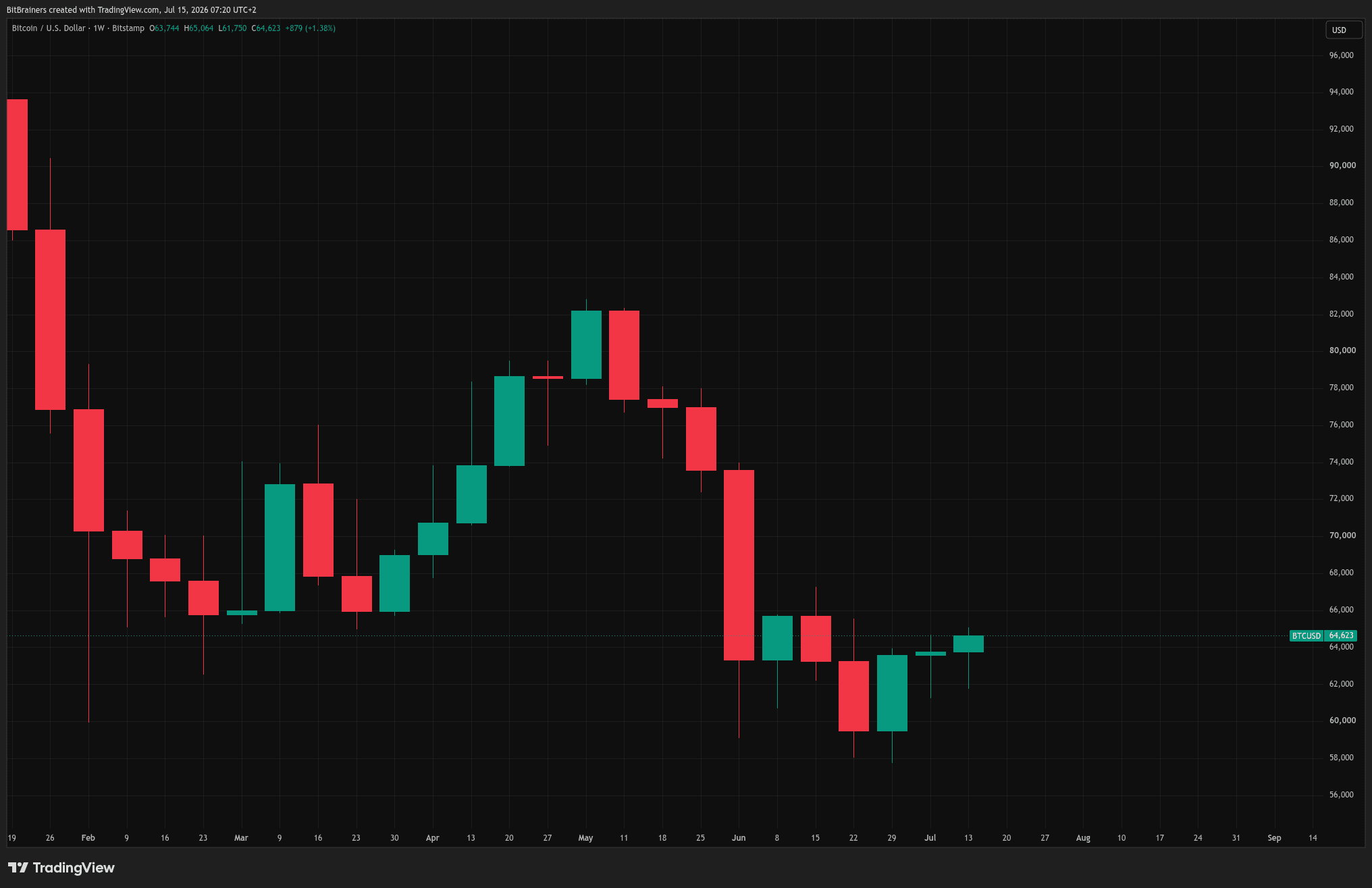
BitBrainers - BTCUSD Weekly Chart July 14 2026

The lesson from five prints: watch core, not headline. Every time core surprised to the downside, Bitcoin rallied regardless of what the headline showed. Every time headline drove the narrative without core relief, the market sold off.

What Today's Number Is Expected to Show


Consensus sits at headline CPI falling roughly 0.1% month-on-month for June, with the annual rate dropping from 4.2% to approximately 3.9%. The driver is straightforward: gasoline prices fell around 10% in June, the fourth largest monthly decline in a decade, as the US-Iran ceasefire temporarily reopened the Strait of Hormuz and reversed the oil spike.

Core CPI, the number the Fed actually targets, is expected to hold at around 2.9% year-on-year with a 0.2% monthly increase.

Here is the catch. The ceasefire ended on July 8. US airstrikes resumed over the weekend. Oil is back above $79 a barrel and the Hormuz situation is again contested. Whatever relief June energy prices provide to today's headline is a backward-looking snapshot of a price level that no longer exists. July's data, released in August, will look materially different.

Shelter costs and tariff pass-through are the other variables. Both remain sticky and neither moved in a helpful direction in recent months. A soft headline driven purely by gasoline reversal, with shelter and services holding firm, gives the Fed nothing to act on.

The macro picture changes faster than the headlines do.

Get BitBrainers analysis in your inbox before the market prices it in.

Subscribe

The Number That Actually Matters


Markets are not pricing today's CPI. They are pricing what Kevin Warsh does on July 28-29. That is the only question that matters for Bitcoin's next significant move.

The Fed meets in two weeks. Warsh has scrapped the practice of telegraphing moves in advance and emphasised data-dependence, which means the July 28-29 decision arrives with almost no preparation and outsized event risk. The market currently assigns roughly a 65% probability of a hold and is already pricing in a rate hike by September.

The two scenarios from here:

Soft print, patient Warsh: Core comes in at or below 2.9%, Warsh signals the Fed is watching but not yet moving. Liquidity narrative improves. Bitcoin recovery toward $64,000-$66,000 opens up, with a test of $70,000 possible if June PCE on July 25 confirms the trend.

Hot core, hawkish signal: Core surprises above 2.9%, Warsh leans into the September hike narrative. Dollar strengthens, risk appetite contracts. Bitcoin retests $58,000-$60,000 support, the zone that defined the June low. A break below $56,200 opens the $50,000-$53,000 range that aligns with the most bearish institutional forecasts.

ETF flows are the secondary signal to watch. Spot Bitcoin ETFs bled roughly $4.5 billion in May and June, the worst stretch since launch. Recent sessions have shown tentative inflows returning. If today's print is soft and inflows hold, the feedback loop that drove the crash can begin to reverse. If outflows resume, it doesn't matter what the headline says.

The CPI print is the short-term noise. The longer signal is liquidity, and Bitcoin has been tracking global M2 with a lag all year. We broke down that relationship in Bitcoin Follows M2 With a Lag Nobody Trades.

What to Watch Into the Close


Warsh delivers his first semiannual testimony to Congress today, ninety minutes after the CPI print. That two-punch combination makes July 14 one of the more consequential single days of the macro calendar this summer.

The levels to watch: $63,800 to the upside, where a break signals the downtrend is likely over. $56,200 to the downside, below which the $50,000-$53,000 zone opens. Bitcoin's weekly RSI is recovering from oversold territory and the 200-week moving average has been tested but not broken on a closing basis. These are not guarantees. They are the lines the market is watching.

Bitcoin has survived five CPI shocks this year. Today is the sixth test. The difference is that the Iran ceasefire that softens the headline has already broken down, and the data the market reads this morning describes a world that ended six days ago.

On The Radar


July 14 (today): June CPI at 8:30am ET. Fed Chair Warsh semiannual testimony to the House, approximately 10:00am ET. Senate testimony Wednesday July 15. JPMorgan, Goldman Sachs and Wells Fargo Q2 earnings today.

July 25: June PCE data, the Fed's preferred inflation gauge and the second inflation input before the FOMC decision.

July 28-29: FOMC meeting. No advance guidance from Warsh. No new dot plot until September. This is the decision that actually moves Bitcoin's next leg.

August: July CPI, which will capture the Iran re-escalation and oil rebound. Expected to look materially hotter than today's print.

Sources


Bureau of Labor Statistics - Consumer Price Index May 2026 Summary

BeInCrypto - Bitcoin Weathered 4 CPI Shocks in 2026: June's Print Lands Today

IG UK - US CPI June 2026 Preview

Yahoo Finance - Bitcoin Price Prediction July 2026

IG UK - Bitcoin Price After CPI: Three Scenarios June 2026

This is market commentary, not financial advice. BitBrainers holds Bitcoin and other digital assets. Nothing here is a recommendation to buy or sell any asset. Do your own research.

Weekly Brief: The Week FOMC Decides Everything

By BitBrainers Editorial Bitcoin hit $66,400 on Tuesday, its highest since June 17, on seven straight days of ETF inflows. By Friday it ...