Wednesday, July 29, 2026

Every Time the Fed Moved, Bitcoin Felt It.

BitBrainers - Every Time the Fed Moved, Bitcoin Felt It

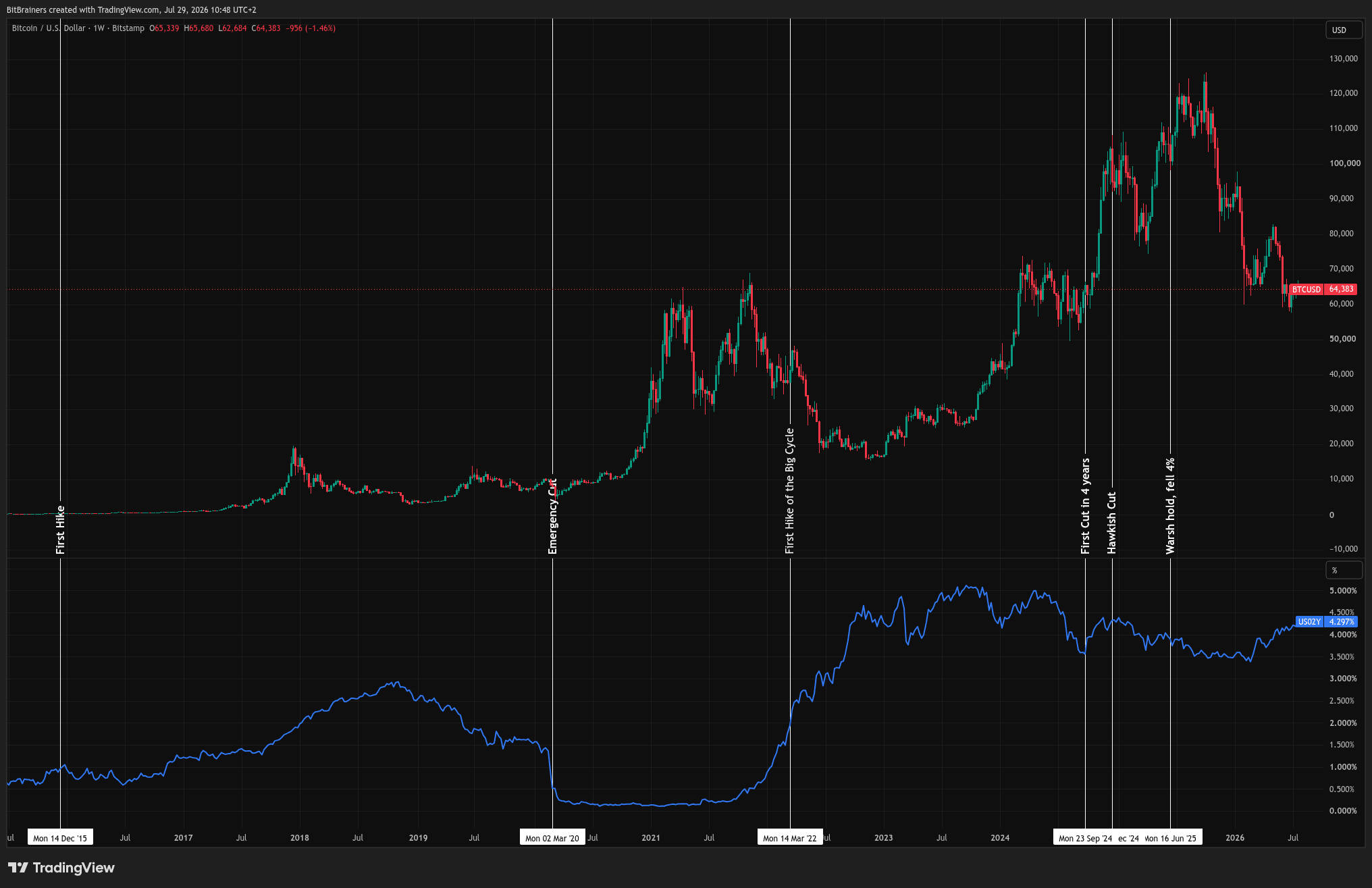
BTCUSD weekly, log scale, with US 2-Year Treasury Yield (lower pane) and FOMC decision dates marked. Source: TradingView / Bitstamp.

By BitBrainers Editorial

The Federal Reserve announces at 2:00 PM Eastern today, and roughly a third of the market is pricing a hike rather than a hold. There is no dot plot at this meeting, so the statement language and the press conference are the entire signal.

Before that lands, it is worth going through what the Fed has actually done to Bitcoin over eleven years of policy decisions. The record is messier than either side of the argument admits.

The short version: the level of the federal funds rate is almost irrelevant. What moves Bitcoin is the gap between what was priced before the meeting and what the Fed communicated on the day. That gap is the variable. The rate itself is just the number everyone argues about.


The Full Record at a Glance

Each row below uses a consistent 24-hour close-to-close window after the decision. Confounders are flagged where they own a meaningful share of the move.

Date Fed Action What Was Priced BTC 24h Move Main Confounder
Dec 16, 2015 +25 bp (first hike since 2006) Fully priced Flat / slight + None significant
Jul 31, 2019 -25 bp (first cut in a decade) Fully priced; rally had run since April -5% then continued lower Easing cycle absorbed in advance
Mar 3, 2020 -50 bp emergency Not priced; between meetings -4% same day; -55% over 9 days Pandemic liquidity crisis; global cash dash
Mar 16, 2022 +25 bp (first hike of the cycle) Fully priced +~$3,000 on the day Relief rally after weeks of pre-pricing
Sep 18, 2024 -50 bp (first cut in four years) Partially priced; genuine policy shift +6.6% over one week Clean signal; strongest post-cut reaction in data
Dec 18, 2024 -25 bp + 2025 dot plot cut from 4 to 2 Cut priced; dot shift was the surprise -5.7% from $108K record Path hawkish despite rate dovish
Oct 29, 2025 -25 bp + Powell signals December not certain Cut priced; guidance was the surprise -6% ($116K to $109K within hours) Verbal guidance outweighed the cut
Dec 10, 2025 -25 bp; 3 dissents (most since 2019) Cut priced; dissent count was the signal -2.1% to $90K after brief pop Market read dissents as easing cycle ending
Jun 17, 2026 Hold at 3.50-3.75%; dot plot hawkish; 9/18 project hike Hold priced at 99%; dot shift was surprise -4% to $64K; 2Y yield +14 bp Rate unchanged; expected path moved materially

The First Entry Is a Hike, and It Was Bullish

The Fed lifted rates off zero on December 16, 2015, its first hike since 2006. Bitcoin ended that year around $430 and did nothing dramatic in response.

The Fed hiked again in December 2016, then three more times during 2017. Over that same stretch Bitcoin went from under $1,000 to $19,783 on December 17, 2017.

Then 2018 arrived. The Fed hiked four more times, and Bitcoin fell roughly 70 percent, from about $13,400 in January to near $3,800 by year end.

Same policy direction, two opposite outcomes, two consecutive years. Anyone claiming rate hikes are mechanically bearish for Bitcoin has to explain 2017, and anyone claiming they are irrelevant has to explain 2018.

2019: The Rally Front-Ran the Cut and Then Died

The Fed cut on July 31, 2019, its first cut in more than a decade, and followed with two more in September and October. This should have been the cleanest bullish setup in the dataset.

It was not. Bitcoin had already run from under $4,000 at the start of 2019 to nearly $14,000 by late June, a full month before the first cut arrived.

By December, with all three cuts delivered, price was back near $7,000. The easing cycle was fully absorbed on the way in and gave nothing back on the way out.

March 2020: The Cut Was the Warning, Not the Relief

On March 3, 2020, the Fed made an emergency 50 basis point cut between scheduled meetings. Bitcoin fell, from roughly $8,800 to $8,400.

Nine days later came the crash that everyone still remembers: price cut in half inside 24 hours, from around $8,000 to $3,800. On March 15 the Fed cut again, to zero, and restarted asset purchases.

The lesson from that week is the one most people skip. An emergency cut is information about how bad the situation is, and markets priced the information before they priced the liquidity.

The liquidity did arrive, and it mattered enormously. Bitcoin finished 2020 near $29,000, then kept going. It just took months, not minutes.

Eleven Hikes, and the First One Was Green

March 16, 2022 was the start of the fastest tightening cycle in four decades. On the day itself, Bitcoin held above $40,000 and added roughly $3,000 within a day.

The cycle-level damage was severe anyway. Bitcoin opened 2022 near $47,000 and bottomed around $15,500 in November, though the FTX collapse landed in that same month and owns a share of the bottom.

Fed day is a recurring market event. Be ready for the next one.

Weekly macro and Bitcoin analysis, every Monday before the market opens.

Subscribe

The meeting-day reactions inside that cycle were not uniform. Bitcoin rose from about $16,500 at the start of 2023 to roughly $28,000 by the end of March, straight through hikes in February and March.

The final hike of the cycle came on July 26, 2023, taking the range to 5.25 to 5.50 percent. Bitcoin sat near $29,000 and barely reacted, because there was nothing left to learn from it.

2024 Produced the One Clean Signal in the Data

On September 18, 2024, the Fed cut 50 basis points, its first cut in four years. Bitcoin gained roughly 6.6 percent over the following week and held about 11 percent a month later.

The November 7, 2024 cut looked even stronger in the data, with gains near 16 percent in a week. That number is not clean, because the US election had resolved two days earlier and was doing most of the work.

Then December 18, 2024. The Fed cut as expected, and the 2025 median dot dropped from four projected cuts to two. Bitcoin fell from a record $108,364 to a low near $100,300, down 5.7 percent in 24 hours. The rate went down. Price went down with it.

2025: Three Cuts, No Payment

The Fed cut in September, October, and December of 2025, ending at 3.50 to 3.75 percent. Bitcoin's all-time high of $126,198 was set on October 6, before two of those three cuts had even happened.

The October 29 cut is the sharpest example. Powell delivered the cut, then said December was not guaranteed, and Bitcoin dropped from about $116,000 to $109,000 within hours. The verbal guidance outweighed the rate move entirely.

The December 10 cut got a brief pop above $92,000 before settling back near $90,000, down 2.1 percent on the day. Three dissents, the most since 2019, told the market the easing had run out of committee support.

June 17, 2026: Nothing Moved and Price Fell Anyway

Kevin Warsh's first meeting produced a unanimous 12 to 0 hold at 3.50 to 3.75 percent. Rates were untouched. Bitcoin fell about 4 percent to $64,000.

What moved was the expected path. Nine of eighteen participants penciled in at least one hike by year end, the PCE forecast went to 3.6 percent from 2.7 percent in March, and Warsh declined to submit a dot of his own while stripping forward guidance from the statement entirely.

Two-year Treasury yields jumped over 14 basis points on the day. That is the number Bitcoin was actually trading against, not the target range.


Why the Overnight Rate Is Almost Irrelevant

The federal funds rate is an overnight interbank lending rate. It directly controls the cost of borrowing money today. What it does not directly control is the expected cost of money over the next one to three years, which is the horizon that matters for risk assets.

Bitcoin trades on forward liquidity. When investors expect money to get cheaper over time, the discount rate applied to future cash flows falls, risk appetite rises, and capital moves toward high-beta assets. When the expected path tightens, the opposite happens. The two-year Treasury yield is a much cleaner proxy for that expectation than the fed funds rate itself, which is why the June 2026 hold still produced a 14 basis point move in 2s and a 4 percent drop in Bitcoin.

The post-ETF era has amplified this further. Institutional flows now track policy expectations in near real time. Bitcoin front-runs the expected path rather than waiting for the rate to move, which is the same mechanism that explains why 2019 and 2025 saw the rally arrive before the cuts and evaporate afterward. That dynamic is also related to the M2 lag we covered in Bitcoin follows M2 with a lag nobody agrees on.


What the Record Actually Shows

Across eleven years, the level of the federal funds rate explains close to nothing on its own. Bitcoin had its biggest percentage bull run during a hiking cycle and its worst drawdown of the last two years during a cutting cycle.

What shows up repeatedly is the gap between what was priced going in and what the Fed communicated coming out. December 2024, October 2025, and June 2026 were all moves in the expected path, with no surprise in the rate itself, and Bitcoin fell after each one. September 2024 was a genuine policy shift that the market had not fully absorbed, and it was the one clean positive reaction.

One thing to be careful with. You will see stats in your feed claiming Bitcoin fell after eight of the last nine FOMC meetings, or six of seven, or that it rallied after only one of eight in 2025. Those are three different counts of an overlapping period. They disagree because each picks a different measurement window. A statistic that flips depending on whether you measure at 2 hours, 48 hours, or a week is a framing choice, not an edge.

The honest version is narrower. Bitcoin reacts hard when the Fed changes the expected path, in either direction, and reacts weakly when the Fed does what was already priced. Everything else in the record is other news wearing a Fed costume.


What Today Can Change

There is no Summary of Economic Projections at this meeting, so there is no dot plot to reprice against. That removes the exact mechanism that did the damage in June.

What is left is the statement wording and Warsh's press conference at 2:30 PM Eastern. He has already shown he will use a shorter statement and refuse to hand markets a guidance anchor. June demonstrated what happens when he does.

A hold with unchanged language is the outcome the record says produces the least movement. A hold delivered with hike language, or an actual hike against a market pricing one at roughly a third probability, is the scenario where the June template repeats.

Bitcoin is near $63,000 with the February low of $60,074 and the May low of $59,130 sitting underneath. Those are the levels that matter if the tone lands hawkish, and there is nothing in the eleven-year record suggesting a dovish surprise is the base case right now.


Sources

Federal Reserve: FOMC Minutes, June 16-17, 2026

Decrypt: Morning Minute: Crypto Sinks After Hawkish FOMC

CryptoSlate: Bitcoin falls to $100,000 following hawkish FOMC despite 25bp rate cut

IG: Fed's hawkish stance rattles Bitcoin amid surging US dollar

CNBC: Fed cuts rates by a quarter point, signals caution ahead

Investing.com: Bitcoin Stalls Near $90K as Rate Cut Volatility Triggers a Broad Deleveraging Wave

Capital.com: Bitcoin price history 2009-2026, key milestones

FXStreet: Bitcoin price maintains uptrend in response to the Federal Reserve's rate hike

This is market commentary, not financial advice. Nothing here is a recommendation to buy or sell any asset. Do your own research.

Tuesday, July 28, 2026

The Fed Meets Tomorrow. Bitcoin Is Watching the Wrong Number.

BitBrainers - The Fed Meets Tomorrow. Bitcoin Is Watching the Wrong Number.

By BitBrainers Editorial

Tomorrow at 2pm ET, the Federal Reserve announces whether the fed funds rate holds at 3.50 to 3.75 percent or ticks up for the first time this cycle. Most of what you will read today is focused on that number. It matters. It is also not the number that should be driving how anyone thinks about Bitcoin this week.

A Rate Call With No Map

Tomorrow is a non-SEP meeting. No dot plot, no updated economic projections. Just a short statement at 2pm ET and a press conference at 2:30pm. Fed Chair Kevin Warsh, who took over from Jerome Powell in May, has also been explicit about giving less forward guidance than his predecessors, so even the statement language carries less signal than usual.

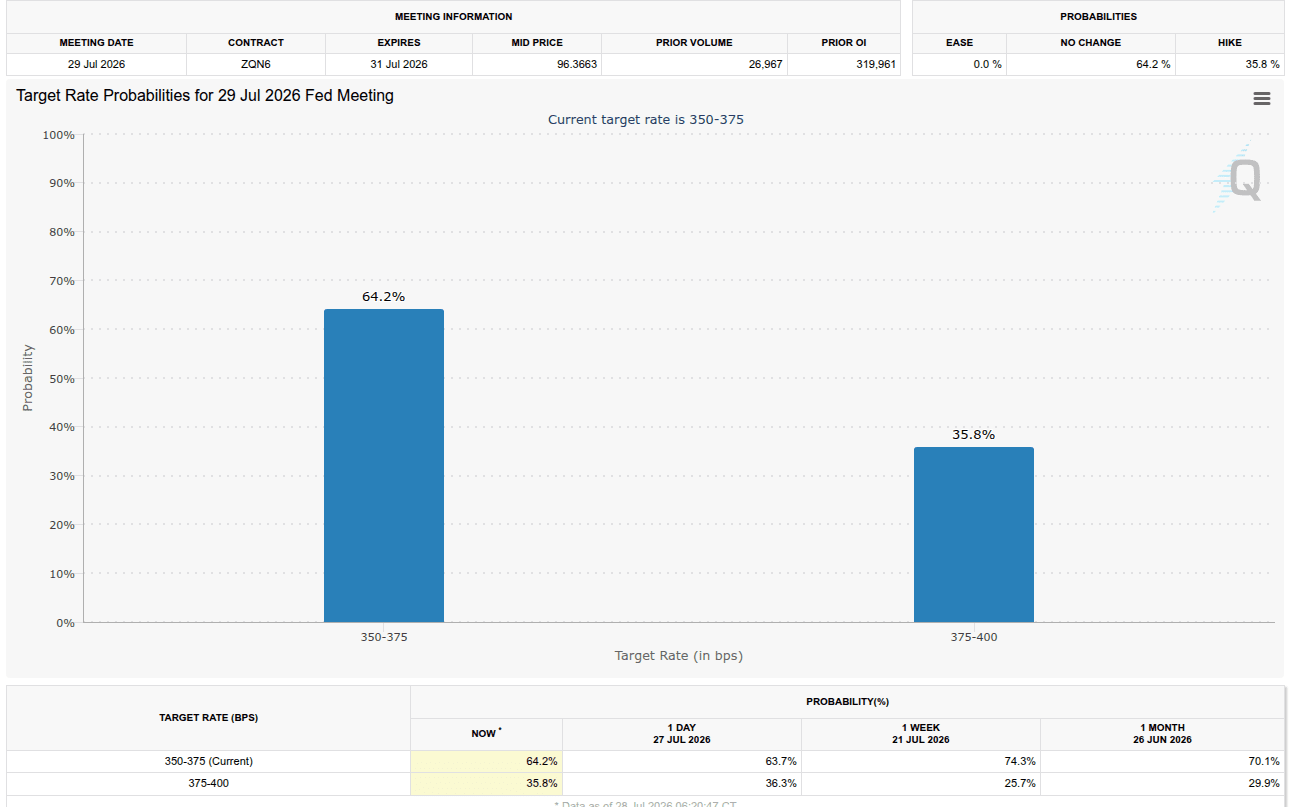
Two weeks ago CME FedWatch had hike odds at roughly 11 percent. By late last week that number had climbed above 35 percent, driven by oil trading above 100 dollars a barrel as the US-Iran conflict escalated. Then oil fell sharply on Monday as the two sides paused strikes. The same whipsaw this conflict has produced most of the year.

A rate call that swings 20-plus points on a single weekend of oil headlines isn't a stable signal, it's noise with a percentage sign attached.

CME FedWatch - July 29 2026 FOMC rate probabilities

Source: CME FedWatch, July 28, 2026. Hike odds up from 25.7% one week ago to 35.8% today, driven by oil volatility from the US-Iran conflict.


A Chair Who Wants Two Different Things

Warsh has been open about wanting lower rates over time and a smaller Fed balance sheet, which currently sits around 6.7 trillion dollars. Those two goals do not obviously fit together. Cutting rates is stimulative, shrinking the balance sheet drains liquidity from the same system rates are supposed to be easing.

Goldman Sachs Asset Management put it plainly earlier this year: building consensus around meaningful balance sheet reduction takes time, and notable shrinkage is unlikely without committee buy-in and regulatory approval.

Warsh formed a task force after the June meeting to review the balance sheet composition. That review is months from producing anything actionable. Whatever the Fed does with rates tomorrow, the liquidity mechanics under the banking system are not changing this week.

So if the Fed holds, it is more of the same: elevated real rates, a chair giving less guidance than markets are used to, and a balance sheet story still a year or more out. If it hikes, expect the standard knee-jerk risk-off move across equities and crypto together.

Watch the vote count in tomorrow's statement more than the headline number. The June hold passed 12 to 0. Any dissents in favor of a hike would signal the committee is less settled than the language suggests.

One Fed Meeting Will Not Tell You Where Bitcoin Is Actually Headed

We track the liquidity signals underneath the headline rate call. New issues land before the market finishes reacting to the last one.

Subscribe

The Number Bitcoin Used to Watch

Before this year, Bitcoin's clearest macro relationship was not the fed funds rate. It was global M2, the combined money supply across the world's major central banks. When M2 expanded, Bitcoin tended to rally a few months later. That pattern held through most of the last two cycles.

Global M2 hit a record of roughly 135 trillion dollars in June, and gold responded the way the old playbook predicted. Bitcoin was the outlier, falling instead of rising.

Some analysts call this mispricing and expect a catch-up rally once the relationship reasserts itself. Others think the correlation simply broke, now that spot ETF flows make Bitcoin's marginal buyer a portfolio allocator rather than a liquidity hedger.

Goldman Sachs data put Bitcoin's three-month correlation to unprofitable tech stocks at 0.78 earlier this year, the 97th percentile of the past decade, which looks less like a liquidity hedge and more like a risk-on proxy.

Whether that shift is permanent or a phase is the actual open question for Bitcoin right now. A quarter-point call tomorrow does not resolve it either way.

We went deeper on this in Three Models Walk Into 2026, including the cycle model, the liquidity model, and the institutional-ownership thesis. Worth reading before the decision lands.


What Is Actually Worth Watching Wednesday

The rate decision will move headlines and probably move price in the first hour. What is more useful is what happens after. Watch the US dollar index and 2-year Treasury yield in real time during the press conference. Those reprice faster than Bitcoin and tell you how the bond market is reading the guidance before crypto catches up.

If yields drop and the dollar weakens during Warsh's remarks, the statement landed dovish regardless of the headline rate. If yields climb, the hold was hawkish. Bitcoin will follow that signal, usually with a 15 to 30 minute lag.

Also worth tracking afterward: whether spot Bitcoin ETF flows turn positive or keep bleeding regardless of the outcome, and whether Warsh drops any hint about balance sheet timing. Neither shows up in the 2pm number. Both matter more for where Bitcoin trades in August.

The Rest of the Week Does Not Stop at 2pm

Wednesday is not the only clock running. Bitcoin's BIP-110 mandatory signaling window opens in the first days of August. Support has crept up from near zero to roughly 3 percent of hashrate, still nowhere near the 55 percent threshold, and none of the four pools controlling most of the network's hashrate have moved. It is a separate, purely Bitcoin-specific story, unrelated to anything the Fed does tomorrow, and worth tracking on its own terms.


Sources
Federal Reserve: FOMC Minutes, June 16-17, 2026
CBS News: Will the Federal Reserve raise interest rates? Here is what experts predict for July's meeting
CNN Business: Why oil keeps tumbling even when the Iran war drags on
Axios: Battles to shrink the Federal Reserve's balance sheet begin
Goldman Sachs Asset Management: The Fed's Balance Sheet: What Does it Mean for Money Markets?
Bloomberg: Warsh Forms Fed Task Force to Review $6.7 Trillion Balance Sheet
CoinDesk: Bitcoin's BIP-110 fork deadline nears with miner support at zero

This is market commentary, not financial advice. Nothing here is a recommendation to buy or sell any asset. Do your own research.

Monday, July 27, 2026

Weekly Brief: The Week FOMC Decides Everything

By BitBrainers Editorial

Bitcoin hit $66,400 on Tuesday, its highest since June 17, on seven straight days of ETF inflows. By Friday it was back at $64,300. The inflows broke, oil held above $96, and every macro variable lined up pointing at Wednesday's Fed decision. That is where the week ends and where next week begins.

Seven Days of Green, Then One IBIT Session

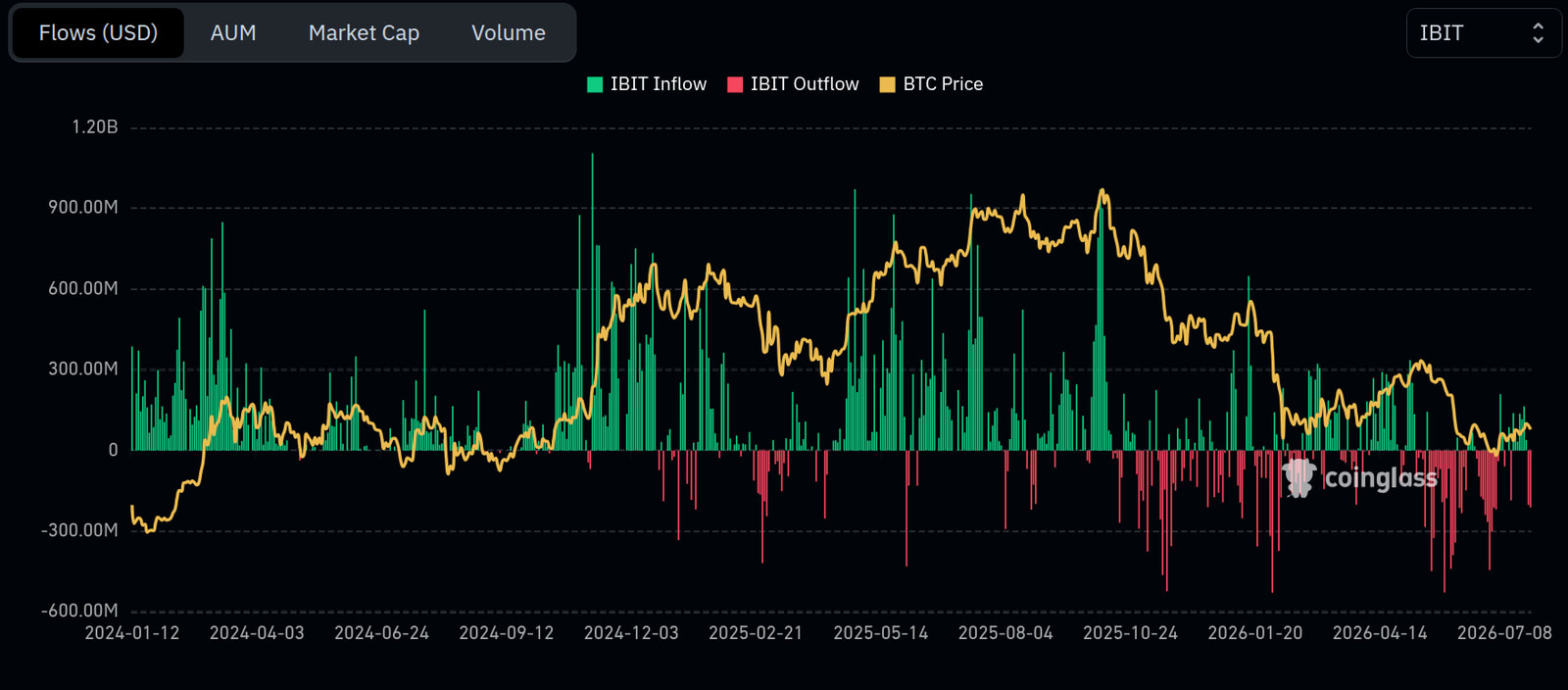
US spot Bitcoin ETFs ran a seven-session inflow streak from July 14 through July 22, pulling in just under $1 billion. The longest stretch of sustained buying since late April, and the one that mattered most was IBIT: BlackRock's fund led four of those sessions and drove the bulk of the $727.3 million cumulative total.

July 23 ended it. ETFs posted $225.1 million in net outflows, with IBIT accounting for $202.5 million of that alone. The other eleven funds combined for roughly $22 million in additional net selling. When one authorized participant at one fund can flip the whole sector red in an afternoon, the inflow narrative is always one session away from reversal.

July 24 added another $240 million in outflows. Combined, the two-day reversal erased roughly 47% of the seven-day streak in 48 hours. The eight-session window still closes positive, but the direction of travel mattered more than the net figure.


The Structure Under the Price

BTC opened the week at $63,587 and hit $66,400 on Tuesday before pulling back. It closed the week around $64,300 and is trading at $65,332 Monday morning. The range between $63,000 support and $66,500 resistance has held for three weeks now.

$63,000 has been tested twice and held both times. $66,500 has been rejected twice. Neither level has broken on meaningful volume. Until one does, the range is the structure and price action inside it is noise.

The 21 EMA on the daily sits just below price, around $65,287. BTC is holding above it. RSI at 46 suggests balanced momentum rather than a directional read in either direction. The chart is waiting for a catalyst, and that catalyst arrives Wednesday.


What the Fed Actually Decides Wednesday

The FOMC announces at 2:00 PM ET on July 29, followed by Chair Kevin Warsh's press conference at 2:30 PM. The federal funds rate has sat at 3.50% to 3.75% for four straight meetings. Markets price a hold at roughly 64% with hike odds at 36% for a 25bps move. There is no cut scenario in the pricing.

This meeting has no updated dot plot and no new economic projections. That means the statement language and Warsh's press conference carry all the repricing weight. The actual policy decision is secondary to what the committee signals about September and October.

The macro backdrop makes the language unusually important. Oil is sitting above $96 after the Hormuz disruption. June CPI came in soft partly because of a brief ceasefire that has since collapsed. If Warsh acknowledges that the disinflation tailwind is gone, rate-sensitive assets reprice immediately. If he signals patience, the brief rally window reopens.

The rate decision is the easy part. The language is what moves markets.

We track the macro setup before it reaches the headlines. Subscribe for the weekly read.

Subscribe

Strategy Pauses for a Fourth Week

Strategy filed its weekly SEC disclosure on July 20 showing no Bitcoin purchased between July 13 and July 19. Holdings remain frozen at 843,775 BTC for a fourth consecutive week of no accumulation. The company sold $263.5 million in common stock through its ATM program instead, lifting its USD reserve to $3.225 billion.

The last actual Bitcoin purchase covered the week ending June 21. Since then the company has sold BTC once, sold equity twice, and held the stack flat. Q2 earnings land July 30, one day after FOMC, and management will face questions about when and whether accumulation resumes.

The mNAV premium, the spread between MSTR's market cap and the value of its Bitcoin, dipped below 1.0 in late June for the first time ever before recovering to roughly 1.03. The original model required a premium above 1.0 to make each equity issuance accretive. Below parity, new shares dilute existing holders rather than grow Bitcoin per share. The premium has recovered but the episode confirmed the model has a floor.

For the full mechanics of the Strategy capital structure and what the selling means for the flywheel, see our earlier breakdown: Why Bitcoin ETF Inflows Stopped: Oil, Iran, and the CLARITY Act.


CLARITY Act: One Senator at a Time

Senator Chris Murphy announced Sunday he will not vote for the CLARITY Act. His stated reason: the bill gives the DOJ sole enforcement authority over an ethics provision covering the sitting president's crypto holdings, while state attorneys general are expressly barred. Murphy called it a red alarm moment.

The Polymarket odds for CLARITY passing in 2026 sit at 38%, down from a peak above 80% in February. The Senate recess begins early August. A floor vote before the recess requires cloture to be filed this week, and no scheduling announcement has come.

The vote math: Republicans hold roughly 53 seats. The bill needs 60. The two Democrats who voted it out of committee, Angela Alsobrooks and Ruben Gallego, have both rejected the current draft. Murphy's announcement yesterday adds a third public no from within the Democratic caucus.

Senator Lummis has said plainly that failure in 2026 likely pushes the next realistic window to 2030. Watch for a cloture filing announcement this week, not press statements. Absence of a filing by Wednesday is the signal.


Iran: Paused, Not Resolved

The US paused strikes on Iran after 13 consecutive nights of attacks, resuming diplomatic talks. Brent crude hit $100.69 on July 23 before pulling back to the high $90s by Friday. The Strait of Hormuz remains heavily disrupted with commercial traffic near a standstill.

The ceasefire framing circulating on social feeds this weekend is not accurate. There is no ceasefire. There is a diplomatic pause while talks continue. The Houthis struck Saudi Aramco facilities in Jizan and Yanbu on Saturday, adding a second chokepoint risk independent of the Iran-US channel.

For markets the distinction matters. A genuine ceasefire with Hormuz reopening removes an oil supply constraint and takes pressure off the Fed's inflation calculus. A temporary pause that breaks down restores both. Bitcoin's sensitivity to the oil-rate relationship is the mechanism to watch, not the headline count.


Key Levels This Week

Bitcoin at $65,332 Monday morning. Weekly range: $63,200 low to $66,400 high. Support at $63,000 held twice. Resistance at $66,500 rejected twice. The 21 EMA on the daily sits at $65,287, price is above it.

A hold with cautious FOMC language and a ceasefire extension could open the $66,500 to $68,000 range. A hawkish surprise or Hormuz escalation points toward $61,000 and the June lows. The range has compressed enough that one session can break it either way.


On the Radar This Week

FOMC Wednesday July 29, 2:00 PM ET. No new projections, no dot plot. Watch the statement language on inflation and the press conference for any signal on September. That is the week's only number that matters.

Strategy Q2 earnings July 30. Unrealized losses, dividend coverage math, and whether management gives any guidance on resuming Bitcoin purchases. The four-week pause without an explanation leaves a gap the earnings call may or may not fill.

CLARITY Act cloture filing. The absence of an announcement by Wednesday tells you more than any press statement will. Senate recess is not a hard stop, but August floor time is scarce and attention shifts to midterms.

ETF flows daily. A return to inflows after the July 23-24 reversal confirms the streak was interrupted rather than ended. A third consecutive outflow session changes the picture materially heading into FOMC.


Sources

CryptoSlate | BlackRock's IBIT accounted for 90% of a $225 million Bitcoin ETF reversal after a seven-day buying streak

Bloomberg | Bitcoin ETFs End Inflow Streak as Fed Rate Concerns Mount

CryptoSlate | Strategy's Bitcoin metrics go negative amid $3.2B cash build

BeInCrypto | Strategy Earnings Loom as Bitcoin Buying Freeze Hits a Month

Decrypt | Bitcoin ETFs Shed $225M, Snapping Seven-Day Inflow Streak as Iran Tensions Spook Markets

Bitcoin.com News | Bitcoin Enters Volatility Trap as Fed Decision, CLARITY Act and Fork Drama Converge

Bloomberg | US Pauses Iran Strikes for Second Night as Red Sea Tensions Rise

This is market commentary, not financial advice. Nothing here is a recommendation to buy or sell any asset. Do your own research.
Sunday, July 26, 2026

The CLARITY Act Got Its Ethics Clause. It Expires With Trump's Term.

BitBrainers - The CLARITY Act Got Its Ethics Clause. It Expires With Trump's Term.

By BitBrainers Editorial

Senate Democrats spent months refusing to move the CLARITY Act without an ethics provision. They got one. It stops working at noon on January 20, 2029.

That date is inauguration day for the next president. The constraint the White House called the most comprehensive ethics provision in history is written to cover exactly one presidential term, and it is the term currently in progress.

Senator Cynthia Lummis put the framing plainly in her own fact sheet. The sunset, she wrote, shows this was a standard the president chose to hold himself to rather than one Congress imposed on him. That is an accurate description. It is also the objection.


What Section 13152 Actually Restricts

The provision bars covered officials from issuing or sponsoring a digital asset for compensation while serving. Covered officials means the president, the vice president, members of Congress, federal judges, and their spouses.

The ban does not extend to children of covered officials. All three of Trump's sons are co-founders of World Liberty Financial, and two launched a Bitcoin mining company, American Bitcoin. None of that activity is touched by Section 13152.

Those officials would have to sell existing crypto holdings or move them into a blind trust they do not control. Penalties run up to $250,000 per day of violation.

Read the verb again. The ban is on issuing and sponsoring. Holding and profiting from assets already issued sits outside it, and the bill says explicitly that covered officials may still invest in digital assets.


The Three Day Gap

Buried in the likeness language is a carve-out that matters more than the sunset. Issuers may keep using a public official's name, image, and likeness if the asset was issued before that official took office.

The $TRUMP memecoin launched three days before the inauguration. Under the draft as written, it sits on the correct side of that line.

Trump's 2025 financial disclosure showed more than $1.4 billion in crypto-related earnings, and Fox News reported total income rising roughly 250% to $2.2 billion. None of the ventures behind those numbers are unwound by a rule that governs future issuance.

Legislation is written in the details, not the headlines

We read the clauses so the summary you get is the one that survives contact with the actual text.

Subscribe

Who Gets to Enforce It

Civil enforcement authority goes to the Department of Justice alone. State attorneys general are expressly barred from bringing action.

The DOJ is currently led by acting Attorney General Todd Blanche, who served as Trump's personal defense counsel in multiple criminal cases before taking the role. His Senate confirmation is still pending.

Senator Angela Alsobrooks, one of only two Democrats who voted the bill out of committee, responded to the structure directly. She called it "an unserious offer" and said she would not support the bill with that language.

The other committee Democrat who voted yes, Ruben Gallego, also opposes the released version. Those were the two votes the bill's sponsors were counting on to build outward from.


Nobody Agrees on the Vote Count

The bill needs 60 votes. Beyond that, published estimates diverge in a way worth noting, because the arithmetic is doing a lot of work in how the odds get reported.

CoinDesk puts the requirement at a minimum of ten Democrats. Crypto.news puts it closer to seven. Either number becomes difficult once the two most supportive Democrats in the caucus have publicly rejected the draft.

Senator Cory Booker was blunter, telling Fox News Digital that the partisan draft is obviously not going anywhere. Prediction markets moved accordingly, with CLARITY odds climbing to 43% on reports of the ethics deal before sliding to 38% two days later.

For the mechanics of how this bill keeps almost passing, see our earlier piece on Washington's two-year pattern of being two weeks away from crypto regulation.


The Calendar Is the Constraint

The Senate leaves for summer recess in early August. There is floor time again in September, but attention shifts to November's midterms, which makes the first week of August the last realistic window in the ordinary course.

Regulators would then get a full year after enactment to implement the ethics rules. Pair that implementation runway with a January 2029 expiry and the enforceable life of the provision compresses considerably.

Watch the enforcement language rather than the vote schedule. If DOJ-only jurisdiction survives the next draft, the Democrats who carried the bill out of committee have already told everyone what happens next. If state attorneys general get written back in, the ethics fight is over and the market structure fight resumes.


Sources

CoinDesk | New Clarity Act emerges that's a start on the final draft, makes ethics rule temporary

The Block | Senate releases latest version of Clarity Act including software developer protections and ethics provision with sunset date in 2029

Forbes | Critics Warn Clarity Act Changes Could Still Let Trump Profit From Crypto

Fox News | Senate Clarity Act ethics rules on Trump crypto face Dem pushback

The Defiant | Crypto Industry Pushes for Senate Vote on New CLARITY Act Text as Democrats Blast Ethics Plan

This is market commentary, not financial advice. Nothing here is a recommendation to buy or sell any asset. Do your own research.

Saturday, July 25, 2026

Why Bitcoin ETF Inflows Stopped: Oil, Iran, and the CLARITY Act.

BitBrainers - Why Bitcoin ETF Inflows Stopped: Oil, Iran, and the CLARITY Act.

By BitBrainers Editorial

Seven straight days of Bitcoin ETF inflows. Nearly $1 billion pulled in. Then July 24 happened and $225.2 million walked back out the door. BlackRock's IBIT alone accounted for $202.5 million of that exit. Morgan Stanley's MSBT was the only Bitcoin fund that added money, taking in $5 million. One day does not make a trend. But the reasons behind it do.

What Actually Triggered the Exit

Brent crude crossed $100 per barrel on July 24. The 10-year Treasury yield pushed past 4.7%. US equity markets sold off across the board. When oil spikes and bond yields rise simultaneously, institutional allocators reduce risk exposure. Bitcoin ETFs sit in the risk-on bucket. They were the first thing sold.

The immediate catalyst was the US-Iran conflict escalating again. Since February, Iranian forces have effectively declared the Strait of Hormuz closed. The US military ran its 13th consecutive night of strikes against Iranian military targets. Houthi rebels struck Saudi Arabia's Jazan oil complex on July 23. Oil moved above $100 for the first time since May. Markets followed. Bitcoin fell as low as $64,600 before recovering to around $65,400 by end of session.

Twenty percent of the world's oil flows through that strait. When it stays contested, energy inflation stays elevated, central banks stay cautious, and rate cuts stay off the table. Kevin Warsh, the Fed's new chair, already pulled this year's cut. Nine of eighteen Fed officials now expect a hike instead. Higher rates push capital toward yield-bearing assets. Bitcoin is not one of them.

The CLARITY Act Is Not Helping

The regulatory picture added pressure. Senate Republicans released updated bill text on July 22 with ethics provisions for the first time, barring officials from issuing or sponsoring digital assets. Democrats rejected it within hours. Senate Majority Leader John Thune told reporters on July 23: "I don't think we'll be able to get them done."

The math has not changed. The bill needs 60 votes to clear a filibuster. Republicans hold 53 seats. Two of those are expected to vote no. That leaves 51 reliable Republican votes. Zero Democrats have publicly confirmed support for the current draft. At least twelve have said no outright. The bill needs nine to cross over. The August 7 recess deadline is not moving.

Here is the part that does not get enough coverage: the opposition is not coming from retail investors or crypto skeptics. Legacy banks view the stablecoin and custody provisions as a direct threat to their business models. Senator Lummis called it a full court press on Senate votes. The institutions that want this bill passed and the institutions lobbying against it are both on Wall Street. The crypto industry just happens to be the battlefield.

Polymarket prices 2026 passage at 35% to 48% depending on the day. The August 7 recess deadline is not moving. Miss it and the next realistic window is a lame-duck session, which is not a window anyone should be counting on. We covered the full arithmetic in an earlier breakdown. The pattern has not changed.


Oil, Iran, and a stalled Senate bill. This is what moves Bitcoin now.

BitBrainers connects the macro to the market, every week.

Subscribe

Why the Weekly Picture Still Holds

One day of outflows does not erase seven. The week as a whole closed with approximately $274 million in net inflows for Bitcoin ETFs despite Thursday's reversal. That number keeps the weekly picture firmly positive.

On-chain data shows wallets holding between 1,000 and 10,000 Bitcoin were actively accumulating during the same session that saw ETF outflows. Sophisticated capital was buying what institutional ETF holders were selling. That divergence is the real signal.

Ethereum ETFs moved in the opposite direction entirely, adding $26.3 million on July 24 to extend their own inflow streak to five consecutive days. The CLARITY Act does not resolve ETH's regulatory status as cleanly as it does Bitcoin's. That distinction is showing up in the flow data.

What the BlackRock Number Actually Means

$202.5 million out of IBIT in a single session sounds large. In context it is less alarming. IBIT has accumulated more than $60.6 billion in net inflows since launch. One day of $202.5 million in redemptions is 0.3% of that total. Institutions that entered at lower levels are not panicking. They are trimming exposure on a risk-off day.

IBIT now holds $47.5 billion in assets, roughly 61% of the entire US spot Bitcoin ETF complex. It is the cleanest daily read on institutional demand. When IBIT bleeds the whole category looks weak. When it leads inflows the opposite message travels fast. One bad session does not change the direction of that signal.

The more telling data point is Morgan Stanley's MSBT adding money on the same day. MSBT clients are explicitly allocated to Bitcoin as a strategic position rather than a trade. That segment did not move. If you want exposure to Bitcoin through a regulated venue while this volatility plays out, Kraken lists both spot and derivatives. For the holdings you are not trading, Trezor keeps them off the exchange entirely.

What to Watch This Weekend

Brent crude above $100 is the number that matters most going into the weekend. If it holds there, the macro pressure on risk assets does not ease. If it pulls back, ETF flows have room to recover fast. One headline out of the Strait can move both in either direction within hours.

On the regulatory side, cloture needs to be filed before Congress breaks. No filing means no vote. No vote before August 7 means no CLARITY Act in 2026, regardless of how close Bessent says it is. Watch for Senate floor scheduling, not press statements.

One outflow session after seven green ones is noise. Three consecutive outflow sessions is a signal. IBIT daily flow data is the number to track. The week closed with $274 million in net inflows overall. Whether Bitcoin gets back toward $67,000 or retests $63,000 depends almost entirely on what happens in the Strait of Hormuz and on a Senate floor that has not scheduled a vote.


Sources
Decrypt | Bitcoin ETFs Shed $225M, Snapping Seven-Day Inflow Streak as Iran Tensions Spook Markets
Cryptonomist | Bitcoin ETF Outflows Mark End to 7-Day Inflow Streak
Bitcoin Magazine | U.S. Senator: Clarity Act Is 'Almost There,' Treasury Secretary Puts It At The '1-Yard Line'
CryptoTimes | CLARITY Act Needs 9 More Senate Votes to Advance
CNN | Oil tops $100 a barrel, Houthi attack in Red Sea marks new escalation
Startup Fortune | BlackRock's IBIT posts longest Bitcoin ETF inflow streak since April

This is market commentary, not financial advice. Nothing here is a recommendation to buy or sell any asset. Do your own research.

The War in the Price of Everything

Illustration: a crude tanker on Gulf water. The strait Iran mined in February carries a fifth of the world's oil.

The War in the Price of Everything