Saturday, August 15, 2026

Bitcoin held $63,000 even after the SEC killed its most important crypto vote without rescheduling

TBitcoin held $63,000 even after the SEC killed its most important crypto vote without rescheduling

By BitBrainers Editorial

On Wednesday we mapped two tracks: SEC rulemaking on one timeline, Senate legislation on another. The SEC had scheduled an open meeting for August 14 to vote on whether to propose a framework for crypto asset offerings. It would have been the first rulemaking of its kind in the agency's ninety-year history. That post is still live if you want the full background.

Friday never happened.

The SEC canceled the meeting on Thursday afternoon. Not postponed to a specific date. Not rescheduled for next week. Canceled outright, with one line about an "unforeseen scheduling issue" and no replacement date on the calendar.

This matters because the industry spent the better part of a year building toward that Friday. The framework, referred to as "Regulation Crypto," was supposed to give projects a path to raise money through token sales without triggering full securities registration. It was not law. It was not even a proposed rule yet. It was a vote on whether to start the comment period. And it evaporated hours before it was supposed to begin.

Nobody at the SEC has explained what actually changed. "Unforeseen scheduling issue" covers everything from a genuine calendar conflict to commissioners who could not agree on language and needed an exit that would not show up in a headline. Both readings fit the sentence. Neither one is confirmed.

The Market Reacted, Then Stopped

The same two days the cancellation was announced, spot Bitcoin ETFs recorded back-to-back daily outflows for the first time since late July. The exact figure varies by source, but the directional read is consistent: roughly $192 million left the funds. Bitcoin slid under $63,000 to its lowest point since August 3.

It is worth saying plainly that no outlet has drawn a straight line from the canceled vote to the outflows. The timing lines up neatly, but correlation is not confirmed causation and we are not going to pretend otherwise just because the overlap is hard to ignore.

What actually happened is more interesting than the headline. Bitcoin took a real hit, dropped under a psychological level, posted its worst two days since late July, and still did not produce anything close to what a genuine regulatory gut-punch usually looks like. No cascading liquidations. No double-digit single-day move. Nothing that reads as panic once you pull up the chart instead of just the outflow number.

It held anyway.

Two Tracks, Both Stalled

This is now two separate regulatory pathways stuck in the same undated limbo at the same time.

The CLARITY Act has been stalled in the Senate since before this week. It passed the House in July 2025 with a 294-134 vote. The Senate Banking Committee moved it 15-9 in May. Then it sat. June 1 it hit the full Senate calendar. It is still there. The cloture vote is scheduled for September 15 at 2:15 p.m. ET. That vote needs 60 senators just to open debate. Republicans have 53. Seven Democrats or independents would need to flip. Polymarket has the bill passing in 2026 at 21 percent, down from 82 percent in February.

Now the SEC track is stalled too. Regulation Crypto has no rescheduled date. The industry spent a year building toward a Friday that evaporated without so much as a follow-up statement. Two branches of government, two different jobs, both sitting idle.

The permanence gap we wrote about on Wednesday still matters. A statute needs another act of Congress to repeal. An SEC rule can be killed by a future commission in one vote. Friday would have been a step toward the weaker kind of stability. Now there is no step at all.


Get the Weekly Brief

One email. Monday morning. The stories that actually move your bitcoin's security, not just its price.

Subscribe

What the Pattern Actually Looks Like

You have seen this before if you have been watching long enough. A regulatory delay gets treated like a rejection for about 48 hours. The outflows show up right on schedule. Then flows normalize the moment somebody floats a new date, real or rumored. Whether that happens again here depends entirely on how long "no new date" stays true, and the SEC has not indicated interest in saying.

Whether the vote gets rescheduled for next week or next quarter, the underlying reality does not change. The industry is operating without a statutory framework and without a durable regulatory one. Staff guidance and policy statements are what remain, and a new chairman can reverse those with a memo. That has been the environment for years. Friday was supposed to be the first real move toward something harder to undo. It did not happen.

What to Watch Now

The cancellation already happened. What matters next is whether it gets treated as a pause or a signal, and that answer comes from money moving, not from another SEC statement written in the blandest language the agency can manage.

Watch the ETF flow data over the next few days more than you watch the news cycle. If the outflows reverse when a new date is floated, the pattern holds and the delay was just a delay. If the outflows continue, the institutional bid is telling you something more durable has shifted.

Watch whether the SEC actually sets a new date. "Unforeseen scheduling issue" does not require a follow-up. The agency could let this sit for months. If September arrives with no rescheduled meeting, Regulation Crypto is functionally dead for 2026.

Watch the September 15 cloture vote on CLARITY. The 21 percent odds are not zero, but they are not optimistic either. If that vote fails to hit 60, the statutory path closes too. The industry would be left with exactly what it has now: staff guidance, enforcement actions, and uncertainty.

And watch the price. Bitcoin is still trading near $63,000, inside the same $62,000 to $66,000 range it has held for five weeks. The range has not broken. The structure beneath it has not broken either. But August is doing what August usually does, and the next few weeks will test whether that structure can hold without either regulatory track moving forward.


Sources

U.S. Securities and Exchange Commission: Sunshine Act Notice, August 10, 2026

CoinDesk: U.S. SEC sets meeting to propose Reg Crypto to support certain digital assets offerings

CoinDesk: SEC Cancels Closed Meeting on Crypto Regulation

CoinStats: Bitcoin ETFs Record Back-to-Back Daily Outflows

Congress.gov: H.R. 3633, Digital Asset Market Clarity Act

CoinPedia: SEC Moves Toward Regulation Crypto as CLARITY Act Faces Delays

Tools: Kraken for trading. Trezor for storage.

This is market commentary, not financial advice. Nothing here is a recommendation to buy or sell any asset. Do your own research.

Friday, August 14, 2026

Metaplanet Just Moved $322M in Bitcoin for Eight Dollars. That's Not the Story.

BitBrainers - Metaplanet Just Moved $322M in Bitcoin for Eight Dollars. That's Not the Story.

Metaplanet BTC transfer, August 2026. Source: Blockchain explorer, CryptoTimes.

By BitBrainers Editorial

Metaplanet's wallets lit up Tuesday. 5,014 BTC moved between addresses in real time, $322 million on the block explorer, $8 in fees. The crowd did what it always does: screenshot the transaction, assume the worst, type "they're selling" before finishing the sentence.

They were not selling.

CEO Simon Gerovich said it plainly: routine custody operation, no bitcoin sold, holdings still at 43,000 BTC. Believe him or not, moving cold storage around is not a crime. But that is not the interesting part of this week.

The interesting part is that Metaplanet spent 2026 building one of the more aggressive structured-finance operations in crypto, and few people have sat with the full picture.

Here is the count.

January: $137 million raised, partly to pay down debt. March: $255 million, equity plus warrants, including a mechanism that only exercises once the stock trades above 1.01x its modified net asset value. April: $50 million in zero-interest bonds. This week: BitBonds — four private bond series, roughly $1.3 million total, 4 to 4.3% interest, three-year maturity, sold through their own in-house securities arm and closed before most people knew the solicitation was open.

Four raises, one year, same company.

The Warrant Deal

The March warrant deal deserves a pause. EVO Fund, a Cayman Islands vehicle, received rights convertible into up to 100 million new shares, gated behind that 1.01x mNAV trigger. It is filed, it is dilution risk sitting on the balance sheet, and there is no public documentation framing it as personal enrichment for Gerovich. That is a leap the timeline does not support.

The Number That Matters

Skip past the wallet noise. Here is the number that actually matters: 43,000 BTC, bought at an average price around $96,191. Current price, roughly $63,600. That is about $1.4 billion underwater. Thirty-four percent down. On the whole stack.

They are still raising debt.

Not because they are desperate. Maybe it is discipline. Maybe the plan is working exactly as designed, four instruments deep, buying time until price catches back up to cost basis. Or maybe it is a company that bet enormous on a number going up on a schedule nobody promised, and is now financing the gap with whatever paper the market will still take. Both readings fit the same facts. That is the uncomfortable part.

The wallet transfer was not the risk. It never was. The risk is a treasury company sitting on a nine-figure unrealized loss that keeps finding new ways to raise money to keep buying more of the thing that is currently losing. Fine until it is not.


Get the Weekly Brief

One email. Monday morning. The stories that actually move your bitcoin's security, not just its price.

Subscribe

Sources

CryptoTimes Metaplanet Moves 5,014 BTC for $8 in Fees, CEO Says No Bitcoin Sold

CoinDesk Bitcoin Treasury Company Metaplanet Unveils BitBonds with $1.3 Million Private Debt Sale

CoinDesk Metaplanet Raises $255 Million to Accelerate Bitcoin Accumulation

TipRanks Metaplanet Taps EVO Fund With New Warrant Issue for Major Capital Raise

CoinDesk Metaplanet Raises Up to $137M to Expand Bitcoin Holdings and Reduce Debt

CoinDesk Bitcoin-Holder Metaplanet Raises $50 Million in Zero-Interest Bonds to Buy More BTC

Tools: Kraken for trading. Trezor for storage.

This is market commentary, not financial advice. Nothing here is a recommendation to buy or sell any asset. Do your own research.

Thursday, August 13, 2026

Trezor's Devices Are Fine. Your Mailing Address Is Not

BitBrainers - Trezor's Devices Are Fine. Your Mailing Address Is Not.

Trezor shipping breach scope, August 2026. Source: Trezor blog, ShipMonk disclosure.

By BitBrainers Editorial

Trezor's shipping provider got breached. Not Trezor's servers, not their firmware. A third-party fulfillment company called ShipMonk. Anyone who has tracked enough of these already knows the shape of it: the vendor holds the line, the vendor's vendor doesn't.

The Numbers

11,742 customers with full exposure — name, shipping address, phone number, email, all four together. Another 1,947 with partial exposure — name, city, email (sounds like less, until you remember that someone patient enough to fill in the rest doesn't need much more than that, and plenty of people have exactly that kind of patience for exactly this kind of target). Seven countries: US, UK, Sweden, Colombia, Brazil, Italy, Portugal. A ninety-day window running back from August 8th.

The Statement

Predictably, the statement leads with reassurance. Devices remain secure, systems remain secure. Technically accurate. Still not the point.

The Actual Risk

Somewhere there is now a list connecting real names to real home addresses to the specific fact that these people bought hardware built to hold bitcoin, and a list like that is worth more than a generic email dump from some SaaS tool nobody remembers signing up for, worth more than most of what gets filed under "breach" in a given month, worth enough that treating this as a routine notification email is the wrong instinct entirely.

Not exactly reassuring.

What Trezor Did Right

Trezor did limit the damage somewhat. Their ninety-day retention policy meant this wasn't years of order history sitting exposed, and they say they negotiated matching terms from their fulfillment partners. A real policy choice, not just a line in a statement. Credit where it's earned. ShipMonk, for what it's worth, handles fulfillment for a long list of consumer brands most people have ordered from this year without thinking twice. Back to Trezor specifically. They're the ones who actually have to answer for this.

The Gap Nobody Checked

Turns out the failure mode nobody built a checklist for is the one that just happened. Wallet security has entire industries built around it, firmware audits, entropy standards, open-source review, all of it pointed at the device itself. Nothing close to that discipline exists for what happens when a shipping partner's systems get compromised, and you already know which way that gap gets exploited first.

What To Do

If your name's on the list Trezor emailed, the advice doesn't really change from any other breach you've sat through by now. Expect sharper phishing attempts, ones that can reference your real address to sound legitimate. Never enter a seed phrase into anything with a screen you didn't set up yourself. Stop posting your hardware wallet setup anywhere a stranger could connect it to a delivery window.

Two hardware wallet companies, one stretch of two weeks, two completely different failure points, the same lesson underneath both of them for anyone paying attention to the pattern instead of just the headline.


Get the Weekly Brief

One email. Monday morning. The stories that actually move your bitcoin's security, not just its price.

Subscribe

Sources

Trezor Recent customer data exposed in shipping provider incident

Tools: Kraken for trading. Trezor for storage.

This is market commentary, not financial advice. Nothing here is a recommendation to buy or sell any asset. Do your own research.
Your Hardware Wallet's Security Now Depends on Who Has Better AI

BitBrainers - Your Hardware Wallet's Security Now Depends on Who Has Better AI

By BitBrainers Editorial

Two weeks. That is how long it has been since Coldcard, and here is what actually survived the panic cycle once the hot takes burned off.

The number kept moving and almost nobody watched it happen in real time. Day one, $38 million. By the time Galaxy Research finished tracing wallets, three confirmed waves, 1,596 BTC, roughly $100 million, plus a suspected fourth wave pushing the real total past 2,000 BTC. Call it $130 million and even that comes with an asterisk. Fifteen separate attackers, working independently, all finding the same open door within days of each other. One of them is still sitting on 1,159 BTC he has not moved, which either means patience or fear. There is no way to tell from the outside.

So drop the loss number. It was never the real story. The real story is the bug lived in the firmware for five years, shipped March 2021, survived whatever review process existed, and nobody caught it until it was already draining wallets. That is not a Coldcard problem specifically. That is every piece of custody hardware you own, running code nobody has actually broken yet, that you are calling "secure" because it has not failed publicly. Yet.

The Headline Everyone Printed Falls Apart

The story that ran everywhere said an attacker used AI to find the bug before Coinkite's own review did. Good headline. Clean narrative. Except Galaxy's own forensic work says Block's engineering team and Coinkite's internal investigation found the flaw independently, no attacker AI required. So the thing that made this story go viral probably was not even true, and almost nobody has gone back to fix it. Which tells you something about how these stories actually spread. It is not the correction that gets the retweets.

The AI angle is not dead. It just is not the one that ran. Somebody, still unnamed, ran an AI-assisted audit across other Bitcoin wallet firmware after Coldcard broke, and found 85 more critical bugs in the same family. Weak reseeding. Fallback bindings that quietly downgrade your randomness under specific build conditions. Most of those have not even been disclosed publicly yet. They are apparently rolling out on coordinated vendor timelines, one wallet at a time, whenever each company decides you are ready to hear it.

Eighty-five. Sit with that.

That means somewhere right now there is a wallet holding real money with a known critical flaw that has not been told to its owner yet. Not maliciously. Responsible disclosure is a real practice with real reasons behind it. But the effect on you is the same either way: you do not know, and you will not, until your wallet's turn comes up in whatever queue this is.

The Actual Shift

This is the actual shift, and it is the reason the title is not hyperbole. This is not about one hacker with one clever tool anymore. Finding a five-year-old logic flaw buried in firmware used to take a determined human years, or never happen at all. Now it takes an AI model pointed at the right codebase for an afternoon. Whoever points theirs first, the wallet maker running the audit or whoever is looking for a way in, decides whether you get a quiet patch or a headline with your balance in it.

Keep firmware current. Use dice-roll entropy where your device supports it, because it does not depend on the internal RNG being right. Stop treating "no known vulnerabilities" as a safety claim. It is a timestamp, nothing more. And accept that the industry is about to find a lot more of these, fast, because the tools for finding them just changed and the tools for patching five years of legacy firmware across a dozen vendors did not.


Get the Weekly Brief

One email. Monday morning. The stories that actually move your bitcoin's security, not just its price.

Subscribe

Sources

Galaxy Research Coldcard Wallets Hacked for $130m and Counting

TRM Labs The Largest Hardware Wallet Exploit of 2026

Block Bitcoin Engineering and Security Predictable RNG Fallback and 32-Bit Reseed Disclosure

Coinkite Coldcard Security Advisory (updated August 1, 2026)

CBC News What we know about ongoing Coldcard hack that's stolen over $100M worth of bitcoin

crypto.news Coldcard's RNG flaw is still draining wallets, and an AI audit just found 85 more critical bugs across the ecosystem

Tools: Kraken for trading. Trezor for storage.

This is market commentary, not financial advice. Nothing here is a recommendation to buy or sell any asset. Do your own research.
Wednesday, August 12, 2026

The SEC Votes Friday, the Senate Doesn't Vote Until September 15

BitBrainers - The SEC Did Not Wait for Congress

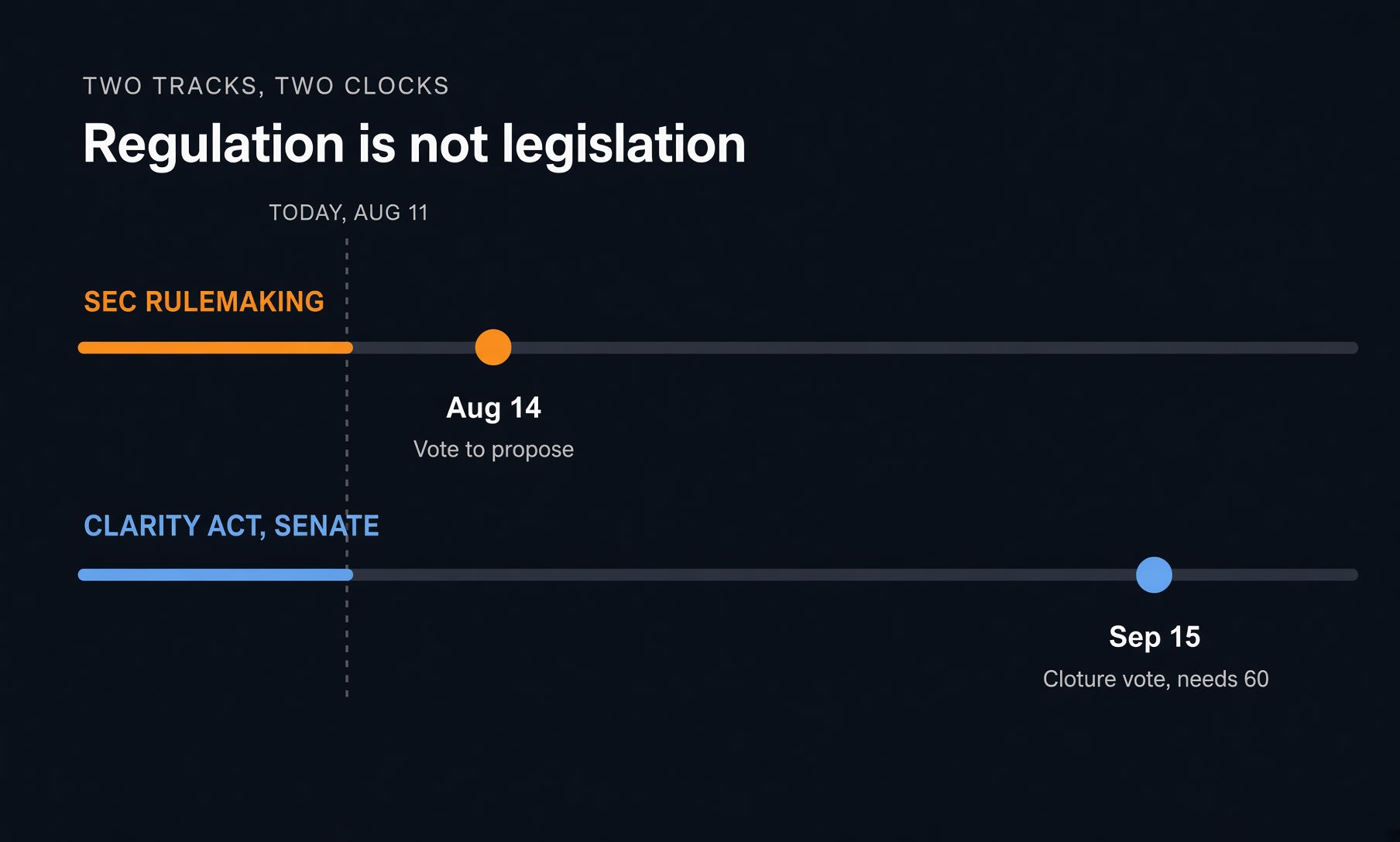
The SEC votes Friday on a crypto rule. The CLARITY Act is stuck in the Senate. Two branches, two timelines. BitBrainers, Aug 2026.

By BitBrainers Editorial

The SEC and the Senate are not the same thing. They don't have the same vote. They are completely different entities in this regulation story. On Friday the SEC votes on whether to propose a crypto rule. The Senate doesn't touch CLARITY until September 15. And that vote is only to start debating it, not pass it. Everyone's treating this week like regulation arrived. It didn't.

What Friday Actually Is

The Sunshine Act notice dropped Monday night. Open meeting. August 14, 10:00 a.m. ET. One item on the agenda.

A vote on whether to issue a release proposing new rules for certain investment contracts involving crypto assets.

That's it. Not law. Not even a proposed rule yet. Just a vote on whether to start the comment period.

Three commissioners, all Republicans. Paul Atkins has pushed Reg Crypto since he took the chair. A yes vote kicks off notice-and-comment. Major SEC rules usually need 12 to 18 months from proposal to final.

Think deeper. The SEC rules over stocks, commodities, crypto, what goes on the table, the prices, the derivatives. The Senate is the one that gets regulation to the top of the country. Two different jobs.


The Bill Is Separate

CLARITY is legislation. It has to pass the Senate, go back to the House, and get signed. Its job is drawing a statutory line: SEC keeps securities, CFTC gets digital commodity spot markets. The CFTC doesn't have that authority now. Congress has to grant it.

The SEC can't do that. No amount of rulemaking lets an agency hand its jurisdiction to someone else. Only a statute works.

What the SEC can do is operate inside the Securities Act of 1933. That's Friday. Using the power it already has, because Congress hasn't acted.

The permanence gap matters. A future commission can kill an SEC rule in one vote. A statute needs another act of Congress to repeal. One lasts. The other doesn't.


Where CLARITY Actually Stands

House passed it July 2025.

294-134.

Senate Banking Committee moved it 15-9 in May. Then it sat. June 1 it hit the full Senate calendar. Still there.

Thune filed cloture on the motion to proceed August 8. Vote is September 15, 2:15 p.m. ET. Five weeks away. Cloture needs 60. Republicans have 53. Seven Democrats or independents would need to flip just to open debate. The bill itself doesn't get negotiated until after that.

The same fights from the July hearing haven't moved: ethics and divestiture for federal officials, the stablecoin yield provision critics call the exchange loophole, and a developer safe harbor that illicit finance hawks want narrowed. Nothing changes while the Senate is out of session.

Polymarket has CLARITY passing in 2026 at 21%. Was 82% in February.

The July 17th hearing was just a hearing before it goes to the Senate. They didn't add anything meaningful. Another attempt to prolong the actual vote. Of course they claimed they were discussing the future of finance. What it actually is: the CLARITY Act. Think deeper. To protect their own. That's why the ethics clauses became the problem.

BITCOIN doesn't care about the CLARITY ACT.


Regulatory noise, sorted from signal

Weekly Bitcoin and macro analysis. Free. We track which agency actually did what.

Subscribe

Why the SEC Is Moving Now

TD Cowen's Jaret Seiberg called Friday's meeting the first of several rulemakings aimed at regulatory certainty. He tied it directly to the Senate failing to advance CLARITY before recess.

Grayscale's head of research said the same thing last week. US crypto markets can keep running even if CLARITY dies in 2026, partly because SEC rules can patch some gaps. That's what Friday is. A patch. Not a fix.

Everything the SEC has issued on crypto so far is staff guidance and policy statements. A new chairman can reverse those with a memo. A Federal Register rule is different. It survives an administration change unless someone runs the full repeal process.

The industry wants that kind of durability. A statute gives more of it than any rule. Friday is a step toward the weaker kind of stability. It doesn't replace the stronger one.


What to Actually Watch

Whether the SEC votes yes Friday. A no vote or a delay kills Reg Crypto before the comment period opens.

What the proposed text says once it's published. Coverage keeps citing a $75 million fundraising exemption Atkins mentioned in a March speech. That number isn't confirmed for Friday's agenda. Treat it as a placeholder.

Whether the September 15 cloture vote hits 60. The 21% Polymarket odds reflect real skepticism. Not just volatility.

Two branches of government are working the same problem on different timelines with different levels of permanence. Run them together in coverage and you get headlines saying regulatory clarity arrived this week. It hasn't. One agency started paperwork. The other is five weeks from its first procedural vote. Still not debating the actual bill.

Sources

U.S. Securities and Exchange Commission: Sunshine Act Notice, August 10, 2026

CoinDesk: U.S. SEC sets meeting to propose Reg Crypto to support certain digital assets offerings

Congress.gov: H.R. 3633, Digital Asset Market Clarity Act

CoinPedia: SEC Moves Toward Regulation Crypto as CLARITY Act Faces Delays

This is market commentary, not financial advice. Nothing here is a recommendation to buy or sell any asset. Do your own research.

Weekly Brief: The War Reached the Ten-Year. Bitcoin Answered the Yield

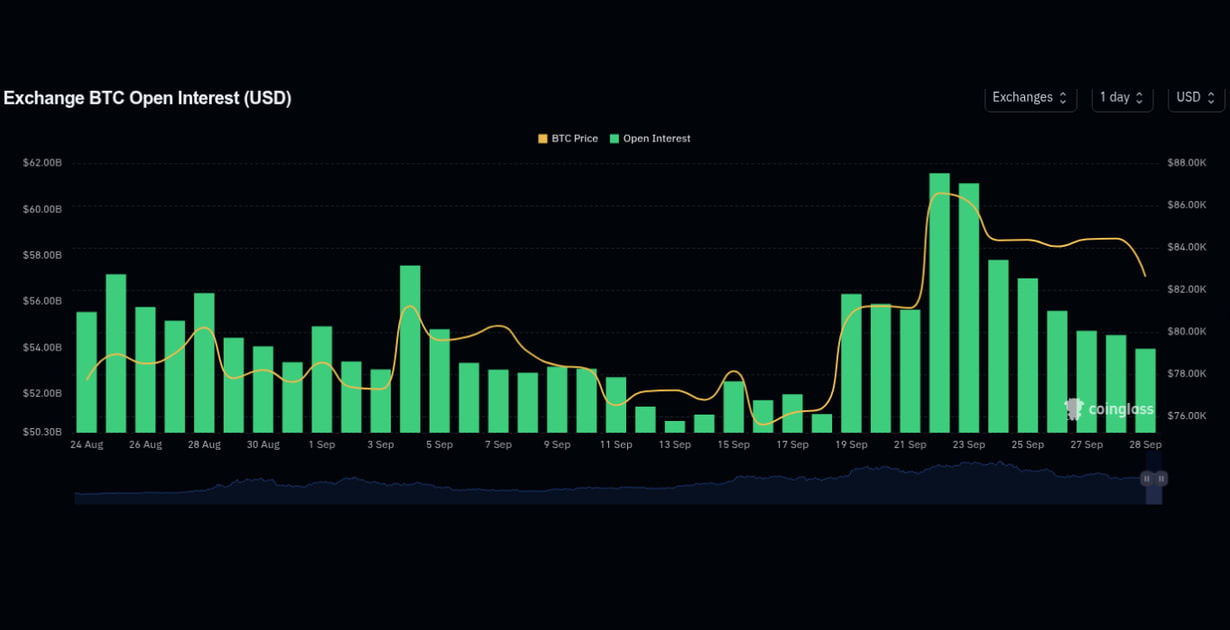
Bitcoin futures open interest, CoinGlass, late Aug to Sep 28, 2026. Peaked near $61.5B on Sep 22, stepped down through the pullback. Sourc...

Weekly Brief: The War Reached the Ten-Year. Bitcoin Answered the Yield